Indonesia Wireless Network Security Market Size & Growth Rate (2026-2032)
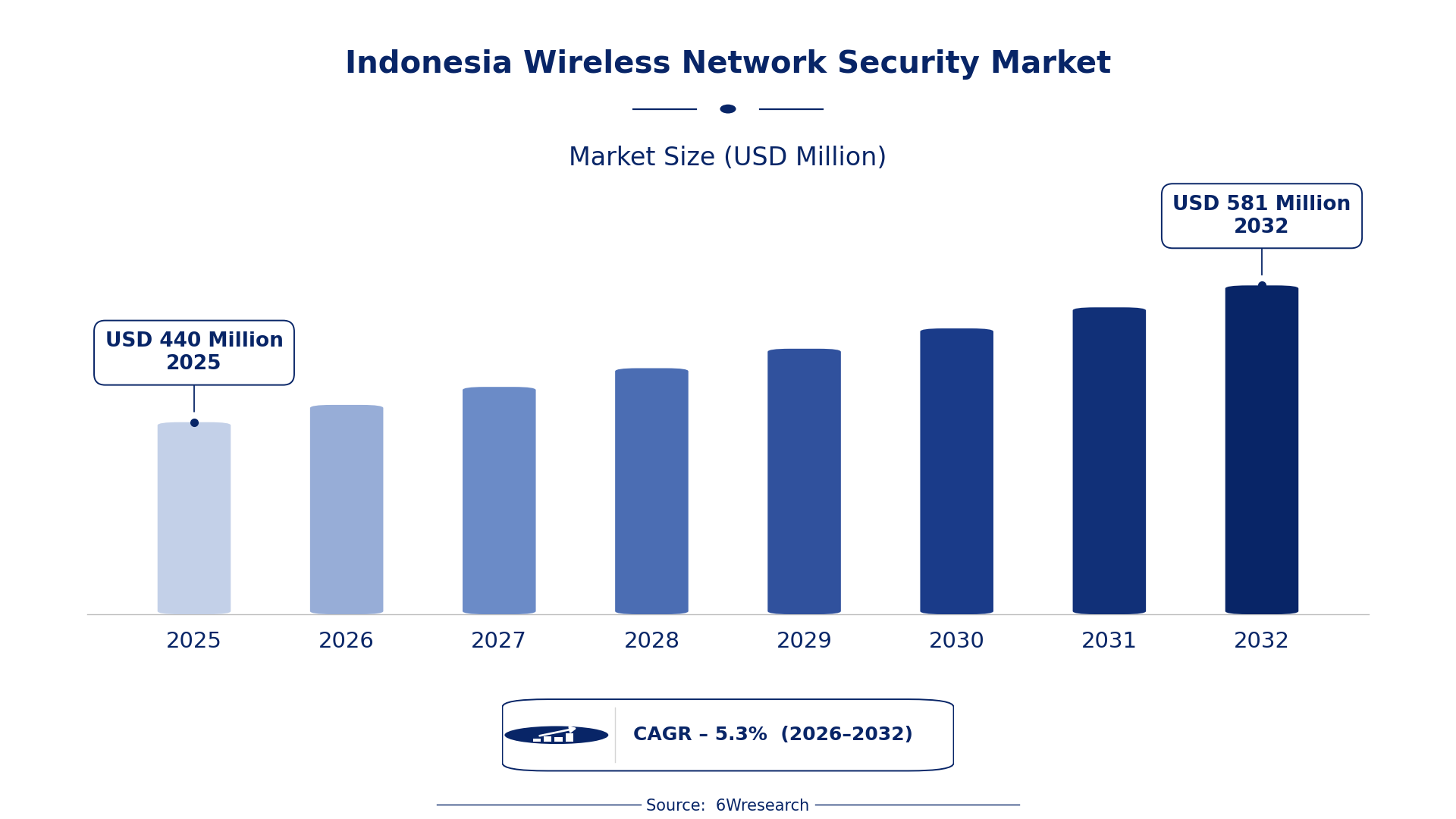
The Indonesia Wireless Network Security Market was estimated at USD 440 Million in 2025 and is projected to reach USD 581 Million by 2032, growing at a CAGR of 5.3% from 2026 to 2032.
Indonesia Wireless Network Security Market Synopsis
The adoption of wireless technologies across various sectors in Indonesia is rapidly changing the security paradigm. As businesses and consumers increasingly rely on wireless connectivity, the demand for effective security measures has surged, particularly in response to rising cyber threats.
This market is characterized by a competitive environment where vendors strive to innovate and offer tailored solutions. The integration of IoT devices and the rollout of 5G are major growth drivers, presenting new challenges and opportunities for securing wireless networks across the archipelago.
Indonesia Wireless Network Security Market Year-wise Growth Rate and Key Drivers
This graph illustrates the annual growth rates of the Indonesia Wireless Network Security Market from 2021 to 2032, highlighting a steady upward trajectory and projected expansion over the forecast period.
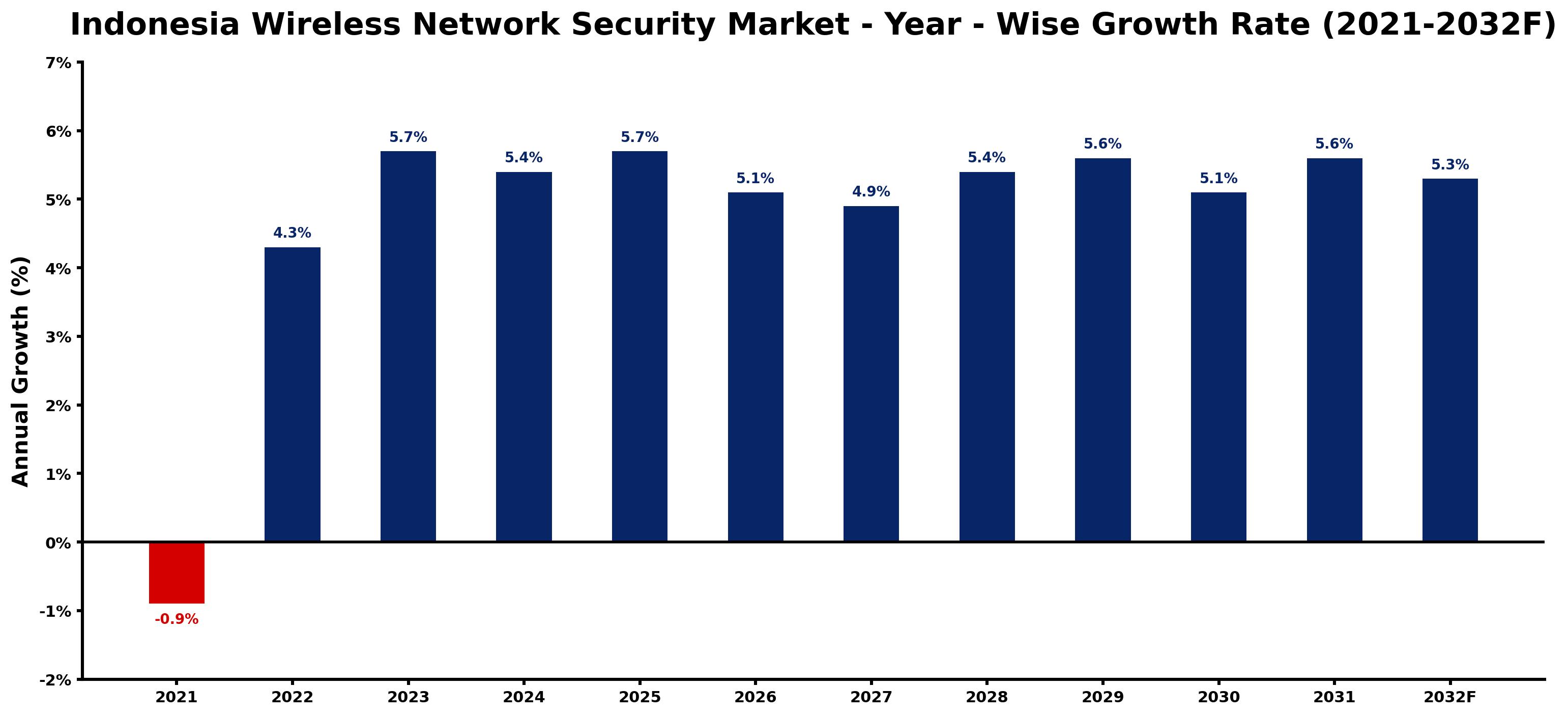
The table below presents the year‑wise growth rates along with the key drivers influencing the market
| Year | Growth Rate | Major Drivers |
| 2021 | -0.9% | Government cybersecurity focus shifted to critical infrastructure only. |
| 2022 | 4.3% | Government's push for secure 5G network adoption |
| 2023 | 5.7% | Surge in remote work requires enhanced cybersecurity measures |
| 2024 | 5.4% | Increased investment in fintech driving network security demands |
| 2025 | 5.7% | Regulatory compliance for data protection intensifying industry focus |
| 2026 | 5.1% | Rise in mobile banking users elevating cybersecurity concerns |
| 2027 | 4.9% | Emergence of IoT devices demanding robust security frameworks |
| 2028 | 5.4% | Local startups leveraging cybersecurity solutions for digital growth |
| 2029 | 5.6% | Growing digital transformation among SMEs increases security investments |
| 2030 | 5.1% | Corporate cybersecurity budgets expanding in response to threats |
| 2031 | 5.6% | Partnerships with global cybersecurity firms boosting local capabilities |
| 2032 | 5.3% | Heightened geopolitical tensions prompting national security strategies |
Note: Market size estimations and growth projections presented in this report are based on 6Wresearch's proprietary forecasting methodology, utilizing the latest available industry data, government publications, and primary research inputs.
Indonesia Wireless Network Security Market Key Takeaways
Below are some of the specific key takeaways from the market, including:
- The rising threat of cyber-attacks is a key driver for investment in wireless security solutions.
- Adoption of IoT and smart city initiatives is expanding the scope for network security measures.
- Ongoing government initiatives focus on enhancing national cybersecurity infrastructure.
- The pandemic has significantly increased reliance on wireless networks, elevating security concerns.
- Continual competition among vendors leads to innovative solutions catering to diverse user needs.
Evaluation of Restraints in Indonesia Wireless Network Security Market
Despite the positive momentum, several factors impede market growth. The complexity of implementing comprehensive security measures poses a challenge for many organizations, especially smaller businesses that may lack the resources or expertise. Additionally, the fast-paced technological advancements create a risk of obsolescence in security solutions. The market also faces difficulties in addressing varying regulations and standards across different sectors, which complicates compliance and investment strategies.
Indonesia Wireless Network Security Market Trends
Key trends shaping the Indonesia Wireless Network Security Market include a significant increase in demand for AI-driven security solutions. These advanced technologies enhance threat detection and response capabilities, allowing organizations to manage risks more effectively. on top of that, the shift towards remote work is propelling the need for robust security protocols, pushing companies to rethink their security strategies and invest in advanced wireless security measures.
Indonesia Wireless Network Security Market Opportunities
Investment opportunities abound in the Indonesia Wireless Network Security Market, particularly in sectors like healthcare and finance, which are experiencing heightened regulatory scrutiny regarding data privacy. The ongoing digital transformation across industries is prompting many organizations to seek out state-of-the-art security solutions. As 5G technology becomes mainstream, the demand for enhanced security frameworks will also grow, representing a lucrative avenue for vendors and service providers.
Government Initiatives in the Indonesia Wireless Network Security Market
The Indonesian government is taking proactive steps to strengthen the cybersecurity framework, recognizing the critical need for effective wireless network security. Various initiatives aim to build resilience against cyber threats, enhancing the protection of sensitive information across public and private sectors.
- A regulatory framework introduced in 2025 mandating stronger security measures for wireless networks across critical sectors.
- A national digital infrastructure upgrade programme now in its rollout phase, aiming to enhance network security capabilities nationwide.
- Current efforts to develop cybersecurity awareness programs targeting businesses and consumers to foster a culture of security.
- A planned public-private initiative expected to enhance collaboration between the government and tech companies, slated for 2028.
- Investment in research and development for cybersecurity solutions through partnerships with local universities, initiated in early 2025.
Future Insights of the Indonesia Wireless Network Security Market
Looking ahead to 2026-2032, the Indonesia Wireless Network Security Market is set to expand significantly. The growing reliance on wireless connectivity will drive demand for innovative security solutions, particularly as IoT integration and smart city developments continue to accelerate. The maturation of regulatory frameworks will also influence investment patterns, steering resources towards compliant and effective security measures.
Indonesia Wireless Network Security Market Latest Developments
The past year has seen a surge in activity within the Indonesia Wireless Network Security Market. Companies are keenly responding to the evolving threat landscape with innovative solutions that address both current and future security challenges.
- A major technology vendor launched a new suite of AI-powered security tools in Q2 2025, designed specifically for wireless networks.
- An initiative that began in early 2025 and remains underway focuses on enhancing cybersecurity infrastructure in urban areas, particularly in Jakarta.
- A partnership between regional telecom operators and cybersecurity firms announced in late 2025 aims to strengthen wireless security protocols.
- By mid-2026, a comprehensive security audit program is expected to be implemented across government agencies to ensure compliance with updated regulations.
- A rollout planned for late 2026 will introduce advanced threat intelligence systems into public sector networks, enhancing overall security posture.
Indonesia Wireless Network Security Market - Key Attractiveness of the Report
- 10 Years of Market Numbers
- Historical Data Starting from 2022 to 2025
- Base Year: 2025
- Forecast Data until 2032
- Key Performance Indicators Impacting the Market
- Major Upcoming Developments and Projects
Key Highlights of the Report:
- Indonesia Wireless Network Security Market Outlook
- Market Size of Indonesia Wireless Network Security Market, 2025
- Forecast of Indonesia Wireless Network Security Market, 2032
- Historical Data and Forecast of Indonesia Wireless Network Security Revenues & Volume for the Period 2022-2032F
- Indonesia Wireless Network Security Market Trend Evolution
- Indonesia Wireless Network Security Market Drivers and Challenges
- Indonesia Wireless Network Security Price Trends
- Indonesia Wireless Network Security Porter's Five Forces
- Indonesia Wireless Network Security Industry Life Cycle
- Historical Data and Forecast of Indonesia Wireless Network Security Market Revenues & Volume By Solutions for the Period 2022-2032F
- Historical Data and Forecast of Indonesia Wireless Network Security Market Revenues & Volume By Firewall for the Period 2022-2032F
- Historical Data and Forecast of Indonesia Wireless Network Security Market Revenues & Volume By IPS/IDS for the Period 2022-2032F
- Historical Data and Forecast of Indonesia Wireless Network Security Market Revenues & Volume By Encryption for the Period 2022-2032F
- Historical Data and Forecast of Indonesia Wireless Network Security Market Revenues & Volume By I&AM for the Period 2022-2032F
- Historical Data and Forecast of Indonesia Wireless Network Security Market Revenues & Volume By UTM for the Period 2022-2032F
- Historical Data and Forecast of Indonesia Wireless Network Security Market Revenues & Volume By Services for the Period 2022-2032F
- Historical Data and Forecast of Indonesia Wireless Network Security Market Revenues & Volume By Security Operations for the Period 2022-2032F
- Historical Data and Forecast of Indonesia Wireless Network Security Market Revenues & Volume By Consulting for the Period 2022-2032F
- Historical Data and Forecast of Indonesia Wireless Network Security Market Revenues & Volume By Managed Security Services for the Period 2022-2032F
- Indonesia Wireless Network Security Import Export Trade Statistics
- Market Opportunity Assessment By Solutions
- Market Opportunity Assessment By Services
- Indonesia Wireless Network Security Top Companies Market Share
- Indonesia Wireless Network Security Competitive Benchmarking By Technical and Operational Parameters
- Indonesia Wireless Network Security Company Profiles
- Indonesia Wireless Network Security Key Strategic Recommendations






































