Indonesia Wood Pellets Market: Import Trend Analysis
Indonesia`s wood pellets import trend experienced a notable decline from 2023 to 2024, with a growth rate of -56.94%. Despite this, the compound annual growth rate (CAGR) for the period of 2020-2024 stood at an impressive 214.14%. This significant drop in import momentum from 2023 to 2024 could be attributed to various factors such as changes in demand patterns, shifts in trade policies, or market fluctuations impacting the overall stability of the market.
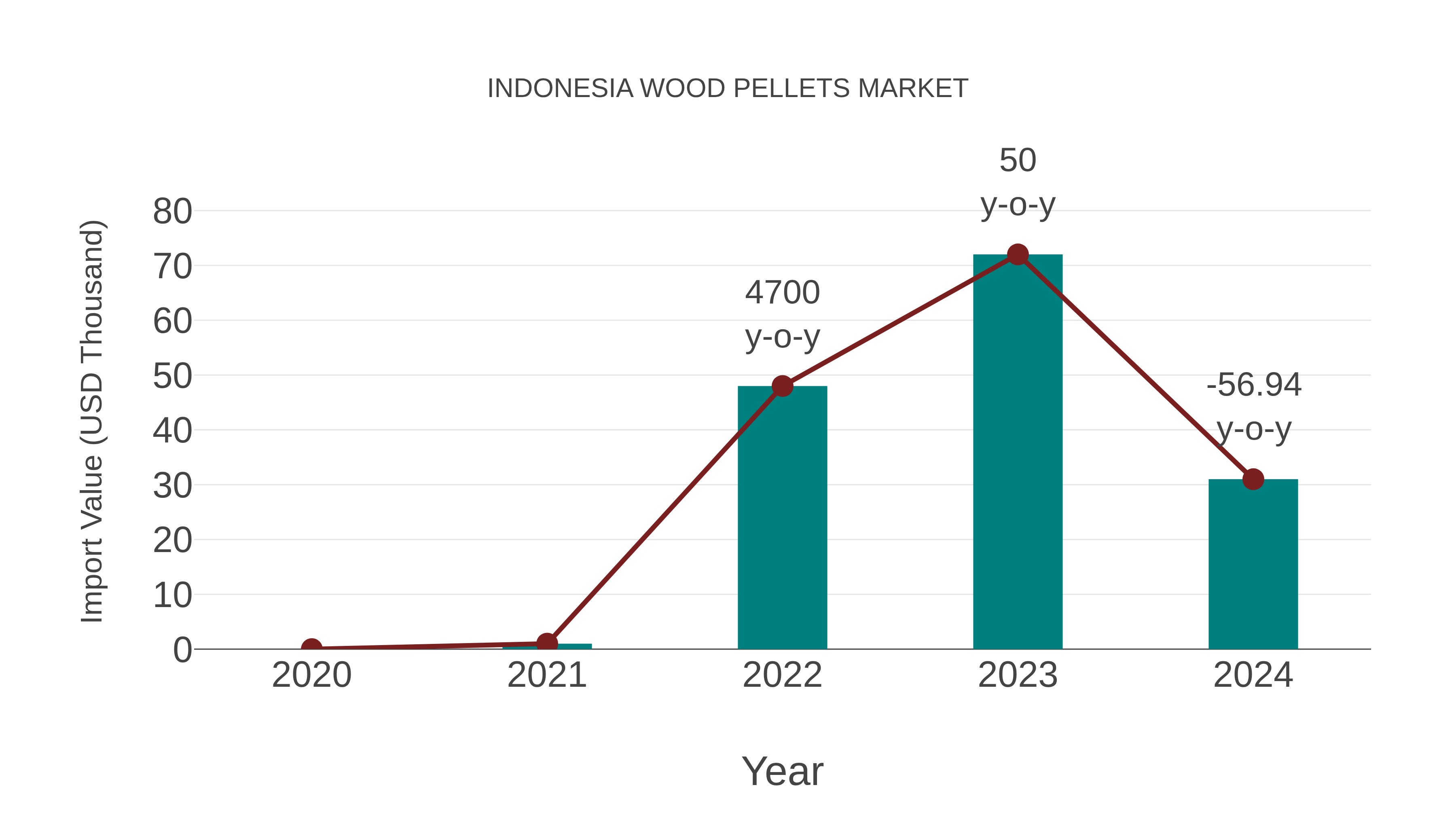
Indonesia Wood Pellets Market Growth Rate
According to 6Wresearch internal database and industry insights, the Indonesia Wood Pellets Market is growing at a compound annual growth rate (CAGR) of 7.85% during the forecast period (2026-2032).
Topics Covered in the Indonesia Wood Pellets Market Report
Indonesia Wood Pellets Market report thoroughly covers the market by types and applications. The market report provides an unbiased and detailed analysis of ongoing market trends, opportunities/high growth areas, and market drivers, which would help stakeholders devise and align their market strategies according to the current and future market dynamics.
Indonesia Wood Pellets Market Highlights
| Report Name | Indonesia Wood Pellets Market |
| Forecast period | 2026-2032 |
| CAGR | 7.85% |
| Growing Sector |
Export & Power Generation |
Indonesia Wood Pellets Market Synopsis
The Indonesia Wood Pellets Market is set to witness a steady growth owing to the rising demand for renewable and eco-friendly energy sources. Increasing exports, especially to countries like Japan and South Korea under long-term biomass energy contracts are said to be a major lead to growth. Also, some government policies supports adoption of clean energy and reduce of dependence on coal are further encouraging market expansion. Moreover, the availability of abundant forestry resources and growing industrial applications are moving forward with the development of the wood pellets industry in Indonesia.
Evaluation of Growth Drivers in the Indonesia Wood Pellets Market
Below mentioned some growth drivers and their impact on market dynamics:
| Drivers | Primary Segments Affected | Why It Matters |
| Government Renewable Energy Policies | Applications (Power Plants, CHP) | Encourages biomass use and supports clean sustainable energy transition |
| Export Demand Growth | Types (Hardwood, Softwood) | Leads to higher revenues by extending access to global pellet markets |
| Industrial Energy Transition | Applications (Power Plants, Commercial) | Enables adoption of low-emission fuels across industrial operations |
| Sustainable Forestry Practices | Types (Hardwood, Softwood) | Make sure of continuous raw material supply through responsible forest management |
| Infrastructure Development | Applications, Export | Strengthens production, logistics, and export efficiency across value chain |
The Indonesia Wood Pellets Market is projected to grow significantly, with a CAGR of 7.85% during the forecast period of 2026-2032. The market expansion is mainly led by a rise in adoption of biomass energy for power generation and heating applications. A strong and steady export demand is to be seen developing as economies look for low-carbon energy sources is elevating production levels. While government support through renewable energy targets and incentives is enhancing industry growth. Furthermore, in the advancements of pelletizing technology and supply chain improvements are likely to further strengthen the market outcome.
Evaluation of Restraints in the Indonesia Wood Pellets Market
Below mentioned are some major restraints and their influence on market dynamics:
| Restraints | Primary Segments Affected | What This Means |
| Raw Material Supply Fluctuations | Types | Causes inconsistent supply, disrupting production planning and output levels |
| High Logistics Costs | Export, Applications | Grows transportation expenses, minimize overall profitability margins |
| Environmental Regulations | Forestry, Production | Restricts resource usage, limiting expansion and production capacity |
| Competition from Other Renewables | Applications | Reduces demand as industries shift toward alternative energy sources |
| Limited Domestic Awareness | Residential Heating | Lowers consumer awareness and limited adoption of pellet-based heating solutions |
Indonesia Wood Pellets Market Challenges
The Indonesia Wood Pellets Market faces challenges like unstable raw material availability due to utilization on forestry residues, which affects the overall Indonesia Wood Pellets Market Share. From high transportation to export logistics costs, it can impact competitiveness in global markets. Furthermore, strict environmental guidelines related to deforestation and land use limits expansion. Competition from alternative renewable sources like solar and wind energy also presents a challenge. Additionally, a lack of an internal awareness regarding pellet-based heating systems minimizes local consumption growth.
Indonesia Wood Pellets Market Trends
Contributing to the Indonesia Wood Pellets Market Growth, are some major trends below here:
- Shift Toward Renewable Energy: The focus of reducing carbon emissions is driving demand for biomass fuels like wood pellets, as governments and industries are actively moving towards cleaner and greener energy alternatives to meet climate targets.
- Export-Oriented Production: Some manufacturers concentrates only on export markets which owns to strong international demand, particularly from countries like Japan and South Korea, where long-term contracts and renewable energy commitments makes sure of continuous revenue streams.
- Technological Advancements: An enhancement of pelletizing technologies can improve efficiency and product quality, enable higher output, reduce waste generation, and better energy density, which strengthens competitiveness in both domestic and global markets.
Investment Opportunities in the Indonesia Wood Pellets Market
Here are some investment opportunities in the Indonesia Wood Pellets Industry:
- Expansion of Pellet Plants: Establishment of new and advanced pellet manufactures facilities that expands production capacity, improves efficiency, and helps to meet an increased domestic and international demand for wood pellets properly.
- Export Infrastructure Development: An enhancement of logistics, transportation, and port facilities ensures that to have a resourceful handling and on-time delivery of wood pellets, steady global trade capabilities and improvement of overall export market position.
- Biomass Power Projects: Development of biomass-based power plants using wood pellets encourages renewable energy generation, reducing carbon emissions, and promoting sustainable energy practices while creating consistent demand for pellets.
Top 5 Leading Players in the Indonesia Wood Pellets Market
Here are some top companies contributing to Indonesia Wood Pellets Market Share:
1. PT Biomasa Jaya Abadi
| Company Name | PT Biomasa Jaya Abadi |
|---|---|
| Established Year | 2012 |
| Headquarters | South Jakarta, Indonesia |
| Official Website | Click Here |
A major player in the Indonesian wood pellets market, specializing in producing and exporting sustainable wood biomass from Gorontalo, Sulawesi. They produce high-quality wood pellets for global energy markets, particularly supplying large Japanese buyers like Tokyo Gas and Hanwa.
2. PT Santomo Biomass Indonesia
| Company Name | PT Santomo Biomass Indonesia |
|---|---|
| Established Year | 2024 |
| Headquarters | Gresik, East Java |
| Official Website | Click Here |
A prominent biomass trading company that began operations in 2024 as part of the renowned Santomo Group. Focused on sourcing top-quality biomass from Indonesia's rich natural resources, that aims to provide sustainable energy solutions to clients worldwide.
3. PT Energi Biomassa Indonesia
| Company Name | PT Energi Biomassa Indonesia |
|---|---|
| Established Year | 2015 |
| Headquarters | Pekanbaru, Indonesia |
| Official Website | Click Here |
A prominent Indonesian company specializing in sustainable biomass solutions, focusing on sourcing, processing, and exporting biomass products like wood pellets and palm kernel shells to support decarbonization.
4. PT Bukit Asam Tbk (PTBA)
| Company Name | PT Bukit Asam Tbk (PTBA) |
|---|---|
| Established Year | 1876 |
| Headquarters | South Sumatra, Indonesia |
| Official Website | Click Here |
A major Indonesian state-owned coal mining company, founded in 1876 and based in Tanjung Enim, South Sumatra. PTBA handles integrated mining, processing, transportation, and trading of coal, with operations focused on sustainability, downstreaming, and renewable energy.
5. PT Korintiga Hutani
| Company Name | PT Korintiga Hutani |
|---|---|
| Established Year | 1998 |
| Headquarters | Central Kalimantan, Indonesia |
| Official Website | Click Here |
An Indonesian plantation company established in 1998, focused on sustainable Eucalyptus and Acacia plantation forestry in Central Kalimantan. Located in Arut Utara, it operates a ~94,000-hectare concession, producing raw materials for pulp and paper, with ~18,000 hectares protected for conservation and orangutan habitat.
Government Regulations Introduced in the Indonesia Wood Pellets Market
According to Indonesian government data, the development of the Indonesia Wood Pellets Market is strongly influenced by regulatory infrastructure. The Ministry of Energy and Mineral Resources promotes biomass energy under the National Energy Policy targeting that increases renewable energy share. Additionally, the “Co-firing Biomass Program” supports coal power plants to adopt wood pellets as a substitute fuel. Forestry guidelines under the Ministry of Environment and Forestry ensures a sustainable sourcing of raw materials through certification systems such as SVLK (Timber Legality Verification System). These initiatives improves sustainability, enhance export potential, and support market expansion.
Future Insights of the Indonesia Wood Pellets Market
The prospects for the Indonesia Wood Pellets Market appears to be a highly promising, driven by increase of global demand for renewable energy. Export opportunities, especially in Asia-Pacific, will continue to expand. An expected rise in national adoption of biomass energy seen to be in power generation and industrial heating. Technological improvements and government incentives will further enhance production efficiency. Furthermore, growing environmental awareness and sustainability initiatives will play a key role in shaping the future of the market.
Market Segmentation Analysis
The report offers a comprehensive study of the subsequent market segments and their leading categories.
Hardwood to Dominate the Market - By Type
According to Kanak Phartiyal, Senior Research Analyst at 6Wresearch, hardwood wood pellets dominate the market due to their higher energy density and longer burning duration. Their superior quality and productivity makes them a reliable choice for large-scale energy generation.
Power Plants to Dominate the Market - By Application
Power plants represents the dominant application segment in the Indonesia Wood Pellets Market on account of an increase in adoption of biomass co-firing technologies. Wood pellets are widely used as an exchange for coal in power generation which helps to reduce carbon emissions.
Key attractiveness of the report
- 10 Years Market Numbers.
- Historical Data Starting from 2022 to 2025.
- Base Year: 2025
- Forecast Data until 2032.
- Key Performance Indicators Impacting the Market.
- Major Upcoming Developments and Projects.
Key Highlights of the Report:
- Indonesia Wood Pellets Market Outlook
- Market Size of Indonesia Wood Pellets Market, 2025
- Forecast of Indonesia Wood Pellets Market, 2032
- Historical Data and Forecast of Indonesia Wood Pellets Revenues & Volume for the Period 2022-2032
- Indonesia Wood Pellets Market Trend Evolution
- Indonesia Wood Pellets Market Drivers and Challenges
- Indonesia Wood Pellets Price Trends
- Indonesia Wood Pellets Porter's Five Forces
- Indonesia Wood Pellets Industry Life Cycle
- Historical Data and Forecast of Indonesia Wood Pellets Market Revenues & Volume By Types for the Period 2022-2032
- Historical Data and Forecast of Indonesia Wood Pellets Market Revenues & Volume By Hardwood for the Period 2022-2032
- Historical Data and Forecast of Indonesia Wood Pellets Market Revenues & Volume By Softwood for the Period 2022-2032
- Historical Data and Forecast of Indonesia Wood Pellets Market Revenues & Volume By Applications for the Period 2022-2032
- Historical Data and Forecast of Indonesia Wood Pellets Market Revenues & Volume By Power Plants for the Period 2022-2032
- Historical Data and Forecast of Indonesia Wood Pellets Market Revenues & Volume By Residential Heating for the Period 2022-2032
- Historical Data and Forecast of Indonesia Wood Pellets Market Revenues & Volume By Commercial Heating for the Period 2022-2032
- Historical Data and Forecast of Indonesia Wood Pellets Market Revenues & Volume By Combined Heat and Power (CHP) for the Period 2022-2032
- Indonesia Wood Pellets Import Export Trade Statistics
- Market Opportunity Assessment By Types
- Market Opportunity Assessment By Applications
- Indonesia Wood Pellets Top Companies Market Share
- Indonesia Wood Pellets Competitive Benchmarking By Technical and Operational Parameters
- Indonesia Wood Pellets Company Profiles
- Indonesia Wood Pellets Key Strategic Recommendations
Market covered
The report subsequently covers the market by following segments and subsegments.
By Type
- Hardwood
- Softwood
By Application
- Power Plants
- Residential Heating
- Commercial Heating
- Combined Heat and Power (CHP)






































