Indonesia Wooden Packaging Market Size, Share & Growth Rate
The Indonesia Wooden Packaging Market was estimated at USD 312 Million in 2025 and is projected to reach USD 412 Million by 2032, growing at a CAGR of 4.1% from 2026 to 2032. This promising growth trajectory is driven primarily by Indonesia's robust export-oriented industries, particularly in agriculture, electronics, and manufacturing, which increasingly rely on durable and sustainable wooden packaging solutions. Additionally, the global shift towards eco-friendly packaging is enhancing the appeal of wood as a sustainable material, ensuring continued demand within this sector.
Indonesia Wooden Packaging Market Year-wise Growth Rate and Key Drivers
This graph highlights how the Indonesia Wooden Packaging Market has steadily grown over the years, supported by major growth factors.
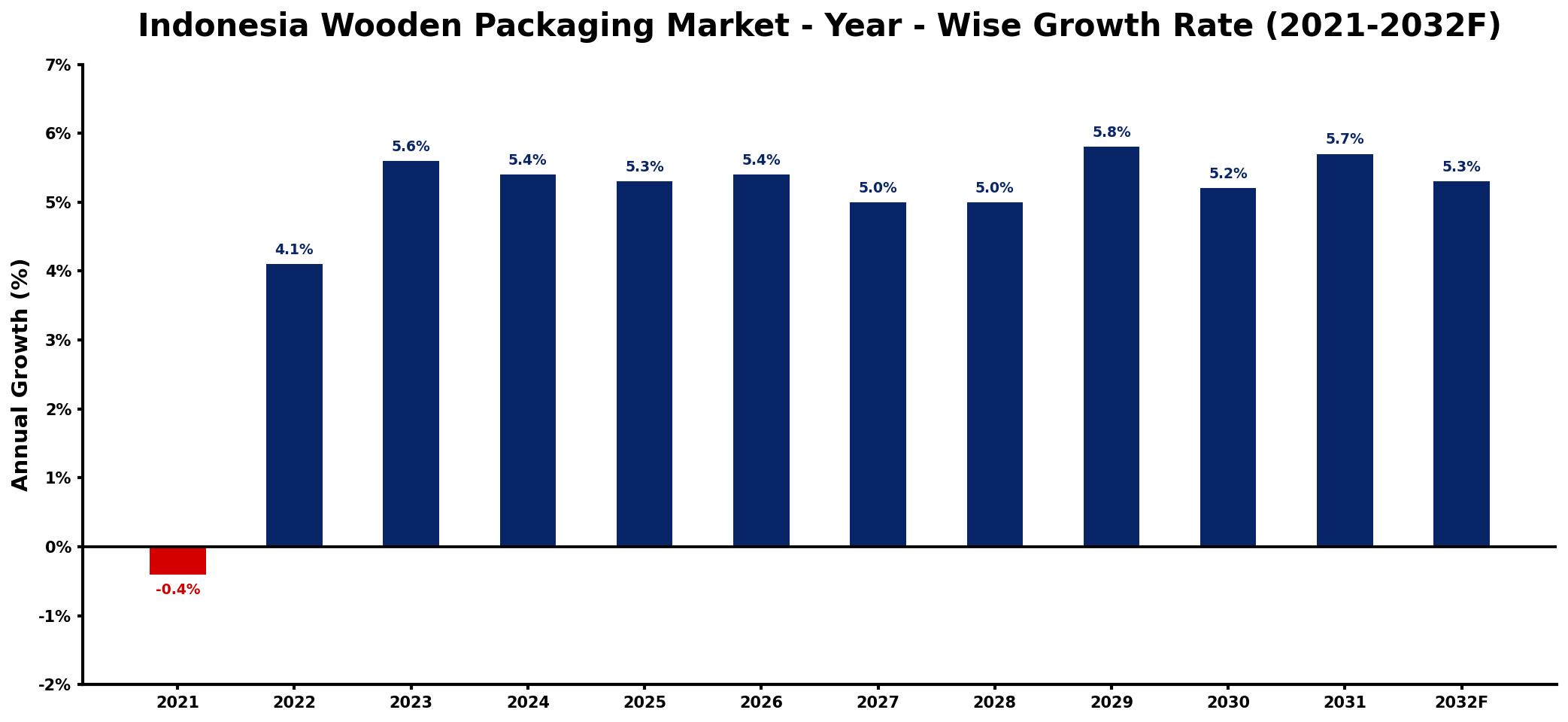
The table below presents the year‑wise growth rates along with the key drivers influencing the market
| Year | Growth Rate | Major Drivers |
| 2021 | -0.4% | decrease in export activities |
| 2022 | 4.1% | rise in e-commerce demand |
| 2023 | 5.6% | expansion in logistics sector |
| 2024 | 5.4% | growth in retail sector |
| 2025 | 5.3% | increased investment in infrastructure |
| 2026 | 5.4% | surge in consumer spending |
| 2027 | 5.0% | development of new industries |
| 2028 | 5.0% | growing emerging market penetration |
| 2029 | 5.8% | increased production capacity utilization |
| 2030 | 5.2% | boost in online shopping |
| 2031 | 5.7% | rising export shipment volumes |
| 2032 | 5.3% | increase in cross-border trade |
Note: Market size estimations and growth projections presented in this report are based on 6Wresearch's proprietary forecasting methodology, utilizing the latest available industry data, government publications, and primary research inputs.
Indonesia Wooden Packaging Market Synopsis
The strongest force shaping the Indonesia Wooden Packaging Market is the country's dynamic export activities, which demand reliable packaging solutions. With wooden materials widely recognized for their strength and longevity, they play a critical role in safeguarding the quality of products during transit across domestic and international borders.
In parallel, the increasing consumer preference for environmentally sustainable options is becoming pivotal. This has prompted businesses to embrace wooden packaging as a means of aligning their operations with broader sustainability goals, while still meeting the logistical requirements of their respective industries.
Indonesia Wooden Packaging Market Key Takeaways
- Strong growth projected driven by export-oriented industries utilizing wooden packaging solutions.
- Wooden packaging offers sustainability advantages, aligning with global eco-friendly trends.
- Competitive pressures from alternative materials necessitate innovation and responsible sourcing in the sector.
- Adaptation to domestic opportunities during disruptions has highlighted the resilience of the industry.
- Key players are focused on quality and sustainable practices to maintain market leadership.
Evaluation of Restraints in Indonesia Wooden Packaging Market
Despite its growth, the Indonesia Wooden Packaging Market faces significant restraints, notably the increasing scrutiny surrounding environmental sustainability. As public awareness regarding deforestation and resource management rises, businesses in the sector are challenged to adopt responsible sourcing practices. The tension between meeting packaging needs and protecting natural resources necessitates companies to pivot towards certified sustainable forestry practices or hybrid materials that combine wood with other eco-friendly alternatives. This balancing act is crucial for maintaining consumer trust and market viability.
Indonesia Wooden Packaging Market Trends
Current trends in the Indonesia Wooden Packaging Market include an uptick in automation and technological innovation in production processes. Companies are investing in advanced machinery that enhances the efficiency and precision of wooden packaging production. Moreover, the rise of e-commerce in Indonesia is leading to increased demand for packaging solutions that not only protect products but also provide attractive presentation options to consumers. Sustainability remains a key driver, with many firms exploring biodegradable additives and certifications to bolster their eco-credentials.
Indonesia Wooden Packaging Market Opportunities
Genuine growth opportunities in the Indonesia Wooden Packaging Market lie in the expanding sectors of e-commerce and agribusiness. As the logistics landscape evolves, there is substantial demand for innovative wooden packaging solutions that cater specifically to online retailers, allowing for enhanced product safety and customer satisfaction. Furthermore, the agricultural sector's continual growth presents opportunities for tailored wooden packaging that meets the unique needs of farmers and producers, further integrating sustainability into their operations.
Government Initiatives in the Indonesia Wooden Packaging Market
The Indonesian government is increasingly recognizing the importance of sustainable packaging within its environmental policies. Initiatives aimed at promoting sustainable forestry practices are being rolled out, alongside incentives for companies that adopt eco-friendly packaging solutions. These policies are designed to encourage compliance with international sustainability standards, fostering a regulatory environment that promotes responsible sourcing and production in the wooden packaging sector.
Future Insights of the Indonesia Wooden Packaging Market
Looking ahead to 2026-2032, the Indonesia Wooden Packaging Market is expected to continue evolving as businesses prioritize sustainability alongside logistical efficiency. The integration of smart technology in packaging processes will likely enhance production capabilities, improving the competitiveness of wooden packaging against alternatives. As international trade grows and the demand for environmentally friendly options rises, the market is poised to capitalize on these trends, securing a solid foothold in the global packaging landscape.
Indonesia Wooden Packaging Market Latest Developments (2025 - 2026)
Recent developments in the Indonesia Wooden Packaging Market have highlighted a shift towards more sustainable practices among major players. The industry is witnessing increased collaborations aimed at developing innovative packaging solutions that meet both regulatory requirements and consumer preferences. Additionally, firms are enhancing their supply chain resilience by diversifying material sources, ensuring quality while maintaining environmental commitments in response to ongoing global market fluctuations.
Indonesia Wooden Packaging Market - Key Attractiveness of the Report
- 10 Years of Market Numbers
- Historical Data Starting from 2022 to 2025
- Base Year: 2025
- Forecast Data until 2032
- Key Performance Indicators Impacting the Market
- Major Upcoming Developments and Projects
Key Highlights of the Report:
- Indonesia Wooden Packaging Market Outlook
- Market Size of Indonesia Wooden Packaging Market, 2025
- Forecast of Indonesia Wooden Packaging Market, 2032
- Historical Data and Forecast of Indonesia Wooden Packaging Revenues & Volume for the Period 2022-2032F
- Indonesia Wooden Packaging Market Trend Evolution
- Indonesia Wooden Packaging Market Drivers and Challenges
- Indonesia Wooden Packaging Price Trends
- Indonesia Wooden Packaging Porter's Five Forces
- Indonesia Wooden Packaging Industry Life Cycle
- Historical Data and Forecast of Indonesia Wooden Packaging Market Revenues & Volume By Type for the Period 2022-2032F
- Historical Data and Forecast of Indonesia Wooden Packaging Market Revenues & Volume By Pallets for the Period 2022-2032F
- Historical Data and Forecast of Indonesia Wooden Packaging Market Revenues & Volume By Boxes and Bins for the Period 2022-2032F
- Historical Data and Forecast of Indonesia Wooden Packaging Market Revenues & Volume By Crates and Cases for the Period 2022-2032F
- Historical Data and Forecast of Indonesia Wooden Packaging Market Revenues & Volume By Spools for the Period 2022-2032F
- Historical Data and Forecast of Indonesia Wooden Packaging Market Revenues & Volume By Dunnage for the Period 2022-2032F
- Historical Data and Forecast of Indonesia Wooden Packaging Market Revenues & Volume By Others for the Period 2022-2032F
- Historical Data and Forecast of Indonesia Wooden Packaging Market Revenues & Volume By Application for the Period 2022-2032F
- Historical Data and Forecast of Indonesia Wooden Packaging Market Revenues & Volume By Food & Beverages Storage for the Period 2022-2032F
- Historical Data and Forecast of Indonesia Wooden Packaging Market Revenues & Volume By Transportation for the Period 2022-2032F
- Historical Data and Forecast of Indonesia Wooden Packaging Market Revenues & Volume By Industrial for the Period 2022-2032F
- Historical Data and Forecast of Indonesia Wooden Packaging Market Revenues & Volume By Shipping for the Period 2022-2032F
- Historical Data and Forecast of Indonesia Wooden Packaging Market Revenues & Volume By Others for the Period 2022-2032F
- Indonesia Wooden Packaging Import Export Trade Statistics
- Market Opportunity Assessment By Type
- Market Opportunity Assessment By Application
- Indonesia Wooden Packaging Top Companies Market Share
- Indonesia Wooden Packaging Competitive Benchmarking By Technical and Operational Parameters
- Indonesia Wooden Packaging Company Profiles
- Indonesia Wooden Packaging Key Strategic Recommendations






































