Indonesia Workplace Safety Market Size & Growth Rate (2026-2032)
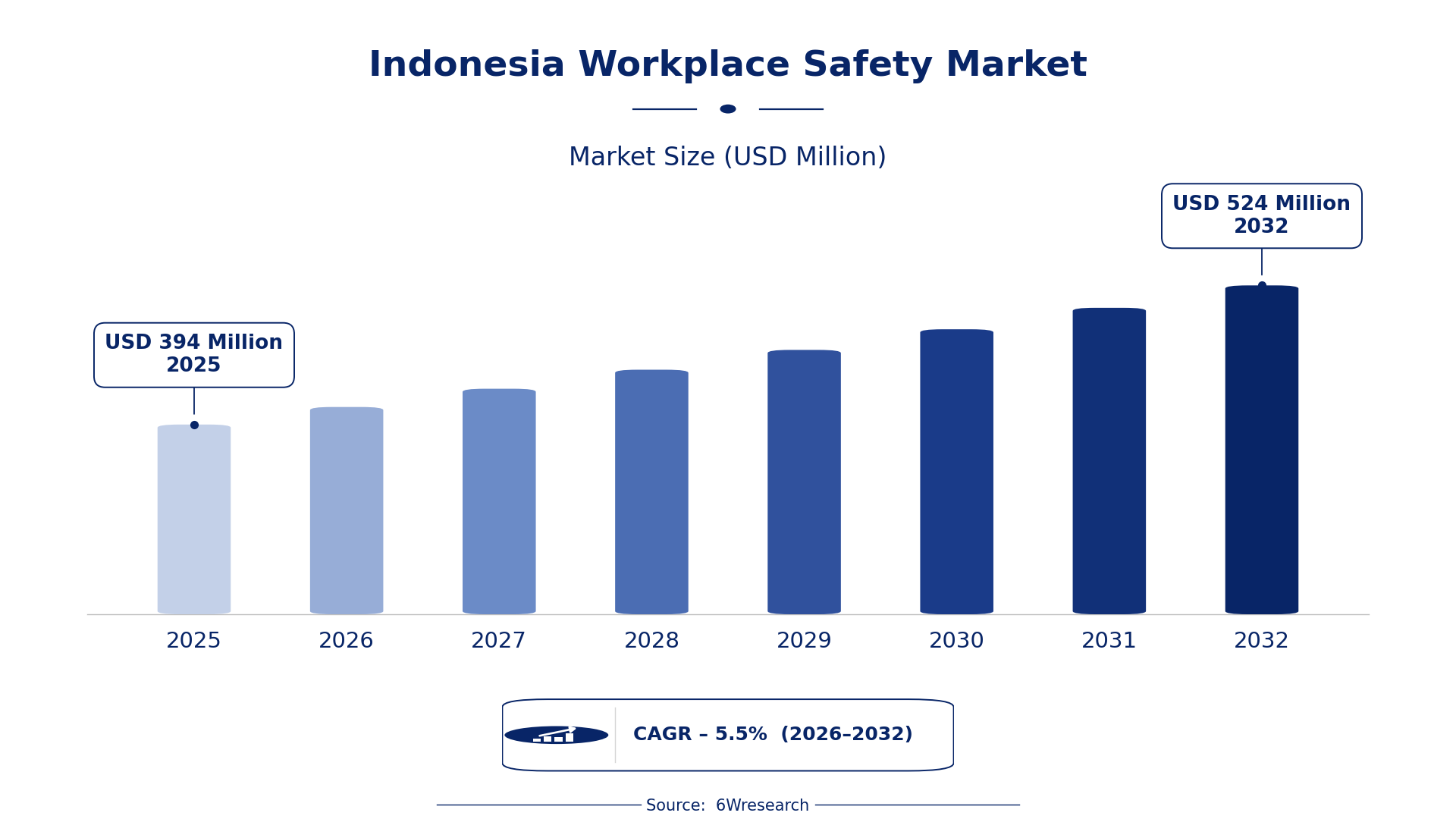
The Indonesia Workplace Safety Market was estimated at USD 394 Million in 2025 and is projected to reach USD 524 Million by 2032, growing at a CAGR of 5.5% from 2026 to 2032.
Indonesia Workplace Safety Market Synopsis
A crucial aspect of workplace culture in Indonesia is the increasing focus on employee health and safety. Companies are actively investing in training programs and advanced technologies to ensure compliance with evolving safety regulations.
The market is characterized by a diverse range of products and services aimed at improving safety measures. From IoT devices to comprehensive training solutions, businesses are exploring innovative methods to mitigate workplace hazards and foster a culture of safety.
Indonesia Workplace Safety Market Year-wise Growth Rate and Key Drivers
This graph illustrates the annual growth rates of the Indonesia Workplace Safety Market from 2021 to 2032, highlighting a steady upward trajectory and projected expansion over the forecast period.
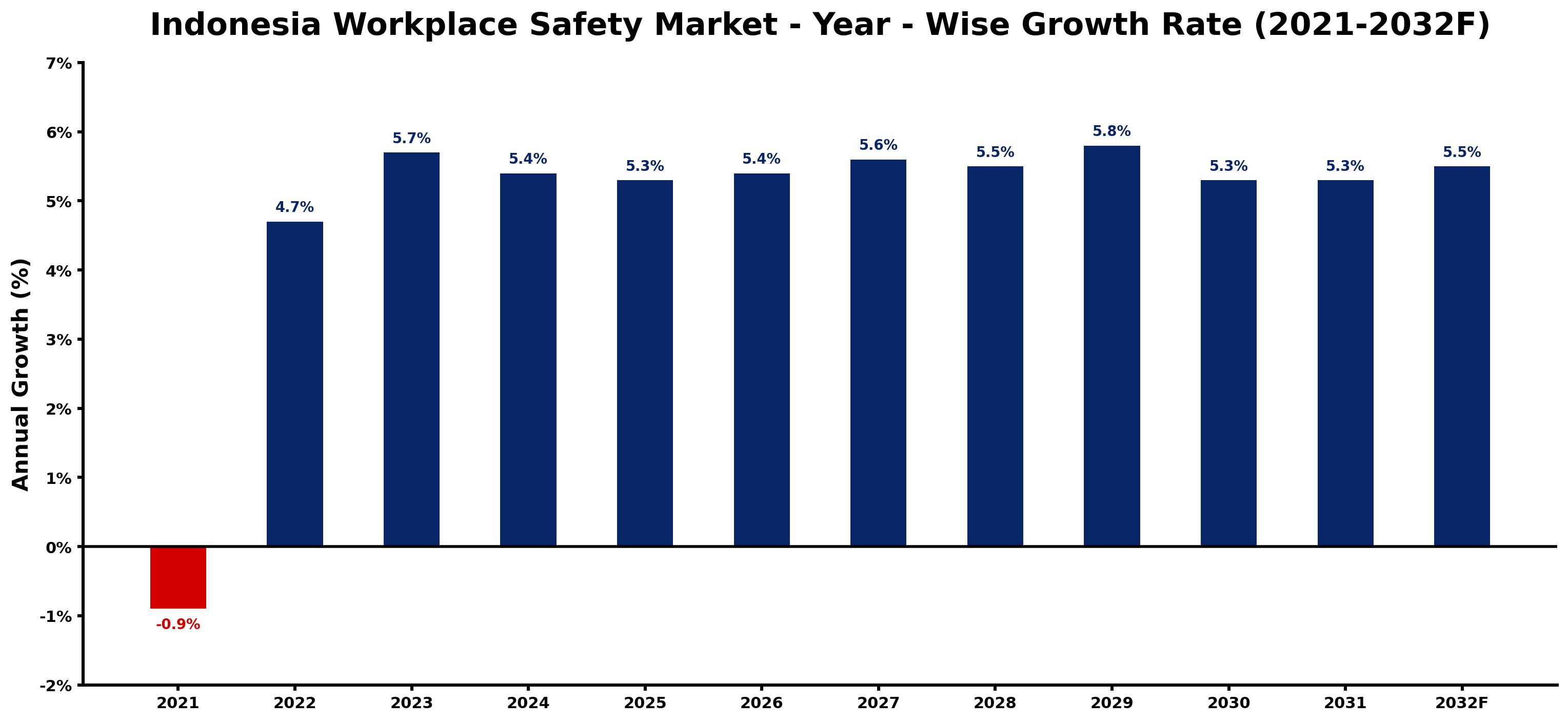
The table below presents the year‑wise growth rates along with the key drivers influencing the market
| Year | Growth Rate | Major Drivers |
| 2021 | -0.9% | Delayed implementation of Ministry of Manpower regulations |
| 2022 | 4.7% | Increasing enforcement of workplace safety regulations by Kemenaker |
| 2023 | 5.7% | Rise in industries adopting safety management systems technology |
| 2024 | 5.4% | Growing awareness of occupational health standards among businesses |
| 2025 | 5.3% | Enhanced training programs aimed at reducing workplace incidents |
| 2026 | 5.4% | Implementation of large-scale safety audits in manufacturing sectors |
| 2027 | 5.6% | Corporate investment in employee health and safety initiatives |
| 2028 | 5.5% | Government incentives for companies improving workplace safety practices |
| 2029 | 5.8% | Emergence of safety-as-a-service models for small firms |
| 2030 | 5.3% | Focus on mental health and psychosocial safety at work |
| 2031 | 5.3% | Increased collaboration between government and safety organizations |
| 2032 | 5.5% | Adoption of digital tools for real-time safety monitoring |
Note: Market size estimations and growth projections presented in this report are based on 6Wresearch's proprietary forecasting methodology, utilizing the latest available industry data, government publications, and primary research inputs.
Indonesia Workplace Safety Market Key Takeaways
Below are some of the specific key takeaways from the market, including:
- The market is driven by stringent government regulations aimed at enhancing safety standards.
- Technological advancements, particularly in IoT and wearable devices, are reshaping safety protocols.
- Investment in employee training is essential to maintaining a compliant and safe workplace.
- The COVID-19 pandemic has permanently changed safety practices in numerous industries.
- Companies are prioritizing health monitoring systems to create a safer work environment.
Evaluation of Restraints in Indonesia Workplace Safety Market
Despite the positive growth trajectory, several constraints hinder the market’s full potential. A major challenge lies in the diverse industrial sectors that each have unique safety requirements. Compliance with safety standards is not uniform across industries such as manufacturing, agriculture, and construction, making it difficult for organizations to implement universal safety protocols. Furthermore, there is a pressing need for comprehensive training initiatives to educate a varied workforce, which requires significant investment and resources. The combination of these factors complicates efforts to enhance workplace safety effectively.
Indonesia Workplace Safety Market Trends
The adoption of digital tools for monitoring workplace safety is gaining traction. Companies are increasingly leveraging IoT-based sensors and real-time data analytics to assess risks and improve safety measures. Wearable technology, particularly devices that monitor health metrics, is becoming essential in preventing workplace accidents and ensuring employee welfare. Training programs are evolving as well, incorporating virtual and augmented reality to provide immersive learning experiences that enhance engagement and retention.
Indonesia Workplace Safety Market Opportunities
There are significant growth prospects within the Indonesia Workplace Safety Market, especially in technology integration. Organizations are encouraged to invest in automated safety solutions and health monitoring systems that enhance operational efficiency. Moreover, the rising emphasis on mental health initiatives presents an opportunity for businesses to develop programs aimed at holistic employee well-being. The government’s push for stringent regulations will further drive demand for compliance-focused safety solutions, making this an optimal time for market entrants to establish a strong presence.
Government Initiatives in the Indonesia Workplace Safety Market
The Indonesian government is actively implementing policies to elevate workplace safety standards across industries. These initiatives are vital in ensuring compliance and fostering a culture of safety among businesses. With a focus on reducing workplace accidents, public policy is aligning with private sector efforts to invest in technology and training.
- A regulatory framework introduced in 2025 mandates all companies to conduct regular safety audits and reporting.
- Current safety awareness campaigns are ongoing, targeting SMEs to promote better compliance with safety standards.
- A public-private partnership program planned for 2026 aims to develop training programs tailored to industry-specific safety requirements.
- In early 2025, a national initiative was launched to promote mental health resources in the workplace as part of a broader safety strategy.
- Ongoing efforts to enhance disaster preparedness training, especially for industries at higher risk of accidents, are being reinforced by government support.
Future Insights of the Indonesia Workplace Safety Market
From 2026 to 2032, the Indonesia Workplace Safety Market is likely to witness transformative changes driven by technological advancements and evolving regulatory standards. Companies that prioritize employee safety through innovative solutions will have a competitive edge. The increasing prevalence of remote monitoring and health-centric technologies will redefine safety practices. This period will also see a greater integration of employee wellness into safety protocols, emphasizing the holistic health of the workforce as a strategic priority.
Indonesia Workplace Safety Market Latest Developments
Recent activities in the Indonesia Workplace Safety Market indicate a strong shift towards innovative solutions and compliance-focused initiatives. Over the last year, businesses have intensified their efforts to implement advanced safety measures that align with new regulations.
- A leading regional operator launched a new health monitoring system in Q1 2025 to track employee well-being and prevent workplace accidents.
- An ongoing initiative started in mid-2025 focuses on enhancing workplace training programs using virtual reality technology, which is expected to improve learning outcomes.
- A safety equipment manufacturer is currently rolling out a line of smart wearable devices aimed at alerting users to potential hazards in real-time, with full deployment expected by late 2025.
- A public awareness campaign focused on workplace mental health is set to begin in the second half of 2026, aimed at reducing stigma and promoting resources.
- A compliance assistance program is underway, which will help SMEs understand and meet the new safety standards mandated by the government.
Indonesia Workplace Safety Market - Key Attractiveness of the Report
- 10 Years of Market Numbers
- Historical Data Starting from 2022 to 2025
- Base Year: 2025
- Forecast Data until 2032
- Key Performance Indicators Impacting the Market
- Major Upcoming Developments and Projects
Key Highlights of the Report:
- Indonesia Workplace Safety Market Outlook
- Market Size of Indonesia Workplace Safety Market, 2025
- Forecast of Indonesia Workplace Safety Market, 2032
- Historical Data and Forecast of Indonesia Workplace Safety Revenues & Volume for the Period 2022-2032F
- Indonesia Workplace Safety Market Trend Evolution
- Indonesia Workplace Safety Market Drivers and Challenges
- Indonesia Workplace Safety Price Trends
- Indonesia Workplace Safety Porter's Five Forces
- Indonesia Workplace Safety Industry Life Cycle
- Historical Data and Forecast of Indonesia Workplace Safety Market Revenues & Volume By Component for the Period 2022-2032F
- Historical Data and Forecast of Indonesia Workplace Safety Market Revenues & Volume By Hardware for the Period 2022-2032F
- Historical Data and Forecast of Indonesia Workplace Safety Market Revenues & Volume By Software for the Period 2022-2032F
- Historical Data and Forecast of Indonesia Workplace Safety Market Revenues & Volume By Services for the Period 2022-2032F
- Historical Data and Forecast of Indonesia Workplace Safety Market Revenues & Volume By Application for the Period 2022-2032F
- Historical Data and Forecast of Indonesia Workplace Safety Market Revenues & Volume By Incident for the Period 2022-2032F
- Historical Data and Forecast of Indonesia Workplace Safety Market Revenues & Volume By Emergency Management for the Period 2022-2032F
- Historical Data and Forecast of Indonesia Workplace Safety Market Revenues & Volume By Asset Tracking for the Period 2022-2032F
- Historical Data and Forecast of Indonesia Workplace Safety Market Revenues & Volume By PPE Detection for the Period 2022-2032F
- Historical Data and Forecast of Indonesia Workplace Safety Market Revenues & Volume By System for the Period 2022-2032F
- Historical Data and Forecast of Indonesia Workplace Safety Market Revenues & Volume By Environmental Health and Safety for the Period 2022-2032F
- Historical Data and Forecast of Indonesia Workplace Safety Market Revenues & Volume By Access Control and Surveillance System for the Period 2022-2032F
- Historical Data and Forecast of Indonesia Workplace Safety Market Revenues & Volume By Real Time Location Monitoring for the Period 2022-2032F
- Historical Data and Forecast of Indonesia Workplace Safety Market Revenues & Volume By Others for the Period 2022-2032F
- Historical Data and Forecast of Indonesia Workplace Safety Market Revenues & Volume By Deployment Mode for the Period 2022-2032F
- Historical Data and Forecast of Indonesia Workplace Safety Market Revenues & Volume By On-premise for the Period 2022-2032F
- Historical Data and Forecast of Indonesia Workplace Safety Market Revenues & Volume By Cloud for the Period 2022-2032F
- Historical Data and Forecast of Indonesia Workplace Safety Market Revenues & Volume By End User for the Period 2022-2032F
- Historical Data and Forecast of Indonesia Workplace Safety Market Revenues & Volume By Energy and Utilities for the Period 2022-2032F
- Historical Data and Forecast of Indonesia Workplace Safety Market Revenues & Volume By Construction and Engineering for the Period 2022-2032F
- Historical Data and Forecast of Indonesia Workplace Safety Market Revenues & Volume By Chemical and Materials for the Period 2022-2032F
- Historical Data and Forecast of Indonesia Workplace Safety Market Revenues & Volume By Government and Defense for the Period 2022-2032F
- Historical Data and Forecast of Indonesia Workplace Safety Market Revenues & Volume By Healthcare for the Period 2022-2032F
- Historical Data and Forecast of Indonesia Workplace Safety Market Revenues & Volume By Food and Beverages for the Period 2022-2032F
- Historical Data and Forecast of Indonesia Workplace Safety Market Revenues & Volume By Others for the Period 2022-2032F
- Indonesia Workplace Safety Import Export Trade Statistics
- Market Opportunity Assessment By Component
- Market Opportunity Assessment By Application
- Market Opportunity Assessment By System
- Market Opportunity Assessment By Deployment Mode
- Market Opportunity Assessment By End User
- Indonesia Workplace Safety Top Companies Market Share
- Indonesia Workplace Safety Competitive Benchmarking By Technical and Operational Parameters
- Indonesia Workplace Safety Company Profiles
- Indonesia Workplace Safety Key Strategic Recommendations






































