Indonesia X-Ray Tube Market Size, Share & Growth Rate
The Indonesia X-Ray Tube Market was estimated at USD 316 Million in 2025 and is projected to reach USD 419 Million by 2032, growing at a CAGR of 4.1% from 2026 to 2032. This growth is primarily driven by an expanding healthcare infrastructure, which has led to increased demand for diagnostic imaging services. Coupled with the rising prevalence of chronic diseases and an aging population, these factors are creating a robust market environment for X-ray tubes in Indonesia.
Indonesia X-Ray Tube Market Year-wise Growth Rate and Key Drivers
This graph highlights how the Indonesia X-Ray Tube Market has steadily grown over the years, supported by major growth factors.
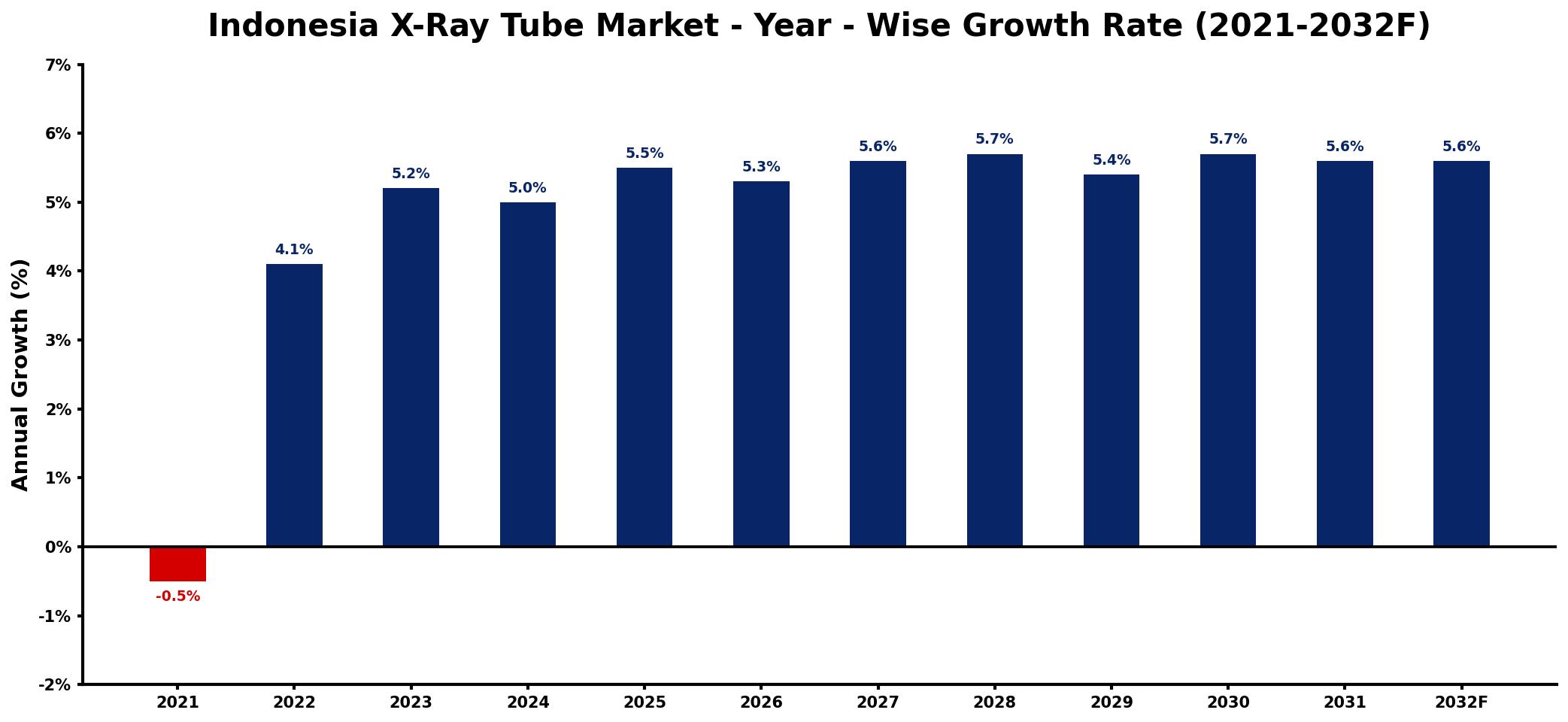
The table below presents the year‑wise growth rates along with the key drivers influencing the market
| Year | Growth Rate | Major Drivers |
| 2021 | -0.5% | decreased healthcare infrastructure investments |
| 2022 | 4.1% | rising demand for medical imaging |
| 2023 | 5.2% | expansion of diagnostic facilities |
| 2024 | 5.0% | increased healthcare expenditure growth |
| 2025 | 5.5% | technological advancements in imaging |
| 2026 | 5.3% | growing geriatric population needs |
| 2027 | 5.6% | enhanced healthcare service accessibility |
| 2028 | 5.7% | surge in preventive health screenings |
| 2029 | 5.4% | rising awareness of health diagnostics |
| 2030 | 5.7% | improved healthcare policies implementation |
| 2031 | 5.6% | growth in private healthcare sectors |
| 2032 | 5.6% | increased investments in healthcare technology |
Note: Market size estimations and growth projections presented in this report are based on 6Wresearch's proprietary forecasting methodology, utilizing the latest available industry data, government publications, and primary research inputs.
Indonesia X-Ray Tube Market Synopsis
The most significant force shaping the Indonesia X-Ray Tube Market is the rising demand for diagnostic imaging services within the healthcare sector. This demand is propelled by a greater emphasis on early disease detection, coupled with the increasing availability of healthcare facilities and resources across the nation.
In addition to healthcare, the industrial and security sectors are also contributing to the demand for X-ray tubes. These sectors utilize advanced X-ray technology for quality control measures and effective threat detection, further expanding the scope of the market and enhancing its overall growth potential.
Indonesia X-Ray Tube Market Key Takeaways
- Continued growth in Indonesias healthcare infrastructure is significantly boosting demand for X-ray tubes.
- The rise in chronic diseases and an aging population are key factors influencing market growth.
- Technological advancements in X-ray tube designs are improving image quality while reducing radiation exposure.
- The industrial sector is increasingly adopting X-ray technology for quality assurance and security applications.
- Local manufacturers are playing a vital role in meeting the growing demand for X-ray tubes in the region.
Evaluation of Restraints in Indonesia X-Ray Tube Market
While the Indonesia X-Ray Tube Market is poised for growth, it faces notable restraints. One significant challenge is the high cost of production associated with manufacturing high-quality X-ray tubes. Balancing competitive pricing with quality assurance remains a critical hurdle for producers. Additionally, fluctuations in demand across healthcare and industrial sectors necessitate that manufacturers diversify their customer bases to mitigate risk.
Indonesia X-Ray Tube Market Trends
Several trends are influencing the Indonesia X-Ray Tube Market. There is a shift towards digital imaging technologies that not only enhance image clarity but also minimize radiation exposure. Furthermore, innovations focusing on compact and portable X-ray machines are on the rise, making diagnostic services more accessible in remote areas. The integration of artificial intelligence in imaging analysis is another noteworthy trend, improving diagnostic accuracy and efficiency.
Indonesia X-Ray Tube Market Opportunities
Growth and investment opportunities within the Indonesia X-Ray Tube Market are abundant. The expansion of private healthcare facilities presents a significant avenue for manufacturers and suppliers to increase their market share. Moreover, collaborations with local healthcare providers can lead to tailored solutions that meet the specific needs of various regions. As the government continues to prioritize healthcare improvements, there are likely to be additional opportunities for innovation and development in X-ray technologies.
Government Initiatives in the Indonesia X-Ray Tube Market
The Indonesian government is actively promoting healthcare infrastructure development through various policies and initiatives aimed at enhancing diagnostic capabilities. Public spending on healthcare has been increasing, with programs focused on improving accessibility to advanced medical technologies. Furthermore, efforts to bolster local manufacturing capabilities in the medical device sector are expected to stimulate the X-ray tube market, ensuring that healthcare facilities are equipped with the necessary diagnostic tools.
Future Insights of the Indonesia X-Ray Tube Market
Looking ahead to 2026-2032, the Indonesia X-Ray Tube Market is anticipated to witness substantial growth, fueled by ongoing advancements in technology and an evolving healthcare landscape. The integration of next-generation imaging solutions will likely enhance the market's appeal, while increased public and private investments will support further developments. As the healthcare sector continues to prioritize efficient and accurate diagnostic tools, the demand for X-ray tubes is expected to rise correspondingly.
Indonesia X-Ray Tube Market Latest Developments (2025 - 2026)
In recent months, the Indonesia X-Ray Tube Market has seen significant developments, particularly in the area of technological advancements. Innovations in imaging technology, including enhanced digital X-ray systems, are being integrated into healthcare facilities. Additionally, the government has initiated programs to boost local manufacturing capabilities, which is expected to increase the supply of high-quality X-ray tubes in response to growing demand.
Indonesia X-Ray Tube Market - Key Attractiveness of the Report
- 10 Years of Market Numbers
- Historical Data Starting from 2022 to 2025
- Base Year: 2025
- Forecast Data until 2032
- Key Performance Indicators Impacting the Market
- Major Upcoming Developments and Projects
Key Highlights of the Report:
- Indonesia X-Ray Tube Market Outlook
- Market Size of Indonesia X-Ray Tube Market, 2025
- Forecast of Indonesia X-Ray Tube Market, 2032
- Historical Data and Forecast of Indonesia X-Ray Tube Revenues & Volume for the Period 2022-2032F
- Indonesia X-Ray Tube Market Trend Evolution
- Indonesia X-Ray Tube Market Drivers and Challenges
- Indonesia X-Ray Tube Price Trends
- Indonesia X-Ray Tube Porter's Five Forces
- Indonesia X-Ray Tube Industry Life Cycle
- Historical Data and Forecast of Indonesia X-Ray Tube Market Revenues & Volume By Type for the Period 2022-2032F
- Historical Data and Forecast of Indonesia X-Ray Tube Market Revenues & Volume By Rotating Anode Tube for the Period 2022-2032F
- Historical Data and Forecast of Indonesia X-Ray Tube Market Revenues & Volume By Stationary X-Ray Tube for the Period 2022-2032F
- Historical Data and Forecast of Indonesia X-Ray Tube Market Revenues & Volume By End-user Industry for the Period 2022-2032F
- Historical Data and Forecast of Indonesia X-Ray Tube Market Revenues & Volume By Manufacturing for the Period 2022-2032F
- Historical Data and Forecast of Indonesia X-Ray Tube Market Revenues & Volume By Healthcare for the Period 2022-2032F
- Historical Data and Forecast of Indonesia X-Ray Tube Market Revenues & Volume By Food for the Period 2022-2032F
- Historical Data and Forecast of Indonesia X-Ray Tube Market Revenues & Volume By Aerospace and Defense for the Period 2022-2032F
- Historical Data and Forecast of Indonesia X-Ray Tube Market Revenues & Volume By Other End-user Industries for the Period 2022-2032F
- Indonesia X-Ray Tube Import Export Trade Statistics
- Market Opportunity Assessment By Type
- Market Opportunity Assessment By End-user Industry
- Indonesia X-Ray Tube Top Companies Market Share
- Indonesia X-Ray Tube Competitive Benchmarking By Technical and Operational Parameters
- Indonesia X-Ray Tube Company Profiles
- Indonesia X-Ray Tube Key Strategic Recommendations






































