Indonesia Yarn, Fiber and Thread Market Summary
The indonesia yarn, fiber and thread market was estimated at USD 387 Million in 2025 and is projected to reach USD 510 Million by 2032, growing at a CAGR of 5.2% from 2026 to 2032.
Indonesia Yarn, Fiber and Thread Market Year-wise Growth Rate and Key Drivers
This graph highlights how the Indonesia Yarn, Fiber and Thread Market has steadily grown over the past five years, supported by major growth factors.
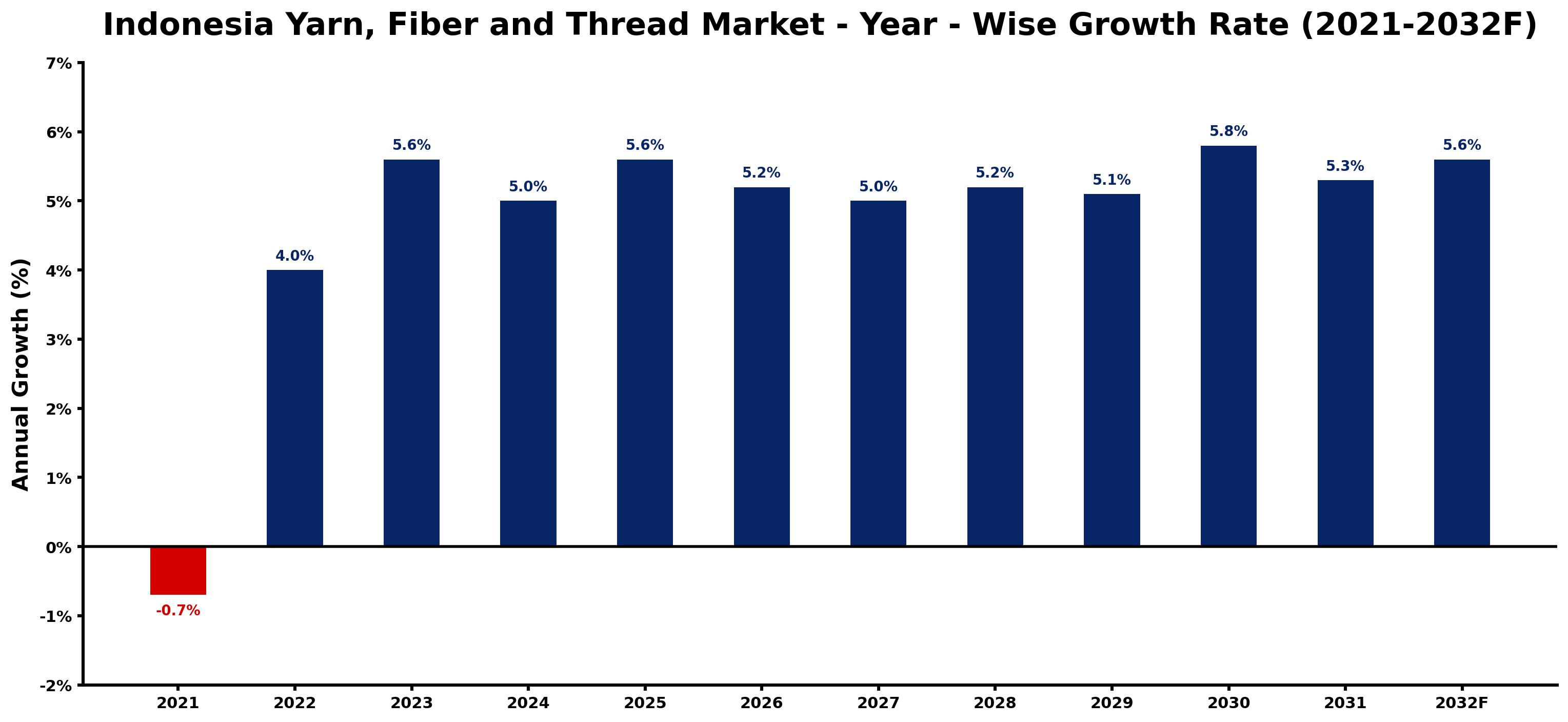
The table below presents the year wise growth rates along with the key drivers influencing the market
| Year | Growth Rate | Major Drivers |
| 2021 | -0.7% | Increased competition from lowcost imports severely impacted local manufacturers' market share and pricing strategies. |
| 2022 | 4.0% | Manufacturers focused on sustainable materials to meet evolving consumer preferences. |
| 2023 | 5.6% | Increased local production capacity reduced reliance on imported yarn and fibers. |
| 2024 | 5.0% | Digital marketing strategies empowered small brands to reach wider audiences effectively. |
| 2025 | 5.6% | Emerging fashion trends emphasized unique, locally-sourced textiles over mass production. |
| 2026 | 5.2% | Regional collaborations strengthened supply chains, enhancing product availability and variety. |
| 2027 | 5.0% | Technological innovations in spinning and weaving improved production efficiency significantly. |
| 2028 | 5.2% | Consumer education campaigns highlighted the benefits of sustainable materials and sourcing. |
| 2029 | 5.1% | Investment in eco-friendly production techniques attracted environmentally conscious consumers. |
| 2030 | 5.8% | Strong e-commerce growth enabled niche brands to thrive amidst larger competitors. |
| 2031 | 5.3% | Cultural initiatives promoting traditional crafts spurred renewed interest in heritage textiles. |
| 2032 | 5.6% | Government policies incentivizing local craft development created a thriving market ecosystem. |
Note - Market size estimations and growth projections presented in this report are based on 6Wresearch's advanced forecasting approach, validated with industry datasets as of June 2026.
Indonesia Yarn, Fiber and Thread Market Synopsis
The Indonesia Yarn, Fiber and Thread Market is projected to reach 5.2% and witness significant growth during the forecast period (2026-2032). This growth trajectory is largely attributed to the increasing demand for apparel in both domestic and export markets, driven by a rising disposable income among the population. The evolution of the country's textile industry has led to the adoption of advanced technologies, enabling improved quality standards that enhance its competitive position in the global market.
Indonesia Yarn, Fiber and Thread Market Growth Drivers
Several key factors are contributing to the expansion of the Indonesia Yarn, Fiber and Thread Market. Firstly, the enhanced fashion consciousness among consumers is leading to greater demand for various apparel types. This demand is further amplified by increased disposable incomes, which provide individuals with more purchasing power for high-quality clothing. As a result, manufacturers are likely to boost production capacities to meet these growing needs.
- The rising trend of sustainable fashion is encouraging manufacturers to innovate and incorporate eco-friendly materials into their yarn and fabric offerings.
- Expanding e-commerce platforms are facilitating greater access to a diverse range of apparel options, thus increasing consumer demand for yarn materials.
- Investments in infrastructure and logistics improvements are expected to enhance the supply chain for yarn, fiber, and thread manufacturing, making products more readily available.
- The ongoing development of specialized textile education programs is creating a skilled workforce that can further support industry growth and innovation.
- Increased participation in international trade fairs and exhibitions is elevating Indonesia's profile in the global textile industry, thereby attracting potential investors.
Indonesia Yarn, Fiber and Thread Market Challenges and Restraints
Despite its growth prospects, the Indonesia Yarn, Fiber and Thread Market faces several challenges that could impede its progress. One significant concern is the volatility in raw material prices, which can squeeze profit margins for manufacturers and affect their operational sustainability.
- Dependency on imported raw materials may lead to supply chain disruptions, particularly during global crises or economic downturns.
- Small-scale manufacturers often lack the bargaining power to negotiate favorable prices for raw materials, making them vulnerable to market fluctuations.
- Environmental regulations are becoming increasingly stringent, requiring companies to invest in compliance measures that may raise operational costs.
- Competition from lower-cost markets can pressure local producers to reduce prices, impacting their profitability.
- Consumer preferences shifting towards online shopping can require traditional manufacturers to adapt their marketing strategies significantly.
Indonesia Yarn, Fiber and Thread Market Government Investment and Initiatives
The Indonesian government has implemented a range of initiatives aimed at bolstering the yarn, fiber, and thread sector. These initiatives focus on enhancing the manufacturing landscape and supporting local producers through various forms of assistance.
- Tax incentives and holidays have been established to encourage foreign and domestic investments in the textile industry.
- Financial support for research and development activities is being provided to foster innovation in yarn and textile technology.
- Public funding aimed at improving infrastructure, such as transportation and logistics, is expected to streamline operations and reduce costs for manufacturers.
- Government programs promoting skill development in textile manufacturing are essential to ensure a competent workforce for the sector.
- Efforts to create favorable electricity tariffs and access to financing options through local banks are intended to lower operational costs and enhance competitiveness.
Indonesia Yarn, Fiber and Thread Market Latest Developments (May 2025 - June 2026)
In the period from May 2025 to June 2026, the Indonesia Yarn, Fiber and Thread Market has witnessed several notable developments that reflect the dynamic nature of the industry. Manufacturers are increasingly adopting sustainable practices, responding to consumer demand for eco-friendly materials. This shift is being supplemented by investments in new technologies that enhance production efficiency, such as automation and digitization.
- There has been a rise in collaborations between textile manufacturers and fashion designers, fostering innovation and enhancing product offerings in line with market trends.
- Local textile fairs have seen increased participation, allowing for networking and showcasing new product lines, which bolsters the industry's visibility.
- Emergence of specialized online platforms dedicated to the sale of yarn and thread has expanded distribution channels for local producers.
- Research partnerships between government agencies and educational institutions are facilitating knowledge transfer and innovation in yarn production techniques.
- Market players are actively exploring export opportunities, especially in emerging markets, as they aim to diversify their portfolios and reduce dependency on domestic sales.
Indonesia Yarn, Fiber and Thread Market - Key Attractiveness of the Report
- 10 Years of Market Numbers
- Historical Data Starting from 2022 to 2025
- Base Year: 2025
- Forecast Data until 2032
- Key Performance Indicators Impacting the Market
- Major Upcoming Developments and Projects
Key Highlights of the Report:
- Indonesia Yarn, Fiber and Thread Market Outlook
- Market Size of Indonesia Yarn, Fiber and Thread Market, 2025
- Forecast of Indonesia Yarn, Fiber and Thread Market, 2032F
- Historical Data and Forecast of Indonesia Yarn, Fiber and Thread Revenues & Volume for the Period 2022-2032F
- Indonesia Yarn, Fiber and Thread Market Trend Evolution
- Indonesia Yarn, Fiber and Thread Market Drivers and Challenges
- Indonesia Yarn, Fiber and Thread Price Trends
- Indonesia Yarn, Fiber and Thread Porter's Five Forces
- Indonesia Yarn, Fiber and Thread Industry Life Cycle
- Historical Data and Forecast of Indonesia Yarn, Fiber and Thread Market Revenues & Volume By Type for the Period 2022-2032F
- Historical Data and Forecast of Indonesia Yarn, Fiber and Thread Market Revenues & Volume By Regular Products for the Period 2022-2032F
- Historical Data and Forecast of Indonesia Yarn, Fiber and Thread Market Revenues & Volume By Special Products for the Period 2022-2032F
- Historical Data and Forecast of Indonesia Yarn, Fiber and Thread Market Revenues & Volume By Applications for the Period 2022-2032F
- Historical Data and Forecast of Indonesia Yarn, Fiber and Thread Market Revenues & Volume By Household for the Period 2022-2032F
- Historical Data and Forecast of Indonesia Yarn, Fiber and Thread Market Revenues & Volume By Commercial for the Period 2022-2032F
- Indonesia Yarn, Fiber and Thread Import Export Trade Statistics
- Market Opportunity Assessment By Type
- Market Opportunity Assessment By Applications
- Indonesia Yarn, Fiber and Thread Top Companies Market Share
- Indonesia Yarn, Fiber and Thread Competitive Benchmarking By Technical and Operational Parameters
- Indonesia Yarn, Fiber and Thread Company Profiles
- Indonesia Yarn, Fiber and Thread Key Strategic Recommendations






































