Iran Cyclohexane Market Growth Rate Analysis (2021-2031)
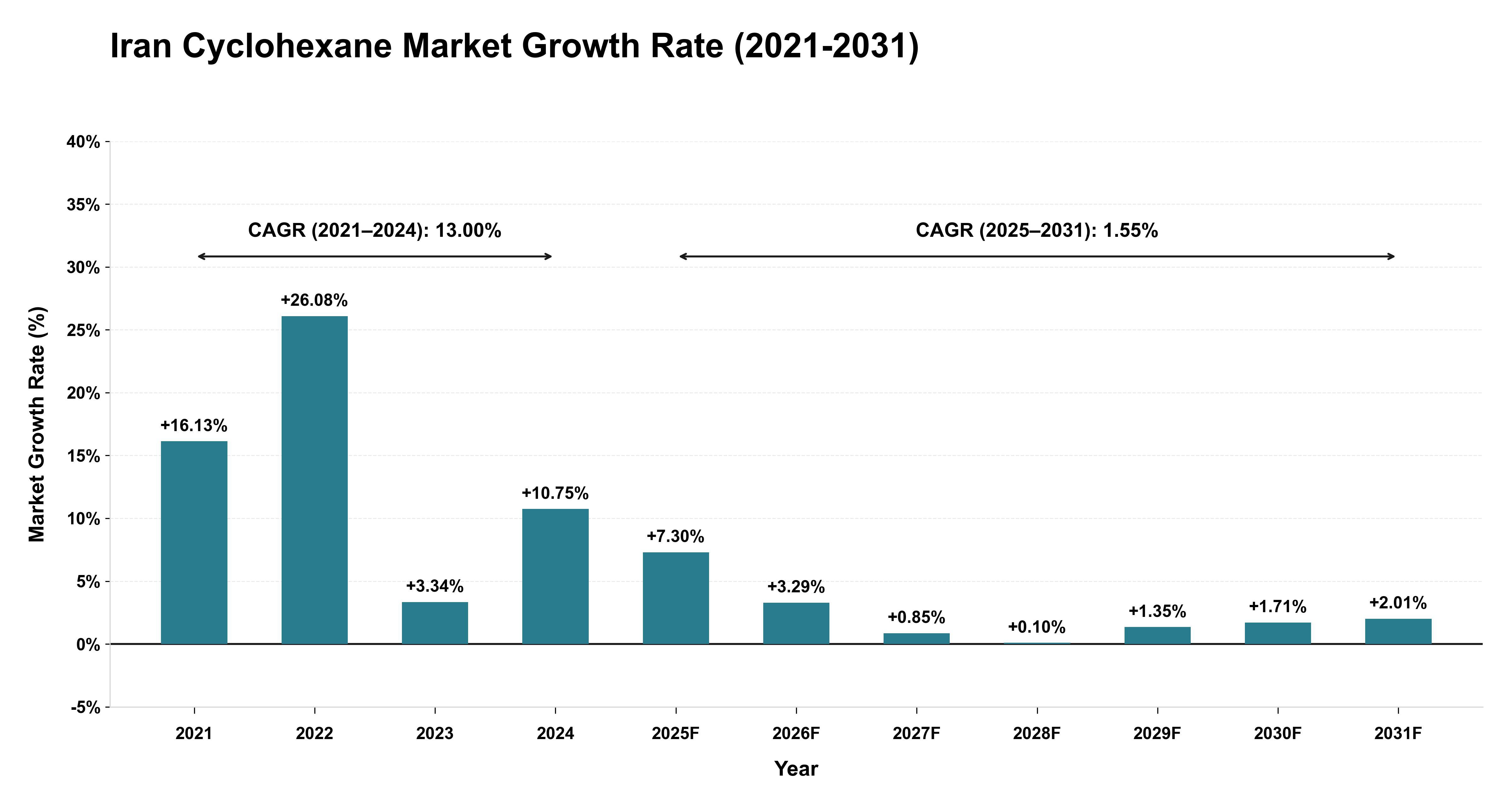
The Iran Cyclohexane market witnessed robust growth from 2021 to 2024, with a remarkable CAGR of 13.00%. This period was characterized by rapid expansion, especially in 2022 when growth spiked at 26.08%. However, starting in 2025, the market began to stabilize, with growth rates gradually declining to single digits. The forecasted CAGR for the period from 2025 to 2031 is 1.55%, indicating a significant slowdown compared to the previous years. The market experienced structural consolidation and demand corrections as it matured post-boom phase, leading to more modest but sustainable growth rates. Despite the deceleration, the Iran Cyclohexane market is expected to maintain positive growth momentum, albeit at a more moderate pace, reflecting a phase of stabilization following volatile historical fluctuations.
Iran Cyclohexane Market Overview
Iran cyclohexane market is driven by its extensive use as a solvent in various industries such as pharmaceuticals, textiles, and paints and coatings. The country`s abundant petrochemical resources contribute to a competitive advantage in cyclohexane production. Moreover, the growing demand for nylon and other synthetic fibers is bolstering the consumption of cyclohexane in Iran.
Drivers of the market
The cyclohexane market in Iran is witnessing significant growth due to the expanding petrochemical industry and the increasing demand for cyclohexane as a solvent and intermediate in various chemical processes. Cyclohexane is widely used in the production of adipic acid, which is further used in the manufacturing of nylon and other polymers. The growing construction and automotive sectors are also driving the demand for cyclohexane-based products such as adhesives, coatings, and plastics, thereby propelling market growth in Iran.
Challenges of the market
The Iran cyclohexane market confronts various challenges that hinder its growth prospects. One primary concern is the reliance on imported raw materials for cyclohexane production, as Iran lacks sufficient domestic feedstock sources such as benzene or hydrogen. This dependency exposes the market to supply chain disruptions, price fluctuations, and geopolitical risks associated with imported feedstock procurement. Additionally, limited infrastructure and outdated production facilities in Iran pose operational challenges for cyclohexane manufacturers, impacting efficiency, quality, and cost competitiveness. Moreover, regulatory hurdles, including environmental regulations and safety standards, add compliance burdens and increase production costs for market players, further constraining market growth and investment.
Government Policy of the market
Government policies in Iran regarding the cyclohexane market have focused on promoting domestic production and reducing dependency on imports. Incentives such as subsidies for domestic manufacturers, investment in infrastructure for production facilities, and research and development grants have been introduced to support the growth of the cyclohexane industry. Additionally, trade policies aimed at regulating imports and exports of cyclohexane products have been implemented to maintain stability in the domestic market and ensure fair competition among industry players.
Key Highlights of the Report:
- Iran Cyclohexane Market Outlook
- Market Size of Iran Cyclohexane Market, 2024
- Forecast of Iran Cyclohexane Market, 2031
- Historical Data and Forecast of Iran Cyclohexane Revenues & Volume for the Period 2021-2031
- Iran Cyclohexane Market Trend Evolution
- Iran Cyclohexane Market Drivers and Challenges
- Iran Cyclohexane Price Trends
- Iran Cyclohexane Porter`s Five Forces
- Iran Cyclohexane Industry Life Cycle
- Historical Data and Forecast of Iran Cyclohexane Market Revenues & Volume By Application for the Period 2021-2031
- Historical Data and Forecast of Iran Cyclohexane Market Revenues & Volume By Adipic acid for the Period 2021-2031
- Historical Data and Forecast of Iran Cyclohexane Market Revenues & Volume By Caprolactam for the Period 2021-2031
- Historical Data and Forecast of Iran Cyclohexane Market Revenues & Volume By Others for the Period 2021-2031
- Historical Data and Forecast of Iran Cyclohexane Market Revenues & Volume By End-use for the Period 2021-2031
- Historical Data and Forecast of Iran Cyclohexane Market Revenues & Volume By Nylon 6 for the Period 2021-2031
- Historical Data and Forecast of Iran Cyclohexane Market Revenues & Volume By Nylon 66 for the Period 2021-2031
- Historical Data and Forecast of Iran Cyclohexane Market Revenues & Volume By Others for the Period 2021-2031
- Iran Cyclohexane Import Export Trade Statistics
- Market Opportunity Assessment By Application
- Market Opportunity Assessment By End-use
- Iran Cyclohexane Top Companies Market Share
- Iran Cyclohexane Competitive Benchmarking By Technical and Operational Parameters
- Iran Cyclohexane Company Profiles
- Iran Cyclohexane Key Strategic Recommendations






































