Iran Data Center Market Growth Rate
According to 6Wresearch internal databases and industry insights, Iran Data Center Market is projected to grow at a steady compound annual growth rate (CAGR) of 4.06% during the forecast period 2026–2032.
Iran Data Center Market Year-wise Growth Rate and Key Drivers (2022-2032)
This graph illustrates the annual growth rates of the Iran Data Center Market from 2022 to 2032, highlighting a steady upward trajectory and projected market expansion over the forecast period.
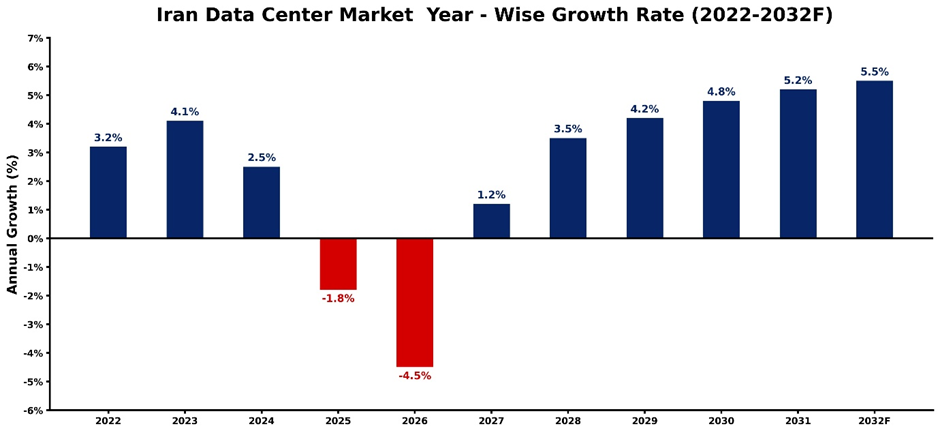
The following table summarizes the historical and forecasted growth rates of Iran Data Center Market, along with the rationale behind each year’s performance.
| Year | Estimated Annual Growth (%) | Market Rationale |
| 2022 | 3.2% | Initial push for National Information Network (NIN) infrastructure. |
| 2023 | 4.1% | Expansion of local e-government and domestic cloud platforms. |
| 2024 | 2.5% | Escalating currency devaluation increasing import costs for hardware. |
| 2025 | -1.8% | Capital diversion toward security and defense; reduced commercial IT spending. |
| 2026 | -4.5% | Severe impact from ongoing regional conflict and restricted tech access. |
| 2027 | 1.2% | Early recovery phase; focus on re-establishing essential state digital services. |
| 2028 | 3.5% | Replacement of critical aging hardware to maintain basic connectivity. |
| 2029 | 4.2% | Growth in local fintech and sovereign cloud hosting requirements. |
| 2030 | 4.8% | State-led incentives for AI and high-performance computing research. |
| 2031 | 5.2% | Maturation of internal cloud service providers and digital economy integration. |
| 2032 | 5.5% | Stabilization of local data residency and expanded domestic digital services. |
Topics Covered in Iran Data Center Market Report
The Iran Data Center Market Report thoroughly covers the market by component and vertical. The report provides an unbiased and detailed analysis of the prevailing market trends, growth opportunities, key market drivers, and industry challenges. It helps stakeholders formulate and align their business strategies with the current market landscape and future growth prospects.
Iran Data Center Market Highlights
| Report Name | Iran Data Center Market |
| Forecast period | 2026-2032 |
| CAGR | 4.06% |
| Growing Sector | IT & Telecom |
Iran Data Center Market Synopsis
The Iran Data Center Market is expected to witness steady growth during the forecast period, supported by increasing digital transformation, expanding cloud adoption, rising internet penetration, and growing demand for secure domestic data storage. As enterprises and government organizations continue to digitize operations, funding in data center infrastructure is increasing to support cloud computing and telecom expansion. The market is further backed by the need for data localization and growing adoption of virtualization technologies.
Evaluation of Growth Drivers in Iran Data Center Market (2026–2032)
Below are the major drivers influencing market dynamics:
| Drivers | Primary Segment Affected | Why It Matters (Evidence) |
| Rapid Digital Transformation & Enterprise Cloud Adoption | Cloud, Enterprise & Colocation Data Centers | Enterprises are increasingly digitizing operations, driving demand for cloud infrastructure. |
| Growing Data Localization & Cybersecurity Requirements | Enterprise & Government Data Centers | Regulatory preferences for storing sensitive information within national borders are increasing investments. |
| Expansion of Telecom Networks & Internet Usage | Colocation & Edge Data Centers | Rising internet penetration is generating higher volumes of data requiring local processing and storage. |
| Increasing AI, Big Data & Analytics Workloads | AI-Ready & Enterprise Data Centers | Growing adoption of AI requires high-performance computing infrastructure and scalable storage capacity. |
| Government Digitalization & E-Government Initiatives | Government & Enterprise Data Centers | Public-sector digital transformation and expanding digital public services continue to stimulate demand. |
The Iran Data Center Market is anticipated to rise at a CAGR of 4.06% during 2026–2032. Increasing enterprise cloud adoption, government digital transformation initiatives, rising cybersecurity investments, and growing demand for AI-enabled infrastructure are the key factors for the market growth. To attract investment in domestic data center facilities, continued expansion of telecom networks, higher internet penetration, and increasing enterprise data generation must be done. The market is projected to expand steadily through domestic infrastructure development and modernization efforts.
Evaluation of Restraints in Iran Data Center Market
Below are the major restraints influencing market dynamics:
| Restraints | Primary Segment Affected | What This Means (Evidence) |
| International Sanctions & Technology Import Restrictions | All Segments | Sanctions limit access to international cloud partnerships, slowing infrastructure modernization. |
| Rising Energy & Infrastructure Costs | Hyperscale & Large Data Centers | Although electricity costs remain relatively competitive, improving power requires substantial capital investment, |
| Limited Foreign Investment | Hyperscale & Colocation | International investment in hyperscale facilities remains constrained which minimizes access to global expertise. |
| Aging Digital Infrastructure | Enterprise & Government Data Centers | To back AI and high-density workloads efficiently, advancement of legacy IT infrastructure is required. |
| Regulatory & Compliance Complexity | Cloud & Enterprise Data Centers | Evolving regulations related to cybersecurity increase operational and compliance requirements. |
Iran Data Center Market Challenges
In spite of the growth factors, the Iran Data Center Market faces significant obstacles due to international sanctions that restrict access to upgrade semiconductors, networking equipment, and global cloud technologies, increasing deployment costs and delaying infrastructure upgrades. More than 80% of Iran’s population uses the internet which owns rapid growth in data traffic and increasing pressure on existing infrastructure. Meanwhile, over 70% of enterprise workloads are expected to be cloud-enabled over the coming years, requiring additional domestic capacity.
Iran Data Center Market Trends
Major trends influencing the Iran Data Center Market include the following:
- Expansion of AI-Ready Infrastructure: Growing adoption of machine learning and advanced analytics is increasing demand for GPU-enabled servers and high-density racks.
- Growth of Enterprise Cloud and Virtualization: Organizations are adopting private cloud and hybrid IT environments to improve operational efficiency and business continuity.
- Increasing Focus on Data Localization: Financial institutions and regulated industries continue expanding investments in domestic data storage to enhance security and regulatory compliance.
- Modernization of Energy-Efficient Facilities: Data center operators are investing in improved power management systems to reduce operational costs and improve facility reliability.
Investment Opportunities in Iran Data Center Market
Growth-oriented investment opportunities in the Iran Data Center industry include the following:
- Expansion of Enterprise & Government Data Centers: Continued digital transformation across telecom sectors creates opportunities for expanding domestic data center capacity.
- AI & High-Performance Computing Infrastructure: Growing AI and big data workloads present opportunities for investment in specialized high-density computing facilities.
- Energy-Efficient Data Center Solutions: Investments in advanced cooling systems and energy optimization technologies can improve operational efficiency.
- Cybersecurity & Disaster Recovery Infrastructure: Rising cybersecurity requirements and business continuity planning create demand for secure colocation facilities.
Top Leading Players in Iran Data Center Market
A detailed compilation of major companies active in the Iran data center market is presented below:
1. Pars Online
| Company Name | Pars Online |
|---|---|
| Established Year | 1999 |
| Headquarters | Tehran, Iran |
| Official Website | Click Here |
Pars Online operates one of Iran’s first major private data centers in Pardis Technology Park, providing enterprise colocation and managed IT infrastructure services.
2. Afranet
| Company Name | Afranet |
|---|---|
| Established Year | 1999 |
| Headquarters | Tehran, Iran |
| Official Website | Click Here |
Afranet is a public joint-stock ICT company offering data center services, cloud computing, web hosting, and enterprise connectivity solutions across Iran.
3. HiWeb
| Company Name | HiWeb |
|---|---|
| Established Year | 2003 |
| Headquarters | Tehran, Iran |
| Official Website | Click Here |
HiWeb provides broadband connectivity, enterprise networking, cloud, and data center services, supporting digital infrastructure across both metropolitan and regional areas.
4. ArvanCloud (Abr Arvan)
| Company Name | ArvanCloud (Abr Arvan) |
|---|---|
| Established Year | 2015 |
| Headquarters | Tehran, Iran |
| Official Website | Click Here |
ArvanCloud is one of Iran’s leading cloud infrastructure providers, offering cloud computing and data center services that support the country's expanding digital ecosystem.
Government Initiatives Introduced in the Iran Data Center Market
According to the Iranian government data, the market is encouraged by several initiatives to strengthen domestic data center market by promoting digital transformation and encouraging the development of local cloud infrastructure. Policies that support data localization have increased the demand for domestic data hosting, particularly across government agencies, banking, healthcare, and telecommunications, to expand the Iran Data Center Market revenue. Additionally, Connectivity and data processing capabilities are increased by investments in broadband expansion, fiber-optic networks, and national information infrastructure.
Future Insights of the Iran Data Center Market
The market is projected to witness steady expansion, supported by rising enterprise digitalization, cloud adoption, and AI-driven workloads. The Iran Data Center Market revenue will be increased as internet penetration is expected to remain above 80%, which will drive higher demand for local data storage. This is expected to actively enhance data traffic, promoting investments in AI-ready facilities. Continued growth in telecom networks and e-government initiatives will further strengthen demand for modern domestic data center infrastructure.
Market Segmentation Analysis
This report presents a detailed analysis of the market segments along with their leading categories:
By Component - Electrical Infrastructure Led the Market and Networking Infrastructure Set for Rapid Growth
According to Ravi Bhandari, Senior Research Analyst, 6Wresearch, by component, in the Iran Data Center Market, the Electrical Infrastructure commanded in 2025, accounting for 40% of the market share, owned by high demand for UPS systems and power distribution units, generators, and energy management solutions. Meanwhile, by 2032, the Networking Infrastructure is projected to witness the fastest progress, with a CAGR of around 7%, driven by increasing cloud adoption, AI workloads, and higher data traffic.
By Vertical - IT & Telecom Dominated the Market and Banking, Financial Services & Insurance (BFSI) Set for Rapid Expansion
By vertical, at the Iran data center market, the IT & Telecom led in 2025, accounting for 45% of the market share, supported by increasing internet usage and telecom network expansion. However, with a CAGR of around 7%, during 2026-2032, the BFSI (Banking, Financial Services & Insurance) is expected to witness growth, backed by digital banking expansion and online payment adoption.
Note: Market size estimations and growth projections presented in this report are based on 6Wresearch's proprietary forecasting methodology, utilizing the latest available industry data, government publications, and primary research inputs.
Key Attractiveness of the Report:
- 10 Years of Market Numbers
- Historical Data Starting from 2022 to 2025
- Base Year: 2025
- Forecast Data until 2032
- Key Performance Indicators Impacting the Market
- Major Upcoming Developments and Projects
Key Highlights of the Report:
- Iran Data Center Market Outlook
- Market Size of Iran Data Center Market, 2025
- Forecast of Iran Data Center Market, 2032
- Historical Data and Forecast of Iran Data Center Revenues & Volume for the Period 2022-2032
- Iran Data Center Market Trend Evolution
- Iran Data Center Market Drivers and Challenges
- Iran Data Center Price Trends
- Iran Data Center Porter`s Five Forces
- Iran Data Center Industry Life Cycle
- Historical Data and Forecast of Iran Data Center Market Revenues & Volume By Component for the Period 2022-2032
- Historical Data and Forecast of Iran Data Center Market Revenues & Volume By Electrical for the Period 2022-2032
- Historical Data and Forecast of Iran Data Center Market Revenues & Volume By Mechanical for the Period 2022-2032
- Historical Data and Forecast of Iran Data Center Market Revenues & Volume By Networking for the Period 2022-2032
- Historical Data and Forecast of Iran Data Center Market Revenues & Volume By Racks for the Period 2022-2032
- Historical Data and Forecast of Iran Data Center Market Revenues & Volume By Security Systems for the Period 2022-2032
- Historical Data and Forecast of Iran Data Center Market Revenues & Volume By Fire Systems for the Period 2022-2032
- Historical Data and Forecast of Iran Data Center Market Revenues & Volume By Vertical for the Period 2022-2032
- Historical Data and Forecast of Iran Data Center Market Revenues & Volume By Banking Financial Services & Insurance (BFSI) for the Period 2022-2032
- Historical Data and Forecast of Iran Data Center Market Revenues & Volume By Government for the Period 2022-2032
- Historical Data and Forecast of Iran Data Center Market Revenues & Volume By IT & Telecom for the Period 2022-2032
- Historical Data and Forecast of Iran Data Center Market Revenues & Volume By Media for the Period 2022-2032
- Historical Data and Forecast of Iran Data Center Market Revenues & Volume By Retail for the Period 2022-2032
- Historical Data and Forecast of Iran Data Center Market Revenues & Volume By Manufacturing for the Period 2022-2032
- Historical Data and Forecast of Iran Data Center Market Revenues & Volume By Others for the Period 2022-2032
- Iran Data Center Import Export Trade Statistics
- Market Opportunity Assessment By Component
- Market Opportunity Assessment By Vertical
- Iran Data Center Top Companies Market Share
- Iran Data Center Competitive Benchmarking By Technical and Operational Parameters
- Iran Data Center Company Profiles
- Iran Data Center Key Strategic Recommendations






































