Iran Timing Belt Market Growth Rate Analysis (2025 - 2031)
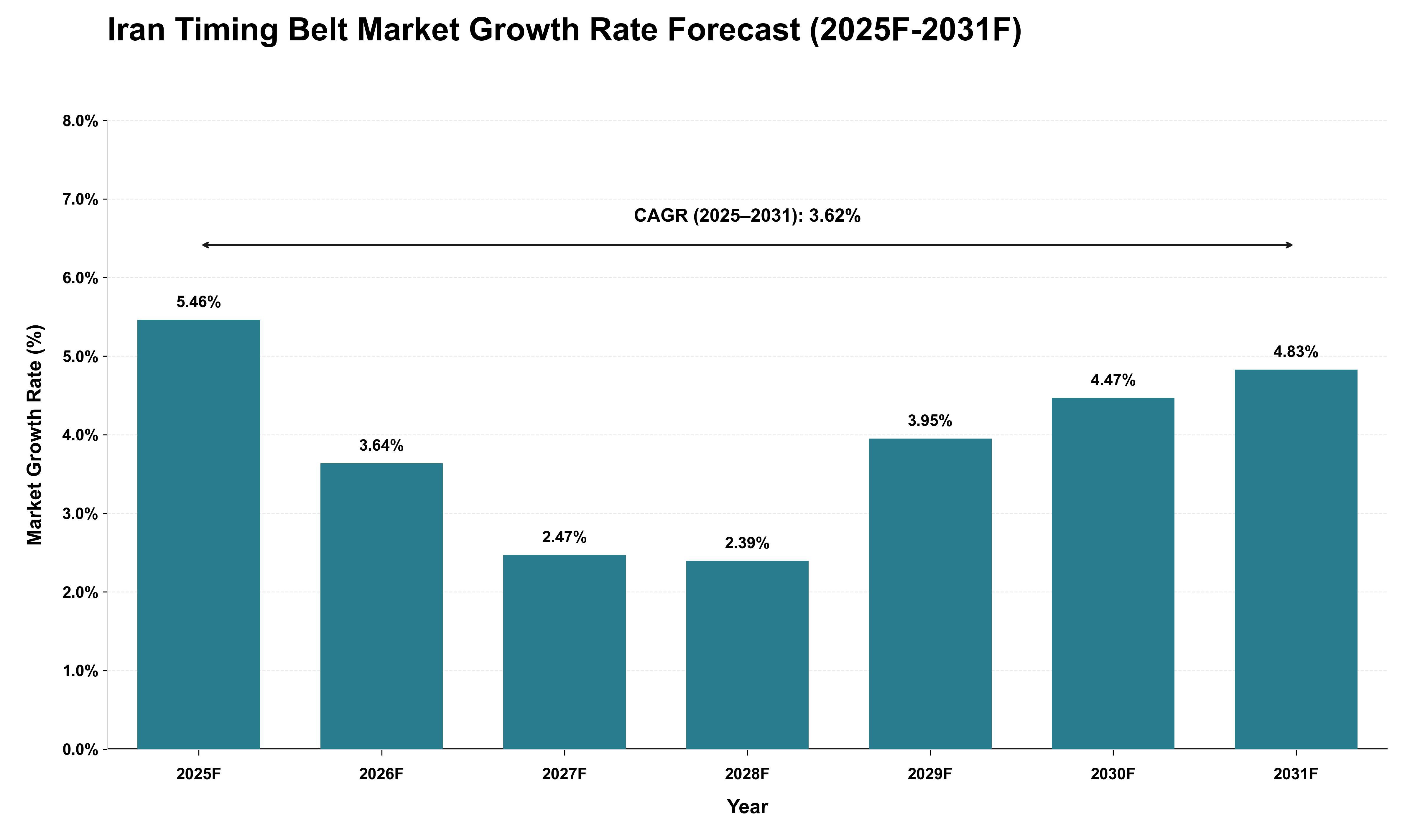
The Iran timing belt market will experience a compound annual growth rate (CAGR) of 3.62% from 2025 to 2031, driven primarily by shifts in end-use demand across the automotive and industrial sectors. As vehicle production ramps up, particularly in response to increasing domestic consumption and potential export opportunities, the demand for timing belts will see notable growth, peaking at 5.46% in 2025. This initial surge will be supported by a recovering manufacturing base and investments in infrastructure that enhance automotive supply chains. However, as the forecast progresses, growth rates are expected to moderate due to cyclical trends inherent in the automotive industry and potential fluctuations in raw material costs influenced by global market dynamics. By 2031, the market is projected to stabilize with a growth rate of 4.83%, reflecting ongoing adjustments to import dependencies and evolving consumer preferences within Iran's economic landscape.
Key Highlights of the Report:
- Iran Timing Belt Market Outlook
- Market Size of Iran Timing Belt Market, 2024
- Forecast of Iran Timing Belt Market, 2031
- Historical Data and Forecast of Iran Timing Belt Revenues & Volume for the Period 2021-2031
- Iran Timing Belt Market Trend Evolution
- Iran Timing Belt Market Drivers and Challenges
- Iran Timing Belt Price Trends
- Iran Timing Belt Porter`s Five Forces
- Iran Timing Belt Industry Life Cycle
- Historical Data and Forecast of Iran Timing Belt Market Revenues & Volume By Drive Type for the Period 2021-2031
- Historical Data and Forecast of Iran Timing Belt Market Revenues & Volume By Dry Belts for the Period 2021-2031
- Historical Data and Forecast of Iran Timing Belt Market Revenues & Volume By Chain for the Period 2021-2031
- Historical Data and Forecast of Iran Timing Belt Market Revenues & Volume By Belt in Oil for the Period 2021-2031
- Historical Data and Forecast of Iran Timing Belt Market Revenues & Volume By Component for the Period 2021-2031
- Historical Data and Forecast of Iran Timing Belt Market Revenues & Volume By Idler Pulley for the Period 2021-2031
- Historical Data and Forecast of Iran Timing Belt Market Revenues & Volume By Sprocket for the Period 2021-2031
- Historical Data and Forecast of Iran Timing Belt Market Revenues & Volume By Tensioner for the Period 2021-2031
- Historical Data and Forecast of Iran Timing Belt Market Revenues & Volume By Timing Shield/Cover for the Period 2021-2031
- Historical Data and Forecast of Iran Timing Belt Market Revenues & Volume By ICE & Hybrid for the Period 2021-2031
- Historical Data and Forecast of Iran Timing Belt Market Revenues & Volume By Passenger Car for the Period 2021-2031
- Historical Data and Forecast of Iran Timing Belt Market Revenues & Volume By Commercial Vehicle for the Period 2021-2031
- Historical Data and Forecast of Iran Timing Belt Market Revenues & Volume By HEV for the Period 2021-2031
- Historical Data and Forecast of Iran Timing Belt Market Revenues & Volume By PHEV for the Period 2021-2031
- Iran Timing Belt Import Export Trade Statistics
- Market Opportunity Assessment By Drive Type
- Market Opportunity Assessment By Component
- Market Opportunity Assessment By ICE & Hybrid
- Iran Timing Belt Top Companies Market Share
- Iran Timing Belt Competitive Benchmarking By Technical and Operational Parameters
- Iran Timing Belt Company Profiles
- Iran Timing Belt Key Strategic Recommendations






































