Iraq Agricultural machinery Market Size, Share & Growth Rate
The Iraq Agricultural machinery Market was estimated at USD 759 Million in 2025 and is projected to reach USD 1106 Million by 2032, growing at a CAGR of 5.5% from 2026 to 2032. This growth trajectory is primarily driven by a shift towards mechanization in agriculture as farmers strive for enhanced productivity and efficiency. Coupled with rising food demand due to an increasing population and supportive government policies aimed at modernizing the agricultural sector, the market is poised for significant expansion.
Iraq Agricultural machinery Market Year-wise Growth Rate and Key Drivers
This graph highlights how the Iraq Agricultural machinery Market has steadily grown over the years, supported by major growth factors.
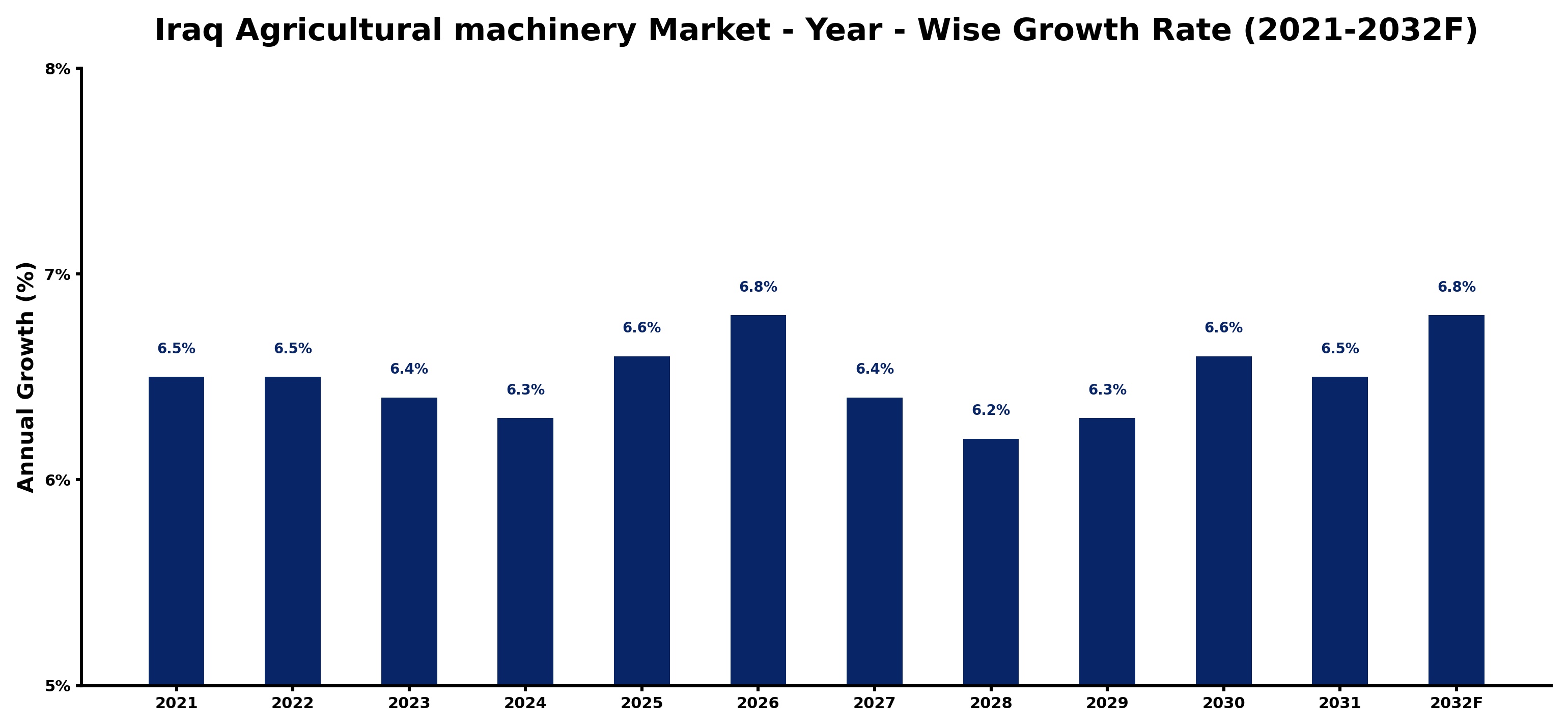
The table below presents the year‑wise growth rates along with the key drivers influencing the market
| Year | Growth Rate | Major Drivers |
| 2021 | 6.5% | Government investment in agriculture |
| 2022 | 6.5% | Rising demand for mechanization |
| 2023 | 6.4% | Increased focus on sustainability |
| 2024 | 6.3% | Technological advancements in machinery |
| 2025 | 6.6% | Growing export opportunities for farmers |
| 2026 | 6.8% | Enhanced training for agricultural workers |
| 2027 | 6.4% | Improved irrigation systems adoption |
| 2028 | 6.2% | Rural infrastructure development initiatives |
| 2029 | 6.3% | Increased financing for farmers |
| 2030 | 6.6% | Collaborations with international suppliers |
| 2031 | 6.5% | Expansion of agricultural cooperatives |
| 2032 | 6.8% | Rising consumer demand for efficiency |
Note - Market size estimations and growth projections presented in this report are based on 6Wresearch's advanced forecasting approach, validated with industry datasets as of June 2026.
Iraq Agricultural machinery Market Synopsis
A noticeable trend in the Iraq Agricultural machinery Market is the rising adoption of advanced irrigation systems, essential for addressing water scarcity in agricultural practices. Additionally, farmers are increasingly investing in modern tractors and harvesters, indicating a transformative shift from traditional farming methods to more efficient, technology-driven solutions.
Local producers are emerging alongside established international brands, enhancing competition and encouraging innovation within the sector. The collaboration between government initiatives and private investors creates a fertile ground for growth and adaptation, fostering a robust agricultural machinery landscape.
Iraq Agricultural machinery Market Key Takeaways
- The market is witnessing increased mechanization, vital for improving agricultural output.
- Government support is essential in promoting modern farming techniques and machinery usage.
- There is a growing demand for sustainable and environmentally friendly agricultural equipment.
- Local manufacturers are beginning to emerge, complementing the dominance of international brands.
- Challenges related to infrastructure and financing remain but present opportunities for targeted investment.
Evaluation of Restraints in Iraq Agricultural machinery Market
The Iraq Agricultural machinery Market faces several significant restraints that hinder its growth. Limited access to financing options for farmers makes it difficult for them to invest in modern machinery, perpetuating reliance on outdated agricultural practices. Moreover, the country's infrastructure challenges complicate the distribution and maintenance of agricultural equipment. Political instability continues to pose risks, causing hesitation among potential investors looking to enter the market. A shortage of skilled labor for operating sophisticated machinery further amplifies the difficulties in advancing the sector.
Iraq Agricultural machinery Market Trends
Current trends indicate a strong move towards precision farming and the incorporation of automation technology in agriculture. Farmers are increasingly interested in utilizing high-tech machinery that enhances their productivity and reduces labor costs. Furthermore, the emphasis on sustainability is prompting demand for eco-friendly equipment, aligning with global agricultural practices focused on minimizing environmental impact. Government-led initiatives to improve infrastructure are expected to facilitate the adoption of these advanced agricultural technologies.
Iraq Agricultural machinery Market Opportunities
Investors have a unique opportunity to explore the Iraq Agricultural machinery Market, primarily due to the escalating demand for innovative agricultural solutions. By introducing cutting-edge machinery that addresses the specific needs of local farmers, companies can significantly enhance crop yields and optimize resource utilization. Collaborative ventures with local distributors can create strategic advantages, tapping into the expanding market efficiently. Furthermore, leveraging government support programs can aid in securing financing and enhancing market entry strategies.
Government Initiatives in the Iraq Agricultural machinery Market
The Iraqi government has introduced various policies aimed at modernizing the agricultural sector, including subsidies for farmers to encourage investment in advanced machinery. Programs designed to enhance agricultural infrastructure and provide financial incentives are pivotal in supporting the transition to mechanization. Additionally, partnerships with international organizations facilitate technology transfer, essential for improving operational capabilities and agricultural practices.
Future Insights of the Iraq Agricultural machinery Market
Looking ahead to the period between 2026 and 2032, the Iraq Agricultural machinery Market is positioned for growth driven by increasing awareness among farmers regarding the benefits of mechanization and advanced technologies. The need to address labor shortages and adapt to changing climatic conditions will likely spur further investment in agricultural machinery. As government initiatives continue to focus on modernizing agricultural practices, the market is expected to experience significant advancements in both technology and productivity.
Iraq Agricultural machinery Market Latest Developments (May 2025 - June 2026)
Recent developments within the Iraq Agricultural machinery Market indicate a growing focus on sustainable practices and technology integration. The introduction of new financing programs by the government aims to support farmers in acquiring modern equipment, while ongoing improvements to agricultural infrastructure are anticipated to enhance market accessibility. Collaborative efforts between local businesses and international manufacturers are also emerging, fostering innovation and enhancing product offerings in the sector.
Iraq Agricultural machinery Market - Key Attractiveness of the Report
- 10 Years of Market Numbers
- Historical Data Starting from 2022 to 2025
- Base Year: 2025
- Forecast Data until 2032
- Key Performance Indicators Impacting the Market
- Major Upcoming Developments and Projects
Key Highlights of the Report:
- Iraq Agricultural machinery Market Outlook
- Market Size of Iraq Agricultural machinery Market, 2025
- Forecast of Iraq Agricultural machinery Market, 2032
- Historical Data and Forecast of Iraq Agricultural machinery Revenues & Volume for the Period 2022-2032F
- Iraq Agricultural machinery Market Trend Evolution
- Iraq Agricultural machinery Market Drivers and Challenges
- Iraq Agricultural machinery Price Trends
- Iraq Agricultural machinery Porter's Five Forces
- Iraq Agricultural machinery Industry Life Cycle
- Historical Data and Forecast of Iraq Agricultural machinery Market Revenues & Volume By Product Type for the Period 2022-2032F
- Historical Data and Forecast of Iraq Agricultural machinery Market Revenues & Volume By Tractors for the Period 2022-2032F
- Historical Data and Forecast of Iraq Agricultural machinery Market Revenues & Volume By Plowing and Cultivating Machinery for the Period 2022-2032F
- Historical Data and Forecast of Iraq Agricultural machinery Market Revenues & Volume By Planting Machinery for the Period 2022-2032F
- Historical Data and Forecast of Iraq Agricultural machinery Market Revenues & Volume By Irrigation Machinery for the Period 2022-2032F
- Historical Data and Forecast of Iraq Agricultural machinery Market Revenues & Volume By Harvesting Machinery for the Period 2022-2032F
- Historical Data and Forecast of Iraq Agricultural machinery Market Revenues & Volume By Others for the Period 2022-2032F
- Iraq Agricultural machinery Import Export Trade Statistics
- Market Opportunity Assessment By Product Type
- Iraq Agricultural machinery Top Companies Market Share
- Iraq Agricultural machinery Competitive Benchmarking By Technical and Operational Parameters
- Iraq Agricultural machinery Company Profiles
- Iraq Agricultural machinery Key Strategic Recommendations






































