Iraq Apparel and Footwear Market Size, Share & Growth Rate
The Iraq Apparel and Footwear Market was estimated at USD 309 Million in 2025 and is projected to reach USD 438 Million by 2032, growing at a CAGR of 5.1% from 2026 to 2032. This growth trajectory is fueled by a burgeoning young population eager for contemporary styles, as well as rising disposable incomes that facilitate access to both local and international brands. As western fashion trends penetrate deeper into Iraqi culture, the demand for both trendy and modest apparel continues to expand, reshaping the landscape of this vibrant market.
Iraq Apparel and Footwear Market Year-wise Growth Rate and Key Drivers
This graph highlights how the Iraq Apparel and Footwear Market has steadily grown over the years, supported by major growth factors.
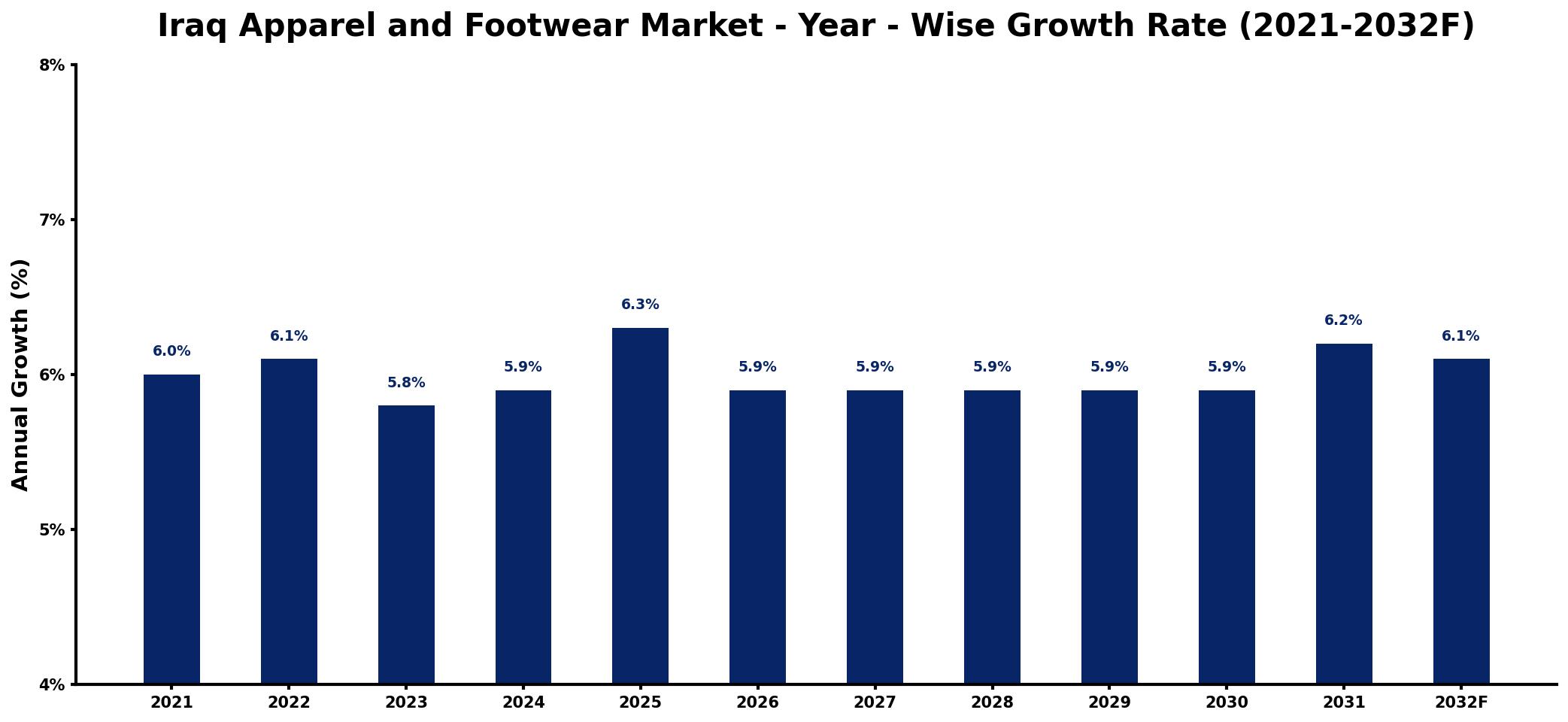
The table below presents the year‑wise growth rates along with the key drivers influencing the market
| Year | Growth Rate | Major Drivers |
| 2021 | 6.0% | Rising consumer spending patterns |
| 2022 | 6.1% | Increased retail expansion initiatives |
| 2023 | 5.8% | Growing e-commerce market penetration |
| 2024 | 5.9% | Strengthening local manufacturing capabilities |
| 2025 | 6.3% | Expanding foreign investment interest |
| 2026 | 5.9% | Enhanced distribution network efficiency |
| 2027 | 5.9% | Growing youth population demographics |
| 2028 | 5.9% | Boosting fashion industry collaborations |
| 2029 | 5.9% | Increasing online shopping adoption |
| 2030 | 5.9% | Strengthening brand loyalty programs |
| 2031 | 6.2% | Expanding export opportunities abroad |
| 2032 | 6.1% | Growing sustainability awareness trends |
Note: Market size estimations and growth projections presented in this report are based on 6Wresearch's proprietary forecasting methodology, utilizing the latest available industry data, government publications, and primary research inputs.
Iraq Apparel and Footwear Market Synopsis
A dynamic shift toward western fashion trends is currently the strongest force shaping the Iraq apparel and footwear market. While traditional styles maintain their appeal, a noticeable transformation is occurring as younger consumers increasingly embrace casual and fashionable clothing options influenced by global styles.
Compounding this trend is the rapid expansion of retail channels, from independent boutiques to comprehensive e-commerce platforms, allowing consumers a diverse range of shopping experiences. The evolving preferences of Iraqi consumers reflect a complex interplay of cultural influences and modern aspirations, positioning the market for significant growth.
Iraq Apparel and Footwear Market Key Takeaways
- Strong growth trajectory driven by a young population and rising disposable incomes.
- A shift towards casual and athleisure wear is reshaping consumer preferences.
- Increasing presence of e-commerce platforms enhances accessibility and variety.
- Cultural influences continue to play a critical role in defining product offerings.
- Government initiatives aimed at supporting local production foster market resilience.
Evaluation of Restraints in Iraq Apparel and Footwear Market
The Iraq apparel and footwear market faces significant hurdles stemming from political instability and economic uncertainty. These factors have led to unpredictable consumer confidence, resulting in fluctuating spending patterns. High inflation rates and unemployment further limit purchasing power, compelling many consumers to prioritize affordability over fashion trends. Additionally, security concerns disrupt supply chains and hinder efficient retail operations, creating barriers for businesses striving to reach a broader audience. The interplay of these challenges necessitates strategic adaptations to optimize market performance.
Iraq Apparel and Footwear Market Trends
Several notable trends are influencing the Iraq apparel and footwear market. There is a marked preference for casual and comfortable clothing styles, especially among younger consumers who are increasingly drawn to streetwear and athleisure. This trend is amplified by the omnipresence of social media, which exposes consumers to global fashion trends and influences their purchasing decisions. Concurrently, there is a rising consciousness around sustainability and ethical sourcing, with more Iraqi consumers seeking eco-friendly options. These emerging preferences are driving a transition toward diverse and inclusive fashion choices.
Iraq Apparel and Footwear Market Opportunities
The Iraq apparel and footwear market presents several attractive investment opportunities for both local and international retailers. With a population exceeding 40 million, the potential for growth is significant, particularly as the younger demographic continues to seek trendy and affordable options. Retailers that establish a strong presence in e-commerce and engage with local distributors can capitalize on shifting consumer attitudes and preferences. Additionally, investments aimed at enhancing product diversity and addressing sustainability concerns can resonate well with Iraqi consumers, fostering brand loyalty and market expansion.
Government Initiatives in the Iraq Apparel and Footwear Market
Government policies in Iraq are increasingly focused on bolstering domestic production in the apparel and footwear sectors. Initiatives such as tariffs on imports and support for local manufacturers aim to stimulate the growth of the textile industry. Furthermore, there are funding and training programs designed to assist small and medium-sized enterprises (SMEs) within the sector, encouraging innovation and development. By enhancing infrastructure and streamlining regulations, the government is fostering a more conducive environment for the growth and sustainability of the apparel and footwear market in Iraq.
Future Insights of the Iraq Apparel and Footwear Market
Looking ahead to 2026-2032, the Iraq apparel and footwear market is positioned for steady growth. The combination of a youthful population and rising disposable incomes will drive demand for fashionable, affordable clothing and footwear. As the economy gradually stabilizes, international brands are likely to seize opportunities for expansion, introducing a wider array of products tailored to the evolving preferences of Iraqi consumers. E-commerce will play an increasingly pivotal role in the shopping experience, facilitating access and convenience in this growing market.
Iraq Apparel and Footwear Market Latest Developments (2025 - 2026)
Recent developments in the Iraq apparel and footwear market indicate a strengthening interest from international brands, keen to tap into the countrys emerging consumer base. E-commerce platforms are expanding their offerings, catering to diverse tastes and preferences across regions. There is also a noticeable uptick in collaborations between local artisans and global brands, blending traditional craftsmanship with modern design. These trends highlight the market's potential for innovation and growth as it adapts to changing consumer demands.
Iraq Apparel and Footwear Market - Key Attractiveness of the Report
- 10 Years of Market Numbers
- Historical Data Starting from 2022 to 2025
- Base Year: 2025
- Forecast Data until 2032
- Key Performance Indicators Impacting the Market
- Major Upcoming Developments and Projects
Key Highlights of the Report:
- Iraq Apparel and Footwear Market Outlook
- Market Size of Iraq Apparel and Footwear Market, 2025
- Forecast of Iraq Apparel and Footwear Market, 2032
- Historical Data and Forecast of Iraq Apparel and Footwear Revenues & Volume for the Period 2022-2032F
- Iraq Apparel and Footwear Market Trend Evolution
- Iraq Apparel and Footwear Market Drivers and Challenges
- Iraq Apparel and Footwear Price Trends
- Iraq Apparel and Footwear Porter's Five Forces
- Iraq Apparel and Footwear Industry Life Cycle
- Historical Data and Forecast of Iraq Apparel and Footwear Market Revenues & Volume By Type for the Period 2022-2032F
- Historical Data and Forecast of Iraq Apparel and Footwear Market Revenues & Volume By Apparel for the Period 2022-2032F
- Historical Data and Forecast of Iraq Apparel and Footwear Market Revenues & Volume By Casual Wear for the Period 2022-2032F
- Historical Data and Forecast of Iraq Apparel and Footwear Market Revenues & Volume By Sports Wear for the Period 2022-2032F
- Historical Data and Forecast of Iraq Apparel and Footwear Market Revenues & Volume By Night Wear for the Period 2022-2032F
- Historical Data and Forecast of Iraq Apparel and Footwear Market Revenues & Volume By Others for the Period 2022-2032F
- Historical Data and Forecast of Iraq Apparel and Footwear Market Revenues & Volume By Footwear for the Period 2022-2032F
- Historical Data and Forecast of Iraq Apparel and Footwear Market Revenues & Volume By Shoes for the Period 2022-2032F
- Historical Data and Forecast of Iraq Apparel Apparel and Footwear Market Revenues & Volume By Slippers for the Period 2022-2032F
- Historical Data and Forecast of Iraq Apparel and Footwear Market Revenues & Volume By End-user for the Period 2022-2032F
- Historical Data and Forecast of Iraq Apparel and Footwear Market Revenues & Volume By Men for the Period 2022-2032F
- Historical Data and Forecast of Iraq Apparel and Footwear Market Revenues & Volume By Women for the Period 2022-2032F
- Historical Data and Forecast of Iraq Apparel and Footwear Market Revenues & Volume By Kids for the Period 2022-2032F
- Historical Data and Forecast of Iraq Apparel and Footwear Market Revenues & Volume By Distribution Channel for the Period 2022-2032F
- Historical Data and Forecast of Iraq Apparel and Footwear Market Revenues & Volume By Speciality Stores for the Period 2022-2032F
- Historical Data and Forecast of Iraq Apparel and Footwear Market Revenues & Volume By Supermarkets/Hypermarkets for the Period 2022-2032F
- Historical Data and Forecast of Iraq Apparel and Footwear Market Revenues & Volume By Online Channels for the Period 2022-2032F
- Historical Data and Forecast of Iraq Apparel and Footwear Market Revenues & Volume By Others for the Period 2022-2032F
- Iraq Apparel and Footwear Import Export Trade Statistics
- Market Opportunity Assessment By Type
- Market Opportunity Assessment By End-user
- Market Opportunity Assessment By Distribution Channel
- Iraq Apparel and Footwear Top Companies Market Share
- Iraq Apparel and Footwear Competitive Benchmarking By Technical and Operational Parameters
- Iraq Apparel and Footwear Company Profiles
- Iraq Apparel and Footwear Key Strategic Recommendations






































