Iraq Artificial Grass Market Summary
The iraq artificial grass market was estimated at USD 416 Million in 2025 and is projected to reach USD 585 Million by 2032, growing at a CAGR of 5.5% from 2026 to 2032.
Iraq Artificial Grass Market Year-wise Growth Rate and Key Drivers
This graph highlights how the Iraq Artificial Grass Market has steadily grown over the past five years, supported by major growth factors.
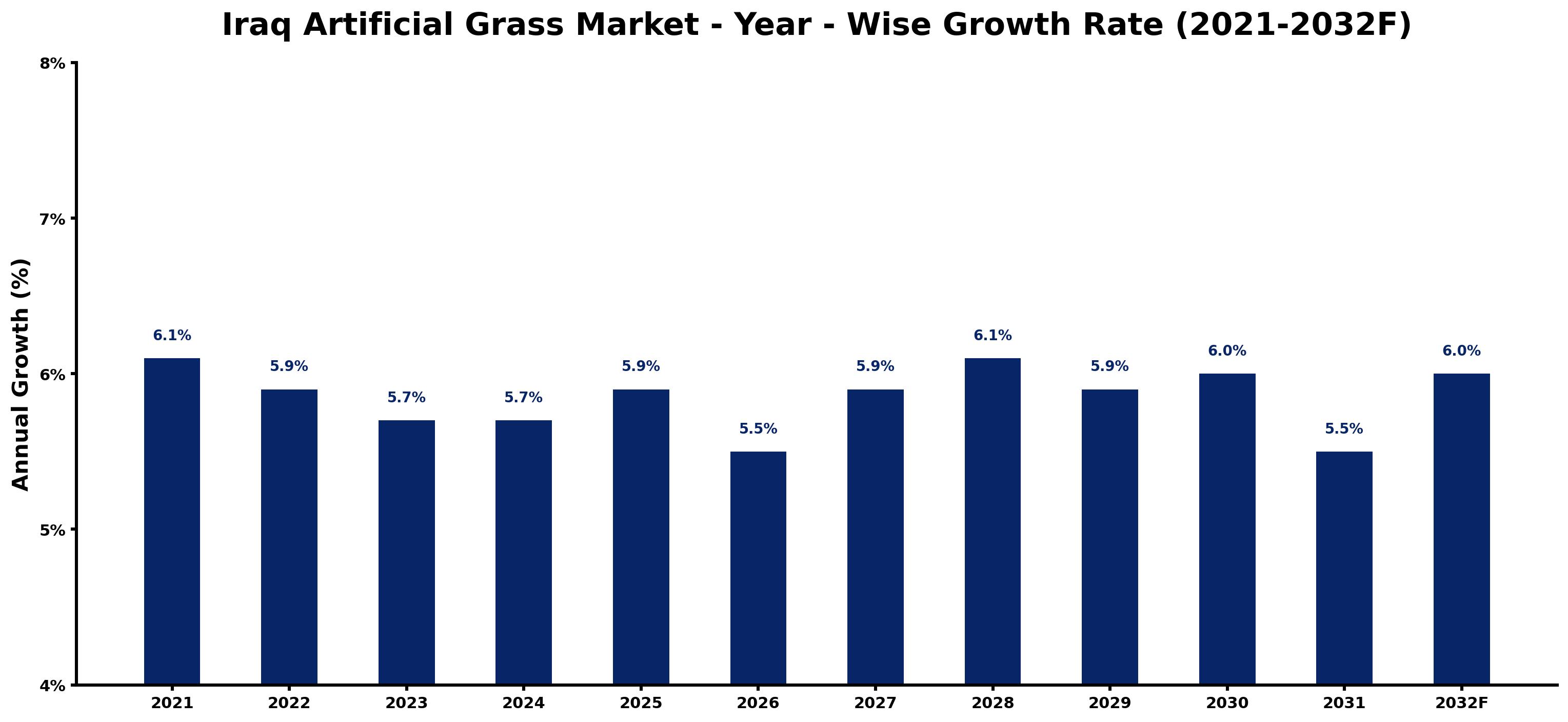
The table below presents the year wise growth rates along with the key drivers influencing the market
| Year | Growth Rate | Major Drivers |
| 2021 | 6.1% | COVID-19 lockdowns halted construction, impacting surfaces like natural grass. |
| 2022 | 5.9% | Emerging infrastructure projects emphasized durable materials suitable for Iraq's climate. |
| 2023 | 5.7% | Increased sports activities spurred interest in artificial grass for fields and courts. |
| 2024 | 5.7% | Local manufacturers began collaborating with international firms for quality assurance. |
| 2025 | 5.9% | The hospitality sector's expansion led to higher demand for aesthetically pleasing landscapes. |
| 2026 | 5.5% | Homeowners increasingly sought low-maintenance gardening solutions amid urbanization trends. |
| 2027 | 5.9% | Partnerships with landscape architects prompted innovative designs integrating artificial grass. |
| 2028 | 6.1% | The rising sun exposure in summers made heat-resistant artificial grass highly attractive. |
| 2029 | 5.9% | Construction regulations evolved, favoring synthetic materials for their longevity and durability. |
| 2030 | 6.0% | Increased public interest in sustainability showcased artificial grass as an eco-friendly option. |
| 2031 | 5.5% | Local sporting events highlighted the need for better training surfaces and facilities. |
| 2032 | 6.0% | Integration of smart technologies with artificial grass units began attracting tech-savvy consumers. |
Note - Market size estimations and growth projections presented in this report are based on 6Wresearch's advanced forecasting approach, validated with industry datasets as of June 2026.
Iraq Artificial Grass Market Synopsis
The Iraq Artificial Grass Market is projected to reach 5.5% and witness significant growth during the forecast period (2026-2032). This optimistic outlook is driven by an increasing demand for artificial turf from various sectors, particularly sports stadiums, parks, and recreational areas across Iraq. The awareness of environmental benefits associated with synthetic grass is also contributing to a growing preference among consumers for alternatives to natural grass. Moreover, rising disposable incomes and the increasing availability of affordable artificial grass products are important factors likely to enhance market growth during this period.
Iraq Artificial Grass Market Growth Drivers
Several key drivers are propelling the expansion of the Iraq Artificial Grass Market. First, the surge in sports activities and the construction of new recreational facilities highlight the demand for durable and low-maintenance grass solutions. Second, artificial turf's resilience and aesthetic appeal make it an ideal option for both private and public spaces. Third, increasing urbanization leads to higher land use efficiency, where synthetic grass provides a viable solution for greenery without the extensive upkeep associated with natural grass. Fourth, the environmental advantages of artificial grass, such as reduced water usage and minimal pesticide requirements, are gaining traction among environmentally conscious consumers. Lastly, vendors are introducing a wider range of affordable products, enhancing accessibility and encouraging more widespread adoption.
Iraq Artificial Grass Market Trends and Opportunities
The Iraq Artificial Grass Market is poised to benefit from various emerging trends that present numerous opportunities. One significant trend is the increasing integration of smart technology in artificial grass products, enhancing user experience and maintenance efficiency. Additionally, there is a notable shift towards eco-friendly materials in synthetic grass manufacturing, which aligns with global sustainability goals. The growing trend of home landscaping is also fostering a demand for high-quality artificial grass, as homeowners seek appealing, maintenance-free options. Furthermore, partnerships between local governments and private developers for public parks and sports complexes are creating avenues for project-based opportunities. Finally, the rising interest in eco-tourism and recreational development in Iraq is likely to further drive the market's expansion.
Iraq Artificial Grass Market Challenges and Restraints
While the Iraq Artificial Grass Market presents numerous growth opportunities, several challenges and restraints could impede its progress. One major concern is the initial installation cost of synthetic turf, which can deter budget-conscious consumers despite the long-term savings on maintenance and water. Additionally, there is a prevailing perception regarding the longevity and performance of artificial grass compared to natural alternatives, which may affect consumer confidence. The lack of sufficient awareness campaigns to educate the public on the benefits and advancements in artificial grass technology further adds to this challenge. Furthermore, fluctuating raw material prices can impact production costs and, subsequently, retail pricing. Lastly, the country's regulatory framework regarding synthetic products may present hurdles, necessitating compliance and adherence to quality standards.
Iraq Artificial Grass Market Government Investment and Initiatives
The growth trajectory of the Iraq Artificial Grass Market is significantly influenced by government investments and initiatives. The Iraqi government is increasingly recognizing the importance of enhancing recreational spaces and sports facilities, leading to increased public spending in these sectors. Strategic development plans aimed at urbanization include investments in parks and sports complexes equipped with artificial grass, to promote healthier lifestyles and community engagement. Additionally, government incentives aimed at improving environmental sustainability encourage the adoption of synthetic turf solutions, which require less water and maintenance, aligning with conservation goals. These efforts reflect a commitment to enhancing community infrastructure and aesthetics while supporting the artificial grass industry in Iraq.
Iraq Artificial Grass Market Latest Developments (May 2025 - June 2026)
Recent developments in the Iraq Artificial Grass Market from May 2025 to June 2026 indicate a burgeoning interest in synthetic turf solutions. The period witnessed increased public awareness campaigns highlighting the benefits of artificial grass, which helped to dispel myths surrounding its performance. As urban areas continue to expand, municipalities have begun prioritizing the development of synthetic grass in public spaces to enhance community amenities. Additionally, several initiatives focusing on sustainable solutions have emerged, further solidifying the role of artificial grass as a viable alternative in landscaping. Moreover, technological advancements in the production of artificial grass are becoming more prevalent, leading to improved durability and environmental performance, which are pivotal in meeting consumer demand.
Iraq Artificial Grass Market - Key Attractiveness of the Report
- 10 Years of Market Numbers
- Historical Data Starting from 2022 to 2025
- Base Year: 2025
- Forecast Data until 2032
- Key Performance Indicators Impacting the Market
- Major Upcoming Developments and Projects
Key Highlights of the Report:
- Iraq Artificial Grass Market Outlook
- Market Size of Iraq Artificial Grass Market, 2025
- Forecast of Iraq Artificial Grass Market, 2032F
- Historical Data and Forecast of Iraq Artificial Grass Revenues & Volume for the Period 2022-2032F
- Iraq Artificial Grass Market Trend Evolution
- Iraq Artificial Grass Market Drivers and Challenges
- Iraq Artificial Grass Price Trends
- Iraq Artificial Grass Porter's Five Forces
- Iraq Artificial Grass Industry Life Cycle
- Historical Data and Forecast of Iraq Artificial Grass Market Revenues & Volume By Installation for the Period 2022-2032F
- Historical Data and Forecast of Iraq Artificial Grass Market Revenues & Volume By Flooring for the Period 2022-2032F
- Historical Data and Forecast of Iraq Artificial Grass Market Revenues & Volume By Wall Clading for the Period 2022-2032F
- Historical Data and Forecast of Iraq Artificial Grass Market Revenues & Volume By Fiber Base Material for the Period 2022-2032F
- Historical Data and Forecast of Iraq Artificial Grass Market Revenues & Volume By Polyethylene for the Period 2022-2032F
- Historical Data and Forecast of Iraq Artificial Grass Market Revenues & Volume By Polypropylene for the Period 2022-2032F
- Historical Data and Forecast of Iraq Artificial Grass Market Revenues & Volume By Nylon for the Period 2022-2032F
- Historical Data and Forecast of Iraq Artificial Grass Market Revenues & Volume By Applications for the Period 2022-2032F
- Historical Data and Forecast of Iraq Artificial Grass Market Revenues & Volume By Contact Sports for the Period 2022-2032F
- Historical Data and Forecast of Iraq Artificial Grass Market Revenues & Volume By Non-contact Sports for the Period 2022-2032F
- Historical Data and Forecast of Iraq Artificial Grass Market Revenues & Volume By Leisure for the Period 2022-2032F
- Historical Data and Forecast of Iraq Artificial Grass Market Revenues & Volume By Landscaping for the Period 2022-2032F
- Historical Data and Forecast of Iraq Artificial Grass Market Revenues & Volume By Infill Material for the Period 2022-2032F
- Historical Data and Forecast of Iraq Artificial Grass Market Revenues & Volume By Petroleum-based infills for the Period 2022-2032F
- Historical Data and Forecast of Iraq Artificial Grass Market Revenues & Volume By Sand infill for the Period 2022-2032F
- Historical Data and Forecast of Iraq Artificial Grass Market Revenues & Volume By Plant-based infills for the Period 2022-2032F
- Iraq Artificial Grass Import Export Trade Statistics
- Market Opportunity Assessment By Installation
- Market Opportunity Assessment By Fiber Base Material
- Market Opportunity Assessment By Applications
- Market Opportunity Assessment By Infill Material
- Iraq Artificial Grass Top Companies Market Share
- Iraq Artificial Grass Competitive Benchmarking By Technical and Operational Parameters
- Iraq Artificial Grass Company Profiles
- Iraq Artificial Grass Key Strategic Recommendations






































