Iraq Automotive Wiper Market Size, Share & Growth Rate
The Iraq Automotive Wiper Market was estimated at USD 326 Million in 2025 and is projected to reach USD 457 Million by 2032, growing at a CAGR of 4.9% from 2026 to 2032. This growth trajectory is primarily fueled by an increasing vehicle population on Iraqi roads, paired with a heightened awareness of road safety. Consumers are increasingly seeking high-quality wiper blades that can endure the demanding weather conditions, including frequent dust storms and heavy rains that characterize the region.
Iraq Automotive Wiper Market Year-wise Growth Rate and Key Drivers
This graph highlights how the Iraq Automotive Wiper Market has steadily grown over the years, supported by major growth factors.
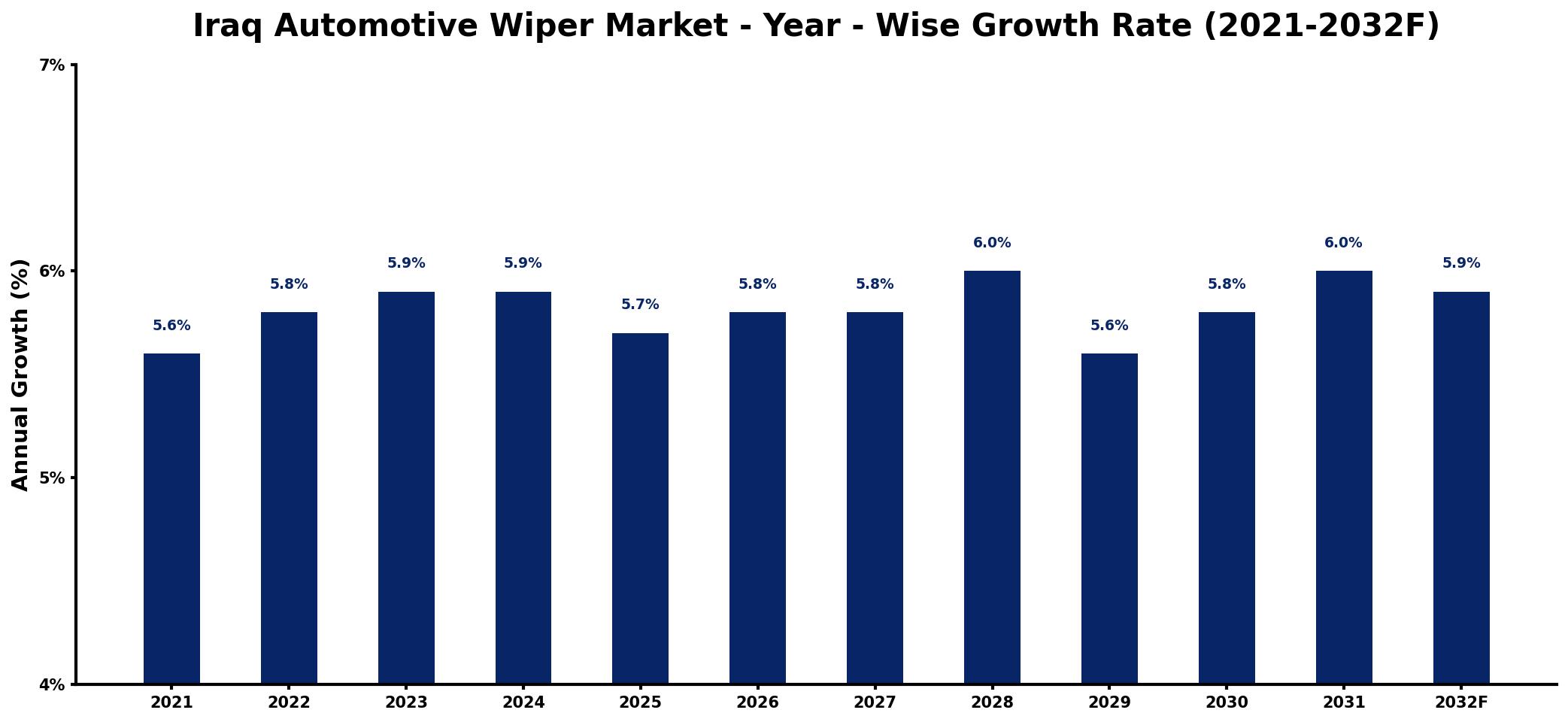
The table below presents the year‑wise growth rates along with the key drivers influencing the market
| Year | Growth Rate | Major Drivers |
| 2021 | 5.6% | Rising vehicle ownership rates |
| 2022 | 5.8% | Increased consumer spending habits |
| 2023 | 5.9% | Growing urbanization trends observed |
| 2024 | 5.9% | Expansion of transportation infrastructure |
| 2025 | 5.7% | Higher disposable income levels |
| 2026 | 5.8% | Investments in vehicle safety features |
| 2027 | 5.8% | Surge in aftermarket services demand |
| 2028 | 6.0% | Technological advancements in manufacturing |
| 2029 | 5.6% | Rising awareness of maintenance importance |
| 2030 | 5.8% | Growth in regional trade agreements |
| 2031 | 6.0% | Increased government infrastructure projects |
| 2032 | 5.9% | Emerging trends in eco-friendly solutions |
Note: Market size estimations and growth projections presented in this report are based on 6Wresearch's proprietary forecasting methodology, utilizing the latest available industry data, government publications, and primary research inputs.
Iraq Automotive Wiper Market Synopsis
The strongest force currently shaping the Iraq Automotive Wiper Market is the rising demand for advanced wiper technologies. Features such as rain-sensing capabilities and heated wipers are becoming increasingly popular, as consumers prioritize safety and convenience in their vehicle accessories.
In parallel, the aftermarket segment is expanding as drivers seek affordable and efficient replacement options for worn-out wipers. This growth is indicative of shifting consumer preferences towards not only cost-effectiveness but also higher durability, aligning with the need for wipers that can endure Iraq's extreme environmental conditions.
Iraq Automotive Wiper Market Key Takeaways
- The market is driven by rising vehicle ownership and an emphasis on road safety.
- Technological innovations such as rain-sensing and heated wipers are gaining traction.
- The aftermarket sector is flourishing as consumers search for cost-effective replacements.
- There is a growing focus on sustainability, with manufacturers developing eco-friendly products.
- Government policies are promoting local manufacturing and enhancing industry competitiveness.
Evaluation of Restraints in Iraq Automotive Wiper Market
The Iraq Automotive Wiper Market faces significant restraints primarily due to economic instability and ongoing political unrest, which can disrupt consumer purchasing power and demand. Additionally, the inadequacy of infrastructure in certain areas hampers manufacturers' ability to efficiently distribute products. The prevalence of counterfeit wiper products also undermines brand trust and affects genuine manufacturers' market share. These factors necessitate strategic adaptation and in-depth local market understanding for players aiming to succeed in this environment.
Iraq Automotive Wiper Market Trends
Current trends indicate a shift toward the incorporation of advanced technologies in wiper systems, with features designed for enhanced safety and comfort. Consumers are increasingly favoring durable wiper blades made to withstand Iraq's harsh climates, coupled with a rise in the demand for eco-friendly products crafted from recyclable materials. As consumer preferences evolve, manufacturers are pivoting towards innovative solutions that align with these emerging demands.
Iraq Automotive Wiper Market Opportunities
Investment opportunities abound within the Iraq Automotive Wiper Market, particularly as the automotive sector expands. With more vehicles on the roads, the demand for high-quality wiper systems is set to surge. Companies that introduce advanced, durable wiper products tailored to local needs stand to gain a competitive advantage. Moreover, collaboration with local distributors can pave the way for successful market entry and growth in the aftermarket segment.
Government Initiatives in the Iraq Automotive Wiper Market
The Iraqi government is implementing policies to bolster domestic manufacturing of automotive wipers, aiming to reduce reliance on imports. Initiatives such as import tariffs and regulatory frameworks are in place to encourage local production and ensure compliance with international safety standards. These measures not only promote economic growth and job creation but also strive to enhance the competitiveness of the national automotive sector.
Future Insights of the Iraq Automotive Wiper Market
Looking ahead to 2026-2032, the Iraq Automotive Wiper Market is expected to thrive, propelled by a continuous increase in vehicle numbers and a persistent focus on safety. Demand for high-performance wiper systems that integrate smart technologies is likely to escalate. Manufacturers that prioritize product innovation and strategic collaborations are well-positioned to capitalize on these burgeoning opportunities, driving significant market evolution in the coming years.
Iraq Automotive Wiper Market Latest Developments (2025 - 2026)
Recent developments in the Iraq Automotive Wiper Market showcase a trend toward enhanced product offerings that cater to consumer demands for durability and performance. Industry participants are increasingly focusing on the development of wipers equipped with advanced features, responding to both safety and convenience needs. Furthermore, the market is witnessing a push towards eco-friendly manufacturing practices, with several initiatives aimed at integrating sustainability into product development.
Iraq Automotive Wiper Market - Key Attractiveness of the Report
- 10 Years of Market Numbers
- Historical Data Starting from 2022 to 2025
- Base Year: 2025
- Forecast Data until 2032
- Key Performance Indicators Impacting the Market
- Major Upcoming Developments and Projects
Key Highlights of the Report:
- Iraq Automotive Wiper Market Outlook
- Market Size of Iraq Automotive Wiper Market, 2025
- Forecast of Iraq Automotive Wiper Market, 2032
- Historical Data and Forecast of Iraq Automotive Wiper Revenues & Volume for the Period 2022-2032F
- Iraq Automotive Wiper Market Trend Evolution
- Iraq Automotive Wiper Market Drivers and Challenges
- Iraq Automotive Wiper Price Trends
- Iraq Automotive Wiper Porter's Five Forces
- Iraq Automotive Wiper Industry Life Cycle
- Historical Data and Forecast of Iraq Automotive Wiper Market Revenues & Volume By Blade Type for the Period 2022-2032F
- Historical Data and Forecast of Iraq Automotive Wiper Market Revenues & Volume By Traditional Brackets for the Period 2022-2032F
- Historical Data and Forecast of Iraq Automotive Wiper Market Revenues & Volume By Low-Profile Beam for the Period 2022-2032F
- Historical Data and Forecast of Iraq Automotive Wiper Market Revenues & Volume By Hybrid Blade for the Period 2022-2032F
- Historical Data and Forecast of Iraq Automotive Wiper Market Revenues & Volume By Application Type for the Period 2022-2032F
- Historical Data and Forecast of Iraq Automotive Wiper Market Revenues & Volume By Windshield for the Period 2022-2032F
- Historical Data and Forecast of Iraq Automotive Wiper Market Revenues & Volume By Rear for the Period 2022-2032F
- Historical Data and Forecast of Iraq Automotive Wiper Market Revenues & Volume By Market Type for the Period 2022-2032F
- Historical Data and Forecast of Iraq Automotive Wiper Market Revenues & Volume By OEM for the Period 2022-2032F
- Historical Data and Forecast of Iraq Automotive Wiper Market Revenues & Volume By Aftermarket for the Period 2022-2032F
- Historical Data and Forecast of Iraq Automotive Wiper Market Revenues & Volume By Vehicle Type for the Period 2022-2032F
- Historical Data and Forecast of Iraq Automotive Wiper Market Revenues & Volume By Passenger Cars for the Period 2022-2032F
- Historical Data and Forecast of Iraq Automotive Wiper Market Revenues & Volume By Light Commercial Vehicles for the Period 2022-2032F
- Historical Data and Forecast of Iraq Automotive Wiper Market Revenues & Volume By Heavy Commercial Vehicles for the Period 2022-2032F
- Iraq Automotive Wiper Import Export Trade Statistics
- Market Opportunity Assessment By Blade Type
- Market Opportunity Assessment By Application Type
- Market Opportunity Assessment By Market Type
- Market Opportunity Assessment By Vehicle Type
- Iraq Automotive Wiper Top Companies Market Share
- Iraq Automotive Wiper Competitive Benchmarking By Technical and Operational Parameters
- Iraq Automotive Wiper Company Profiles
- Iraq Automotive Wiper Key Strategic Recommendations






































