Iraq Beverage Cans Market Size, Share & Growth Rate
The Iraq Beverage Cans Market was estimated at USD 314 Million in 2025 and is projected to reach USD 547 Million by 2032, growing at a CAGR of 8.3% from 2026 to 2032. This robust trajectory is fueled by an increasing appetite for convenient packaging solutions among consumers, particularly among the nation's younger demographic. As disposable incomes rise, there's a notable shift towards packaged beverages, enhancing the attractiveness of canned products.
Iraq Beverage Cans Market Year-wise Growth Rate and Key Drivers
This graph highlights how the Iraq Beverage Cans Market has steadily grown over the years, supported by major growth factors.
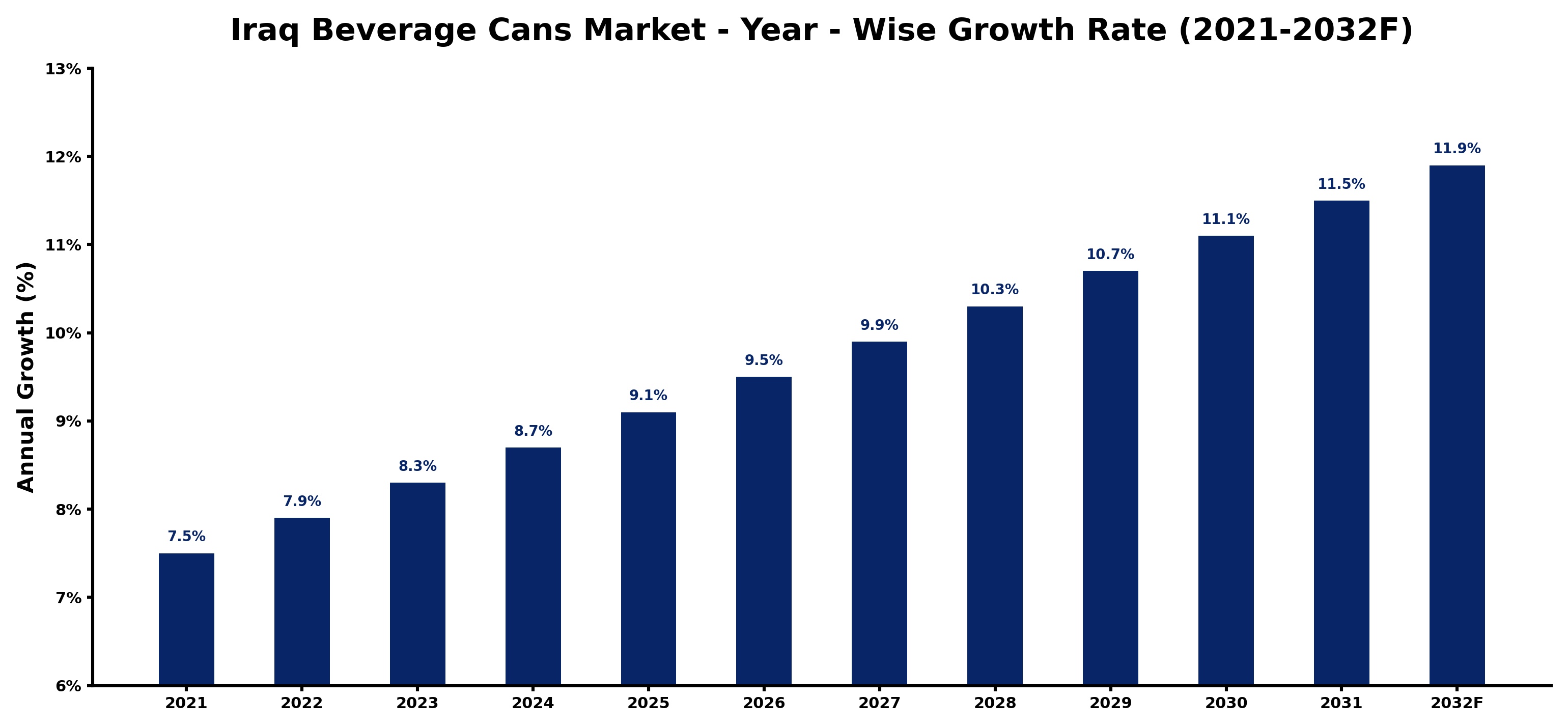
The table below presents the year‑wise growth rates along with the key drivers influencing the market
| Year | Growth Rate | Major Drivers |
| 2021 | 7.5% | Increased demand for convenience products |
| 2022 | 7.9% | Rising consumer preference for cans |
| 2023 | 8.3% | Sustainable packaging trends gained traction |
| 2024 | 8.7% | Local beverage production expanded rapidly |
| 2025 | 9.1% | Health-conscious choices drove sales |
| 2026 | 9.5% | E-commerce growth enhanced distribution |
| 2027 | 9.9% | Innovative flavors attracted new consumers |
| 2028 | 10.3% | Export opportunities expanded significantly |
| 2029 | 10.7% | Brand loyalty programs increased engagement |
| 2030 | 11.1% | Collaborations with local producers increased |
| 2031 | 11.5% | Event sponsorships boosted brand visibility |
| 2032 | 11.9% | Technological advancements improved production efficiency |
Note - Market size estimations and growth projections presented in this report are based on 6Wresearch's advanced forecasting approach, validated with industry datasets as of June 2026.
Iraq Beverage Cans Market Synopsis
The Iraq Beverage Cans Market is currently undergoing a transformation, driven by the growing preference for ready-to-drink options among consumers. With rising urbanization and a youthful population, there's an increasing demand for convenience, making beverage cans an appealing choice.
Moreover, sustainability concerns are reshaping the market landscape, as consumers gravitate towards aluminum cans, which are not only lightweight but also recyclable. This alignment with eco-friendly practices supports the expansion of the beverage cans segment as manufacturers innovate to meet evolving demands.
Iraq Beverage Cans Market Key Takeaways
- The market is primarily driven by carbonated soft drinks, with energy drinks and juices also gaining traction.
- Aluminum cans are favored for their recyclability, aligning with increasing consumer awareness about sustainability.
- Innovative packaging designs are emerging to cater to consumer preferences for differentiation and appeal.
- Challenges such as political instability and logistical hurdles are influencing operational strategies within the market.
- Investment opportunities are substantial due to limited local production capacity and growing demand for canned beverages.
Evaluation of Restraints in Iraq Beverage Cans Market
The Iraq Beverage Cans Market faces several significant constraints that could impede its growth trajectory. Logistical challenges stemming from underdeveloped infrastructure can hinder distribution efficiency, making it difficult for manufacturers to reach consumers in diverse geographic areas. Additionally, the ongoing political instability poses a risk to business operations and can deter potential investments. Fluctuating currency values also complicate pricing strategies, further limiting profitability in a market that is still in a nascent stage. Moreover, cultural preferences for traditional beverages may inhibit the penetration of canned options, while limited access to advanced manufacturing technology may affect production standards and quality control.
Iraq Beverage Cans Market Trends
The current trends in the Iraq Beverage Cans Market indicate a notable shift towards convenience-driven consumption patterns. Consumers are increasingly seeking portable packaging solutions that align with their fast-paced lifestyles. Additionally, the market is witnessing a surge in demand for sustainable practices, propelling the adoption of aluminum cans over traditional packaging materials.
Furthermore, innovation in packaging design is playing a crucial role in attracting consumers. Companies are experimenting with various sizes and artistic designs to enhance shelf visibility and brand appeal. Collaborations between beverage producers and can manufacturers are emerging as a strategy to create unique branding opportunities, further shaping the market dynamics.
Iraq Beverage Cans Market Opportunities
The Iraq Beverage Cans Market presents numerous investment opportunities as demand for convenient beverage options continues to escalate. The growing preference for carbonated drinks, energy beverages, and ready-to-drink products highlights a lucrative area for production and distribution expansion. As local manufacturers grapple with limited capacity, the potential for new entrants is significant. Additionally, advancements in packaging technology, coupled with increased consumer interest in sustainability, position the market for substantial growth and innovation, making it a prime target for strategic investments.
Government Initiatives in the Iraq Beverage Cans Market
The Iraqi government is actively implementing policies aimed at fostering growth within the beverage cans market. These include import restrictions designed to promote domestic production, along with quality control measures that ensure consumer safety. Taxation policies are also in place, contributing to revenue generation while balancing the interests of domestic manufacturers. Additionally, the government supports industry innovation through incentives and subsidies, establishing a framework intended to cultivate a competitive and sustainable market landscape while safeguarding consumer interests.
Future Insights of the Iraq Beverage Cans Market
Looking ahead to 2026-2032, the Iraq Beverage Cans Market is set for a positive evolution, driven by ongoing changes in consumer habits that favor convenience and sustainability. With rising disposable incomes and an inclination towards on-the-go beverage options, the demand for canned beverages is expected to maintain its upward momentum. Moreover, advancements in packaging technology will likely enhance production efficiency and sustainability efforts, allowing manufacturers to address environmental concerns while tapping into the growing market for packaged drinks.
Iraq Beverage Cans Market Latest Developments (May 2025 - June 2026)
In recent months, the Iraq Beverage Cans Market has seen a surge in initiatives aimed at enhancing production capacity and efficiency. Companies are focusing on technological upgrades to meet the rising demand for innovative packaging solutions. Collaborations between beverage producers and can manufacturers have intensified, resulting in unique branding strategies and improved market visibility. Furthermore, sustainability initiatives are being prioritized, with various stakeholders exploring eco-friendly materials and practices to align with consumer expectations.
Iraq Beverage Cans Market - Key Attractiveness of the Report
- 10 Years of Market Numbers
- Historical Data Starting from 2022 to 2025
- Base Year: 2025
- Forecast Data until 2032
- Key Performance Indicators Impacting the Market
- Major Upcoming Developments and Projects
Key Highlights of the Report:
- Iraq Beverage Cans Market Outlook
- Market Size of Iraq Beverage Cans Market, 2025
- Forecast of Iraq Beverage Cans Market, 2032
- Historical Data and Forecast of Iraq Beverage Cans Revenues & Volume for the Period 2022-2032F
- Iraq Beverage Cans Market Trend Evolution
- Iraq Beverage Cans Market Drivers and Challenges
- Iraq Beverage Cans Price Trends
- Iraq Beverage Cans Porter's Five Forces
- Iraq Beverage Cans Industry Life Cycle
- Historical Data and Forecast of Iraq Beverage Cans Market Revenues & Volume By Product Type for the Period 2022-2032F
- Historical Data and Forecast of Iraq Beverage Cans Market Revenues & Volume By Aluminium for the Period 2022-2032F
- Historical Data and Forecast of Iraq Beverage Cans Market Revenues & Volume By Steel for the Period 2022-2032F
- Historical Data and Forecast of Iraq Beverage Cans Market Revenues & Volume By Application for the Period 2022-2032F
- Historical Data and Forecast of Iraq Beverage Cans Market Revenues & Volume By Carbonated Water for the Period 2022-2032F
- Historical Data and Forecast of Iraq Beverage Cans Market Revenues & Volume By Flavored Water for the Period 2022-2032F
- Historical Data and Forecast of Iraq Beverage Cans Market Revenues & Volume By Still Water for the Period 2022-2032F
- Historical Data and Forecast of Iraq Beverage Cans Market Revenues & Volume By Functional Water for the Period 2022-2032F
- Iraq Beverage Cans Import Export Trade Statistics
- Market Opportunity Assessment By Product Type
- Market Opportunity Assessment By Application
- Iraq Beverage Cans Top Companies Market Share
- Iraq Beverage Cans Competitive Benchmarking By Technical and Operational Parameters
- Iraq Beverage Cans Company Profiles
- Iraq Beverage Cans Key Strategic Recommendations






































