Iraq Calcium Hypochlorite Market Size, Share & Growth Rate
The Iraq Calcium Hypochlorite Market was estimated at USD 251 Million in 2025 and is projected to reach USD 341 Million by 2032, growing at a CAGR of 4.5% from 2026 to 2032. This growth trajectory is primarily driven by ongoing water treatment and sanitation initiatives within the country, which highlight the importance of effective disinfection solutions. As Iraq grapples with waterborne diseases and urban infrastructure demands, the increasing reliance on calcium hypochlorite for water purification and sanitation is expected to underpin this upward market trend.
Iraq Calcium Hypochlorite Market Year-wise Growth Rate and Key Drivers
This graph highlights how the Iraq Calcium Hypochlorite Market has steadily grown over the years, supported by major growth factors.
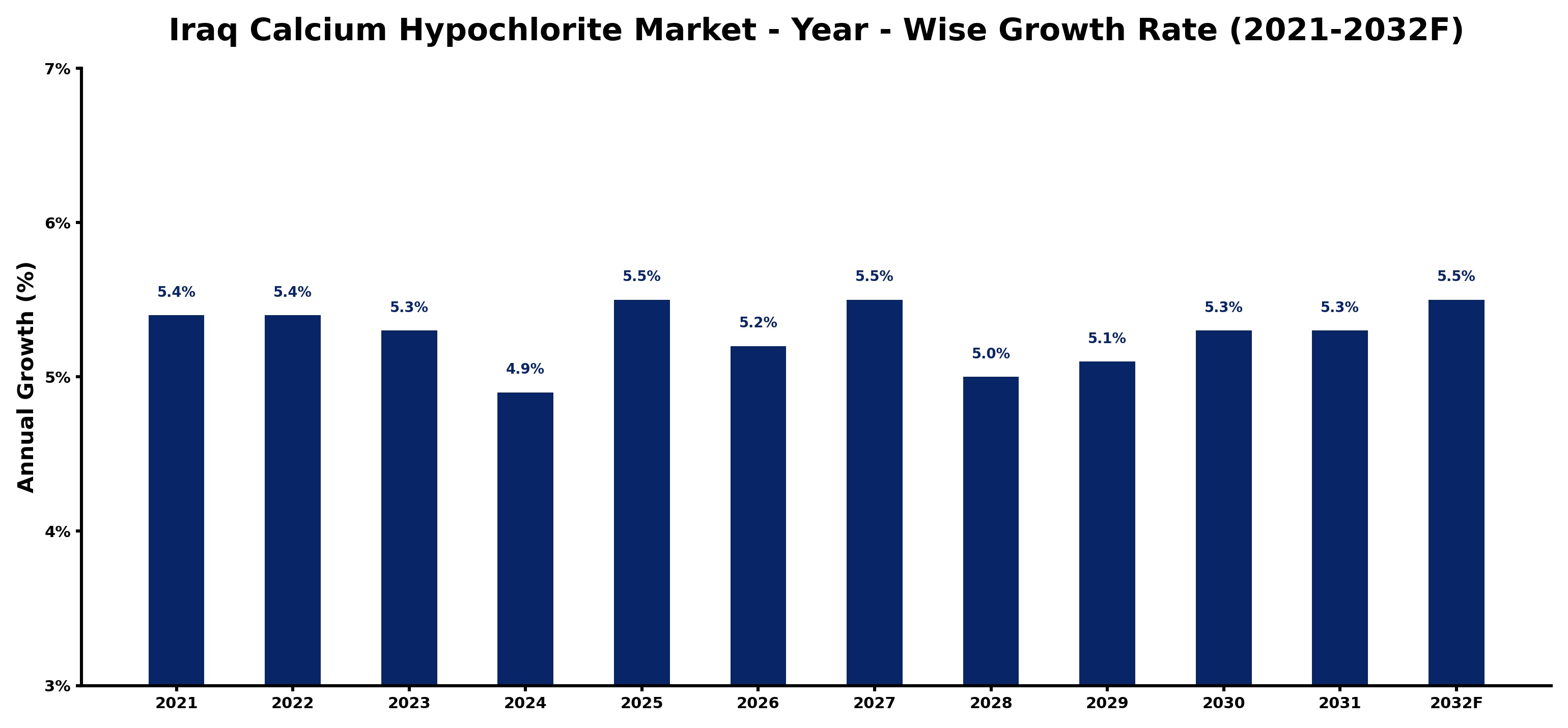
The table below presents the year‑wise growth rates along with the key drivers influencing the market
| Year | Growth Rate | Major Drivers |
| 2021 | 5.4% | Increased water treatment demand |
| 2022 | 5.4% | Rising sanitation awareness improved usage |
| 2023 | 5.3% | Industrial applications expanded significantly |
| 2024 | 4.9% | Government regulations enhanced safety standards |
| 2025 | 5.5% | Tourism recovery boosted chemical usage |
| 2026 | 5.2% | Agricultural sector growth increased demand |
| 2027 | 5.5% | Urbanization drove water purification needs |
| 2028 | 5.0% | Health sector expansion increased consumption |
| 2029 | 5.1% | Environmental initiatives promoted sustainability |
| 2030 | 5.3% | Infrastructure development enhanced distribution |
| 2031 | 5.3% | Public health campaigns raised awareness |
| 2032 | 5.5% | Technological advancements improved efficiency |
Note - Market size estimations and growth projections presented in this report are based on 6Wresearch’s advanced forecasting approach, validated with industry datasets as of June 2026.
Iraq Calcium Hypochlorite Market Synopsis
In Iraq, calcium hypochlorite is a pivotal component in the disinfection processes for drinking water, wastewater treatment, and even swimming pool sanitation. The growing acknowledgment of public health safety and the essential need for clean water sources are propelling demand across various sectors, ranging from municipal applications to industrial uses.
Moreover, with rising awareness of the dangers posed by waterborne illnesses, local governments and organizations are advocating for the use of calcium hypochlorite as a reliable disinfectant. This has cultivated a solid market base that is likely to expand as both public and private sectors seek to bolster their sanitation measures.
Iraq Calcium Hypochlorite Market Key Takeaways
- The market is poised for steady growth, driven by increased sanitation and public health initiatives.
- Calcium hypochlorite plays a critical role in both residential and industrial water treatment processes.
- Challenges like supply chain disruptions require innovative solutions and strategic investments.
- Government policies are geared towards enhancing quality standards in production and distribution.
- Investment in infrastructure development presents significant opportunities for market players.
Evaluation of Restraints in Iraq Calcium Hypochlorite Market
The Iraq Calcium Hypochlorite Market encounters notable restraints primarily due to supply chain disruptions and logistical challenges that can hinder the timely distribution of products. Additionally, fluctuations in demand from critical sectors such as water treatment and sanitation can create volatility in market dynamics. The presence of alternative disinfection methods further adds pressure on calcium hypochlorite's market share. Handling safety concerns related to this compound also necessitate that manufacturers prioritize the implementation of stringent safety protocols, which can divert resources and impact market growth.
Iraq Calcium Hypochlorite Market Trends
Key trends in the Iraq Calcium Hypochlorite Market include a heightened focus on eco-friendly disinfection alternatives, which are increasingly being explored as consumers demand safer chemical handling practices. Moreover, the advancement of water treatment technologies continues to shape how calcium hypochlorite is utilized, with innovation in application methods driving efficiency in disinfection processes.
The public awareness campaigns focusing on sanitation and hygiene are also encouraging greater adoption of calcium hypochlorite, particularly in rural areas that face significant public health challenges. As the market matures, a trend towards product diversification is likely to emerge, catering to specific industrial needs and environmental regulations.
Iraq Calcium Hypochlorite Market Opportunities
Significant growth opportunities exist in the Iraq Calcium Hypochlorite Market, particularly in light of ongoing investments in water treatment infrastructure. With a strategic focus on enhancing public health, there is a compelling need for reliable disinfectants that can effectively mitigate waterborne diseases. These requirements open pathways for manufacturers to introduce innovative and improved formulations of calcium hypochlorite, which can better address local needs.
Furthermore, as governments implement policies aimed at modernizing sanitation facilities and improving water quality, manufacturers that align with these initiatives are likely to gain a competitive edge. Collaborative partnerships with local authorities and institutions can amplify outreach and foster more robust market entry strategies.
Government Initiatives in the Iraq Calcium Hypochlorite Market
The Iraqi government has introduced various initiatives aimed at bolstering public health and sanitation through the effective regulation of the calcium hypochlorite market. These measures encompass stringent quality standards for production and distribution, alongside financial support for upgrading water treatment infrastructure. Moreover, the government is actively promoting best practices in sanitation and disinfection processes to foster community awareness, ultimately enhancing the overall health landscape in the country.
Future Insights of the Iraq Calcium Hypochlorite Market
Looking forward to the period from 2026 to 2032, the Iraq Calcium Hypochlorite Market is anticipated to witness robust expansion as the government continues to prioritize public health initiatives. The ongoing development of water treatment facilities, along with increasing investments from private entities, is likely to contribute positively to market dynamics. Moreover, the rising recognition of the critical role that effective disinfection plays in safeguarding public health will further solidify the demand for calcium hypochlorite across diverse applications, ensuring a sustained growth trajectory for the market.
Iraq Calcium Hypochlorite Market Latest Developments (May 2025 - June 2026)
In recent months, there has been a notable shift towards improving the efficiency of calcium hypochlorite production processes, driven by the increasing need for sustainable practices. Industry players are exploring advanced technologies that enhance product effectiveness while mitigating environmental impact. Additionally, collaborations between local manufacturers and international firms are becoming more prevalent, aimed at exchanging knowledge and fostering innovation in the water treatment sector.
Iraq Calcium Hypochlorite Market - Key Attractiveness of the Report
- 10 Years of Market Numbers
- Historical Data Starting from 2022 to 2025
- Base Year: 2025
- Forecast Data until 2032
- Key Performance Indicators Impacting the Market
- Major Upcoming Developments and Projects
Key Highlights of the Report:
- Iraq Calcium Hypochlorite Market Outlook
- Market Size of Iraq Calcium Hypochlorite Market, 2025
- Forecast of Iraq Calcium Hypochlorite Market, 2032
- Historical Data and Forecast of Iraq Calcium Hypochlorite Revenues & Volume for the Period 2022-2032F
- Iraq Calcium Hypochlorite Market Trend Evolution
- Iraq Calcium Hypochlorite Market Drivers and Challenges
- Iraq Calcium Hypochlorite Price Trends
- Iraq Calcium Hypochlorite Porter's Five Forces
- Iraq Calcium Hypochlorite Industry Life Cycle
- Historical Data and Forecast of Iraq Calcium Hypochlorite Market Revenues & Volume By Form for the Period 2022-2032F
- Historical Data and Forecast of Iraq Calcium Hypochlorite Market Revenues & Volume By Powder for the Period 2022-2032F
- Historical Data and Forecast of Iraq Calcium Hypochlorite Market Revenues & Volume By Pellet for the Period 2022-2032F
- Historical Data and Forecast of Iraq Calcium Hypochlorite Market Revenues & Volume By Granule for the Period 2022-2032F
- Historical Data and Forecast of Iraq Calcium Hypochlorite Market Revenues & Volume By Application for the Period 2022-2032F
- Historical Data and Forecast of Iraq Calcium Hypochlorite Market Revenues & Volume By House Cleaners And Detergents for the Period 2022-2032F
- Historical Data and Forecast of Iraq Calcium Hypochlorite Market Revenues & Volume By Agrochemicals for the Period 2022-2032F
- Historical Data and Forecast of Iraq Calcium Hypochlorite Market Revenues & Volume By Water Treatment for the Period 2022-2032F
- Historical Data and Forecast of Iraq Calcium Hypochlorite Market Revenues & Volume By Pulp And Paper for the Period 2022-2032F
- Historical Data and Forecast of Iraq Calcium Hypochlorite Market Revenues & Volume By Food And Beverage for the Period 2022-2032F
- Historical Data and Forecast of Iraq Calcium Hypochlorite Market Revenues & Volume By Others for the Period 2022-2032F
- Iraq Calcium Hypochlorite Import Export Trade Statistics
- Market Opportunity Assessment By Form
- Market Opportunity Assessment By Application
- Iraq Calcium Hypochlorite Top Companies Market Share
- Iraq Calcium Hypochlorite Competitive Benchmarking By Technical and Operational Parameters
- Iraq Calcium Hypochlorite Company Profiles
- Iraq Calcium Hypochlorite Key Strategic Recommendations






































