Iraq Candle Market Size, Share & Growth Rate
The Iraq Candle Market was estimated at USD 401 Million in 2025 and is projected to reach USD 538 Million by 2032, growing at a CAGR of 4.3% from 2026 to 2032. This growth trajectory is fueled by a combination of increasing consumer interest in home décor, alongside a rising appreciation for scented and therapeutic candles. The shift towards eco-friendly products and a robust cultural inclination towards candles for religious ceremonies also drive this upward trend.
Iraq Candle Market Year-wise Growth Rate and Key Drivers
This graph highlights how the Iraq Candle Market has steadily grown over the years, supported by major growth factors.
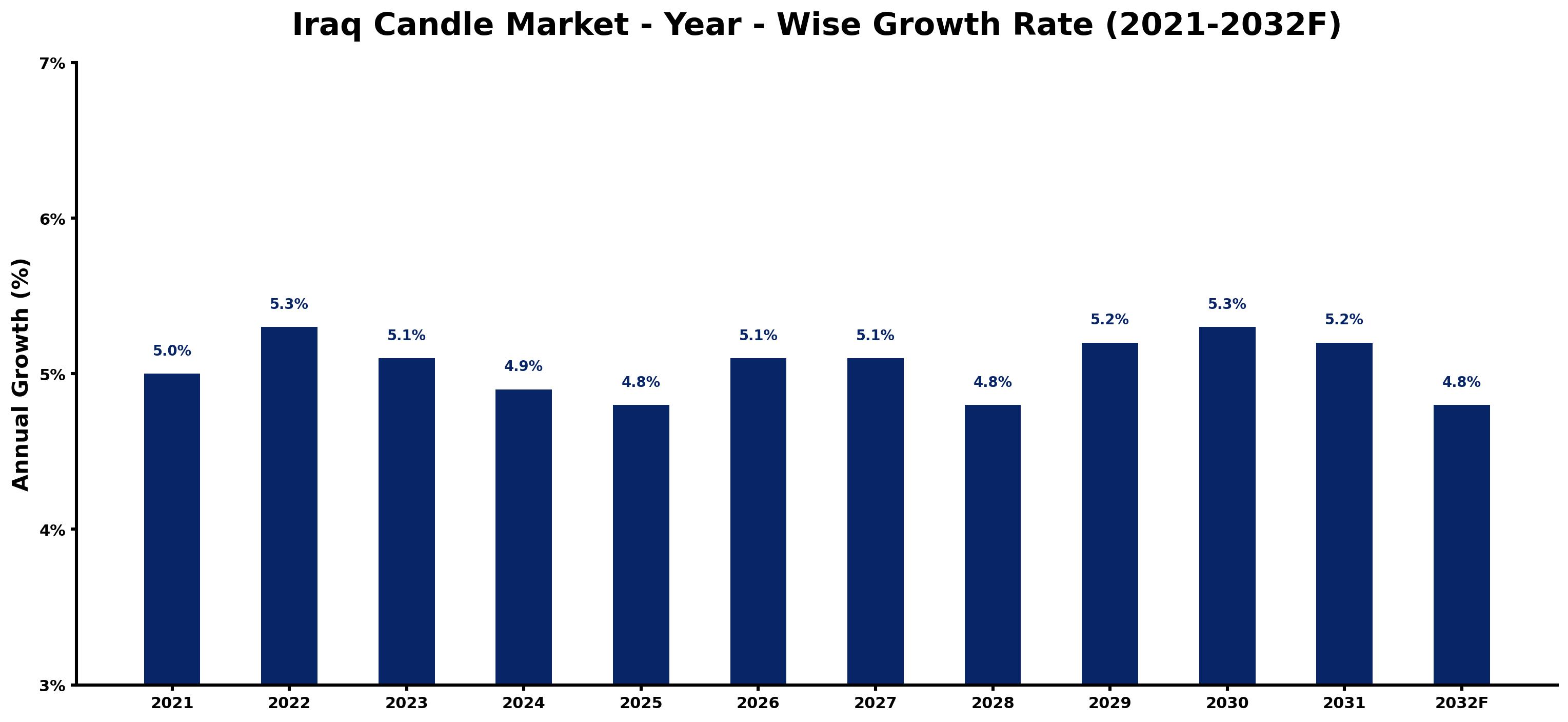
The table below presents the year‑wise growth rates along with the key drivers influencing the market
| Year | Growth Rate | Major Drivers |
| 2021 | 5.0% | Increasing smart city development projects |
| 2022 | 5.3% | Growing urbanization and commercial development |
| 2023 | 5.1% | Expansion of commercial construction activities |
| 2024 | 4.9% | Increasing industrial infrastructure investments |
| 2025 | 4.8% | Increasing industrial automation investments |
| 2026 | 5.1% | Increasing smart city development projects |
| 2027 | 5.1% | Increasing adoption of advanced technologies |
| 2028 | 4.8% | Expansion of transportation and logistics networks |
| 2029 | 5.2% | Expansion of commercial construction activities |
| 2030 | 5.3% | Government infrastructure modernization initiatives |
| 2031 | 5.2% | Increasing industrial automation investments |
| 2032 | 4.8% | Expansion of manufacturing activities |
Note - Market size estimations and growth projections presented in this report are based on 6Wresearch's advanced forecasting approach, validated with industry datasets as of June 2026.
Iraq Candle Market Synopsis
A significant force shaping the Iraq Candle Market is the burgeoning consumer demand for decorative and scented candles. As people increasingly seek to enhance their living spaces with aesthetic and aromatic experiences, candles have emerged as a favored choice for ambiance creation.
Simultaneously, the trend towards eco-friendly options is revolutionizing the market landscape. Consumers are leaning towards natural wax alternatives such as soy and beeswax, reflecting a growing awareness of sustainability and health-conscious purchasing decisions.
Iraq Candle Market Key Takeaways
- The Iraq Candle Market is anticipated to grow significantly due to rising disposable incomes and consumer spending on home decor.
- There is a clear shift towards premium, scented, and eco-friendly candle options among Iraqi consumers.
- Traditional candles made from paraffin wax remain prevalent, although the demand for natural wax alternatives is increasing.
- Custom-designed candles for special occasions are gaining traction, enhancing market diversity and opportunities.
- Challenges such as economic instability and supply chain disruptions continue to affect market dynamics.
Evaluation of Restraints in Iraq Candle Market
The Iraq Candle Market is hindered by a complex interplay of challenges. Political instability creates uncertainty, impacting consumer confidence and disrupting supply chains, which can lead to delays and increased costs for manufacturers. Additionally, economic fluctuations and currency volatility affect pricing structures, making affordability a pressing concern for both producers and consumers. Limited access to high-quality raw materials further constrains local production, and the presence of counterfeit products undermines the competitive edge of established brands. Together, these factors necessitate careful strategic planning for market participants.
Iraq Candle Market Trends
A growing trend within the Iraq Candle Market is the surge in demand for scented candles, particularly those featuring natural and essential oil-based fragrances. Lavender, eucalyptus, and citrus scents are particularly popular as consumers seek relaxation and stress relief from their candle experiences. Additionally, the rise of decorative and luxury candles with intricate designs caters to a more discerning clientele looking to enhance their interior aesthetics. The environmental consciousness among consumers is also prompting a shift towards candles made from sustainable materials, aligning with global trends towards eco-friendliness.
Iraq Candle Market Opportunities
Investment opportunities abound in the Iraq Candle Market, driven by the diverse applications of candles across residential, commercial, and religious sectors. With a notable increase in consumers looking to create inviting home environments, there is a clear opportunity for innovative candle designs that combine functionality with aesthetic appeal. Moreover, the cultural significance of candles in religious ceremonies ensures a steady demand, providing a lucrative avenue for manufacturers willing to cater to this niche. Engaging in robust marketing strategies will be key for investors aiming to tap into this growth potential.
Government Initiatives in the Iraq Candle Market
Government policies in Iraq pertaining to the candle market focus on enforcing quality and safety standards for consumer products. The Ministry of Health regulates the use of specific chemicals in candle production, aiming to safeguard public health. Additionally, the Ministry of Industry and Minerals oversees licensing and registration requirements for manufacturers, ensuring compliance with industry standards. Import and export regulations are implemented to manage the flow of candle products in and out of the country, with the government striving to promote a competitive, sustainable market that protects consumer interests.
Future Insights of the Iraq Candle Market
Looking ahead to 2026-2032, the Iraq Candle Market is poised for continued growth as consumer preferences evolve. Rising disposable incomes and a burgeoning middle class are expected to further boost demand for decorative and scented candles. The popularity of aromatherapy and the shift towards eco-friendly products will likely dominate the landscape, influencing both consumer choices and production methods. As stability increases within the economy and supply chains normalize, manufacturers can anticipate a favorable environment for growth and innovation.
Iraq Candle Market Latest Developments (May 2025 - June 2026)
Recent developments in the Iraq Candle Market have highlighted an increasing emphasis on product quality and sustainability. Manufacturers are introducing more eco-friendly options to cater to the growing consumer demand for natural and organic ingredients. Additionally, there is a notable rise in collaborative ventures between local artisans and international brands, expanding the market's diversity and creativity. Innovations in candle design and functionality are emerging as key focal points, reflecting broader trends in consumer preferences.
Iraq Candle Market - Key Attractiveness of the Report
- 10 Years of Market Numbers
- Historical Data Starting from 2022 to 2025
- Base Year: 2025
- Forecast Data until 2032
- Key Performance Indicators Impacting the Market
- Major Upcoming Developments and Projects
Key Highlights of the Report:
- Iraq Candle Market Outlook
- Market Size of Iraq Candle Market, 2025
- Forecast of Iraq Candle Market, 2032
- Historical Data and Forecast of Iraq Candle Revenues & Volume for the Period 2022-2032F
- Iraq Candle Market Trend Evolution
- Iraq Candle Market Drivers and Challenges
- Iraq Candle Price Trends
- Iraq Candle Porter's Five Forces
- Iraq Candle Industry Life Cycle
- Historical Data and Forecast of Iraq Candle Market Revenues & Volume By Product Type for the Period 2022-2032F
- Historical Data and Forecast of Iraq Candle Market Revenues & Volume By Votive for the Period 2022-2032F
- Historical Data and Forecast of Iraq Candle Market Revenues & Volume By Container Candle for the Period 2022-2032F
- Historical Data and Forecast of Iraq Candle Market Revenues & Volume By Pillars for the Period 2022-2032F
- Historical Data and Forecast of Iraq Candle Market Revenues & Volume By Tapers for the Period 2022-2032F
- Historical Data and Forecast of Iraq Candle Market Revenues & Volume By Others for the Period 2022-2032F
- Historical Data and Forecast of Iraq Candle Market Revenues & Volume By Wax for the Period 2022-2032F
- Historical Data and Forecast of Iraq Candle Market Revenues & Volume By Paraffin for the Period 2022-2032F
- Historical Data and Forecast of Iraq Candle Market Revenues & Volume By Soy Wax for the Period 2022-2032F
- Historical Data and Forecast of Iraq Candle Market Revenues & Volume By Beeswax for the Period 2022-2032F
- Historical Data and Forecast of Iraq Candle Market Revenues & Volume By Palm Wax for the Period 2022-2032F
- Historical Data and Forecast of Iraq Candle Market Revenues & Volume By Others for the Period 2022-2032F
- Historical Data and Forecast of Iraq Candle Market Revenues & Volume By Distribution Channel for the Period 2022-2032F
- Historical Data and Forecast of Iraq Candle Market Revenues & Volume By Offline for the Period 2022-2032F
- Historical Data and Forecast of Iraq Candle Market Revenues & Volume By Online for the Period 2022-2032F
- Iraq Candle Import Export Trade Statistics
- Market Opportunity Assessment By Product Type
- Market Opportunity Assessment By Wax
- Market Opportunity Assessment By Distribution Channel
- Iraq Candle Top Companies Market Share
- Iraq Candle Competitive Benchmarking By Technical and Operational Parameters
- Iraq Candle Company Profiles
- Iraq Candle Key Strategic Recommendations






































