Iraq Canned Food Market Size, Share & Growth Rate
The Iraq Canned Food Market was estimated at USD 157 Million in 2025 and is projected to reach USD 209 Million by 2032, growing at a CAGR of 4.2% from 2026 to 2032. This growth trajectory is driven by rising urbanization, an increasing preference for convenient food solutions, and a greater awareness of nutritional value among consumers. The market's expansion is further supported by advancements in food processing technologies and the diversification of retail channels that facilitate access to canned products.
Iraq Canned Food Market Year-wise Growth Rate and Key Drivers
This graph highlights how the Iraq Canned Food Market has steadily grown over the years, supported by major growth factors.
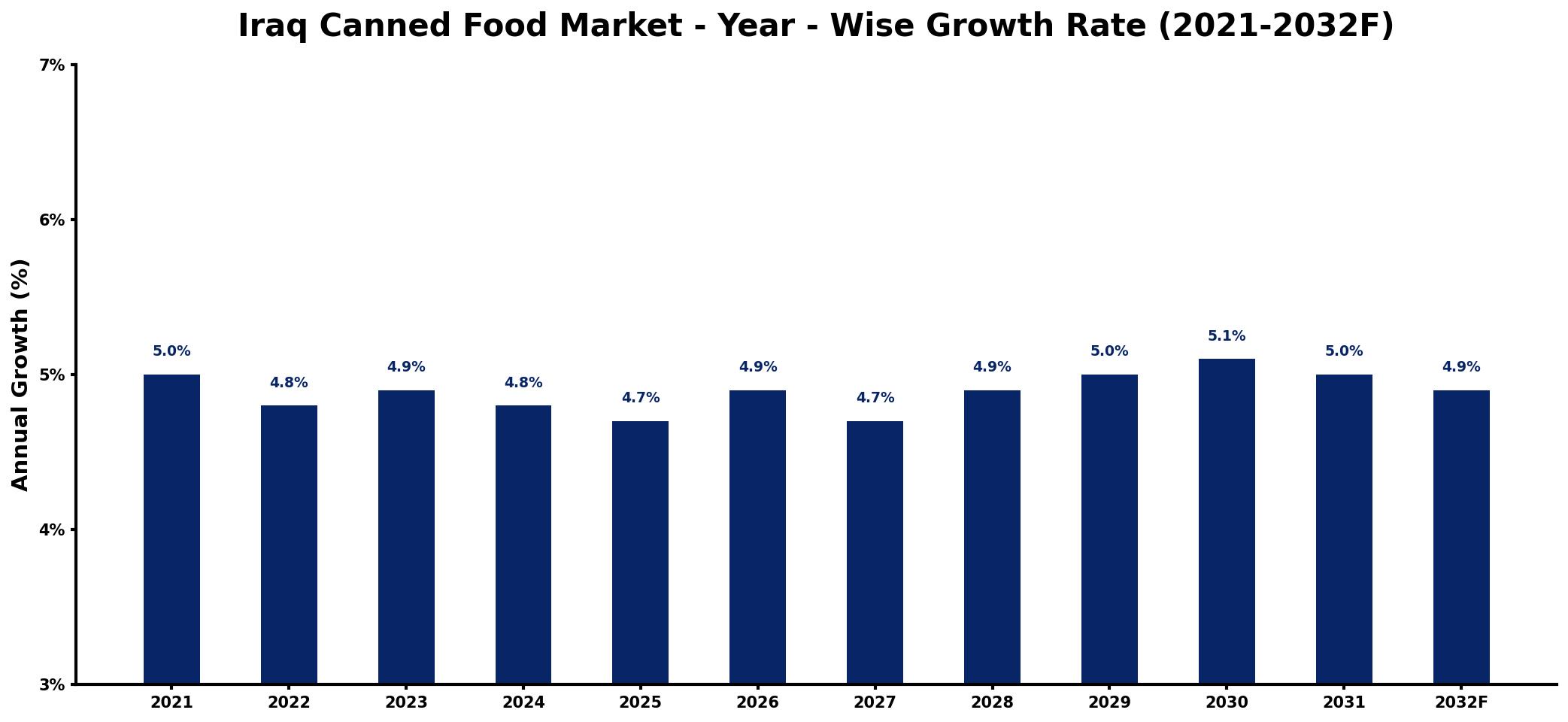
The table below presents the year‑wise growth rates along with the key drivers influencing the market
| Year | Growth Rate | Major Drivers |
| 2021 | 5.0% | Rising urban population demand |
| 2022 | 4.8% | Increased retail distribution networks |
| 2023 | 4.9% | Growing consumer health awareness |
| 2024 | 4.8% | Expansion of modern supermarkets |
| 2025 | 4.7% | Higher disposable income levels |
| 2026 | 4.9% | Increased focus on convenience |
| 2027 | 4.7% | Emergence of new brands |
| 2028 | 4.9% | Growth in online shopping platforms |
| 2029 | 5.0% | Rising expatriate community influence |
| 2030 | 5.1% | Innovative packaging technologies development |
| 2031 | 5.0% | strengthening international trade flows |
| 2032 | 4.9% | Increased government support initiatives |
Note: Market size estimations and growth projections presented in this report are based on 6Wresearch's proprietary forecasting methodology, utilizing the latest available industry data, government publications, and primary research inputs.
Iraq Canned Food Market Synopsis
The Iraq Canned Food Market has recently gained momentum as consumers shift towards convenient and shelf-stable food options. This trend contrasts with previous years when fresh and frozen foods dominated the consumer landscape. The outlook for the market remains positive, driven by innovations in canned food manufacturing and increased distribution capabilities.
As the market evolves, manufacturers are focusing on product quality and variety to cater to changing consumer preferences. The increasing demand for premium canned goods is indicative of a broader trend toward health-conscious choices, ensuring that the market stays aligned with consumer expectations in an increasingly competitive landscape.
Iraq Canned Food Market Key Takeaways
- Market projected to grow significantly, reaching USD 209 Million by 2032.
- Urbanization and convenience are primary growth drivers in the sector.
- Increased consumer awareness of nutritional benefits boosts demand.
- Investment in production technology is vital for overcoming challenges.
- Diversification of retail channels enhances accessibility for consumers.
Evaluation of Restraints in Iraq Canned Food Market
Despite the promising growth prospects, the Iraq Canned Food Market faces several real challenges. The volatility of raw material prices can significantly impact production costs, squeezing margins for manufacturers. Additionally, limited production capacities hinder the ability to scale operations in response to rising consumer demand. Competition from fresh and frozen food options poses another significant challenge, as these alternatives offer perception advantages in terms of freshness and quality. Manufacturers must focus on addressing these limitations through strategic investments in technology and resource management to enhance their competitive edge.
Iraq Canned Food Market Trends
Current trends indicate a shift towards health-oriented canned food products, with an increasing focus on organic and non-GMO options. Consumer preferences are evolving toward transparency in sourcing and production methods, prompting manufacturers to highlight these aspects in their marketing. Additionally, the growth of e-commerce platforms is expanding the market's reach, allowing consumers more convenient access to canned goods. This trend is expected to continue, influencing both product innovation and consumer engagement strategies.
Iraq Canned Food Market Opportunities
There are significant growth opportunities in the Iraq Canned Food Market, particularly for manufacturers willing to innovate. Developing premium-quality canned products that cater to health-conscious consumers can capture a substantial market share. Moreover, enhancing partnerships with local retailers and expanding distribution channels can drive sales and improve visibility in the marketplace. The growing demand for ready-to-eat meals also presents an avenue for product diversification, allowing businesses to tap into the convenience segment further.
Government Initiatives in the Iraq Canned Food Market
The Iraqi government has been proactive in implementing policies aimed at regulating and enhancing the canned food market. These initiatives are vital for food security and include safety and quality assurance measures for canned food production. The government is also promoting best practices in food manufacturing to minimize waste and spoilage, while incentivizing investments in processing facilities. Consumer education programs about the benefits and nutritional value of canned products are part of broader efforts to bolster the market.
Future Insights of the Iraq Canned Food Market
Looking ahead to 2026-2032, the Iraq Canned Food Market is poised for continued expansion. With urbanization trends and a busy lifestyle driving demand for convenience foods, the market will likely see increasing innovation in product offerings. Additionally, as consumer preferences evolve towards healthier options, manufacturers will need to adapt accordingly. Enhanced distribution networks, alongside government support and investment, will play critical roles in shaping the market's future dynamics and ensuring sustainable growth.
Iraq Canned Food Market Latest Developments (2025 - 2026)
Recent industry developments reflect a strengthening of the Iraq Canned Food Market, with an increase in the introduction of diverse product lines targeting health-conscious consumers. Manufacturers are leveraging advancements in technology to improve canning processes and maintain product quality. Furthermore, there has been a noticeable uptick in collaborations between local producers and international firms, aimed at enhancing product offerings and optimizing supply chains. This strategic direction is indicative of a vibrant market adapting to consumer needs and preferences.
Iraq Canned Food Market - Key Attractiveness of the Report
- 10 Years of Market Numbers
- Historical Data Starting from 2022 to 2025
- Base Year: 2025
- Forecast Data until 2032
- Key Performance Indicators Impacting the Market
- Major Upcoming Developments and Projects
Key Highlights of the Report:
- Iraq Canned Food Market Outlook
- Market Size of Iraq Canned Food Market, 2025
- Forecast of Iraq Canned Food Market, 2032
- Historical Data and Forecast of Iraq Canned Food Revenues & Volume for the Period 2022-2032F
- Iraq Canned Food Market Trend Evolution
- Iraq Canned Food Market Drivers and Challenges
- Iraq Canned Food Price Trends
- Iraq Canned Food Porter's Five Forces
- Iraq Canned Food Industry Life Cycle
- Historical Data and Forecast of Iraq Canned Food Market Revenues & Volume By Product Type for the Period 2022-2032F
- Historical Data and Forecast of Iraq Canned Food Market Revenues & Volume By Canned meat & seafood for the Period 2022-2032F
- Historical Data and Forecast of Iraq Canned Food Market Revenues & Volume By Canned fruit & vegetables for the Period 2022-2032F
- Historical Data and Forecast of Iraq Canned Food Market Revenues & Volume By Canned ready meals for the Period 2022-2032F
- Historical Data and Forecast of Iraq Canned Food Market Revenues & Volume By Others for the Period 2022-2032F
- Historical Data and Forecast of Iraq Canned Food Market Revenues & Volume By Type for the Period 2022-2032F
- Historical Data and Forecast of Iraq Canned Food Market Revenues & Volume By Organic for the Period 2022-2032F
- Historical Data and Forecast of Iraq Canned Food Market Revenues & Volume By Conventional for the Period 2022-2032F
- Historical Data and Forecast of Iraq Canned Food Market Revenues & Volume By Distribution Channel for the Period 2022-2032F
- Historical Data and Forecast of Iraq Canned Food Market Revenues & Volume By Supermarket/Hypermarket for the Period 2022-2032F
- Historical Data and Forecast of Iraq Canned Food Market Revenues & Volume By Convenience stores for the Period 2022-2032F
- Historical Data and Forecast of Iraq Canned Food Market Revenues & Volume By E-commerce for the Period 2022-2032F
- Historical Data and Forecast of Iraq Canned Food Market Revenues & Volume By Others for the Period 2022-2032F
- Iraq Canned Food Import Export Trade Statistics
- Market Opportunity Assessment By Product Type
- Market Opportunity Assessment By Type
- Market Opportunity Assessment By Distribution Channel
- Iraq Canned Food Top Companies Market Share
- Iraq Canned Food Competitive Benchmarking By Technical and Operational Parameters
- Iraq Canned Food Company Profiles
- Iraq Canned Food Key Strategic Recommendations






































