Iraq Canned Fruits Market Summary
The iraq canned fruits market was estimated at USD 476 Million in 2025 and is projected to reach USD 650 Million by 2032, growing at a CAGR of 5.6% from 2026 to 2032.
Iraq Canned Fruits Market Year-wise Growth Rate and Key Drivers
This graph highlights how the Iraq Canned Fruits Market has steadily grown over the past five years, supported by major growth factors.
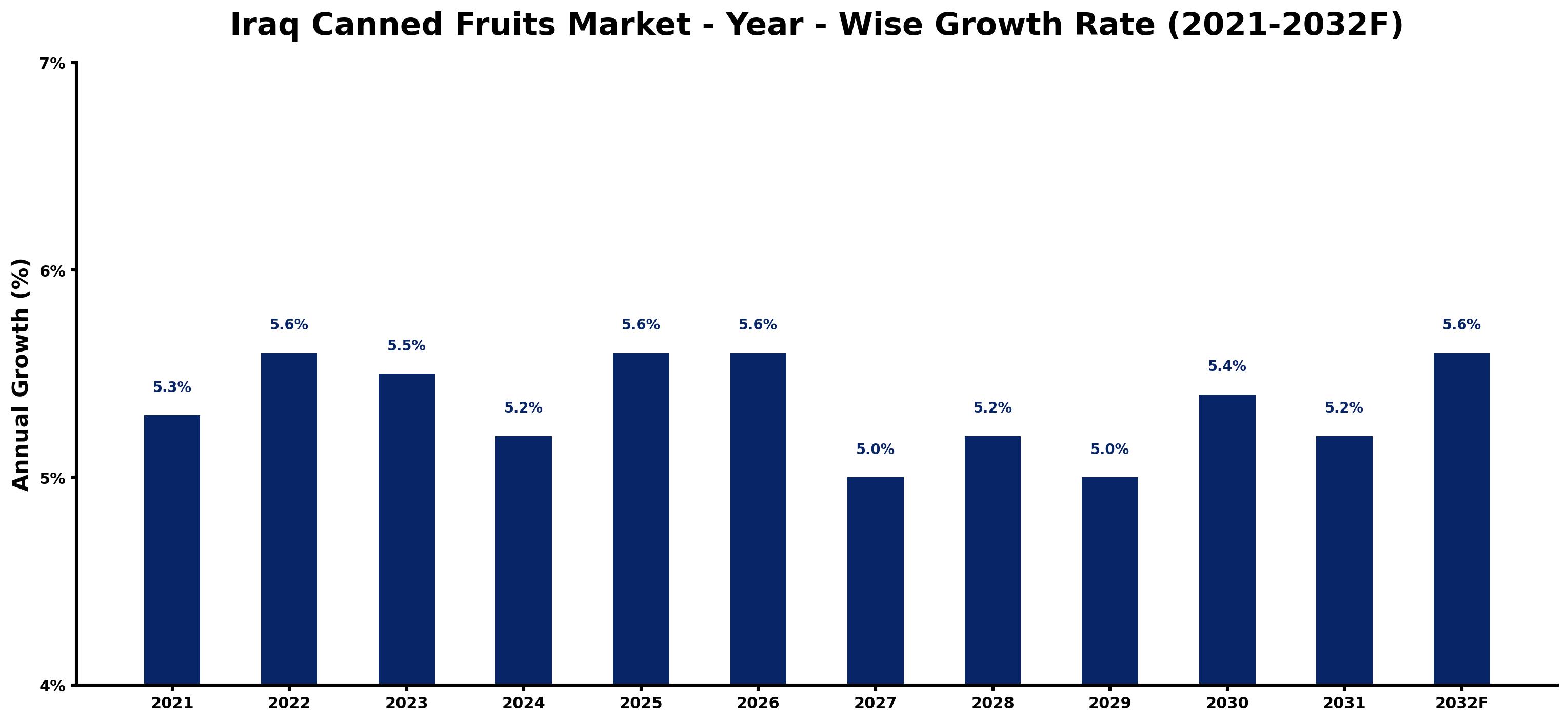
The table below presents the year wise growth rates along with the key drivers influencing the market
| Year | Growth Rate | Major Drivers |
| 2021 | 5.3% | Supply chain recovery post-pandemic increased availability of canned fruits in Iraq. |
| 2022 | 5.6% | Urbanization trends led to higher consumption rates for convenient food options. |
| 2023 | 5.5% | Revitalization of the agriculture sector enhanced local canned fruit production capabilities. |
| 2024 | 5.2% | Rising disposable incomes prompted consumers to explore premium canned fruit brands. |
| 2025 | 5.6% | Health-conscious consumers increasingly sought nutritious, long-shelf-life fruit alternatives. |
| 2026 | 5.6% | Expanding retail networks introduced a broader range of canned fruit products. |
| 2027 | 5.0% | Local manufacturers began innovating to cater to evolving taste preferences. |
| 2028 | 5.2% | Increased tourism boosted demand for ready-to-eat local food products like canned fruits. |
| 2029 | 5.0% | Shifts towards e-commerce enabled easier access to canned fruit varieties. |
| 2030 | 5.4% | Sustainable packaging trends gained traction, appealing to environmentally-conscious consumers. |
| 2031 | 5.2% | Culinary interest in international cuisines increased canned fruit usage in recipes. |
| 2032 | 5.6% | Collaborations with international brands enhanced product diversity in the market. |
Note - Market size estimations and growth projections presented in this report are based on 6Wresearch's advanced forecasting approach, validated with industry datasets as of June 2026.
Iraq Canned Fruits Market Synopsis
The Iraq Canned Fruits Market is projected to reach 5.6% and witness significant growth during the forecast period (2026-2032). This growth trajectory is largely attributable to increasing consumer demands for convenient and long-lasting food products. As urbanization spreads and lifestyles become busier, the need for easily accessible food options intensifies. Furthermore, heightened awareness regarding the nutritional advantages of fruits continues to shape consumer preferences, thereby driving the market forward.
Iraq Canned Fruits Market Growth Drivers
A myriad of factors contributes to the growth of the Iraq Canned Fruits Market, including:
- Convenience: With the acceleration of urban lifestyles, consumers increasingly favor ready-to-eat meals, making canned fruits an attractive option.
- Health Consciousness: An ongoing trend towards healthier eating habits has prompted a rise in demand for canned fruits that offer nutritional benefits without added preservatives.
- Diverse Offerings: A wide range of canned fruit options, such as peaches, pears, and mixed fruit cocktails, caters to varied consumer preferences and enhances market growth.
- Rising Income Levels: Increasing disposable incomes among consumers in Iraq allow for greater expenditure on quality food products, including canned fruits.
- Innovative Marketing: Effective strategies employed to educate consumers about the convenience and benefits of canned fruits are further stimulating market demand.
Iraq Canned Fruits Market Trends and Opportunities
The evolving landscape of the Iraq Canned Fruits Market is characterized by several notable trends:
- Preference for Organic Products: As consumers become more health-oriented, there is a marked increase in demand for natural and organic canned fruits that have no artificial additives.
- Exotic Fruit Varieties: A growing inclination towards unique flavors and exotic fruits is reshaping market offerings, attracting adventurous consumers seeking diversity in their diets.
- E-Commerce Growth: The expansion of online shopping platforms serves as a crucial channel for reaching consumers, particularly the tech-savvy younger demographic.
- Sustainability Focus: There is a rising expectation for brands to engage in sustainable practices, from sourcing to packaging, aligning with broader industry trends toward environmental consciousness.
- Nutrition Awareness: Increased education on the health benefits of consuming fruits bolsters demand for canned options that retain essential vitamins and minerals.
Iraq Canned Fruits Market Challenges and Restraints
Despite its growth potential, the Iraq Canned Fruits Market faces several challenges:
- Logistical Issues: Ongoing security concerns in certain regions may disrupt supply chains, complicating distribution and affecting product availability.
- Price Volatility: Fluctuations in prices due to economic instability can hinder consumer purchasing behaviors and market expansion efforts.
- Competition from Fresh Produce: The preference for fresh fruits, driven by perceptions of higher quality, poses a challenge to the growth of canned fruit sales.
- Technological Gaps: Limited access to advanced packaging and processing technologies may restrict the ability to innovate and improve product offerings.
- Consumer Education: Raising awareness about the nutritional benefits and convenience of canned fruits remains essential to overcoming negative biases about processed foods.
Iraq Canned Fruits Market Investment Opportunities
The Iraq Canned Fruits Market presents several attractive investment opportunities:
- Local Production: Investing in domestic manufacturing can help reduce import dependency, supporting economic self-sufficiency and supply chain stability.
- E-Commerce Infrastructure: Developing online sales channels can capitalize on the rising trend of e-commerce, reaching a wider consumer base effectively.
- Health-Focused Products: Launching product lines that emphasize health benefits could tap into the growing sector of health-conscious consumers.
- Partnerships with Local Growers: Collaborating with local fruit producers can enhance the supply chain while fostering community support and promoting local sourcing.
- Marketing Innovation: Implementing innovative marketing strategies to effectively convey the benefits of canned fruits can help attract and retain customers in a competitive environment.
Iraq Canned Fruits Market Government Investment and Initiatives
Government initiatives play a critical role in shaping the Iraq Canned Fruits Market. Policies aimed at promoting domestic production include various subsidies and incentives designed to bolster production capacities in local fruit cultivation and processing. Additionally, regulatory frameworks enforced to maintain food safety standards ensure that consumer interests are protected, with measures established to monitor and certify the quality of canned fruit products. Import tariffs and restrictions further incentivize local production, aiming to reduce reliance on external suppliers and fostering self-sufficiency in the market. These government-backed efforts are integral to catalyzing growth within the canned fruits sector of Iraq.
Iraq Canned Fruits Market Latest Developments (May 2025 - June 2026)
Recent developments in the Iraq Canned Fruits Market indicate a dynamic shift towards healthier product offerings and innovative marketing strategies. Many companies are focusing on enhancing their product lines with organic and additive-free options, responding to consumer demands for cleaner labels. Additionally, the implementation of e-commerce solutions is enabling brands to engage with consumers in new ways, facilitating direct-to-consumer sales that cater to younger demographics. Furthermore, there is a noticeable uptick in government initiatives aimed at supporting local manufacturers, which is expected to strengthen the domestic supply chain. Overall, this period has seen a heightened focus on adapting to consumer trends, ensuring that the canned fruits market evolves in line with shifting preferences.
Iraq Canned Fruits Market - Key Attractiveness of the Report
- 10 Years of Market Numbers
- Historical Data Starting from 2022 to 2025
- Base Year: 2025
- Forecast Data until 2032
- Key Performance Indicators Impacting the Market
- Major Upcoming Developments and Projects
Key Highlights of the Report:
- Iraq Canned Fruits Market Outlook
- Market Size of Iraq Canned Fruits Market, 2025
- Forecast of Iraq Canned Fruits Market, 2032F
- Historical Data and Forecast of Iraq Canned Fruits Revenues & Volume for the Period 2022-2032F
- Iraq Canned Fruits Market Trend Evolution
- Iraq Canned Fruits Market Drivers and Challenges
- Iraq Canned Fruits Price Trends
- Iraq Canned Fruits Porter's Five Forces
- Iraq Canned Fruits Industry Life Cycle
- Historical Data and Forecast of Iraq Canned Fruits Market Revenues & Volume By Fruit Type for the Period 2022-2032F
- Historical Data and Forecast of Iraq Canned Fruits Market Revenues & Volume By Peaches for the Period 2022-2032F
- Historical Data and Forecast of Iraq Canned Fruits Market Revenues & Volume By Pineapple for the Period 2022-2032F
- Historical Data and Forecast of Iraq Canned Fruits Market Revenues & Volume By Mandarin oranges for the Period 2022-2032F
- Historical Data and Forecast of Iraq Canned Fruits Market Revenues & Volume By Pears for the Period 2022-2032F
- Historical Data and Forecast of Iraq Canned Fruits Market Revenues & Volume By Others for the Period 2022-2032F
- Historical Data and Forecast of Iraq Canned Fruits Market Revenues & Volume By Form for the Period 2022-2032F
- Historical Data and Forecast of Iraq Canned Fruits Market Revenues & Volume By Whole fruits for the Period 2022-2032F
- Historical Data and Forecast of Iraq Canned Fruits Market Revenues & Volume By Cut fruits for the Period 2022-2032F
- Historical Data and Forecast of Iraq Canned Fruits Market Revenues & Volume By Distribution Channel for the Period 2022-2032F
- Historical Data and Forecast of Iraq Canned Fruits Market Revenues & Volume By Supermarkets/Hypermarkets for the Period 2022-2032F
- Historical Data and Forecast of Iraq Canned Fruits Market Revenues & Volume By Convenience Stores for the Period 2022-2032F
- Historical Data and Forecast of Iraq Canned Fruits Market Revenues & Volume By Online Retail for the Period 2022-2032F
- Historical Data and Forecast of Iraq Canned Fruits Market Revenues & Volume By Other for the Period 2022-2032F
- Iraq Canned Fruits Import Export Trade Statistics
- Market Opportunity Assessment By Fruit Type
- Market Opportunity Assessment By Form
- Market Opportunity Assessment By Distribution Channel
- Iraq Canned Fruits Top Companies Market Share
- Iraq Canned Fruits Competitive Benchmarking By Technical and Operational Parameters
- Iraq Canned Fruits Company Profiles
- Iraq Canned Fruits Key Strategic Recommendations






































