Iraq Carbonated Beverages Market Summary
The iraq carbonated beverages market was estimated at USD 822 Million in 2025 and is projected to reach USD 1409 Million by 2032, growing at a CAGR of 9.2% from 2026 to 2032.
Iraq Carbonated Beverages Market Year-wise Growth Rate and Key Drivers
This graph highlights how the Iraq Carbonated Beverages Market has steadily grown over the past five years, supported by major growth factors.
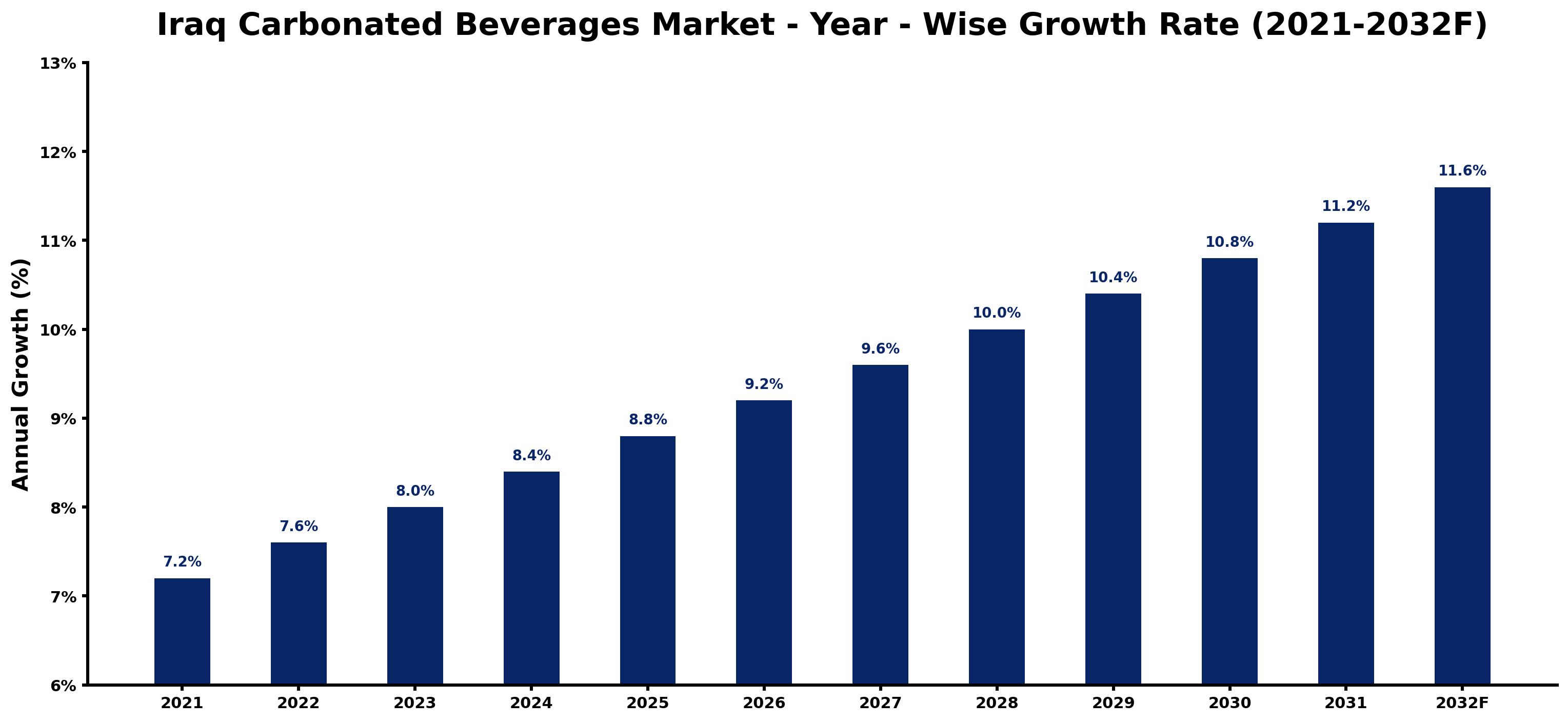
The table below presents the year wise growth rates along with the key drivers influencing the market
| Year | Growth Rate | Major Drivers |
| 2021 | 7.2% | Local brands focus on unique flavors, appealing to Iraq's diverse palate preferences. |
| 2022 | 7.6% | Increased investment in distribution networks enhances product availability and visibility. |
| 2023 | 8.0% | Health-conscious consumers drive interest towards lower-sugar and natural ingredient options. |
| 2024 | 8.4% | Rising disposable incomes enable consumers to explore premium beverage options more frequently. |
| 2025 | 8.8% | Urbanization accelerates demand for convenient beverages in busy metropolitan areas. |
| 2026 | 9.2% | Marketing strategies shift toward digital platforms, attracting a younger demographic effectively. |
| 2027 | 9.6% | Partnerships with local retailers expand product reach to previously underserved regions. |
| 2028 | 10.0% | Sustainability trends influence packaging innovations, responding to eco-conscious consumer preferences. |
| 2029 | 10.4% | Event sponsorships and local festivals amplify brand visibility and consumer engagement. |
| 2030 | 10.8% | Enhanced logistics capabilities support faster delivery times, elevating customer satisfaction levels. |
| 2031 | 11.2% | Collaborations with international brands introduce new flavors and expand market offerings. |
| 2032 | 11.6% | E-commerce platforms flourish, providing new sales channels for carbonated beverage companies. |
Note - Market size estimations and growth projections presented in this report are based on 6Wresearch's advanced forecasting approach, validated with industry datasets as of June 2026.
Iraq Carbonated Beverages Market Synopsis
The Iraq Carbonated Beverages Market is projected to reach 9.2% and witness significant growth during the forecast period (2026-2032). This growth trajectory is driven by a combination of evolving consumer preferences, urbanization, and increasing disposable incomes, leading to a heightened demand for carbonated drinks. The diversity of products available, including sodas, sparkling waters, and flavored beverages, caters to the tastes of Iraq's consumers across various age groups. The ongoing transformation in lifestyle choices reflects a shift towards more convenient and indulgent consumption options, thereby enhancing market opportunities for innovative product offerings.
Iraq Carbonated Beverages Market Growth Drivers
The foremost drivers of the Iraq Carbonated Beverages Market include:
- Changing Consumer Preferences: The Iraqi consumer base is increasingly gravitating towards carbonated beverages due to their refreshing qualities and diverse flavor profiles, making them a popular choice across demographics.
- Urbanization Trends: As urbanization accelerates in Iraq, there is a significant rise in demand for convenient beverage options that align with the fast-paced lifestyles of city dwellers.
- Rising Disposable Incomes: With an increase in disposable income, consumers are more willing to spend on premium carbonated products, driving the market's overall growth.
- On-the-Go Consumption Patterns: The demand for ready-to-drink beverages is rising as consumers seek quick and easy refreshment options, boosting the carbonated drinks segment.
- Product Innovations: Beverage manufacturers are constantly introducing new flavors and packaging formats to attract consumers, reflecting the market's responsiveness to evolving taste preferences.
Iraq Carbonated Beverages Market Challenges and Restraints
Despite its potential, the Iraq Carbonated Beverages Market faces several challenges:
- Economic Constraints: Fluctuations in the economy can impact consumer purchasing power, leading to cautious spending on discretionary items such as carbonated beverages.
- Logistical Issues: Infrastructure shortcomings can hinder the distribution of products across various regions, limiting market accessibility.
- Health Concerns: Growing awareness regarding the health implications of excessive carbonated beverage consumption poses a challenge, as more consumers lean towards healthier alternatives.
- Competition from Alternatives: The rise of alternative beverages, such as natural juices and flavored waters, presents competitive pressure on traditional carbonated drinks.
- Consumer Education Needs: There is a necessity for enhanced consumer education around the nutritional content of carbonated beverages, which can affect consumption choices.
Iraq Carbonated Beverages Market Trends and Opportunities
The Iraq Carbonated Beverages Market is witnessing notable trends that present substantial opportunities for growth:
- Sustainable Packaging: With a global shift towards sustainability, manufacturers are increasingly adopting eco-friendly packaging solutions to appeal to environmentally conscious consumers.
- Flavored Sparkling Water Popularity: There is a rising trend towards flavored sparkling waters as consumers seek healthier, low-calorie alternatives to traditional sodas.
- Functional Beverages: The introduction of functional carbonated beverages, infused with vitamins and minerals, is gaining traction among health-focused consumers.
- Digital Marketing Strategies: Leveraging digital platforms for marketing initiatives helps brands connect with younger audiences, enhancing market penetration.
- Seasonal and Limited-Edition Flavors: Introducing seasonal flavors can create buzz and attract consumers looking for unique experiences, thereby boosting sales during peak consumption periods.
Iraq Carbonated Beverages Market Government Investment and Initiatives
The Iraqi government has recognized the importance of the carbonated beverages sector, implementing several initiatives to foster market growth:
- Regulatory Frameworks: Policies are in place to ensure the safety and quality standards in manufacturing processes, which help maintain consumer trust in carbonated products.
- Support for Innovation: The government promotes innovation in product formulation and flavor development to encourage manufacturers to diversify their offerings.
- Consumer Education Programs: Initiatives aimed at educating consumers about the nutritional content of carbonated beverages are being implemented, encouraging informed purchasing decisions.
- Infrastructure Development Plans: Investments in infrastructure improvements are being made to enhance the distribution network for carbonated beverages, ensuring better market access.
- Responsible Marketing Guidelines: The government emphasizes responsible marketing practices to ensure that the promotion of carbonated beverages does not mislead consumers regarding their health impacts.
Iraq Carbonated Beverages Market Latest Developments (May 2025 - June 2026)
The period from May 2025 to June 2026 has seen significant developments in the Iraq Carbonated Beverages Market:
- Increased consumer focus on health has led to the introduction of low-sugar and sugar-free carbonated options by various manufacturers, responding to the rising health consciousness.
- Technological advancements in production processes have improved efficiency, allowing manufacturers to meet the growing demand for carbonated products.
- Partnerships between local and international firms have emerged, facilitating knowledge transfer and access to a broader range of innovative beverage solutions.
- Marketing strategies have increasingly focused on social media platforms, targeting younger demographics through engaging campaigns and interactive content.
- The launch of limited-edition flavors around cultural events has generated excitement and increased footfall in retail locations, enhancing brand visibility and consumer engagement.
Iraq Carbonated Beverages Market - Key Attractiveness of the Report
- 10 Years of Market Numbers
- Historical Data Starting from 2022 to 2025
- Base Year: 2025
- Forecast Data until 2032
- Key Performance Indicators Impacting the Market
- Major Upcoming Developments and Projects
Key Highlights of the Report:
- Iraq Carbonated Beverages Market Outlook
- Market Size of Iraq Carbonated Beverages Market, 2025
- Forecast of Iraq Carbonated Beverages Market, 2032
- Historical Data and Forecast of Iraq Carbonated Beverages Revenues & Volume for the Period 2022-2032F
- Iraq Carbonated Beverages Market Trend Evolution
- Iraq Carbonated Beverages Market Drivers and Challenges
- Iraq Carbonated Beverages Price Trends
- Iraq Carbonated Beverages Porter's Five Forces
- Iraq Carbonated Beverages Industry Life Cycle
- Historical Data and Forecast of Iraq Carbonated Beverages Market Revenues & Volume By Product Types for the Period 2022-2032F
- Historical Data and Forecast of Iraq Carbonated Beverages Market Revenues & Volume By Soft Drinks for the Period 2022-2032F
- Historical Data and Forecast of Iraq Carbonated Beverages Market Revenues & Volume By Carbonated Water for the Period 2022-2032F
- Historical Data and Forecast of Iraq Carbonated Beverages Market Revenues & Volume By Sports & Energy Drinks for the Period 2022-2032F
- Historical Data and Forecast of Iraq Carbonated Beverages Market Revenues & Volume By Others for the Period 2022-2032F
- Historical Data and Forecast of Iraq Carbonated Beverages Market Revenues & Volume By Flavour for the Period 2022-2032F
- Historical Data and Forecast of Iraq Carbonated Beverages Market Revenues & Volume By Cola for the Period 2022-2032F
- Historical Data and Forecast of Iraq Carbonated Beverages Market Revenues & Volume By Fruit Based for the Period 2022-2032F
- Historical Data and Forecast of Iraq Carbonated Beverages Market Revenues & Volume By Others for the Period 2022-2032F
- Historical Data and Forecast of Iraq Carbonated Beverages Market Revenues & Volume By Distribution Channel for the Period 2022-2032F
- Historical Data and Forecast of Iraq Carbonated Beverages Market Revenues & Volume By Hypermarkets & Supermarkets for the Period 2022-2032F
- Historical Data and Forecast of Iraq Carbonated Beverages Market Revenues & Volume By Convenience Stores for the Period 2022-2032F
- Historical Data and Forecast of Iraq Carbonated Beverages Market Revenues & Volume By Food Service Outlets for the Period 2022-2032F
- Historical Data and Forecast of Iraq Carbonated Beverages Market Revenues & Volume By Transport Terminals for the Period 2022-2032F
- Historical Data and Forecast of Iraq Carbonated Beverages Market Revenues & Volume By Online Stores & D2C for the Period 2022-2032F
- Iraq Carbonated Beverages Import Export Trade Statistics
- Market Opportunity Assessment By Product Types
- Market Opportunity Assessment By Flavour
- Market Opportunity Assessment By Distribution Channel
- Iraq Carbonated Beverages Top Companies Market Share
- Iraq Carbonated Beverages Competitive Benchmarking By Technical and Operational Parameters
- Iraq Carbonated Beverages Company Profiles
- Iraq Carbonated Beverages Key Strategic Recommendations






































