Iraq Compressors Market Summary
The iraq compressors market was estimated at USD 504 Million in 2025 and is projected to reach USD 728 Million by 2032, growing at a CAGR of 6.5% from 2026 to 2032.
Iraq Compressors Market Year-wise Growth Rate and Key Drivers
This graph highlights how the Iraq Compressors Market has steadily grown over the past five years, supported by major growth factors.
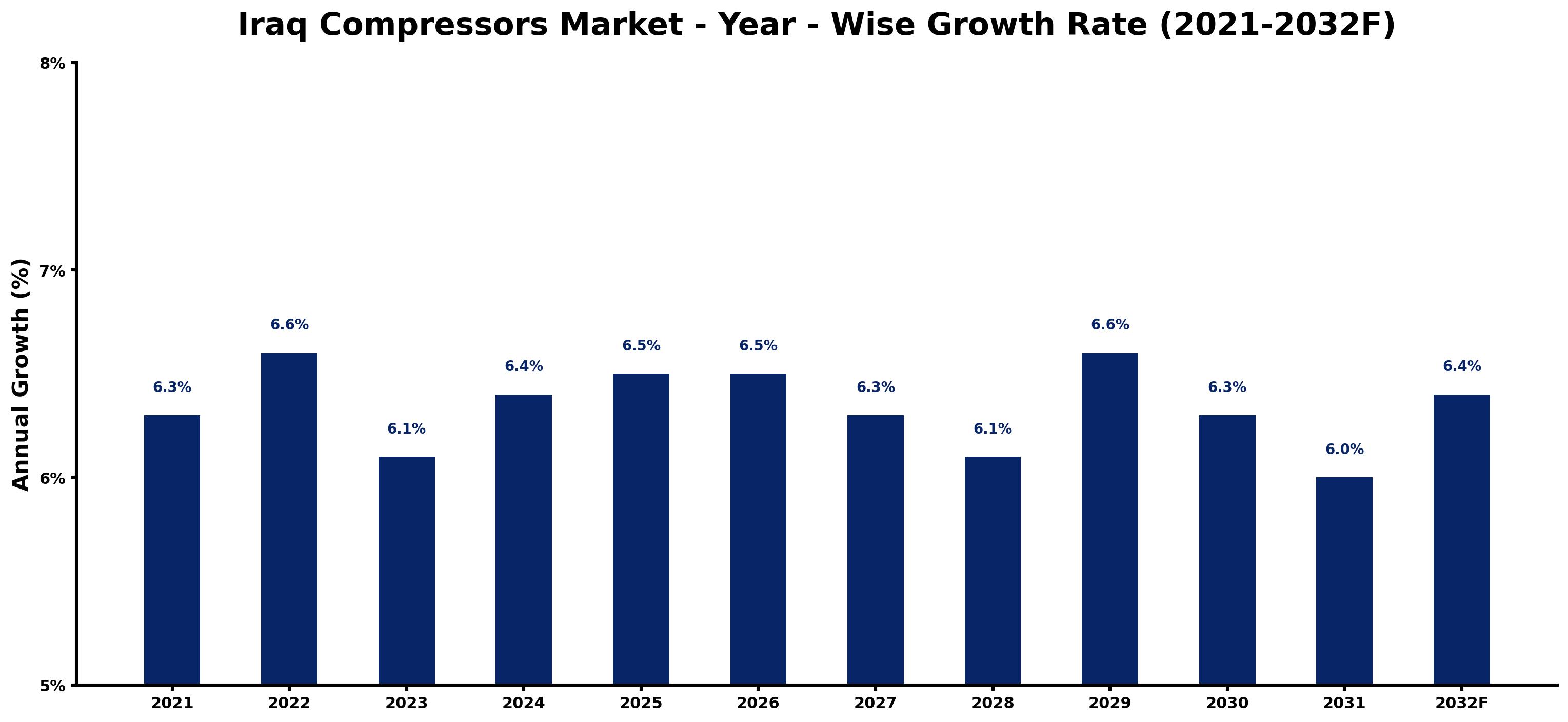
The table below presents the year wise growth rates along with the key drivers influencing the market
| Year | Growth Rate | Major Drivers |
| 2021 | 6.3% | Post-conflict reconstruction efforts begin revitalizing infrastructure across various sectors. |
| 2022 | 6.6% | Increased construction activities fuel demand for energy-efficient compressor technologies. |
| 2023 | 6.1% | Oil and gas sector expansion requires reliable and durable compressor systems. |
| 2024 | 6.4% | Investors target renewable energy projects, boosting the market for hybrid compressors. |
| 2025 | 6.5% | Technological upgrades in industrial facilities enhance compressor efficiency and reliability. |
| 2026 | 6.5% | Rising urbanization creates demand for HVAC systems using advanced compressors. |
| 2027 | 6.3% | Local manufacturing operations scale up, reducing reliance on imported compressor units. |
| 2028 | 6.1% | Emerging logistics and transport networks drive compressor needs in distribution centers. |
| 2029 | 6.6% | Focus on sustainable practices inspires innovations in eco-friendly compressor designs. |
| 2030 | 6.3% | Shifts towards automation in factories elevate demand for smart compressor solutions. |
| 2031 | 6.0% | Diverse industrial applications encourage customization of compressor units in various sectors. |
| 2032 | 6.4% | Increased partnerships among local businesses foster growth in the compressor market. |
Note - Market size estimations and growth projections presented in this report are based on 6Wresearch's advanced forecasting approach, validated with industry datasets as of June 2026.
Iraq Compressors Market Synopsis
The Iraq Compressors Market is projected to reach 6.5% and witness significant growth during the forecast period (2026-2032). This steady expansion is fueled by increasing industrial activities across key sectors, including oil and gas, manufacturing, and construction. As the demand for efficient air and gas compression solutions rises, so too does the diversity of applications, ranging from power generation and pneumatic tools to refrigeration and air conditioning. The evolution of compressor technologies towards energy efficiency and environmental sustainability is a crucial factor in meeting regulatory requirements and market expectations.
Iraq Compressors Market Growth Drivers
The dynamics of the Iraq Compressors Market are largely influenced by several growth drivers:
- Increased activity in the oil and gas sector, where compressors are essential for gas processing, pipeline transportation, and refining processes.
- The resurgence of the construction industry is prompting a greater demand for compressors used in powering pneumatic tools and heavy machinery.
- A nationwide push towards industrialization is fostering the requirement for compressors in manufacturing processes across various sectors.
- Technological advancements in compressors are promoting the adoption of energy-efficient and environmentally friendly models, helping businesses lower operational costs.
- Government initiatives aimed at infrastructure development are creating favorable conditions for investments in compressor technologies.
Iraq Compressors Market Challenges and Restraints
In the midst of growth opportunities, the Iraq Compressors Market encounters several challenges that could impede progress:
- Political instability and security concerns can cause fluctuations in market demand, as businesses may defer investments in new equipment during uncertain periods.
- The underdevelopment of infrastructure, particularly in rural areas, poses a logistical barrier for the distribution and maintenance of compressors.
- A shortage of trained personnel in the workforce can limit the effective deployment and operation of advanced compressor technologies.
- Foreign exchange rate fluctuations may affect the pricing of imported compressors, impacting overall market viability.
- Compliance with stringent import/export regulations can pose additional obstacles for companies looking to enter or expand within the market.
Iraq Compressors Market Trends and Opportunities
As the Iraq Compressors Market evolves, several trends and opportunities are shaping its future:
- The increasing focus on energy efficiency is pushing companies to invest in advanced compressor technologies that align with sustainability goals.
- Digitalization trends are driving the demand for smart compressors equipped with real-time monitoring capabilities and IoT connectivity, enhancing operational efficiency.
- Investment in R&D is on the rise, with companies striving to introduce innovative products that address the unique needs of the Iraqi market.
- Reconstruction efforts following conflicts are presenting ample opportunities for tying compressor solutions to major construction projects.
- The growing need for effective air and gas compression solutions in various sectors encourages potential investors to explore partnerships with local distributors.
Iraq Compressors Market Government Investment and Initiatives
Government policies play a pivotal role in shaping the Iraq Compressors Market. Regulatory frameworks dictate import regulations and taxation policies that impact compressor costs and market dynamics:
- The Iraqi government enforces strict import regulations to safeguard local manufacturers while ensuring product quality for compressors entering the market.
- Importers are mandated to obtain necessary permits and comply with customs requirements, influencing the operational fluidity of market participants.
- Taxation policies, including tariffs and value-added tax (VAT), affect the pricing structure of compressors and their accessibility to businesses.
- Commitment to enhancing industry standards is vital for ensuring product safety and performance, which is increasingly recognized by market stakeholders.
- Public spending on infrastructure development is consistently increasing, creating a favorable climate for investment in compressor technologies, with potential incentives for early adopters.
Iraq Compressors Market Latest Developments (May 2025 - June 2026)
Recent industry developments in the Iraq Compressors Market reflect ongoing adjustments to emerging challenges and opportunities:
- Investments in energy-efficient compressor models have gained traction as companies seek to align with global sustainability trends.
- Increased collaboration between local and international firms has been observed, with a focus on enhancing service delivery and supply chain efficiency.
- Government announcements regarding infrastructural projects signify a rising commitment to upgrading national facilities, impacting compressor demand positively.
- The market is witnessing an upsurge in digital transformation efforts, leading to the introduction of smart, IoT-enabled compressors designed for enhanced monitoring and control.
- Training programs and initiatives to develop a skilled workforce have been implemented, addressing the personnel shortages that currently challenge the market.
Iraq Compressors Market - Key Attractiveness of the Report
- 10 Years of Market Numbers
- Historical Data Starting from 2022 to 2025
- Base Year: 2025
- Forecast Data until 2032
- Key Performance Indicators Impacting the Market
- Major Upcoming Developments and Projects
Key Highlights of the Report:
- Iraq Compressors Market Outlook
- Market Size of Iraq Compressors Market, 2025
- Forecast of Iraq Compressors Market, 2032F
- Historical Data and Forecast of Iraq Compressors Revenues & Volume for the Period 2022-2032F
- Iraq Compressors Market Trend Evolution
- Iraq Compressors Market Drivers and Challenges
- Iraq Compressors Price Trends
- Iraq Compressors Porter's Five Forces
- Iraq Compressors Industry Life Cycle
- Historical Data and Forecast of Iraq Compressors Market Revenues & Volume By Type for the Period 2022-2032F
- Historical Data and Forecast of Iraq Compressors Market Revenues & Volume By Positive Displacement for the Period 2022-2032F
- Historical Data and Forecast of Iraq Compressors Market Revenues & Volume By Dynamic for the Period 2022-2032F
- Historical Data and Forecast of Iraq Compressors Market Revenues & Volume By Industry for the Period 2022-2032F
- Historical Data and Forecast of Iraq Compressors Market Revenues & Volume By Automotive for the Period 2022-2032F
- Historical Data and Forecast of Iraq Compressors Market Revenues & Volume By Steel for the Period 2022-2032F
- Historical Data and Forecast of Iraq Compressors Market Revenues & Volume By Chemical for the Period 2022-2032F
- Historical Data and Forecast of Iraq Compressors Market Revenues & Volume By Medical for the Period 2022-2032F
- Historical Data and Forecast of Iraq Compressors Market Revenues & Volume By Others for the Period 2022-2032F
- Iraq Compressors Import Export Trade Statistics
- Market Opportunity Assessment By Type
- Market Opportunity Assessment By Industry
- Iraq Compressors Top Companies Market Share
- Iraq Compressors Competitive Benchmarking By Technical and Operational Parameters
- Iraq Compressors Company Profiles
- Iraq Compressors Key Strategic Recommendations






































