Iraq Cooking Appliances Market Summary
The iraq cooking appliances market was estimated at USD 321 Million in 2025 and is projected to reach USD 429 Million by 2032, growing at a CAGR of 5.0% from 2026 to 2032.
Iraq Cooking Appliances Market Year-wise Growth Rate and Key Drivers
This graph highlights how the Iraq Cooking Appliances Market has steadily grown over the past five years, supported by major growth factors.
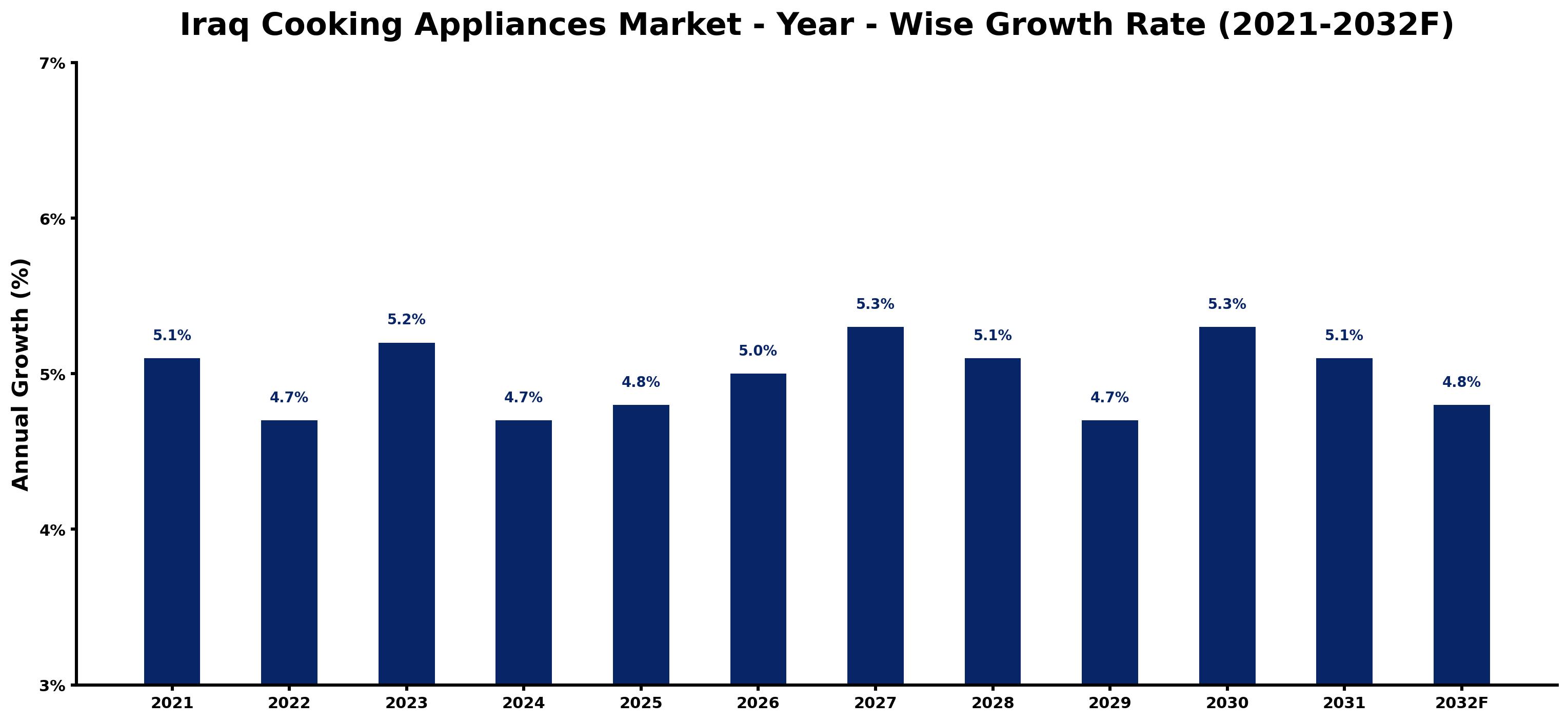
The table below presents the year wise growth rates along with the key drivers influencing the market
| Year | Growth Rate | Major Drivers |
| 2021 | 5.1% | Post-pandemic consumer behavior shifted towards home cooking and appliance upgrades. |
| 2022 | 4.7% | Increased interest in modern kitchen technologies aligns with rising disposable incomes. |
| 2023 | 5.2% | Urban expansion drives appliance manufacturers to cater to smaller living spaces efficiently. |
| 2024 | 4.7% | Cultural shifts highlight the need for energy-efficient cooking solutions in households. |
| 2025 | 4.8% | Emerging online retail platforms provide broader access to diverse cooking appliance choices. |
| 2026 | 5.0% | Local manufacturers ramp up production to meet demand for affordable kitchen appliances. |
| 2027 | 5.3% | Technological advancements enable the introduction of smart appliances into the Iraqi market. |
| 2028 | 5.1% | Consumer interest in health and wellness boosts demand for high-quality cooking equipment. |
| 2029 | 4.7% | Regional stability encourages foreign investments in appliance manufacturing and distribution. |
| 2030 | 5.3% | Sustainability trends prompt consumers to seek energy-efficient cooking solutions actively. |
| 2031 | 5.1% | Demographic shifts, including family size changes, impact appliance purchasing decisions significantly. |
| 2032 | 4.8% | E-commerce expansion continues to transform traditional shopping habits for cooking appliances. |
Note - Market size estimations and growth projections presented in this report are based on 6Wresearch's advanced forecasting approach, validated with industry datasets as of June 2026.
Iraq Cooking Appliances Market Synopsis
The Iraq Cooking Appliances Market is projected to reach 5.0% and witness significant growth during the forecast period (2026-2032). This growth is primarily driven by the increasing population, rising disposable incomes, and a shift towards urbanization in the country. As more households transition to modern cooking solutions, the demand for cooking appliances, especially electric cookers, is anticipated to rise, reflecting a changing preference among consumers.
Iraq Cooking Appliances Market Growth Drivers
Several factors are contributing to the growth of the Iraq cooking appliances market. Firstly, the expanding population is leading to a higher demand for various kitchen appliances that meet the needs of families. Secondly, as disposable incomes continue to rise, consumers are increasingly willing to invest in more efficient and convenient cooking solutions. Thirdly, the trend of urbanization is prompting a shift from traditional cooking methods to modern appliances, which are often more aligned with contemporary lifestyles.
- Electric cookers are becoming more popular due to their affordability; this shift highlights a changing consumer mindset towards efficiency in cooking methods.
- Convenience plays a significant role in appliance choices, with electric cookers offering features such as auto-shutoff systems which enhance safety and ease of use.
- The introduction of innovative products, such as induction cookers and multi-cookers, has further stimulated interest in cooking appliances among tech-savvy consumers.
- Increased awareness of energy consumption and efficient cooking methods is driving consumers towards electric appliances, which are often perceived as more energy-efficient than traditional gas stoves.
- Investment in infrastructure and the growth of retail channels are facilitating the availability and accessibility of diverse cooking appliances across Iraq.
Iraq Cooking Appliances Market Trends and Opportunities
The Iraq cooking appliances market is characterized by a number of emerging trends that present opportunities for growth. One notable trend is the increasing demand for energy-efficient appliances, as consumers become more conscious of their energy consumption and environmental impact. Moreover, the popularity of smart home technology is making its way into kitchens, with appliances that offer connectivity and smart features gaining traction.
- Consumer preferences are shifting towards multifunctional appliances that can replace several single-purpose devices, thus saving space and enhancing convenience.
- Innovations in design and technology are leading to more aesthetically pleasing and ergonomically friendly products, appealing to the modern consumer.
- The rising influence of social media and cooking shows is inspiring consumers to explore advanced cooking techniques, driving demand for high-tech cooking appliances.
- Online retail platforms are becoming increasingly popular, making it easier for consumers to purchase cooking appliances from the comfort of their homes.
- As the younger generation enters the market, there is a growing emphasis on stylish and versatile kitchen appliances that cater to this demographic's lifestyle and value for innovation.
Iraq Cooking Appliances Market Challenges and Restraints
Despite positive growth indicators, the Iraq cooking appliances market faces several challenges and restraints. The region's economic stability can be uncertain, impacting consumer purchasing power and confidence. Additionally, there is often a lack of awareness regarding the benefits of modern cooking appliances, which can hinder widespread adoption.
- The presence of a significant number of traditional cooking methods and appliances can limit the penetration of newer technologies.
- Logistical challenges in distribution and supply chain management can impede the availability of advanced cooking appliances in remote areas.
- The fluctuating prices of raw materials used in manufacturing appliances may affect the final pricing and availability of products.
- Limited access to credit facilities for consumers can restrict purchases of higher-end cooking appliances, which are often priced at a premium.
- Regulatory challenges and standards for appliance safety and energy efficiency can create barriers for manufacturers looking to introduce new products in the market.
Iraq Cooking Appliances Market Government Investment and Initiatives
The Iraqi government has recognized the importance of modernizing the household appliance market as part of broader economic reforms. Various initiatives aim to boost public spending in infrastructure and energy-efficient technologies. Programs designed to encourage local manufacturing of cooking appliances are being encouraged to reduce import dependency and foster economic growth.
In alignment with these efforts, the government is also focusing on enhancing energy resources, which is imperative for sustaining the demand for electric cooking appliances. Policies aimed at improving consumer access to financing options for purchasing household appliances are being considered to stimulate market growth further.
Iraq Cooking Appliances Market Latest Developments (May 2025 - June 2026)
The period between May 2025 and June 2026 has seen several notable developments within the Iraq cooking appliances market. The adoption of innovative cooking technologies has gained traction, with increased interest in electric and smart cooking solutions being evident among consumers. Additionally, investments in local manufacturing capabilities have been prioritized to enhance the availability of domestic products.
Public awareness campaigns promoting the benefits of energy-efficient cooking appliances have also been on the rise, further encouraging consumer adoption. Moreover, retail channels have expanded, facilitating easier access to a wider array of cooking appliances for consumers, thereby increasing market competitiveness.
Iraq Cooking Appliances Market - Key Attractiveness of the Report
- 10 Years of Market Numbers
- Historical Data Starting from 2022 to 2025
- Base Year: 2025
- Forecast Data until 2032
- Key Performance Indicators Impacting the Market
- Major Upcoming Developments and Projects
Key Highlights of the Report:
- Iraq Cooking Appliances Market Outlook
- Market Size of Iraq Cooking Appliances Market, 2025
- Forecast of Iraq Cooking Appliances Market, 2032
- Historical Data and Forecast of Iraq Cooking Appliances Revenues & Volume for the Period 2022-2032
- Iraq Cooking Appliances Market Trend Evolution
- Iraq Cooking Appliances Market Drivers and Challenges
- Iraq Cooking Appliances Price Trends
- Iraq Cooking Appliances Porter's Five Forces
- Iraq Cooking Appliances Industry Life Cycle
- Historical Data and Forecast of Iraq Cooking Appliances Market Revenues & Volume By Types for the Period 2022-2032
- Historical Data and Forecast of Iraq Cooking Appliances Market Revenues & Volume By Microwaves for the Period 2022-2032
- Historical Data and Forecast of Iraq Cooking Appliances Market Revenues & Volume By Ovens for the Period 2022-2032
- Historical Data and Forecast of Iraq Cooking Appliances Market Revenues & Volume By Cooktops for the Period 2022-2032
- Historical Data and Forecast of Iraq Cooking Appliances Market Revenues & Volume By Range Hoods for the Period 2022-2032
- Historical Data and Forecast of Iraq Cooking Appliances Market Revenues & Volume By Small Appliances for the Period 2022-2032
- Historical Data and Forecast of Iraq Cooking Appliances Market Revenues & Volume By Parts & Accessories for the Period 2022-2032
- Historical Data and Forecast of Iraq Cooking Appliances Market Revenues & Volume By Applications for the Period 2022-2032
- Historical Data and Forecast of Iraq Cooking Appliances Market Revenues & Volume By Household for the Period 2022-2032
- Historical Data and Forecast of Iraq Cooking Appliances Market Revenues & Volume By Commercial for the Period 2022-2032
- Historical Data and Forecast of Iraq Cooking Appliances Market Revenues & Volume By Fuel Type for the Period 2022-2032
- Historical Data and Forecast of Iraq Cooking Appliances Market Revenues & Volume By Cooking gas for the Period 2022-2032
- Historical Data and Forecast of Iraq Cooking Appliances Market Revenues & Volume By Electricity for the Period 2022-2032
- Historical Data and Forecast of Iraq Cooking Appliances Market Revenues & Volume By Distribution Channel for the Period 2022-2032
- Historical Data and Forecast of Iraq Cooking Appliances Market Revenues & Volume By Online for the Period 2022-2032
- Historical Data and Forecast of Iraq Cooking Appliances Market Revenues & Volume By Offline for the Period 2022-2032
- Iraq Cooking Appliances Import Export Trade Statistics
- Market Opportunity Assessment By Types
- Market Opportunity Assessment By Applications
- Market Opportunity Assessment By Fuel Type
- Market Opportunity Assessment By Distribution Channel
- Iraq Cooking Appliances Top Companies Market Share
- Iraq Cooking Appliances Competitive Benchmarking By Technical and Operational Parameters
- Iraq Cooking Appliances Company Profiles
- Iraq Cooking Appliances Key Strategic Recommendations






































