Iraq Cottonseed Oil Market Size, Share & Growth Rate
The Iraq Cottonseed Oil Market was estimated at USD 786 Million in 2025 and is projected to reach USD 1119 Million by 2032, growing at a CAGR of 5.2% from 2026 to 2032. This promising growth trajectory is driven by increasing consumer awareness surrounding the health benefits of cottonseed oil, particularly its low cholesterol levels and antioxidant properties. Additionally, the expanding food manufacturing sector, which incorporates cottonseed oil in various culinary applications, is expected to further bolster the market's performance in the coming years.
Iraq Cottonseed Oil Market Year-wise Growth Rate and Key Drivers
This graph highlights how the Iraq Cottonseed Oil Market has steadily grown over the years, supported by major growth factors.
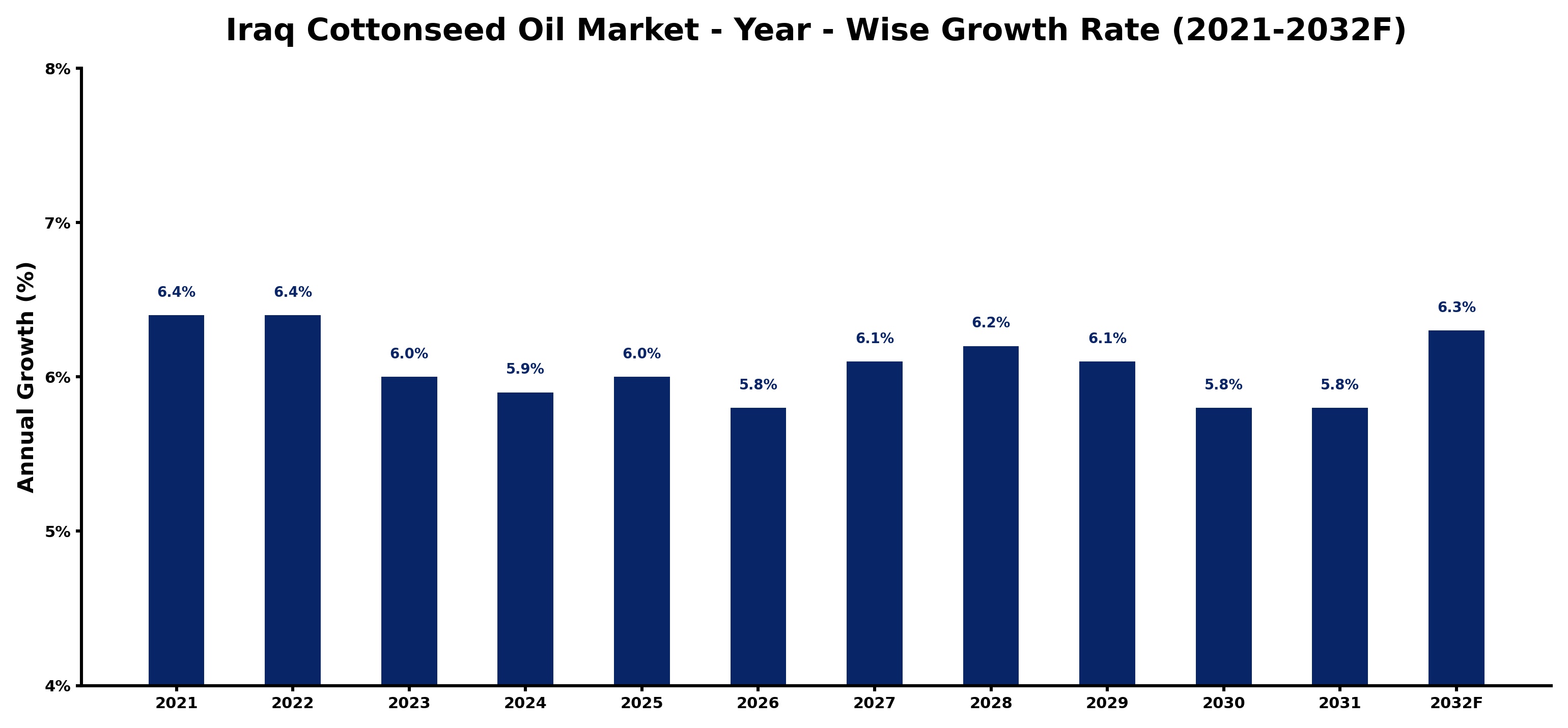
The table below presents the year‑wise growth rates along with the key drivers influencing the market
| Year | Growth Rate | Major Drivers |
| 2021 | 6.4% | Rapid growth in telecom and data center sectors |
| 2022 | 6.4% | Increasing adoption of advanced technologies |
| 2023 | 6.0% | Rising electricity demand across industries |
| 2024 | 5.9% | Expansion of manufacturing activities |
| 2025 | 6.0% | Increasing industrial infrastructure investments |
| 2026 | 5.8% | Growing renewable energy integration projects |
| 2027 | 6.1% | Increasing industrial infrastructure investments |
| 2028 | 6.2% | Increasing adoption of advanced technologies |
| 2029 | 6.1% | Growing urbanization and commercial development |
| 2030 | 5.8% | Rapid growth in telecom and data center sectors |
| 2031 | 5.8% | Growing renewable energy integration projects |
| 2032 | 6.3% | Expansion of manufacturing activities |
Note - Market size estimations and growth projections presented in this report are based on 6Wresearch's advanced forecasting approach, validated with industry datasets as of June 2026.
Iraq Cottonseed Oil Market Synopsis
The growing use of cottonseed oil in cooking and food processing showcases its versatility and affordability as a preferred cooking oil in Iraq. As consumers shift towards healthier cooking alternatives, the demand for cottonseed oil is anticipated to rise, reflecting broader trends in the food industry.
Furthermore, advancements in oil extraction technologies are enhancing the production quality of cottonseed oil, making it a more attractive option for both consumers and producers. Such innovations are critical in maximizing yield, addressing supply chain disruptions, and fostering competition within the market.
Iraq Cottonseed Oil Market Key Takeaways
- The market is projected to experience robust growth driven by health awareness and food industry expansion.
- Technological advancements in extraction methods are improving product quality and production efficiency.
- Government policies support domestic oil production and set quality standards to safeguard consumer interests.
- Raw material availability remains a challenge, influenced by fluctuations in cotton production.
- Competition from other vegetable oils necessitates strategic innovation and marketing efforts.
Evaluation of Restraints in Iraq Cottonseed Oil Market
Despite its growth potential, the Iraq Cottonseed Oil Market faces significant restraints primarily stemming from raw material availability and production efficiency. Cottonseed, as a byproduct of cotton farming, can be subject to fluctuations in supply based on the overall health of the cotton industry. Additionally, the presence of outdated extraction technologies has a direct impact on both the yield and quality of the oil produced, hindering the ability of local producers to compete with imported alternatives. These limitations underscore the necessity for investments in modern technologies to enhance processing capabilities and secure a more stable supply chain.
Iraq Cottonseed Oil Market Trends
Current trends indicate a growing preference for healthier cooking oils, prompting manufacturers to emphasize the nutritional benefits of cottonseed oil in their marketing strategies. Moreover, consumer demand for transparency in sourcing and production practices is influencing brand loyalty, pushing companies to adopt more sustainable practices. The rise of e-commerce platforms is also reshaping distribution channels, allowing producers to reach a broader audience and adapt to changing consumer preferences.
Iraq Cottonseed Oil Market Opportunities
There are several promising opportunities for growth within the Iraq Cottonseed Oil Market. Investment in state-of-the-art extraction facilities can significantly enhance oil quality and yield, catering to both local and export markets. Additionally, expanding the range of product applications—such as in margarine production and salad dressings—can capture a larger share of the food manufacturing sector. Collaborations with health-focused brands may also position cottonseed oil as a leading choice in health-conscious consumer segments.
Government Initiatives in the Iraq Cottonseed Oil Market
The Iraqi government is actively working to bolster domestic oil production through supportive policies aimed at enhancing quality standards and promoting consumer welfare. Regulatory frameworks are in place to ensure safe extraction methods and adherence to quality benchmarks, which protect public health. Furthermore, initiatives to incentivize investments in oil processing facilities and expand cottonseed cultivation reflect the government's commitment to developing a robust domestic market for cottonseed oil.
Future Insights of the Iraq Cottonseed Oil Market
Looking ahead to the period from 2026 to 2032, the Iraq Cottonseed Oil Market is poised for significant evolution. An anticipated increase in health consciousness among consumers will likely drive demand further, particularly for products that highlight nutritional advantages. The integration of advanced processing technologies could facilitate greater efficiency and output quality, aligning local producers more closely with international standards. This trajectory positions the market for sustained growth, underscoring the potential for both local and international investments.
Iraq Cottonseed Oil Market Latest Developments (May 2025 - June 2026)
Recent developments in the Iraq Cottonseed Oil Market reflect a strategic focus on enhancing production capabilities and expanding market access. Key initiatives include the introduction of modern extraction technology, which has improved the quality and yield of cottonseed oil. Additionally, manufacturers are increasingly exploring partnerships to diversify their product lines and meet the evolving preferences of health-conscious consumers. The market is witnessing a gradual shift towards more sustainable practices, which is expected to resonate positively with consumers.
Iraq Cottonseed Oil Market - Key Attractiveness of the Report
- 10 Years of Market Numbers
- Historical Data Starting from 2022 to 2025
- Base Year: 2025
- Forecast Data until 2032
- Key Performance Indicators Impacting the Market
- Major Upcoming Developments and Projects
Key Highlights of the Report:
- Iraq Cottonseed Oil Market Outlook
- Market Size of Iraq Cottonseed Oil Market, 2025
- Forecast of Iraq Cottonseed Oil Market, 2032
- Historical Data and Forecast of Iraq Cottonseed Oil Revenues & Volume for the Period 2022-2032F
- Iraq Cottonseed Oil Market Trend Evolution
- Iraq Cottonseed Oil Market Drivers and Challenges
- Iraq Cottonseed Oil Price Trends
- Iraq Cottonseed Oil Porter's Five Forces
- Iraq Cottonseed Oil Industry Life Cycle
- Historical Data and Forecast of Iraq Cottonseed Oil Market Revenues & Volume By Raw Material for the Period 2022-2032F
- Historical Data and Forecast of Iraq Cottonseed Oil Market Revenues & Volume By Genetically Modified Cotton for the Period 2022-2032F
- Historical Data and Forecast of Iraq Cottonseed Oil Market Revenues & Volume By Non-GM Cotton for the Period 2022-2032F
- Historical Data and Forecast of Iraq Cottonseed Oil Market Revenues & Volume By End-Users for the Period 2022-2032F
- Historical Data and Forecast of Iraq Cottonseed Oil Market Revenues & Volume By Retail for the Period 2022-2032F
- Historical Data and Forecast of Iraq Cottonseed Oil Market Revenues & Volume By Food Processing for the Period 2022-2032F
- Historical Data and Forecast of Iraq Cottonseed Oil Market Revenues & Volume By Cosmetics for the Period 2022-2032F
- Historical Data and Forecast of Iraq Cottonseed Oil Market Revenues & Volume By Other Applications for the Period 2022-2032F
- Iraq Cottonseed Oil Import Export Trade Statistics
- Market Opportunity Assessment By Raw Material
- Market Opportunity Assessment By End-Users
- Iraq Cottonseed Oil Top Companies Market Share
- Iraq Cottonseed Oil Competitive Benchmarking By Technical and Operational Parameters
- Iraq Cottonseed Oil Company Profiles
- Iraq Cottonseed Oil Key Strategic Recommendations






































