Iraq Cranes Market Size, Share & Growth Rate
The Iraq Cranes Market was estimated at USD 427 Million in 2025 and is projected to reach USD 592 Million by 2032, growing at a CAGR of 4.8% from 2026 to 2032. This growth trajectory is underpinned by a surge in infrastructure development projects across the nation, particularly within the construction, oil and gas, and mining sectors. As the demand for efficient lifting solutions intensifies, so does the incorporation of advanced technology, which is anticipated to further elevate operational standards in the industry.
Iraq Cranes Market Year-wise Growth Rate and Key Drivers
This graph highlights how the Iraq Cranes Market has steadily grown over the years, supported by major growth factors.
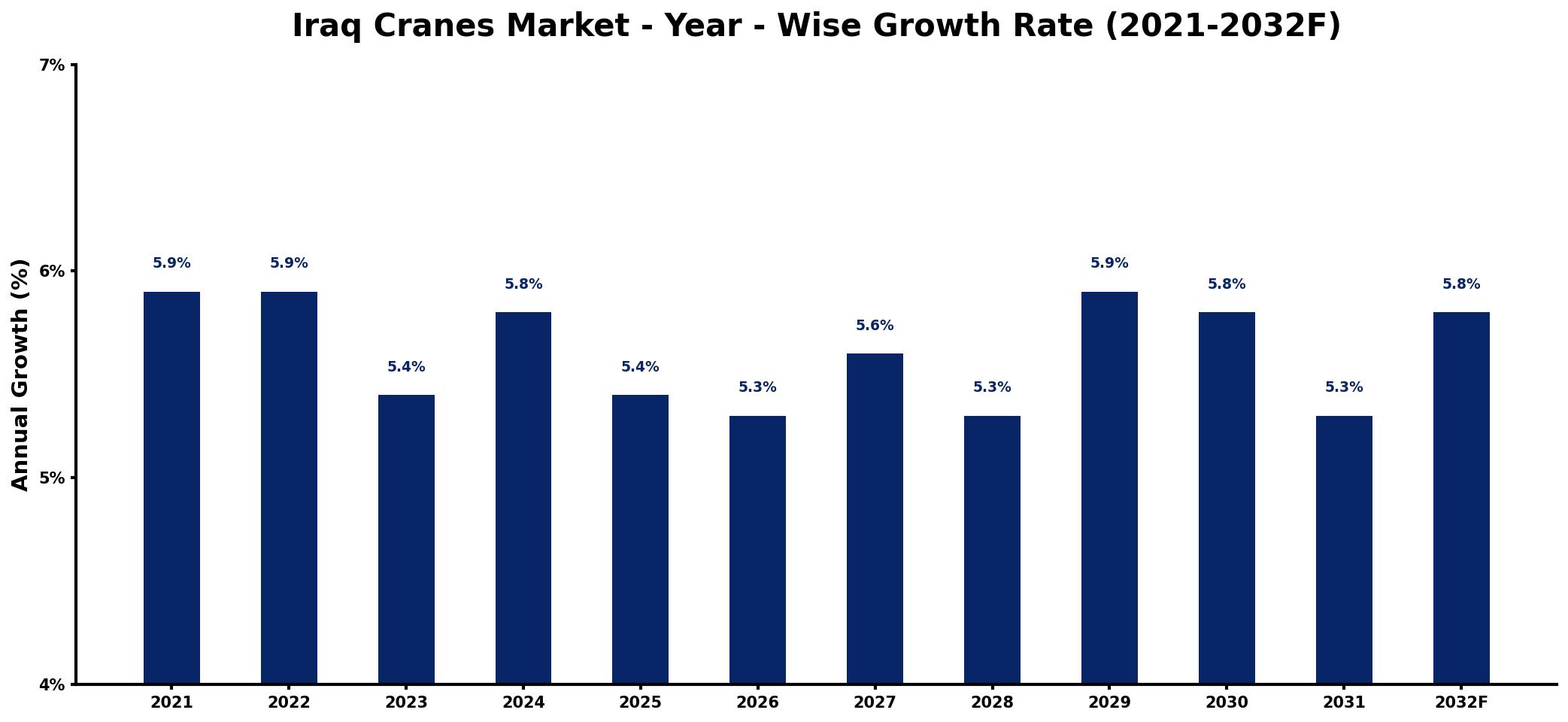
The table below presents the year‑wise growth rates along with the key drivers influencing the market
| Year | Growth Rate | Major Drivers |
| 2021 | 5.9% | Construction sector recovery initiatives |
| 2022 | 5.9% | Infrastructure development funding increase |
| 2023 | 5.4% | Real estate project launches rise |
| 2024 | 5.8% | Government construction projects expansion |
| 2025 | 5.4% | Energy sector investment growth |
| 2026 | 5.3% | Urbanization trends driving demand |
| 2027 | 5.6% | Public-private partnerships in infrastructure |
| 2028 | 5.3% | Logistics and transport sector investments |
| 2029 | 5.9% | Manufacturing sector capacity enhancements |
| 2030 | 5.8% | Technological advancements in construction |
| 2031 | 5.3% | International collaborations on projects |
| 2032 | 5.8% | Sustainable building practices adoption |
Note: Market size estimations and growth projections presented in this report are based on 6Wresearch's proprietary forecasting methodology, utilizing the latest available industry data, government publications, and primary research inputs.
Iraq Cranes Market Synopsis
The demand for cranes in Iraq is significantly driven by large-scale infrastructure projects, especially in urban areas. This includes the construction of roads, bridges, and commercial facilities, all of which necessitate reliable lifting and material handling equipment to ensure timely project delivery.
Moreover, the evolving landscape of industrial operations in Iraq indicates a rising need for specialized cranes equipped with cutting-edge technology. As industries adopt more automated solutions, the requirement for cranes that enhance safety and efficiency becomes paramount, thus stimulating market dynamics.
Iraq Cranes Market Key Takeaways
- The market is fueled by increased infrastructure development and government-backed industrial initiatives.
- Technological advancements, including automation and telematics, are transforming operational efficiency in the cranes market.
- Logistical challenges and regulatory complexities continue to pose significant obstacles for crane operations.
- Local manufacturers are urged to focus on differentiation through quality and customer service to compete with international players.
- The government's investment in training programs is enhancing workforce skills, crucial for safety and operational excellence.
Evaluation of Restraints in Iraq Cranes Market
Despite the promising growth trajectory, the Iraq Cranes Market faces several restraints that could impede its potential. One notable issue is the inadequate infrastructure that complicates the transportation and deployment of cranes across the country. These logistical challenges can delay project timelines and add unforeseen costs. Furthermore, the existing regulatory environment is complex and often bureaucratic, leading to uncertainties and extended procurement processes. In a competitive landscape dominated by international manufacturers, local entities must navigate these barriers effectively to sustain their market presence.
Iraq Cranes Market Trends
Current trends indicate a shift towards the adoption of smart cranes, incorporating IoT and telematics to enhance operational monitoring and efficiency. There is also a growing emphasis on sustainability, with manufacturers focusing on eco-friendly cranes that align with global standards. Additionally, the rental market for cranes is gaining traction, providing flexibility for businesses wary of committing large capital expenditures for equipment ownership.
Iraq Cranes Market Opportunities
Significant growth opportunities lie in the burgeoning oil and gas sector, where advanced lifting solutions are essential for exploration and production activities. Furthermore, as governmental policies favor infrastructure development, contractors in public works projects are seeking modern, reliable cranes. The ongoing urbanization efforts, particularly in major cities, further expand the potential market for innovative crane solutions that cater to diverse operational needs.
Government Initiatives in the Iraq Cranes Market
To bolster the cranes market, the Iraqi government has introduced policies aimed at promoting local manufacturing and reducing import tariffs on advanced machinery. These initiatives include tax incentives for manufacturers and subsidies for construction firms that utilize cranes for public infrastructure projects. Additionally, efforts to streamline regulations and enhance training programs for crane operators are designed to foster a more skilled workforce, ultimately contributing to safer and more efficient crane operations.
Future Insights of the Iraq Cranes Market
Looking ahead to 2026-2032, the Iraq Cranes Market is poised for significant evolution, driven by continued investments in infrastructure and industrial expansion. Emerging technologies are set to redefine efficiency standards, while increasing collaboration between government and private sectors will likely stimulate further demand. The market's growth will hinge on overcoming current logistical and regulatory challenges, but the overall outlook remains optimistic, as the trajectory aligns with Iraq's broader economic objectives.
Iraq Cranes Market Latest Developments (2025 - 2026)
Recent developments indicate a shift towards greater collaboration between local manufacturers and international technology providers. This partnership aims to integrate advanced crane technologies that enhance safety and productivity within the market. Additionally, the government has initiated several infrastructure projects that prioritize local sourcing of materials and equipment, underscoring its commitment to stimulating domestic industries while advancing large-scale construction efforts.
Iraq Cranes Market - Key Attractiveness of the Report
- 10 Years of Market Numbers
- Historical Data Starting from 2022 to 2025
- Base Year: 2025
- Forecast Data until 2032
- Key Performance Indicators Impacting the Market
- Major Upcoming Developments and Projects
Key Highlights of the Report:
- Iraq Cranes Market Outlook
- Market Size of Iraq Cranes Market, 2025
- Forecast of Iraq Cranes Market, 2032
- Historical Data and Forecast of Iraq Cranes Revenues & Volume for the Period 2022-2032F
- Iraq Cranes Market Trend Evolution
- Iraq Cranes Market Drivers and Challenges
- Iraq Cranes Price Trends
- Iraq Cranes Porter's Five Forces
- Iraq Cranes Industry Life Cycle
- Historical Data and Forecast of Iraq Cranes Market Revenues & Volume By Product Type for the Period 2022-2032F
- Historical Data and Forecast of Iraq Cranes Market Revenues & Volume By Mobile for the Period 2022-2032F
- Historical Data and Forecast of Iraq Cranes Market Revenues & Volume By Fixed for the Period 2022-2032F
- Historical Data and Forecast of Iraq Cranes Market Revenues & Volume By Marine for the Period 2022-2032F
- Historical Data and Forecast of Iraq Cranes Market Revenues & Volume By End-User for the Period 2022-2032F
- Historical Data and Forecast of Iraq Cranes Market Revenues & Volume By Construction for the Period 2022-2032F
- Historical Data and Forecast of Iraq Cranes Market Revenues & Volume By Mining for the Period 2022-2032F
- Historical Data and Forecast of Iraq Cranes Market Revenues & Volume By Industrial for the Period 2022-2032F
- Historical Data and Forecast of Iraq Cranes Market Revenues & Volume By Oil & Gas for the Period 2022-2032F
- Historical Data and Forecast of Iraq Cranes Market Revenues & Volume By Others for the Period 2022-2032F
- Iraq Cranes Import Export Trade Statistics
- Market Opportunity Assessment By Product Type
- Market Opportunity Assessment By End-User
- Iraq Cranes Top Companies Market Share
- Iraq Cranes Competitive Benchmarking By Technical and Operational Parameters
- Iraq Cranes Company Profiles
- Iraq Cranes Key Strategic Recommendations






































