Iraq Dark Analytics Market Size & Growth Rate (2026-2032)
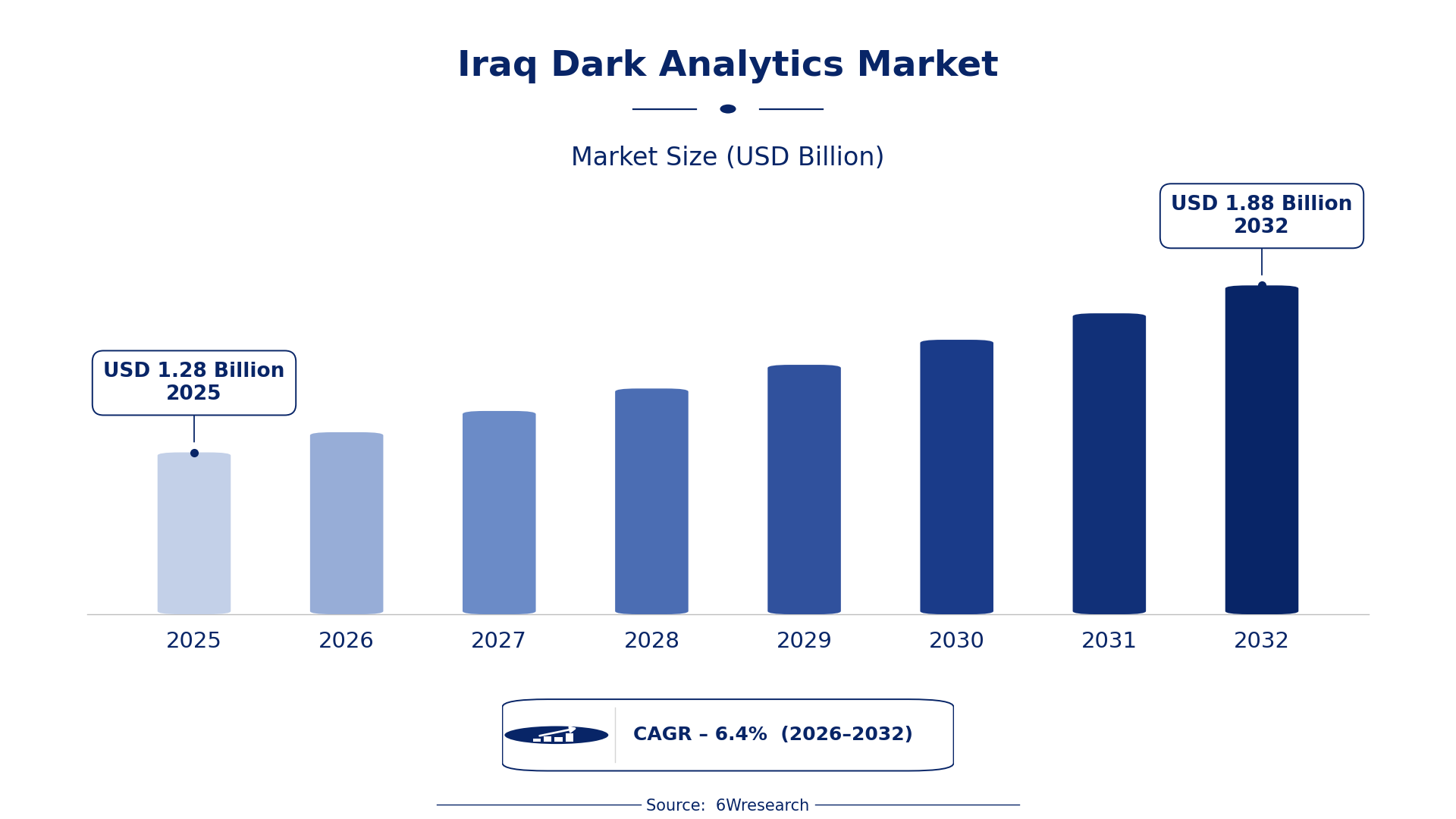
The Iraq Dark Analytics Market was estimated at USD 1284 Million in 2025 and is projected to reach USD 1880 Million by 2032, growing at a CAGR of 6.4% from 2026 to 2032.
Iraq Dark Analytics Market Synopsis
The increasing volume of unstructured data is the most influential factor shaping the Iraq Dark Analytics Market today. Organizations across various sectors are recognizing the untapped potential of dark data, prompting a shift towards advanced analytics solutions to derive actionable insights.
Industries such as banking, oil & gas, and healthcare are at the forefront of this trend, utilizing dark analytics to enhance decision-making processes. However, the market also faces significant challenges, including data privacy concerns and regulatory compliance, which must be navigated to achieve sustainable growth.
Iraq Dark Analytics Market Year-wise Growth Rate and Key Drivers
This graph illustrates the annual growth rates of the Iraq Dark Analytics Market from 2021 to 2032, highlighting a steady upward trajectory and projected expansion over the forecast period.
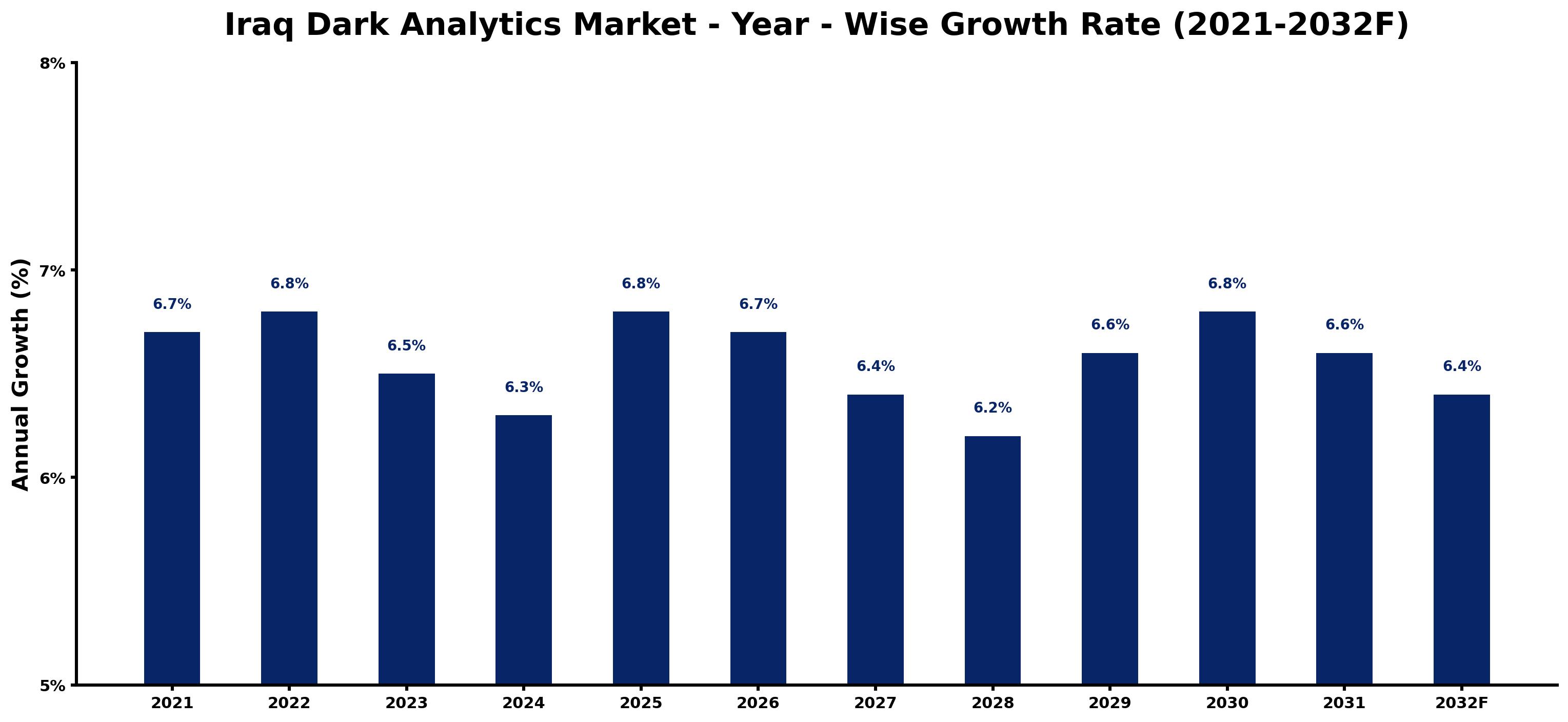
The table below presents the year‑wise growth rates along with the key drivers influencing the market
| Year | Growth Rate | Major Drivers |
| 2021 | 6.7% | Launch of national cybersecurity strategy by Iraqi government. |
| 2022 | 6.8% | Increased demand for analytics in oil and energy sectors. |
| 2023 | 6.5% | New regulations on data retention by Iraqi telecommunications authority. |
| 2024 | 6.3% | Rising investments in sector-specific analytics training programs. |
| 2025 | 6.8% | Growth in mobile banking driving need for dark analytics. |
| 2026 | 6.7% | Government push for digitization in public sector services. |
| 2027 | 6.4% | Increased cyber threats prompting enhanced data analysis tools. |
| 2028 | 6.2% | Partnerships between local universities and tech firms for research. |
| 2029 | 6.6% | Adoption of blockchain for data integrity in transactions. |
| 2030 | 6.8% | Emergence of local startups innovating in analytics solutions. |
| 2031 | 6.6% | Focus on enhancing national resilience against cyber attacks. |
| 2032 | 6.4% | The rise of e-commerce necessitating better fraud detection tools. |
Note: Market size estimations and growth projections presented in this report are based on 6Wresearch's proprietary forecasting methodology, utilizing the latest available industry data, government publications, and primary research inputs.
Iraq Dark Analytics Market Key Takeaways
Below are some of the specific key takeaways from the market, including:
- The market is driven by a surge in unstructured data generated across multiple sectors.
- Adoption of AI and machine learning is critical for extracting insights from dark data.
- Government policies are evolving to balance innovation and data security.
- Challenges such as cybersecurity and skill shortages must be addressed for growth.
- Future opportunities lie in developing specialized dark analytics tools.
Evaluation of Restraints in Iraq Dark Analytics Market
Several constraints are currently inhibiting the Iraq Dark Analytics Market. A notable challenge is the limited access to reliable data sources, which hampers organizations' ability to fully utilize dark analytics. Additionally, the regional political and economic instability contributes to uncertainty, making investment in analytics technologies less attractive. The shortage of skilled professionals adept in data analysis further complicates matters, limiting the effective extraction of insights from unstructured data. Addressing these issues is vital for the market's advancement.
Iraq Dark Analytics Market Trends
A prominent trend in the Iraq Dark Analytics Market is the growing emphasis on advanced analytics technologies. Companies are increasingly deploying AI and machine learning algorithms to mine dark data, with a focus on integrating these solutions into existing business intelligence frameworks. Additionally, the market is witnessing a rise in specialized tools designed specifically for dark analytics, catering to the unique needs of different industries. This trend reflects a broader recognition of the competitive advantages that can be gained through effective data utilization.
Iraq Dark Analytics Market Opportunities
The Iraq Dark Analytics Market presents numerous opportunities for growth and investment. As organizations strive to tap into their dark data reservoirs, the demand for advanced analytics tools will continue to increase. There is a significant potential for partnerships between technology providers and local businesses to develop tailored solutions. on top of that, as awareness of dark data's value grows, educational initiatives aimed at upskilling the workforce could facilitate the broader adoption of analytics technologies.
Government Initiatives in the Iraq Dark Analytics Market
The Iraqi government is actively shaping the Dark Analytics Market through various initiatives aimed at enhancing data privacy and security. These efforts are critical in fostering an environment conducive to innovation while ensuring the protection of sensitive information. Regulatory frameworks are being established to govern the use of dark analytics tools, reflecting a commitment to addressing cybersecurity concerns.
- A national cybersecurity strategy was recently completed, focusing on safeguarding data in the analytics sector.
- Current initiatives include the rollout of a data protection regulatory framework to monitor dark analytics practices.
- The government is currently implementing public-private partnerships aimed at enhancing digital infrastructure capabilities.
- A planned initiative to develop a national talent development program for data analytics professionals is expected to launch in 2026.
Future Insights of the Iraq Dark Analytics Market
Looking ahead, the Iraq Dark Analytics Market is set for steady growth through 2026-2032. Organizations are becoming increasingly aware of the need to leverage dark data to gain competitive advantages. With advancements in technology and growing investments in data infrastructure, businesses will increasingly prioritize data-driven decision-making strategies. This shift will likely spur demand for innovative analytics solutions tailored to address the unique challenges faced by Iraqi industries.
Iraq Dark Analytics Market Latest Developments
In the last year, the Iraq Dark Analytics Market has seen a flurry of activity, signaling a burgeoning interest in data analytics solutions. Companies are investing in new technologies and partnerships, aiming to enhance their capabilities in dark analytics. This momentum reflects a broader trend of recognition among Iraqi businesses regarding the importance of unstructured data.
- A leading regional operator announced a partnership in early 2025 to develop a new dark analytics platform tailored for the healthcare sector.
- A major technology vendor is currently upgrading its analytics tools to incorporate machine learning capabilities, with implementation underway.
- An initiative to enhance data literacy among employees began in Q1 2025 and is expected to conclude by Q4 2025.
- A planned product launch of an advanced dark analytics tool is anticipated in mid-2026, focusing on the oil & gas industry.
Iraq Dark Analytics Market - Key Attractiveness of the Report
- 10 Years of Market Numbers
- Historical Data Starting from 2022 to 2025
- Base Year: 2025
- Forecast Data until 2032
- Key Performance Indicators Impacting the Market
- Major Upcoming Developments and Projects
Industries such as banking, oil & gas, and healthcare are at the forefront of adopting dark analytics solutions, utilizing advanced tools to improve decision-making and operational efficiency.
Key Highlights of the Report:
- Iraq Dark Analytics Market Outlook
- Market Size of Iraq Dark Analytics Market, 2025
- Forecast of Iraq Dark Analytics Market, 2032
- Historical Data and Forecast of Iraq Dark Analytics Revenues & Volume for the Period 2022-2032F
- Iraq Dark Analytics Market Trend Evolution
- Iraq Dark Analytics Market Drivers and Challenges
- Iraq Dark Analytics Price Trends
- Iraq Dark Analytics Porter's Five Forces
- Iraq Dark Analytics Industry Life Cycle
- Historical Data and Forecast of Iraq Dark Analytics Market Revenues & Volume By Component for the Period 2022-2032F
- Historical Data and Forecast of Iraq Dark Analytics Market Revenues & Volume By Solutions for the Period 2022-2032F
- Historical Data and Forecast of Iraq Dark Analytics Market Revenues & Volume By Services for the Period 2022-2032F
- Historical Data and Forecast of Iraq Dark Analytics Market Revenues & Volume By Business Application for the Period 2022-2032F
- Historical Data and Forecast of Iraq Dark Analytics Market Revenues & Volume By Marketing for the Period 2022-2032F
- Historical Data and Forecast of Iraq Dark Analytics Market Revenues & Volume By Operations for the Period 2022-2032F
- Historical Data and Forecast of Iraq Dark Analytics Market Revenues & Volume By Finance for the Period 2022-2032F
- Historical Data and Forecast of Iraq Dark Analytics Market Revenues & Volume By Human Resource (HR) for the Period 2022-2032F
- Historical Data and Forecast of Iraq Dark Analytics Market Revenues & Volume By Deployment Mode for the Period 2022-2032F
- Historical Data and Forecast of Iraq Dark Analytics Market Revenues & Volume By Cloud for the Period 2022-2032F
- Historical Data and Forecast of Iraq Dark Analytics Market Revenues & Volume By On-premises for the Period 2022-2032F
- Historical Data and Forecast of Iraq Dark Analytics Market Revenues & Volume By Vertical for the Period 2022-2032F
- Historical Data and Forecast of Iraq Dark Analytics Market Revenues & Volume By Retail & E-commerce for the Period 2022-2032F
- Historical Data and Forecast of Iraq Dark Analytics Market Revenues & Volume By BFSI for the Period 2022-2032F
- Historical Data and Forecast of Iraq Dark Analytics Market Revenues & Volume By Healthcare for the Period 2022-2032F
- Historical Data and Forecast of Iraq Dark Analytics Market Revenues & Volume By Travel & Hospitality for the Period 2022-2032F
- Historical Data and Forecast of Iraq Dark Analytics Market Revenues & Volume By Government for the Period 2022-2032F
- Historical Data and Forecast of Iraq Dark Analytics Market Revenues & Volume By Telecommunication for the Period 2022-2032F
- Historical Data and Forecast of Iraq Dark Analytics Market Revenues & Volume By Others for the Period 2022-2032F
- Iraq Dark Analytics Import Export Trade Statistics
- Market Opportunity Assessment By Component
- Market Opportunity Assessment By Business Application
- Market Opportunity Assessment By Deployment Mode
- Market Opportunity Assessment By Vertical
- Iraq Dark Analytics Top Companies Market Share
- Iraq Dark Analytics Competitive Benchmarking By Technical and Operational Parameters
- Iraq Dark Analytics Company Profiles
- Iraq Dark Analytics Key Strategic Recommendations






































