Iraq Desiccated Coconut Market Size, Share & Growth Rate
The Iraq Desiccated Coconut Market was estimated at USD 534 Million in 2025 and is projected to reach USD 772 Million by 2032, growing at a CAGR of 5.4% from 2026 to 2032. This steady growth trajectory can be attributed to a notable increase in consumer awareness regarding the health benefits of coconut products, as well as a burgeoning food processing sector. Moreover, rising disposable incomes and a shift towards plant-based diets are further propelling the market's expansion.
Iraq Desiccated Coconut Market Year-wise Growth Rate and Key Drivers
This graph highlights how the Iraq Desiccated Coconut Market has steadily grown over the years, supported by major growth factors.
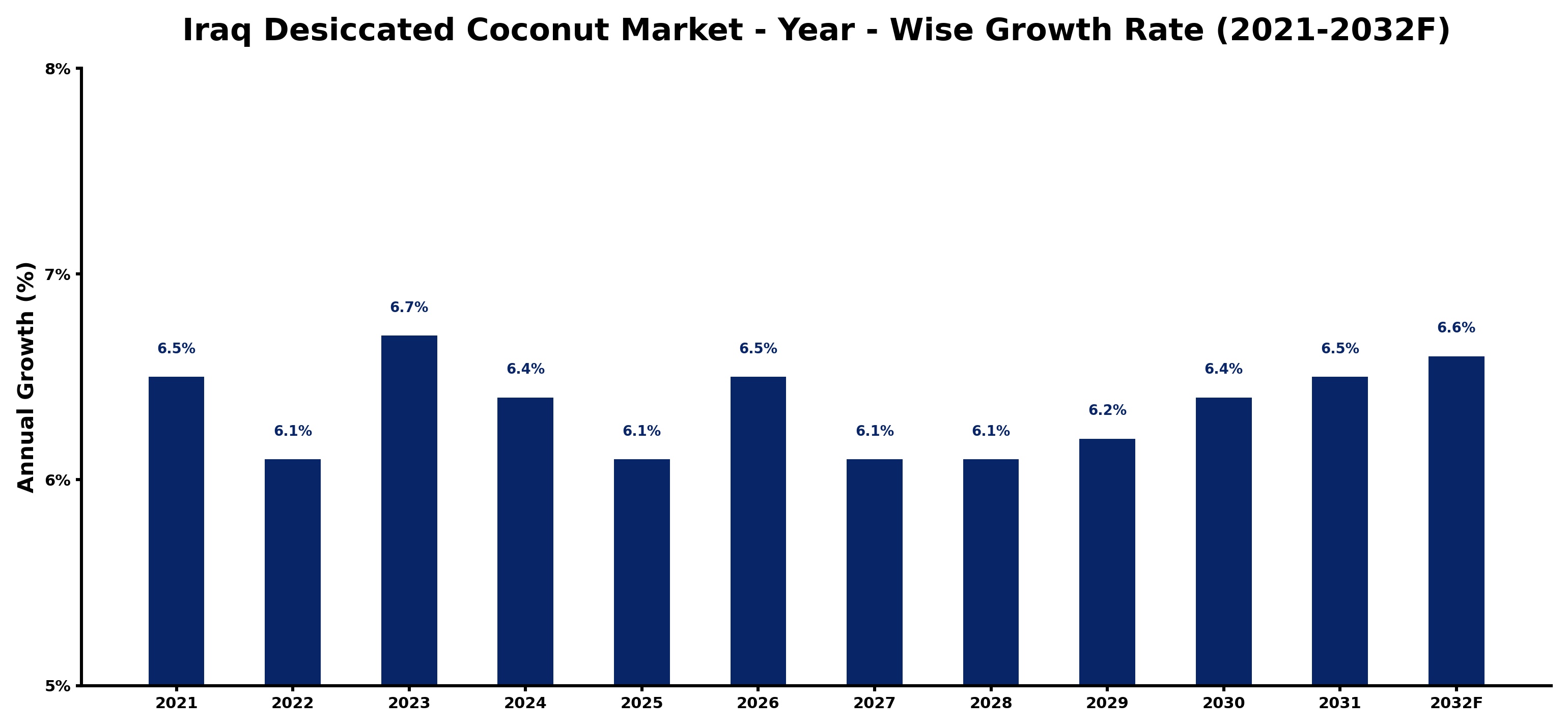
The table below presents the year‑wise growth rates along with the key drivers influencing the market
| Year | Growth Rate | Major Drivers |
| 2021 | 6.5% | Health trends increased coconut demand |
| 2022 | 6.1% | Culinary innovation drove product variety |
| 2023 | 6.7% | Export opportunities expanded market reach |
| 2024 | 6.4% | Local production enhanced supply chain |
| 2025 | 6.1% | Consumer awareness of health benefits |
| 2026 | 6.5% | Sustainable sourcing practices gained popularity |
| 2027 | 6.1% | E-commerce growth improved accessibility |
| 2028 | 6.1% | Coconut-based products diversified offerings |
| 2029 | 6.2% | Food industry collaborations increased visibility |
| 2030 | 6.4% | Nutritional awareness boosted sales growth |
| 2031 | 6.5% | Cultural cuisine integration expanded market |
| 2032 | 6.6% | Social media marketing enhanced engagement |
Note - Market size estimations and growth projections presented in this report are based on 6Wresearch's advanced forecasting approach, validated with industry datasets as of June 2026.
Iraq Desiccated Coconut Market Synopsis
A significant aspect of the Iraq Desiccated Coconut Market is the rising demand for this ingredient in the food and beverage sector. Desiccated coconut is increasingly favored in baked goods, confectionery, and breakfast cereals, enhancing its appeal among both manufacturers and consumers. The product's versatility and health attributes solidify its position in a rapidly evolving culinary landscape.
On the supply side, the Iraqi market faces challenges, particularly regarding the availability of raw coconuts due to the country's arid climate. This dependency on imports not only raises costs but also influences profit margins for local producers. Nevertheless, the commitment to quality improvement and product innovation is enabling industry players to meet the growing demand effectively.
Iraq Desiccated Coconut Market Key Takeaways
- The market is projected to grow significantly, driven by increased consumer awareness of coconut health benefits.
- Desiccated coconut is becoming a staple ingredient across various food and beverage applications.
- Investment opportunities are emerging for processing facilities and partnerships with local suppliers.
- Government policies aim to enhance production standards and support local farmers.
- Emerging trends include the introduction of organic and flavored desiccated coconut options.
Evaluation of Restraints in Iraq Desiccated Coconut Market
Despite the promising growth, the Iraq Desiccated Coconut Market faces notable restraints. The limited availability of raw coconuts, a consequence of environmental conditions, leads to reliance on imports, which can be both costly and logistically challenging. Additionally, inconsistent quality control measures and a lack of standardized production processes can create product variability, which undermines consumer trust. Infrastructure limitations, compounded by regional political instability, may also disrupt supply chains and hinder overall market advancement.
Iraq Desiccated Coconut Market Trends
Currently, the market is experiencing a surge in popularity due to heightened consumer awareness about health benefits associated with coconut-based products. There is a growing inclination towards incorporating natural and organic ingredients in food production, driving demand for desiccated coconut. Additionally, manufacturers are focusing on product innovation, introducing flavored and organic options to cater to a more health-conscious demographic. This aligns with the broader trend of plant-based eating, which is gaining traction among Iraqi consumers.
Iraq Desiccated Coconut Market Opportunities
Investors are presented with lucrative opportunities in the Iraq Desiccated Coconut Market, particularly in establishing processing facilities and enhancing distribution channels. As local demand rises, partnerships with domestic suppliers can help meet this growing need effectively. Furthermore, investing in research and development for innovative coconut-based products tailored to the preferences of Iraqi consumers can yield significant returns, capitalizing on the market's expansion potential.
Government Initiatives in the Iraq Desiccated Coconut Market
The Iraqi government has implemented several policies to support the Desiccated Coconut Market. These initiatives include establishing quality standards for production, enforcing food safety regulations, and promoting sustainable agricultural practices. Furthermore, there are incentives in place for local coconut farmers and processors to boost domestic production and enhance export capabilities. By fostering a competitive environment, these policies aim to ensure the market's growth while maintaining consumer health and safety.
Future Insights of the Iraq Desiccated Coconut Market
Looking ahead to 2026-2032, the Iraq Desiccated Coconut Market is poised for continuous growth. Factors such as increasing health consciousness among consumers and the rising popularity of coconut-based snacks and beverages will likely propel demand. The adaptability of desiccated coconut across various culinary applications, combined with its long shelf life, further strengthens its market position. As food innovation flourishes in Iraq, opportunities for diversified product offerings will expand, making this an exciting market for stakeholders.
Iraq Desiccated Coconut Market Latest Developments (May 2025 - June 2026)
Recent developments in the Iraq Desiccated Coconut Market indicate a shift towards greater product diversification and enhancement of distribution networks. Key players are increasingly focusing on establishing partnerships with local suppliers to ensure quality and consistency in product offerings. Additionally, several manufacturers have begun exploring export opportunities, aiming to tap into the international market while meeting the growing domestic demand.
Iraq Desiccated Coconut Market - Key Attractiveness of the Report
- 10 Years of Market Numbers
- Historical Data Starting from 2022 to 2025
- Base Year: 2025
- Forecast Data until 2032
- Key Performance Indicators Impacting the Market
- Major Upcoming Developments and Projects
Key Highlights of the Report:
- Iraq Desiccated Coconut Market Outlook
- Market Size of Iraq Desiccated Coconut Market, 2025
- Forecast of Iraq Desiccated Coconut Market, 2032
- Historical Data and Forecast of Iraq Desiccated Coconut Revenues & Volume for the Period 2022-2032F
- Iraq Desiccated Coconut Market Trend Evolution
- Iraq Desiccated Coconut Market Drivers and Challenges
- Iraq Desiccated Coconut Price Trends
- Iraq Desiccated Coconut Porter's Five Forces
- Iraq Desiccated Coconut Industry Life Cycle
- Historical Data and Forecast of Iraq Desiccated Coconut Market Revenues & Volume By Cut Type for the Period 2022-2032F
- Historical Data and Forecast of Iraq Desiccated Coconut Market Revenues & Volume By Regular cut for the Period 2022-2032F
- Historical Data and Forecast of Iraq Desiccated Coconut Market Revenues & Volume By Fancy cut for the Period 2022-2032F
- Historical Data and Forecast of Iraq Desiccated Coconut Market Revenues & Volume By Fat Content for the Period 2022-2032F
- Historical Data and Forecast of Iraq Desiccated Coconut Market Revenues & Volume By High fat content for the Period 2022-2032F
- Historical Data and Forecast of Iraq Desiccated Coconut Market Revenues & Volume By Low fat content for the Period 2022-2032F
- Historical Data and Forecast of Iraq Desiccated Coconut Market Revenues & Volume By Distribution Channel for the Period 2022-2032F
- Historical Data and Forecast of Iraq Desiccated Coconut Market Revenues & Volume By Supermarket for the Period 2022-2032F
- Historical Data and Forecast of Iraq Desiccated Coconut Market Revenues & Volume By Specialty stores for the Period 2022-2032F
- Historical Data and Forecast of Iraq Desiccated Coconut Market Revenues & Volume By Online sales for the Period 2022-2032F
- Historical Data and Forecast of Iraq Desiccated Coconut Market Revenues & Volume By Retail stores for the Period 2022-2032F
- Iraq Desiccated Coconut Import Export Trade Statistics
- Market Opportunity Assessment By Cut Type
- Market Opportunity Assessment By Fat Content
- Market Opportunity Assessment By Distribution Channel
- Iraq Desiccated Coconut Top Companies Market Share
- Iraq Desiccated Coconut Competitive Benchmarking By Technical and Operational Parameters
- Iraq Desiccated Coconut Company Profiles
- Iraq Desiccated Coconut Key Strategic Recommendations






































