Iraq Digital Lending Market Size & Growth Rate (2026-2032)
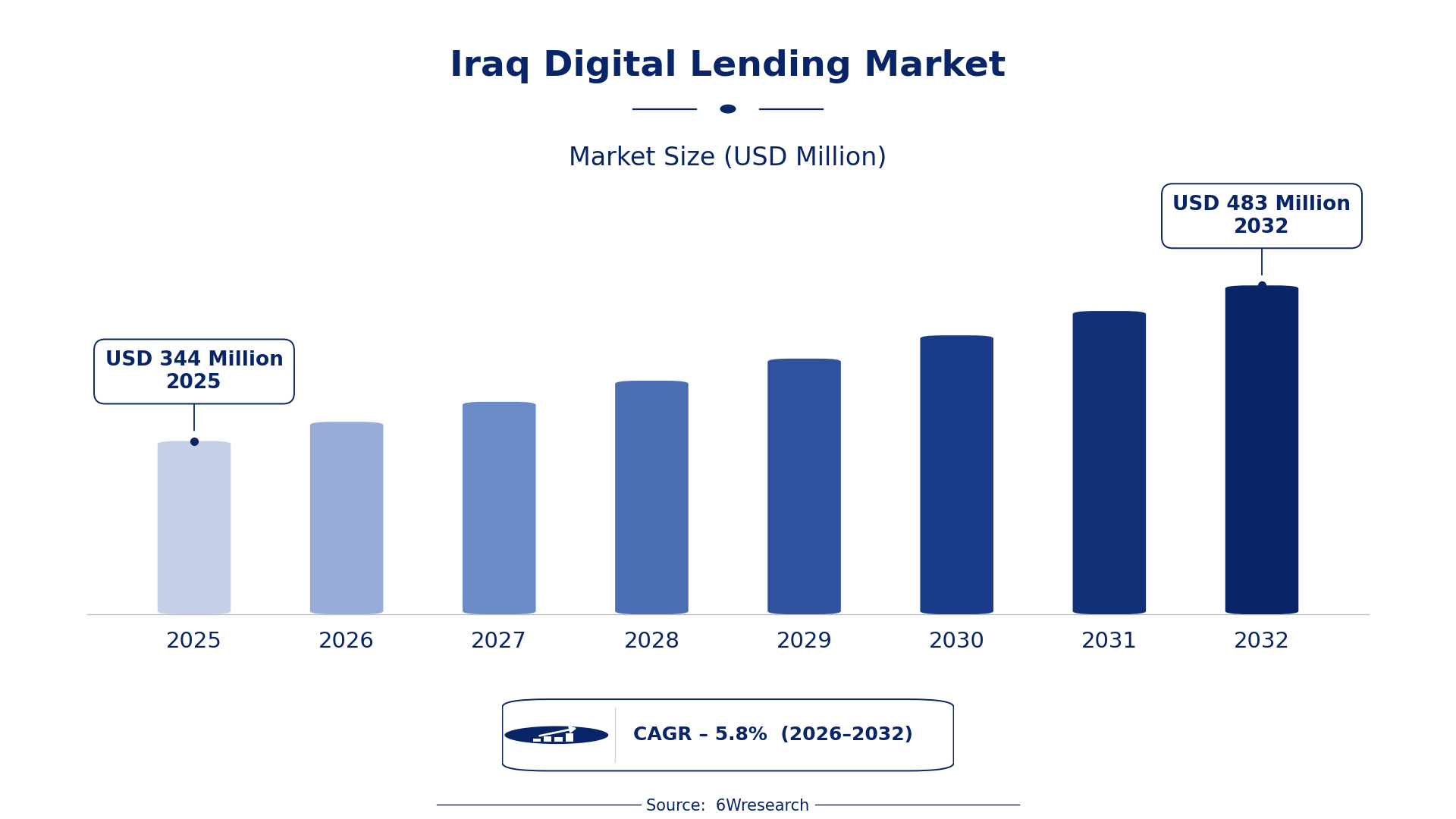
The Iraq Digital Lending Market was estimated at USD 344 Million in 2025 and is projected to reach USD 483 Million by 2032, growing at a CAGR of 5.8% from 2026 to 2032.
Iraq Digital Lending Market Synopsis
The driving force behind the Iraq Digital Lending Market is the rapid rise in smartphone adoption and internet connectivity. With a large segment of the population still unbanked, digital lending platforms are stepping in to fill a critical gap in the financial services ecosystem.
In a country where access to traditional banking remains limited, fintech companies are innovating to provide users with fast and convenient credit solutions. This growing demand is catalyzing a shift toward digital financial services, positioning Iraq as a burgeoning market for digital lending.
Iraq Digital Lending Market Year-wise Growth Rate and Key Drivers
This graph illustrates the annual growth rates of the Iraq Digital Lending Market from 2021 to 2032, highlighting a steady upward trajectory and projected expansion over the forecast period.
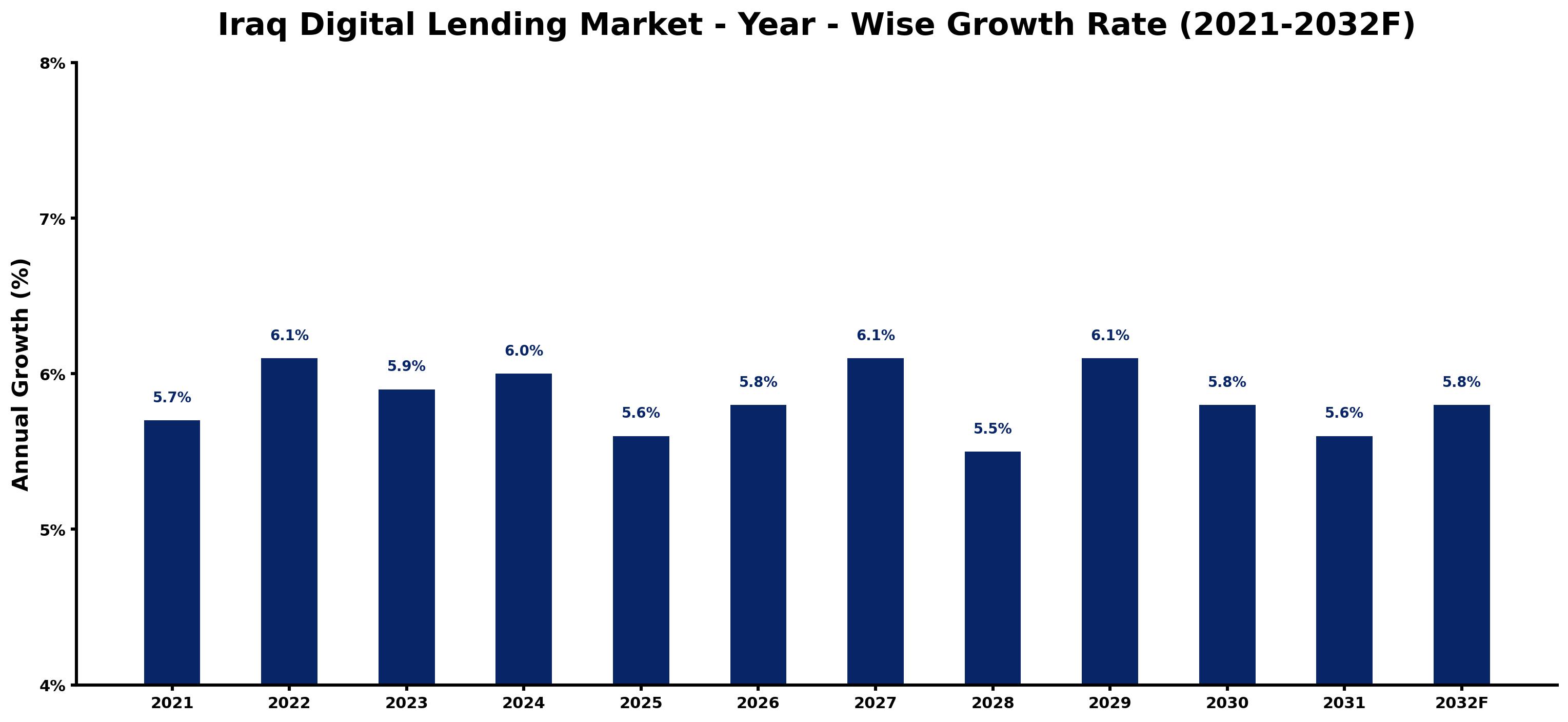
The table below presents the year‑wise growth rates along with the key drivers influencing the market
| Year | Growth Rate | Major Drivers |
| 2021 | 5.7% | Central Bank of Iraq promotes digital financial services |
| 2022 | 6.1% | Increased smartphone penetration boosts lending app usage |
| 2023 | 5.9% | Youth population drives demand for accessible finance options |
| 2024 | 6.0% | Growing fintech ecosystem enhances competition and innovation |
| 2025 | 5.6% | Government initiatives support financial inclusion programs |
| 2026 | 5.8% | Rising e-commerce surged demand for consumer credit solutions |
| 2027 | 6.1% | Enhanced digital infrastructure facilitates online lending growth |
| 2028 | 5.5% | Increased remittances fuel personal loan applications |
| 2029 | 6.1% | Partnerships between banks and fintechs expand lending reach |
| 2030 | 5.8% | Regulatory reforms streamline digital lending processes |
| 2031 | 5.6% | Local startups innovate tailored loan products for youth |
| 2032 | 5.8% | Educational campaigns raise awareness on digital financial services |
Note: Market size estimations and growth projections presented in this report are based on 6Wresearch's proprietary forecasting methodology, utilizing the latest available industry data, government publications, and primary research inputs.
Iraq Digital Lending Market Key Takeaways
Below are some of the specific key takeaways from the market, including:
- Strong growth driven by increasing smartphone usage and internet access.
- A significant portion of the population remains unbanked, creating a high demand for digital lending solutions.
- Government initiatives are aimed at fostering financial inclusion and enhancing the regulatory framework.
- Fintech innovations are reshaping how credit is accessed, making it faster and more convenient.
- Challenges remain, particularly around regulatory compliance and cybersecurity issues.
Evaluation of Restraints in Iraq Digital Lending Market
The Iraq Digital Lending Market faces several key constraints that limit its growth potential. A primary concern is the absence of a comprehensive credit scoring system, which hampers accurate assessments of borrowers' creditworthiness. This not only increases risk for lenders but can also lead to higher default rates.
Additionally, informal lending practices persist, complicating the regulatory landscape and potentially leading to exploitative interest rates. Without a structured approach to consumer protection and transparent lending practices, building trust in digital lending remains a significant challenge.
Iraq Digital Lending Market Trends
One of the most notable trends in the Iraq Digital Lending Market is the increasing reliance on mobile lending platforms. These services cater to the urgent need for credit among individuals and small businesses, offering quick access to funds. As financial literacy improves, more users are expected to adopt these digital solutions.
on top of that, partnerships between fintech companies and traditional banks are becoming more common, facilitating a smoother integration of digital lending services into the existing financial framework. This collaboration is essential for scaling operations and expanding the customer base.
Iraq Digital Lending Market Opportunities
Opportunities in the Iraq Digital Lending Market are abundant, particularly for companies willing to innovate. With a large unbanked population, there is a clear need for accessible credit solutions tailored to diverse customer profiles. Fintech companies can capitalize on this by developing user-friendly applications that simplify the borrowing process.
on top of that, as the government pushes for financial inclusion and digital payments, fintech firms can expect supportive policies that enhance their operational capabilities. Investments in cybersecurity and data protection will also be crucial as companies look to build consumer trust.
Government Initiatives in the Iraq Digital Lending Market
Government policies are actively shaping the Iraq Digital Lending Market by promoting a framework conducive to financial inclusion. The Central Bank of Iraq is implementing regulatory guidelines that require digital lending platforms to adhere to anti-money laundering measures and consumer protection standards, fostering a safer environment for both lenders and borrowers.
- A regulatory framework introduced in 2025 mandates transparency in billing practices for digital lenders.
- A national digital infrastructure upgrade program is currently underway, aimed at enhancing internet access across urban and rural areas.
- Ongoing workshops and training sessions for fintech companies focus on compliance with new regulatory standards.
- Planned public-private partnerships are expected to expand access to digital financial services by 2028.
- The Central Bank is developing a national credit scoring system to improve lending assessments, set to launch in 2026.
Future Insights of the Iraq Digital Lending Market
Looking ahead to 2026-2032, the Iraq Digital Lending Market is expected to experience substantial growth. Increasing smartphone penetration and improved internet infrastructure will likely drive demand for digital lending services, especially among the unbanked population.
The ongoing government initiatives aimed at financial inclusion will create an even more favorable environment for fintech innovations. While challenges such as regulatory compliance and security will remain, the overall outlook for the digital lending sector in Iraq is optimistic, with substantial opportunities for investment and expansion.
Iraq Digital Lending Market Latest Developments
Recent activity in the Iraq Digital Lending Market indicates a strong momentum towards digital transformation. Over the past year, numerous fintech startups have emerged, each seeking to address the growing need for accessible credit solutions among the underserved populations.
- A major technology vendor launched a mobile lending application in early 2023, aimed at small businesses requiring quick access to funds.
- In Q2 2023, a fintech company partnered with a local bank to offer co-branded lending products, enhancing customer reach.
- An initiative to develop a national credit scoring system is currently underway, with pilot testing expected by late 2023.
- A digital literacy campaign launched in mid-2023 aims to educate consumers about digital lending options and responsible borrowing.
- Plans for a public-private initiative to improve cybersecurity measures for digital lending platforms are scheduled to begin in early 2024.
Iraq Digital Lending Market - Key Attractiveness of the Report
- 10 Years of Market Numbers
- Historical Data Starting from 2022 to 2025
- Base Year: 2025
- Forecast Data until 2032
- Key Performance Indicators Impacting the Market
- Major Upcoming Developments and Projects
Key Highlights of the Report:
- Iraq Digital Lending Market Outlook
- Market Size of Iraq Digital Lending Market, 2025
- Forecast of Iraq Digital Lending Market, 2032
- Historical Data and Forecast of Iraq Digital Lending Revenues & Volume for the Period 2022-2032F
- Iraq Digital Lending Market Trend Evolution
- Iraq Digital Lending Market Drivers and Challenges
- Iraq Digital Lending Price Trends
- Iraq Digital Lending Porter's Five Forces
- Iraq Digital Lending Industry Life Cycle
- Historical Data and Forecast of Iraq Digital Lending Market Revenues & Volume By Offering for the Period 2022-2032F
- Historical Data and Forecast of Iraq Digital Lending Market Revenues & Volume By Solutions for the Period 2022-2032F
- Historical Data and Forecast of Iraq Digital Lending Market Revenues & Volume By Services for the Period 2022-2032F
- Historical Data and Forecast of Iraq Digital Lending Market Revenues & Volume By Deployment Mode for the Period 2022-2032F
- Historical Data and Forecast of Iraq Digital Lending Market Revenues & Volume By Cloud for the Period 2022-2032F
- Historical Data and Forecast of Iraq Digital Lending Market Revenues & Volume By On-premises for the Period 2022-2032F
- Historical Data and Forecast of Iraq Digital Lending Market Revenues & Volume By End User for the Period 2022-2032F
- Historical Data and Forecast of Iraq Digital Lending Market Revenues & Volume By Banks for the Period 2022-2032F
- Historical Data and Forecast of Iraq Digital Lending Market Revenues & Volume By Credit Unions for the Period 2022-2032F
- Historical Data and Forecast of Iraq Digital Lending Market Revenues & Volume By NBFCs for the Period 2022-2032F
- Iraq Digital Lending Import Export Trade Statistics
- Market Opportunity Assessment By Offering
- Market Opportunity Assessment By Deployment Mode
- Market Opportunity Assessment By End User
- Iraq Digital Lending Top Companies Market Share
- Iraq Digital Lending Competitive Benchmarking By Technical and Operational Parameters
- Iraq Digital Lending Company Profiles
- Iraq Digital Lending Key Strategic Recommendations






































