Singapore Digital Lending Market Size & Growth Rate (2026-2032)
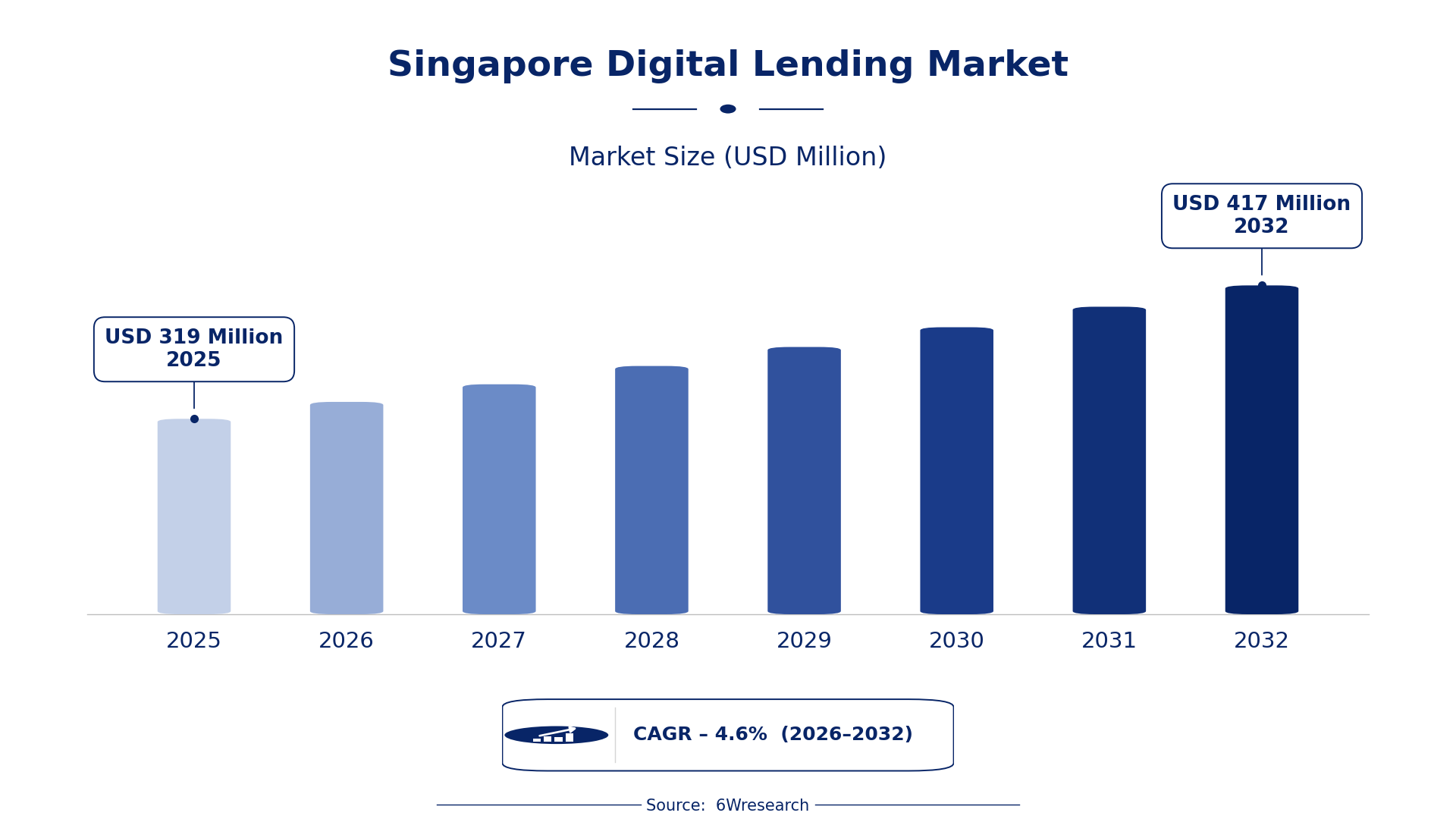
The Singapore Digital Lending Market was estimated at USD 319 Million in 2025 and is projected to reach USD 417 Million by 2032, growing at a CAGR of 4.6% from 2026 to 2032.
Singapore Digital Lending Market Synopsis
The demand for digital lending solutions in Singapore is surging, driven by consumers' desire for immediate access to credit. With the proliferation of fintech companies and digital banks, borrowers now enjoy a range of options that cater to their unique financial needs, from personal loans to business financing.
The evolution of digital lending is not merely a trend; it represents a fundamental shift in how financial services are consumed. As these platforms refine their loan origination processes and risk assessment methodologies, they are setting new standards for efficiency and customer satisfaction within the financial sector.
Singapore Digital Lending Market Year-wise Growth Rate and Key Drivers
This graph illustrates the annual growth rates of the Singapore Digital Lending Market from 2021 to 2032, highlighting a steady upward trajectory and projected expansion over the forecast period.
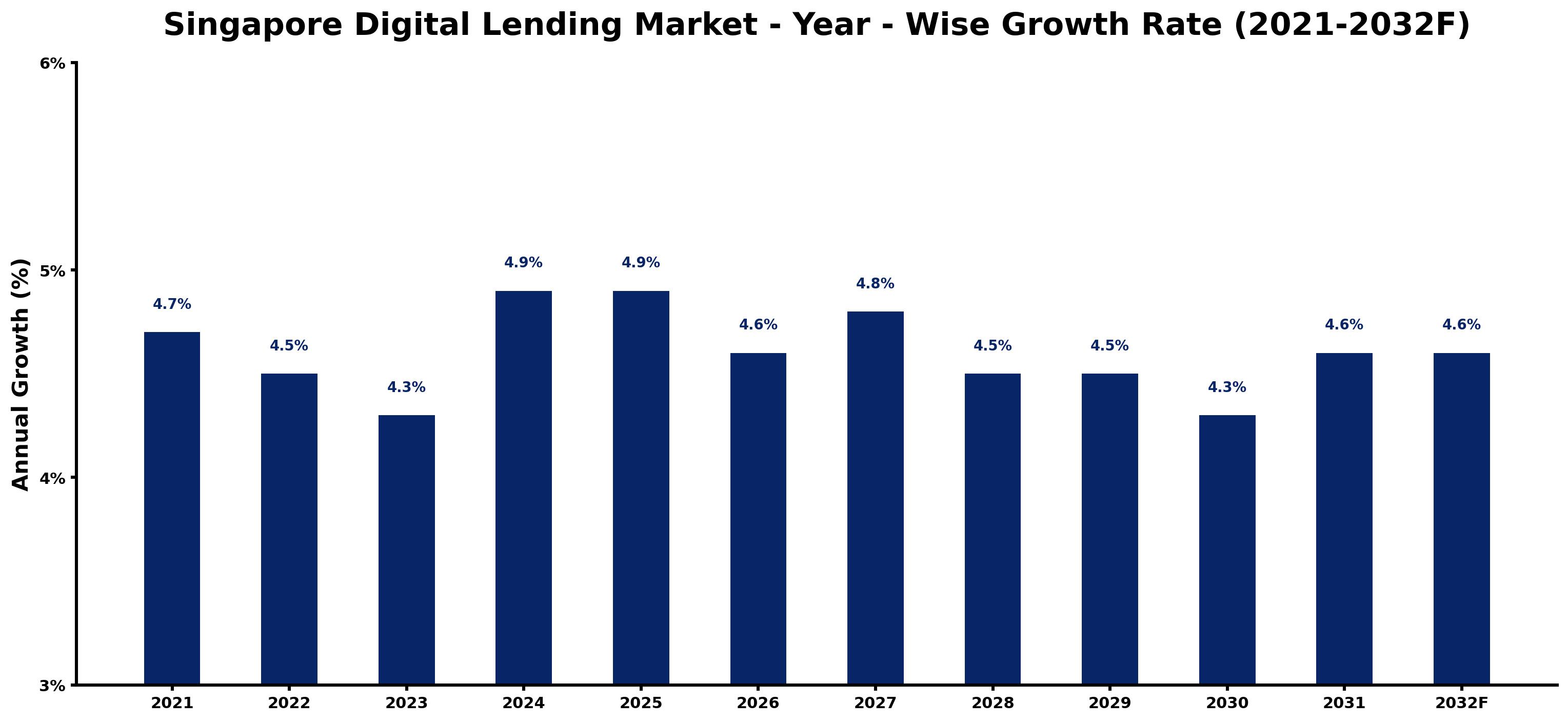
The table below presents the year‑wise growth rates along with the key drivers influencing the market
| Year | Growth Rate | Major Drivers |
| 2021 | 4.7% | Monetary Authority of Singapore's regulatory sandbox initiatives |
| 2022 | 4.5% | Increased smartphone adoption boosting digital lending accessibility |
| 2023 | 4.3% | Rise in freelance economy driving alternative lending solutions |
| 2024 | 4.9% | Enhanced fintech partnerships expanding service offerings |
| 2025 | 4.9% | Government support for digital financial services innovation |
| 2026 | 4.6% | Growing interest in green loans among consumers |
| 2027 | 4.8% | Collaboration with local banks to enhance lending platforms |
| 2028 | 4.5% | Increased focus on financial inclusion for underbanked segments |
| 2029 | 4.5% | Regional fintech hubs attracting investment in digital lending |
| 2030 | 4.3% | Implementation of open banking regulations facilitating access |
| 2031 | 4.6% | Surge in e-commerce fostering personal loan demand |
| 2032 | 4.6% | Consumer awareness of credit scoring improving loan uptake |
Note: Market size estimations and growth projections presented in this report are based on 6Wresearch's proprietary forecasting methodology, utilizing the latest available industry data, government publications, and primary research inputs.
Singapore Digital Lending Market Key Takeaways
Below are some of the specific key takeaways from the market, including:
- The market is experiencing significant growth due to increased demand for quick and accessible credit solutions.
- Technological advancements are enhancing loan origination and risk assessment processes.
- Regulatory frameworks are evolving to support innovation while ensuring consumer protection.
- Digital lending platforms are reshaping traditional banking relationships and expanding access to capital.
- The COVID-19 pandemic acted as a catalyst, accelerating the shift towards digital lending solutions.
Evaluation of Restraints in Singapore Digital Lending Market
The Singapore Digital Lending Market faces several challenges that hinder its growth potential. One of the primary concerns is the accuracy of risk assessment methods employed by digital lenders. As they strive to approve loans swiftly, ensuring compliance with stringent regulatory standards becomes a balancing act. Additionally, the need to foster trust among users is paramount, as skepticism around digital lending practices persists. These factors can slow down the adoption rates and limit the market's expansion.
Singapore Digital Lending Market Trends
Several key trends are emerging in the Singapore Digital Lending Market. The integration of artificial intelligence and machine learning technologies is significantly enhancing the borrower experience, allowing for personalized loan offerings. on top of that, the rise of alternative data sources for credit scoring is changing how lenders evaluate borrower risk, making credit more accessible to underbanked segments of the population.
Another notable trend is the collaboration between fintech companies and traditional banks, which aims to leverage the strengths of both sectors. This hybrid approach not only enhances product offerings but also broadens market reach.
Singapore Digital Lending Market Opportunities
The future holds numerous opportunities for growth within the Singapore Digital Lending Market. Expansion into underserved demographics, such as small businesses and freelancers, presents a promising avenue for innovation. Additionally, the increasing acceptance of digital payment systems provides a fertile ground for integrated lending solutions.
Investments in advanced technologies, such as blockchain for secure transactions and enhanced fraud detection, can further solidify the competitive advantage of digital lenders. As consumer preferences shift towards convenience, those who adapt swiftly will capture a significant share of the market.
Government Initiatives in the Singapore Digital Lending Market
The Singapore government plays a crucial role in shaping the digital lending environment through its regulatory framework and initiatives aimed at promoting financial inclusion. A proactive stance on fintech innovation is evident, as policies are continuously refined to support the sector while safeguarding consumer interests.
- A regulatory framework introduced in 2025 mandating transparency in digital lending practices is currently in effect.
- A national digital infrastructure upgrade programme, launched in early 2025, focuses on enhancing the digital capabilities of financial institutions.
- Ongoing collaborations with industry stakeholders aim to develop best practices for responsible lending and consumer protection.
- A planned public-private initiative expected to enhance digital literacy and access to financial services for underrepresented groups is set to begin in late 2026.
- Recent efforts to streamline licensing procedures for fintech companies have been completed, reducing barriers to entry for new market players.
Future Insights of the Singapore Digital Lending Market
Looking ahead to 2026-2032, the Singapore Digital Lending Market is likely to witness a transformation driven by technological advancements and evolving consumer expectations. As digital lenders continue to innovate their offerings, competition will intensify, leading to better rates and services for borrowers. on top of that, the market's regulatory landscape will adapt to ensure safety and fairness, which will further solidify consumer confidence in digital lending solutions.
Singapore Digital Lending Market Latest Developments
Recent months have seen a flurry of activity within the Singapore Digital Lending Market. As traditional financial institutions and fintech companies ramp up their digital offerings, the competitive landscape is becoming increasingly dynamic. Innovations in lending technologies and shifts in consumer behavior are driving these developments.
- A major technology vendor launched a new AI-driven credit assessment tool in Q2 2025, aimed at enhancing risk evaluation for digital lenders.
- An initiative to integrate blockchain technology for secure digital transactions began in early 2025 and is currently underway.
- In early 2025, a regional operator completed a successful pilot of a peer-to-peer lending platform tailored for small business owners.
- A rollout of an upgraded mobile lending application is expected to begin in mid-2026, featuring enhanced user experience and loan management tools.
- Current partnerships between fintech startups and established banks are ongoing, focusing on co-developing innovative lending products.
Singapore Digital Lending Market - Key Attractiveness of the Report
- 10 Years of Market Numbers
- Historical Data Starting from 2022 to 2025
- Base Year: 2025
- Forecast Data until 2032
- Key Performance Indicators Impacting the Market
- Major Upcoming Developments and Projects
Key Highlights of the Report:
- Singapore Digital Lending Market Outlook
- Market Size of Singapore Digital Lending Market, 2025
- Forecast of Singapore Digital Lending Market, 2032
- Historical Data and Forecast of Singapore Digital Lending Revenues & Volume for the Period 2022-2032F
- Singapore Digital Lending Market Trend Evolution
- Singapore Digital Lending Market Drivers and Challenges
- Singapore Digital Lending Price Trends
- Singapore Digital Lending Porter's Five Forces
- Singapore Digital Lending Industry Life Cycle
- Historical Data and Forecast of Singapore Digital Lending Market Revenues & Volume By Offering for the Period 2022-2032F
- Historical Data and Forecast of Singapore Digital Lending Market Revenues & Volume By Solutions for the Period 2022-2032F
- Historical Data and Forecast of Singapore Digital Lending Market Revenues & Volume By Services for the Period 2022-2032F
- Historical Data and Forecast of Singapore Digital Lending Market Revenues & Volume By Deployment Mode for the Period 2022-2032F
- Historical Data and Forecast of Singapore Digital Lending Market Revenues & Volume By Cloud for the Period 2022-2032F
- Historical Data and Forecast of Singapore Digital Lending Market Revenues & Volume By On-premises for the Period 2022-2032F
- Historical Data and Forecast of Singapore Digital Lending Market Revenues & Volume By End User for the Period 2022-2032F
- Historical Data and Forecast of Singapore Digital Lending Market Revenues & Volume By Banks for the Period 2022-2032F
- Historical Data and Forecast of Singapore Digital Lending Market Revenues & Volume By Credit Unions for the Period 2022-2032F
- Historical Data and Forecast of Singapore Digital Lending Market Revenues & Volume By NBFCs for the Period 2022-2032F
- Singapore Digital Lending Import Export Trade Statistics
- Market Opportunity Assessment By Offering
- Market Opportunity Assessment By Deployment Mode
- Market Opportunity Assessment By End User
- Singapore Digital Lending Top Companies Market Share
- Singapore Digital Lending Competitive Benchmarking By Technical and Operational Parameters
- Singapore Digital Lending Company Profiles
- Singapore Digital Lending Key Strategic Recommendations






































