Iraq Digital Remittance Market Size, Share & Growth Rate
The Iraq Digital Remittance Market was estimated at USD 230 Million in 2025 and is projected to reach USD 307 Million by 2032, growing at a CAGR of 4.2% from 2026 to 2032. This growth is significantly driven by the increasing reliance of the Iraqi diaspora and migrant workers on digital platforms to send funds to their families back home. As these communities seek faster and more affordable remittance options, the demand for secure online and mobile money transfer services continues to rise, enhancing financial inclusion across the country.
Iraq Digital Remittance Market Year-wise Growth Rate and Key Drivers
This graph highlights how the Iraq Digital Remittance Market has steadily grown over the years, supported by major growth factors.
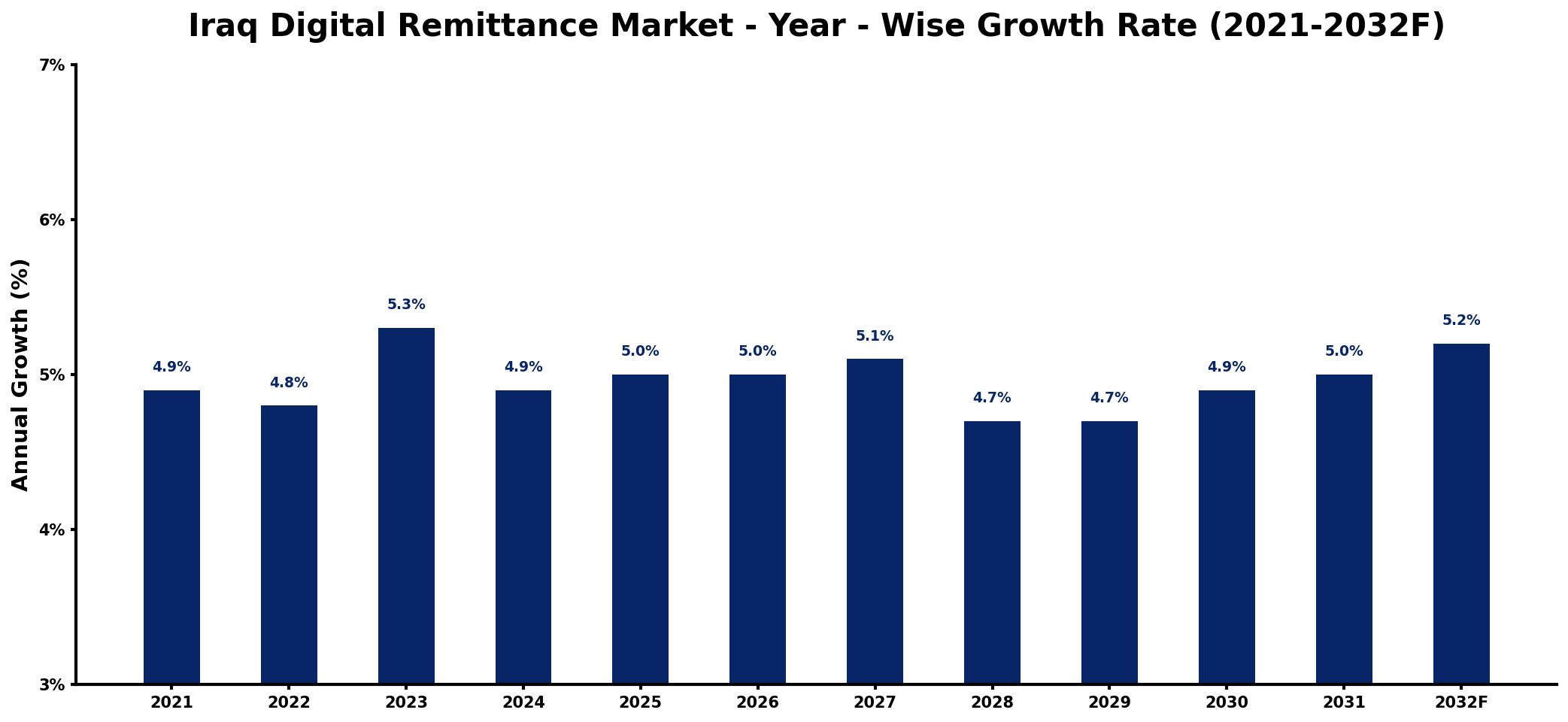
The table below presents the year‑wise growth rates along with the key drivers influencing the market
| Year | Growth Rate | Major Drivers |
| 2021 | 4.9% | Increase in mobile payment adoption |
| 2022 | 4.8% | Growth of fintech startups ecosystem |
| 2023 | 5.3% | Rising demand for cross-border transactions |
| 2024 | 4.9% | Expansion of banking infrastructure services |
| 2025 | 5.0% | Improved regulatory framework support |
| 2026 | 5.0% | Surge in online merchant platforms |
| 2027 | 5.1% | Enhanced consumer trust in technology |
| 2028 | 4.7% | Diversification of financial service offerings |
| 2029 | 4.7% | Increased investment in tech innovations |
| 2030 | 4.9% | Growth in expatriate population numbers |
| 2031 | 5.0% | Development of competitive service providers |
| 2032 | 5.2% | Rising consumer preference for convenience |
Note: Market size estimations and growth projections presented in this report are based on 6Wresearch's proprietary forecasting methodology, utilizing the latest available industry data, government publications, and primary research inputs.
Iraq Digital Remittance Market Synopsis
The Iraq Digital Remittance Market is characterized by a robust demand for digital payment solutions, fueled by the growing number of Iraqi expatriates globally. Enhanced internet connectivity and mobile banking adoption are facilitating seamless transactions, bridging the gap between senders and receivers.
Furthermore, Iraqi households have increasingly recognized the benefits of utilizing digital remittance services, which offer speed, security, and reduced costs compared to traditional channels. This shift is bolstered by governmental efforts to promote financial literacy and access to banking services among underserved populations.
Iraq Digital Remittance Market Key Takeaways
- The market is experiencing steady growth due to rising digital adoption among the diaspora community.
- Enhanced mobile and internet infrastructure is contributing to increased remittance flow.
- Government initiatives are playing a pivotal role in shaping the regulatory landscape for digital transactions.
- Financial inclusion efforts are critical, allowing underserved populations to participate in the economy.
- Challenges remain, particularly in regulatory compliance and foreign exchange volatility.
Evaluation of Restraints in Iraq Digital Remittance Market
Despite the promising growth trajectory, the Iraq Digital Remittance Market faces significant restraints that could impede its expansion. The regulatory landscape, particularly concerning anti-money laundering (AML) controls, adds layers of complexity for service providers. Compliance with customer authentication requirements can create bottlenecks in the remittance process. Additionally, the challenge of foreign exchange volatility poses a risk for both senders and recipients, affecting the overall attractiveness of digital remittance services. Addressing these issues requires coordinated efforts among stakeholders, including government entities and financial institutions, to ensure a more stable and efficient operating environment.
Iraq Digital Remittance Market Trends
Several key trends are currently shaping the Iraq Digital Remittance Market. Notably, the integration of fintech solutions is revolutionizing how consumers interact with remittance services. Enhanced user experiences and digital wallets are becoming standard, facilitating easier transactions. Additionally, there is a growing emphasis on developing partnerships between digital platforms and local financial institutions, which can help address liquidity and interoperability challenges. The rise in public awareness campaigns is also driving adoption, as more individuals recognize the benefits of digital remittance solutions.
Iraq Digital Remittance Market Opportunities
Opportunities for growth in the Iraq Digital Remittance Market are abundant. The increasing number of Iraqis residing abroad presents a vast customer base ripe for targeted digital solutions. Investments in advanced technology such as blockchain could enhance transaction security and reduce costs. Furthermore, improving financial literacy among users opens avenues for new service offerings tailored to diverse needs. As the government continues to reform regulations and promote digital finance, businesses should capitalize on these favorable conditions to expand their market presence.
Government Initiatives in the Iraq Digital Remittance Market
The Iraqi government is actively implementing policies to bolster the digital remittance sector. Initiatives include regulatory reforms aimed at simplifying the process for digital money transfers and enhancing international remittance transactions. The government is also investing in digital payment infrastructure and promoting mobile banking platforms to enhance access to financial services in rural and underserved areas. Public awareness campaigns are integral to these efforts, aimed at educating migrant workers and their families about the advantages of using digital remittance services.
Future Insights of the Iraq Digital Remittance Market
Looking forward, the Iraq Digital Remittance Market is poised for significant developments from 2026 to 2032. The convergence of digital innovation and government support will likely create a robust environment for remittance services. As regulatory challenges are gradually addressed, more players will enter the market, increasing competition and driving enhancements in service delivery. The anticipated growth in global remittance flows, coupled with an expanding diaspora community, will further solidify the market's trajectory, positioning Iraq as a key player in the regional digital remittance landscape.
Iraq Digital Remittance Market Latest Developments (2025 - 2026)
Recently, the Iraq Digital Remittance Market has seen a flurry of activity aimed at bolstering service offerings and improving user experiences. Companies are increasingly leveraging technology to enhance transaction security and streamline processes, which is crucial for building consumer trust. Additionally, partnerships between local banks and fintech providers are emerging as a strategy to enhance liquidity and improve service delivery. These developments reflect a market that is evolving rapidly, adapting to meet the changing needs of consumers.
Iraq Digital Remittance Market - Key Attractiveness of the Report
- 10 Years of Market Numbers
- Historical Data Starting from 2022 to 2025
- Base Year: 2025
- Forecast Data until 2032
- Key Performance Indicators Impacting the Market
- Major Upcoming Developments and Projects
Key Highlights of the Report:
- Iraq Digital Remittance Market Outlook
- Market Size of Iraq Digital Remittance Market, 2025
- Forecast of Iraq Digital Remittance Market, 2032
- Historical Data and Forecast of Iraq Digital Remittance Revenues & Volume for the Period 2022-2032F
- Iraq Digital Remittance Market Trend Evolution
- Iraq Digital Remittance Market Drivers and Challenges
- Iraq Digital Remittance Price Trends
- Iraq Digital Remittance Porter's Five Forces
- Iraq Digital Remittance Industry Life Cycle
- Historical Data and Forecast of Iraq Digital Remittance Market Revenues & Volume By Type for the Period 2022-2032F
- Historical Data and Forecast of Iraq Digital Remittance Market Revenues & Volume By Inward Digital Remittance for the Period 2022-2032F
- Historical Data and Forecast of Iraq Digital Remittance Market Revenues & Volume By Outward Digital Remittance for the Period 2022-2032F
- Historical Data and Forecast of Iraq Digital Remittance Market Revenues & Volume By Channel for the Period 2022-2032F
- Historical Data and Forecast of Iraq Digital Remittance Market Revenues & Volume By Banks for the Period 2022-2032F
- Historical Data and Forecast of Iraq Digital Remittance Market Revenues & Volume By Money Transfer Operators for the Period 2022-2032F
- Historical Data and Forecast of Iraq Digital Remittance Market Revenues & Volume By Online Platforms for the Period 2022-2032F
- Historical Data and Forecast of Iraq Digital Remittance Market Revenues & Volume By Others for the Period 2022-2032F
- Historical Data and Forecast of Iraq Digital Remittance Market Revenues & Volume By End-use for the Period 2022-2032F
- Historical Data and Forecast of Iraq Digital Remittance Market Revenues & Volume By Migrant Labor Workforce for the Period 2022-2032F
- Historical Data and Forecast of Iraq Digital Remittance Market Revenues & Volume By Personal for the Period 2022-2032F
- Historical Data and Forecast of Iraq Digital Remittance Market Revenues & Volume By Small Businesses for the Period 2022-2032F
- Historical Data and Forecast of Iraq Digital Remittance Market Revenues & Volume By Others for the Period 2022-2032F
- Iraq Digital Remittance Import Export Trade Statistics
- Market Opportunity Assessment By Type
- Market Opportunity Assessment By Channel
- Market Opportunity Assessment By End-use
- Iraq Digital Remittance Top Companies Market Share
- Iraq Digital Remittance Competitive Benchmarking By Technical and Operational Parameters
- Iraq Digital Remittance Company Profiles
- Iraq Digital Remittance Key Strategic Recommendations






































