Iraq Electric shavers Market Size, Share & Growth Rate
The Iraq Electric shavers Market was estimated at USD 1268 Million in 2025 and is projected to reach USD 1836 Million by 2032, growing at a CAGR of 5.4% from 2026 to 2032. This upward trajectory is fueled by rising disposable incomes and a cultural shift towards personal grooming, particularly in urban centers. Men increasingly view electric shavers as essential tools for modern grooming, which enhances their appeal within the population.
Iraq Electric shavers Market Year-wise Growth Rate and Key Drivers
This graph highlights how the Iraq Electric shavers Market has steadily grown over the years, supported by major growth factors.
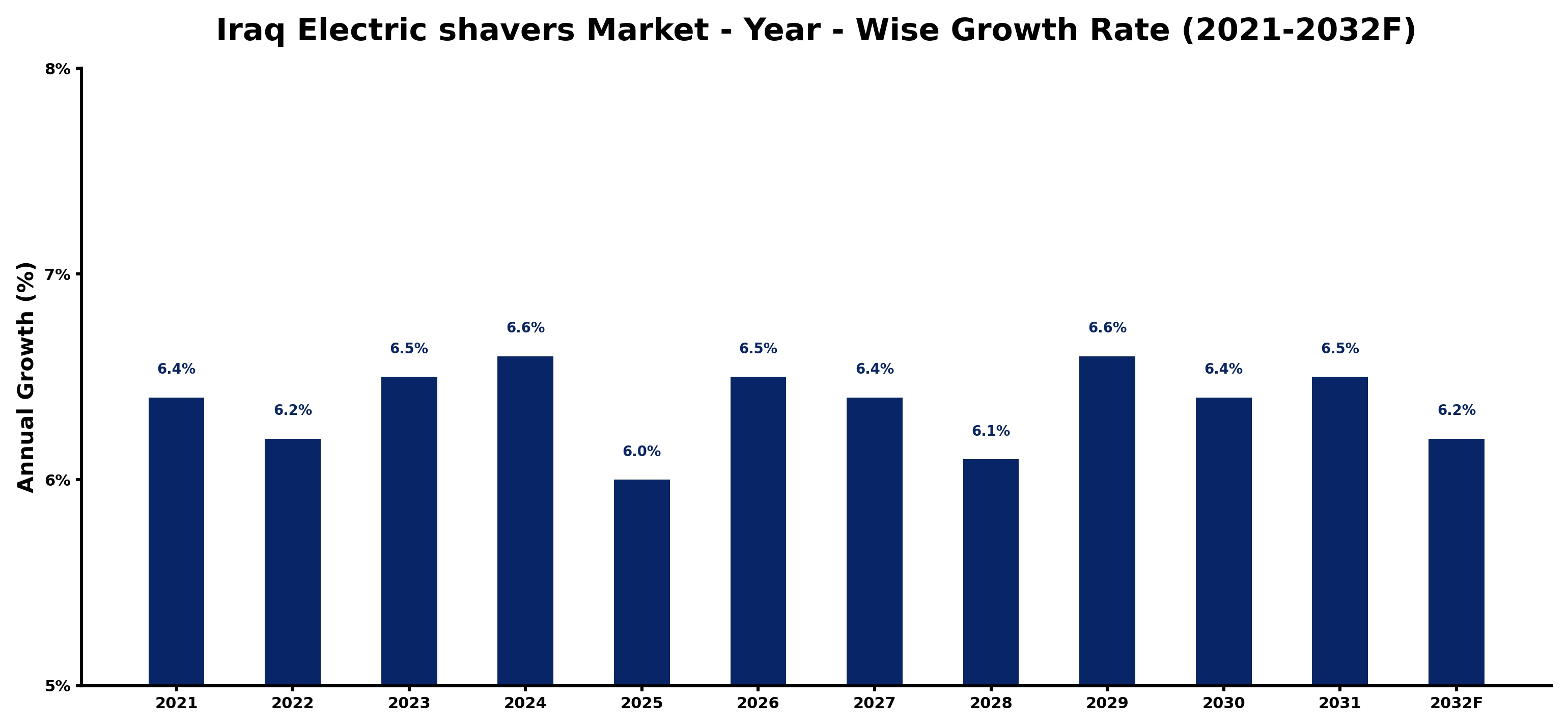
The table below presents the year‑wise growth rates along with the key drivers influencing the market
| Year | Growth Rate | Major Drivers |
| 2021 | 6.4% | Technological advancements improved electric shaver manufacturing efficiency and precision |
| 2022 | 6.2% | Higher factory uptime boosts electric shaver assembly line output |
| 2023 | 6.5% | Manufacturing investments in assembly lines boost electric shaver output |
| 2024 | 6.6% | Modern assembly line upgrades boost electric shaver production capacity |
| 2025 | 6.0% | Increased retail distribution channels boosted electric shaver sales volume |
| 2026 | 6.5% | Improved local assembly capabilities boosted electric shaver production efficiency |
| 2027 | 6.4% | Retail sector revitalization boosts electric shaver import requirements |
| 2028 | 6.1% | Increased local assembly operations boosted electric shaver market competitiveness |
| 2029 | 6.6% | Smart shaver technology adoption drives manufacturing efficiency improvements |
| 2030 | 6.4% | Local manufacturing facilities boost demand for electric shaver components |
| 2031 | 6.5% | Manufacturing investments boost electric shaver production capacity in Iraq |
| 2032 | 6.2% | Modernized production lines boost electric shaver assembly capacity |
Note - Market size estimations and growth projections presented in this report are based on 6Wresearch’s advanced forecasting approach, validated with industry datasets as of June 2026.
Iraq Electric shavers Market Synopsis
Currently, the Iraqi electric shaver market is experiencing robust growth driven by changing consumer behavior and urbanization. Consumers are increasingly drawn to electric shavers for their convenience, speed, and effectiveness compared to traditional shaving methods.
Innovation is a key theme, as manufacturers introduce advanced features that cater to specific grooming needs. This includes products designed for sensitive skin and various shaving environments, which align with the evolving preferences of Iraqi consumers.
Iraq Electric shavers Market Key Takeaways
- The market is currently valued at USD 1268 Million and expected to grow significantly by 2032.
- Urbanization and rising disposable incomes are driving the demand for electric shavers.
- Innovation in product features and designs is essential for capturing market share.
- Consumer preference is shifting towards skin-friendly and multi-functional electric shavers.
- Challenges such as economic instability and traditional grooming practices remain prevalent.
Evaluation of Restraints in Iraq Electric shavers Market
Despite its promising growth prospects, the Iraq electric shavers market faces notable challenges that inhibit its full potential. Economic instability poses a significant threat, affecting consumer confidence and purchasing power. Furthermore, many consumers still prefer traditional methods like manual razors or barbershop services, limiting the market penetration of electric shavers. The prevalence of counterfeit products creates mistrust in electric options, while limited access to robust distribution channels hinders effective market expansion.
Iraq Electric shavers Market Trends
The market is witnessing trends that emphasize technological advancement and consumer preferences. There is a noticeable demand for electric shavers that offer high precision and skin-friendly performance. Products boasting longer battery life, ergonomic designs, and features tailored for wet and dry shaving conditions are increasingly appealing to consumers. Additionally, the inclination towards high-end models with sophisticated functionalities is reshaping product offerings.
Iraq Electric shavers Market Opportunities
Investment opportunities in the Iraq electric shavers market are plentiful, given the growing interest in personal grooming. As consumers seek efficient grooming solutions, the market presents prospects for brands that introduce innovative technologies tailored to local preferences. Establishing localized production or assembly units could be a strategic move, reducing import dependency and aligning with the national demand for quality grooming products.
Government Initiatives in the Iraq Electric shavers Market
Currently, the Iraqi government does not have specific regulations focused solely on the electric shavers market. However, broader economic policies, import regulations, and general quality standards significantly influence market operations. Businesses must navigate this regulatory landscape to ensure compliance, which will ultimately shape their strategies and consumer offerings in the electric shavers market.
Future Insights of the Iraq Electric shavers Market
Looking ahead to 2026-2032, the Iraq electric shavers market is poised for steady growth fueled by continued urbanization and rising awareness of personal grooming. The integration of e-commerce platforms will provide consumers greater access to a diverse range of products, facilitating increased market penetration for electric shavers. Although economic and infrastructural challenges remain, the prospects for innovation and consumer engagement will drive market expansion in the coming years.
Iraq Electric shavers Market Latest Developments (May 2025 - June 2026)
Recent trends indicate a shift towards online purchasing as e-commerce becomes more prominent in Iraq. This has created an opportunity for brands to capitalize on digital marketing strategies, enhancing their outreach to consumers. Furthermore, manufacturers are increasingly focusing on sustainability and eco-friendly technologies, responding to the global demand for environmentally conscious products.
Iraq Electric shavers Market - Key Attractiveness of the Report
- 10 Years of Market Numbers
- Historical Data Starting from 2022 to 2025
- Base Year: 2025
- Forecast Data until 2032
- Key Performance Indicators Impacting the Market
- Major Upcoming Developments and Projects
Key Highlights of the Report:
- Iraq Electric shavers Market Outlook
- Market Size of Iraq Electric shavers Market, 2025
- Forecast of Iraq Electric shavers Market, 2032
- Historical Data and Forecast of Iraq Electric shavers Revenues & Volume for the Period 2022-2032F
- Iraq Electric shavers Market Trend Evolution
- Iraq Electric shavers Market Drivers and Challenges
- Iraq Electric shavers Price Trends
- Iraq Electric shavers Porter's Five Forces
- Iraq Electric shavers Industry Life Cycle
- Historical Data and Forecast of Iraq Electric shavers Market Revenues & Volume By Product for the Period 2022-2032F
- Historical Data and Forecast of Iraq Electric shavers Market Revenues & Volume By Oil Shaver for the Period 2022-2032F
- Historical Data and Forecast of Iraq Electric shavers Market Revenues & Volume By Wet/Dry Shaver for the Period 2022-2032F
- Historical Data and Forecast of Iraq Electric shavers Market Revenues & Volume By Clippers for the Period 2022-2032F
- Historical Data and Forecast of Iraq Electric shavers Market Revenues & Volume By A Rotary Shaver for the Period 2022-2032F
- Historical Data and Forecast of Iraq Electric shavers Market Revenues & Volume By Accessories for the Period 2022-2032F
- Historical Data and Forecast of Iraq Electric shavers Market Revenues & Volume By End-user for the Period 2022-2032F
- Historical Data and Forecast of Iraq Electric shavers Market Revenues & Volume By Male for the Period 2022-2032F
- Historical Data and Forecast of Iraq Electric shavers Market Revenues & Volume By Female for the Period 2022-2032F
- Historical Data and Forecast of Iraq Electric shavers Market Revenues & Volume By Distribution Channel for the Period 2022-2032F
- Historical Data and Forecast of Iraq Electric shavers Market Revenues & Volume By Health & Beauty Stores for the Period 2022-2032F
- Historical Data and Forecast of Iraq Electric shavers Market Revenues & Volume By General Merchandising/Mass Stores for the Period 2022-2032F
- Historical Data and Forecast of Iraq Electric shavers Market Revenues & Volume By Supermarkets & Hypermarkets for the Period 2022-2032F
- Historical Data and Forecast of Iraq Electric shavers Market Revenues & Volume By Others for the Period 2022-2032F
- Historical Data and Forecast of Iraq Electric shavers Market Revenues & Volume By Type for the Period 2022-2032F
- Historical Data and Forecast of Iraq Electric shavers Market Revenues & Volume By Rechargeable Shaver for the Period 2022-2032F
- Historical Data and Forecast of Iraq Electric shavers Market Revenues & Volume By Battery Type Shaver for the Period 2022-2032F
- Iraq Electric shavers Import Export Trade Statistics
- Market Opportunity Assessment By Product
- Market Opportunity Assessment By End-user
- Market Opportunity Assessment By Distribution Channel
- Market Opportunity Assessment By Type
- Iraq Electric shavers Top Companies Market Share
- Iraq Electric shavers Competitive Benchmarking By Technical and Operational Parameters
- Iraq Electric shavers Company Profiles
- Iraq Electric shavers Key Strategic Recommendations






































