Iraq Feminine Hygiene Market Summary
The iraq feminine hygiene market was estimated at USD 436 Million in 2025 and is projected to reach USD 608 Million by 2032, growing at a CAGR of 5.8% from 2026 to 2032.
Iraq Feminine Hygiene Market Year-wise Growth Rate and Key Drivers
This graph highlights how the Iraq Feminine Hygiene Market has steadily grown over the past five years, supported by major growth factors.
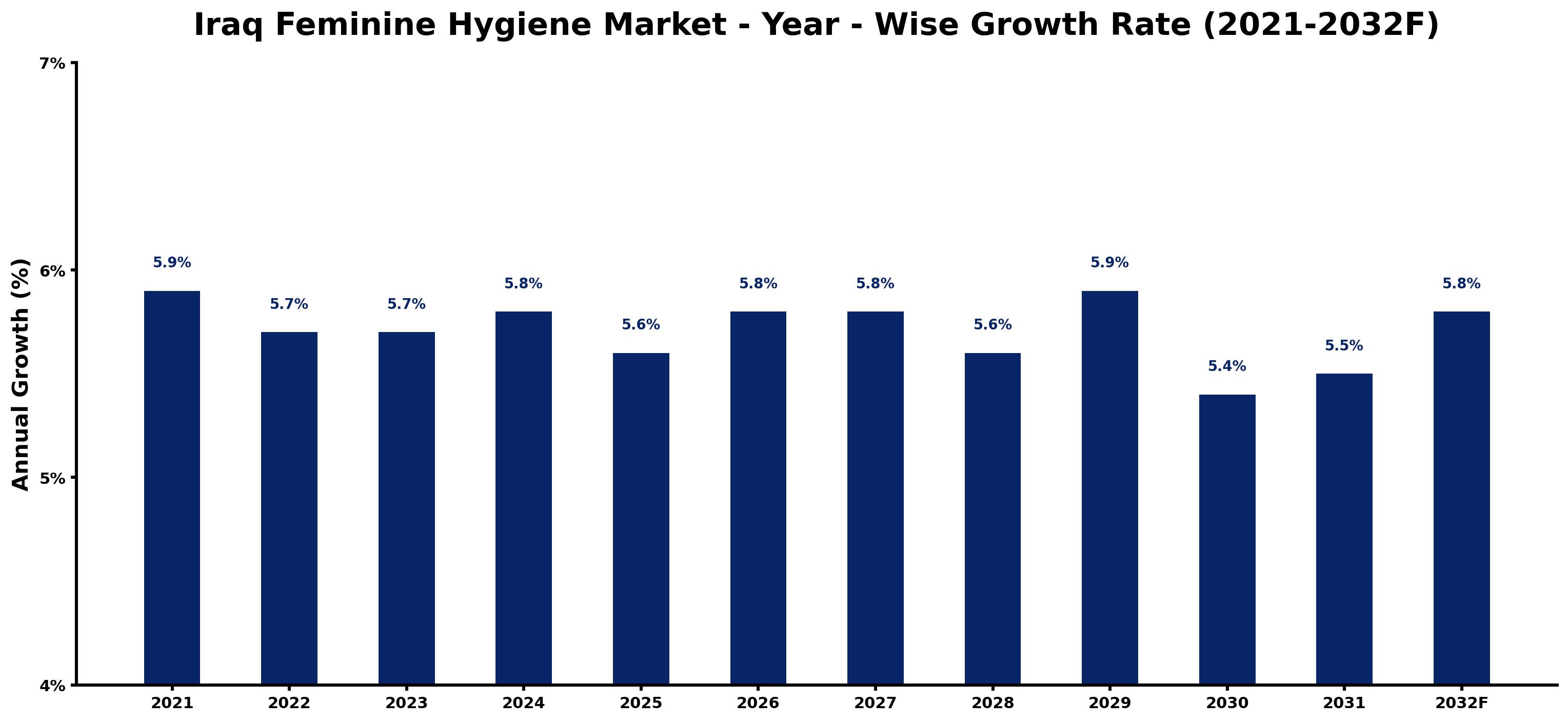
The table below presents the year wise growth rates along with the key drivers influencing the market
| Year | Growth Rate | Major Drivers |
| 2021 | 5.9% | Cultural shifts emphasize women's health, encouraging local brands to emerge in Iraq. |
| 2022 | 5.7% | Increased visibility of feminine hygiene products on social media boosts consumer awareness. |
| 2023 | 5.7% | Import tariffs on foreign brands create opportunities for domestic manufacturers in Iraq. |
| 2024 | 5.8% | Educational campaigns from NGOs highlight menstrual health, expanding market penetration rates. |
| 2025 | 5.6% | Urbanization trends lead to greater retail space availability, enhancing product accessibility. |
| 2026 | 5.8% | Partnerships between healthcare providers and manufacturers improve product trust among consumers. |
| 2027 | 5.8% | Youth engagement through digital platforms creates demand for innovative feminine hygiene solutions. |
| 2028 | 5.6% | Local production facilities reduce costs, making hygiene products more affordable for women. |
| 2029 | 5.9% | Collaborations with local influencers drive brand loyalty and product recommendations effectively. |
| 2030 | 5.4% | E-commerce growth offers women easier access to hygiene products amid urban challenges. |
| 2031 | 5.5% | Sustainability trends encourage eco-friendly product development, appealing to environmentally conscious consumers. |
| 2032 | 5.8% | Investment in rural distribution networks enhances market reach in underserved areas. |
Note - Market size estimations and growth projections presented in this report are based on 6Wresearch's advanced forecasting approach, validated with industry datasets as of June 2026.
Iraq Feminine Hygiene Market Synopsis
The Iraq Feminine Hygiene Market is projected to reach 5.8% and witness significant growth during the forecast period (2026-2032). The market is driven by a confluence of factors including heightened awareness among women regarding menstrual hygiene, increasing availability of diverse sanitary products, and a steady rise in disposable incomes. As societal attitudes evolve, the demand for feminine hygiene products such as pads, tampons, menstrual cups, and panty liners continues to grow, marking a pivotal shift in consumer behavior and market dynamics.
Iraq Feminine Hygiene Market Growth Drivers
One of the primary catalysts for the expansion of the Iraq Feminine Hygiene Market is the growing awareness among women about the importance of menstrual hygiene. Education campaigns and community outreach programs are facilitating this awareness, leading to increased adoption of hygiene products. Furthermore, the increasing purchasing power of consumers is enabling a broader segment of the population to invest in quality feminine hygiene solutions, breaking away from traditional practices.
- The rising presence of women in the workforce is significantly influencing the demand for convenient and effective hygiene products.
- Access to modern retail and e-commerce platforms is expanding the availability of feminine hygiene products across various demographics.
- There is a growing trend toward environmentally friendly and sustainable products, which is reshaping purchasing decisions.
- Healthcare providers are increasingly emphasizing the importance of menstrual health, which is leading to greater product familiarity and preference.
- The ongoing improvement in supply chain logistics allows for better distribution and availability of hygiene products in urban and rural settings alike.
Iraq Feminine Hygiene Market Trends and Opportunities
The Iraq Feminine Hygiene Market is exhibiting several key trends that present substantial opportunities for growth. One notable trend is the shift towards more innovative product offerings, including organic and bio-degradable sanitary products that cater to environmentally conscious consumers. Additionally, the development of educational programs that promote menstrual health is encouraging women to prioritize their hygiene needs, resulting in an uptick in product usage.
- Customization and personalization of feminine hygiene products are gaining popularity, as brands seek to address the diverse needs of women.
- Emerging brands are leveraging social media and digital marketing strategies to enhance engagement and reach among younger consumers.
- There is an increasing focus on menstrual cups and reusable products due to their cost-effectiveness and eco-friendliness.
- The introduction of subscription services for feminine hygiene products is streamlining purchasing and enhancing customer loyalty.
- Innovations in packaging that enhance convenience and user experience are becoming more prevalent in the market.
Iraq Feminine Hygiene Market Challenges and Restraints
Despite the promising growth trajectory of the Iraq Feminine Hygiene Market, several challenges remain. Cultural stigmas surrounding menstruation can still hinder open discussions and acceptance of feminine hygiene products. Moreover, socioeconomic disparities may limit access to these essential products for certain populations, posing a barrier to overall market penetration.
- Limited awareness and education about menstrual health can perpetuate myths and hinder product utilization.
- High prices of branded products in comparison to traditional options may deter lower-income consumers.
- Distribution inefficiencies in rural areas can create disparities in product availability, impacting overall consumption patterns.
- Resistance to change from traditional practices can slow the adoption of modern hygiene solutions.
- Regulatory challenges may affect the introduction and marketing of new products in the market.
Iraq Feminine Hygiene Market Government Investment and Initiatives
The Iraqi government has recognized the importance of menstrual health and hygiene in its public health initiatives. Recent policies have aimed at increasing funding for educational campaigns focused on menstrual hygiene awareness. Through partnerships with non-governmental organizations, the government is working to improve access to sanitary products across the country, particularly in underserved regions. Additionally, developmental plans that target healthcare infrastructure are being enhanced to support women's health initiatives, thus facilitating a supportive environment for the growth of the Iraq Feminine Hygiene Market.
Iraq Feminine Hygiene Market Latest Developments (May 2025 - June 2026)
Recent trends in the Iraq Feminine Hygiene Market have been characterized by a surge in product innovation and the introduction of new distribution channels. Retailers are beginning to adopt omnichannel strategies, integrating e-commerce with traditional retail to enhance customer experience. Community-driven initiatives promoting menstrual health have gained traction, leading to improved awareness and acceptance of feminine hygiene products. Simultaneously, there are ongoing discussions among stakeholders regarding the potential for government-backed programs to subsidize costs for low-income families, aimed at increasing product accessibility.
Iraq Feminine Hygiene Market - Key Attractiveness of the Report
- 10 Years of Market Numbers
- Historical Data Starting from 2022 to 2025
- Base Year: 2025
- Forecast Data until 2032
- Key Performance Indicators Impacting the Market
- Major Upcoming Developments and Projects
Key Highlights of the Report:
- Iraq Feminine Hygiene Market Outlook
- Market Size of Iraq Feminine Hygiene Market, 2025
- Forecast of Iraq Feminine Hygiene Market, 2032F
- Historical Data and Forecast of Iraq Feminine Hygiene Revenues & Volume for the Period 2022-2032F
- Iraq Feminine Hygiene Market Trend Evolution
- Iraq Feminine Hygiene Market Drivers and Challenges
- Iraq Feminine Hygiene Price Trends
- Iraq Feminine Hygiene Porter's Five Forces
- Iraq Feminine Hygiene Industry Life Cycle
- Historical Data and Forecast of Iraq Feminine Hygiene Market Revenues & Volume By Product Types for the Period 2022-2032F
- Historical Data and Forecast of Iraq Feminine Hygiene Market Revenues & Volume By Sanitary Napkins/Pads for the Period 2022-2032F
- Historical Data and Forecast of Iraq Feminine Hygiene Market Revenues & Volume By Tampons for the Period 2022-2032F
- Historical Data and Forecast of Iraq Feminine Hygiene Market Revenues & Volume By Menstrual Cups for the Period 2022-2032F
- Historical Data and Forecast of Iraq Feminine Hygiene Market Revenues & Volume By Others for the Period 2022-2032F
- Historical Data and Forecast of Iraq Feminine Hygiene Market Revenues & Volume By Distribution Channel for the Period 2022-2032F
- Historical Data and Forecast of Iraq Feminine Hygiene Market Revenues & Volume By Hypermarkets/Supermarket for the Period 2022-2032F
- Historical Data and Forecast of Iraq Feminine Hygiene Market Revenues & Volume By Convenience Stores for the Period 2022-2032F
- Historical Data and Forecast of Iraq Feminine Hygiene Market Revenues & Volume By Drug Stores/Pharmacies for the Period 2022-2032F
- Historical Data and Forecast of Iraq Feminine Hygiene Market Revenues & Volume By Others for the Period 2022-2032F
- Iraq Feminine Hygiene Import Export Trade Statistics
- Market Opportunity Assessment By Product Types
- Market Opportunity Assessment By Distribution Channel
- Iraq Feminine Hygiene Top Companies Market Share
- Iraq Feminine Hygiene Competitive Benchmarking By Technical and Operational Parameters
- Iraq Feminine Hygiene Company Profiles
- Iraq Feminine Hygiene Key Strategic Recommendations






































