Iraq Football Market Size, Share & Growth Rate
The Iraq Football Market was estimated at USD 488 Million in 2025 and is projected to reach USD 702 Million by 2032, growing at a CAGR of 5.3% from 2026 to 2032. This upward trajectory is largely fueled by a resurgent interest in the sport following the national team's recent successes, which have rekindled national pride. Coupled with substantial investments in youth development and infrastructure, the Iraqi football market is rapidly evolving into a competitive landscape.
Iraq Football Market Year-wise Growth Rate and Key Drivers
This graph highlights how the Iraq Football Market has steadily grown over the years, supported by major growth factors.
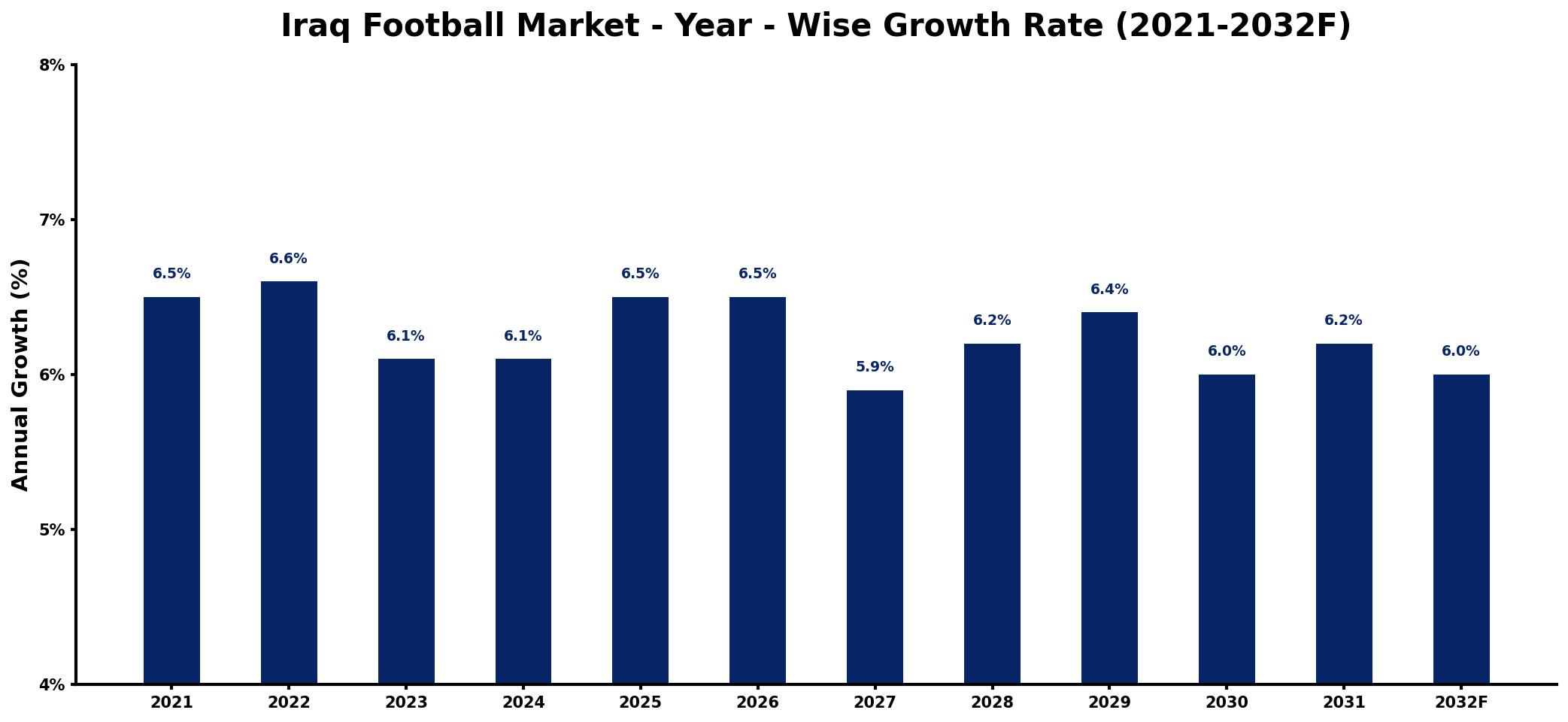
The table below presents the year‑wise growth rates along with the key drivers influencing the market
| Year | Growth Rate | Major Drivers |
| 2021 | 6.5% | Rising youth participation rates |
| 2022 | 6.6% | Increased media broadcasting deals |
| 2023 | 6.1% | Growing fan engagement initiatives |
| 2024 | 6.1% | Expansion of local sponsorships |
| 2025 | 6.5% | Boost in sports infrastructure investments |
| 2026 | 6.5% | Surge in merchandise sales growth |
| 2027 | 5.9% | Enhanced community outreach programs |
| 2028 | 6.2% | Strengthened international collaboration efforts |
| 2029 | 6.4% | Development of training academies |
| 2030 | 6.0% | Increase in online streaming platforms |
| 2031 | 6.2% | Growth in grassroots development projects |
| 2032 | 6.0% | Rising interest in local leagues |
Note: Market size estimations and growth projections presented in this report are based on 6Wresearch's proprietary forecasting methodology, utilizing the latest available industry data, government publications, and primary research inputs.
Iraq Football Market Synopsis
Football is not just a sport in Iraq; its a way of life. The fervor exhibited by fans during local league matches is palpable, with clubs like Al-Quwa Al-Jawiya and Al-Zawraa drawing massive crowds. This cultural significance has galvanized efforts to improve grassroots programs and bolster the national league structure.
Despite facing challenges such as infrastructural deficits, the market remains resilient, buoyed by passionate supporters and increasing commercial interest. The ongoing push for better facilities and youth training initiatives signals a brighter future for Iraqi football.
Iraq Football Market Key Takeaways
- Passionate fan engagement is a driving force behind the market's growth.
- Investment in grassroots development is pivotal for nurturing future talent.
- Infrastructure improvements are essential for elevating the quality of play.
- The national team's recent achievements have spurred increased interest and investment.
- Commercial opportunities, including sponsorships and merchandise sales, are on the rise.
Evaluation of Restraints in Iraq Football Market
While the Iraq Football Market demonstrates robust growth potential, several real constraints hinder its full development. Political instability and ongoing security concerns often disrupt the operational aspects of clubs, limiting their ability to host matches and attract foreign talent. Additionally, the lack of modern infrastructure, such as state-of-the-art stadiums and training facilities, significantly impacts the overall quality and competitiveness of the league. Financial constraints further exacerbate these issues, as clubs struggle to secure funding for essential development projects and player development programs.
Iraq Football Market Trends
The landscape of the Iraq football market is shaped by several emerging trends that are redefining its dynamics. Firstly, theres a notable shift towards grassroots talent development, with clubs and academies focusing on nurturing young players. Moreover, the establishment of more professional leagues is creating pathways for players, which is attracting attention from international scouts. Another key trend is the increasing commercialization of the sport, where demand for merchandise, broadcast rights, and sponsorships continues to rise, reflecting a maturing market eager for growth.
Iraq Football Market Opportunities
The potential for growth in the Iraq football market is vast and varied. Investors have ample opportunities to capitalize on the ongoing demand for modern infrastructure, such as constructing new stadiums and enhancing training facilities. Establishing player academies aimed at cultivating local talent presents another lucrative avenue. Additionally, sponsorship deals with emerging local clubs provide strategic avenues for brand exposure and financial returns. Overall, the convergence of passion for football and increasing commercial interests positions this market for robust investment opportunities.
Government Initiatives in the Iraq Football Market
The Iraqi government has embarked on several initiatives aimed at fostering the growth of the football market. Key policies include investment in infrastructure projects, such as building new stadiums and upgrading existing facilities. Additionally, there are efforts to provide financial support to local clubs, ensuring they can operate sustainably. The government also promotes organized tournaments and leagues that enhance visibility and participation across the nation. Together, these measures seek to create a framework that nurtures talent and elevates the countrys standing in the international football arena.
Future Insights of the Iraq Football Market
Looking ahead to the period from 2026 to 2032, the Iraq football market appears poised for substantial evolution. The integration of modern training methodologies and further investment in youth programs will likely yield a more competitive national team. As stability improves, both politically and economically, there is an increasing likelihood of attracting foreign investments and partnerships. Moreover, the expansion of local leagues is expected to bolster the visibility of Iraqi football on a global scale, creating a platform for the country's talent to shine.
Iraq Football Market Latest Developments (2025 - 2026)
Recent developments in the Iraq football market indicate a focused effort on infrastructure enhancement, with plans for new training facilities and stadium upgrades surfacing. Clubs are actively seeking partnerships to boost their competitive edges, while grassroots programs are witnessing increased participation levels. Additionally, community-based initiatives to engage fans and promote local matches are gaining traction, fostering a stronger sense of belonging and loyalty among supporters.
Iraq Football Market - Key Attractiveness of the Report
- 10 Years of Market Numbers
- Historical Data Starting from 2022 to 2025
- Base Year: 2025
- Forecast Data until 2032
- Key Performance Indicators Impacting the Market
- Major Upcoming Developments and Projects
Key Highlights of the Report:
- Iraq Football Market Outlook
- Market Size of Iraq Football Market, 2025
- Forecast of Iraq Football Market, 2032
- Historical Data and Forecast of Iraq Football Revenues & Volume for the Period 2022-2032F
- Iraq Football Market Trend Evolution
- Iraq Football Market Drivers and Challenges
- Iraq Football Price Trends
- Iraq Football Porter's Five Forces
- Iraq Football Industry Life Cycle
- Historical Data and Forecast of Iraq Football Market Revenues & Volume By Type for the Period 2022-2032F
- Historical Data and Forecast of Iraq Football Market Revenues & Volume By Training Ball for the Period 2022-2032F
- Historical Data and Forecast of Iraq Football Market Revenues & Volume By Match Ball for the Period 2022-2032F
- Historical Data and Forecast of Iraq Football Market Revenues & Volume By Others for the Period 2022-2032F
- Historical Data and Forecast of Iraq Football Market Revenues & Volume By Manufacturing Process for the Period 2022-2032F
- Historical Data and Forecast of Iraq Football Market Revenues & Volume By Hand Stitched for the Period 2022-2032F
- Historical Data and Forecast of Iraq Football Market Revenues & Volume By Machine Stitched for the Period 2022-2032F
- Historical Data and Forecast of Iraq Football Market Revenues & Volume By Thermally Bonded for the Period 2022-2032F
- Historical Data and Forecast of Iraq Football Market Revenues & Volume By Distribution Channel for the Period 2022-2032F
- Historical Data and Forecast of Iraq Football Market Revenues & Volume By Online for the Period 2022-2032F
- Historical Data and Forecast of Iraq Football Market Revenues & Volume By Offline for the Period 2022-2032F
- Iraq Football Import Export Trade Statistics
- Market Opportunity Assessment By Type
- Market Opportunity Assessment By Manufacturing Process
- Market Opportunity Assessment By Distribution Channel
- Iraq Football Top Companies Market Share
- Iraq Football Competitive Benchmarking By Technical and Operational Parameters
- Iraq Football Company Profiles
- Iraq Football Key Strategic Recommendations






































