Iraq Footwear Market Summary
The iraq footwear market was estimated at USD 206 Million in 2025 and is projected to reach USD 290 Million by 2032, growing at a CAGR of 5.9% from 2026 to 2032.
Iraq Footwear Market Year-wise Growth Rate and Key Drivers
This graph highlights how the Iraq Footwear Market has steadily grown over the past five years, supported by major growth factors.
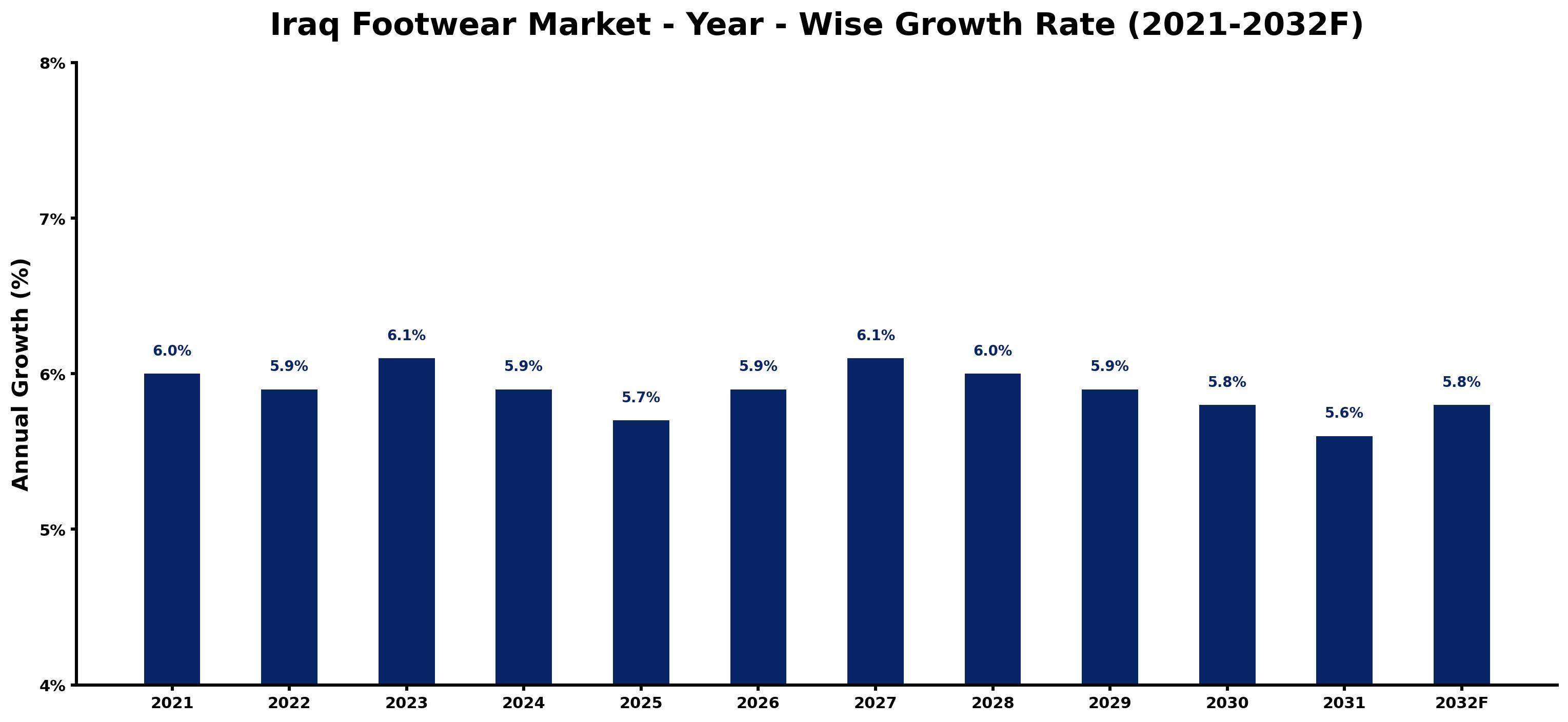
The table below presents the year wise growth rates along with the key drivers influencing the market
| Year | Growth Rate | Major Drivers |
| 2021 | 6.0% | Emerging consumer preferences lean heavily towards stylish yet functional footwear options. |
| 2022 | 5.9% | Local brands increasingly capture market share, emphasizing craftsmanship and cultural relevance. |
| 2023 | 6.1% | E-commerce platforms expand, providing accessible channels for diverse footwear selections. |
| 2024 | 5.9% | Urbanization accelerates, driving demand for durable and fashionable footwear among youth. |
| 2025 | 5.7% | Investment in local manufacturing facilities boosts availability and reduces import dependency. |
| 2026 | 5.9% | Footwear brands focus on sustainability, responding to environmental concerns among consumers. |
| 2027 | 6.1% | Innovative design trends create niche markets for specialized footwear products. |
| 2028 | 6.0% | Increased disposable income enables consumers to invest in premium footwear lines. |
| 2029 | 5.9% | Collaboration between international brands and local designers enhances product diversity. |
| 2030 | 5.8% | Health consciousness promotes the popularity of athletic and functional footwear options. |
| 2031 | 5.6% | Cultural events and festivals stimulate demand for traditional footwear styles. |
| 2032 | 5.8% | Technological integration in retail fosters personalized shopping experiences for consumers. |
Note - Market size estimations and growth projections presented in this report are based on 6Wresearch's advanced forecasting approach, validated with industry datasets as of June 2026.
Iraq Footwear Market Synopsis
The Iraq Footwear Market is projected to reach 5.9% and witness significant growth during the forecast period (2026-2032). This burgeoning market is driven by various factors, including rising disposable income, increasing urbanization, and evolving fashion trends among Iraqi consumers. The market encompasses a diverse range of products, from casual and formal footwear to sports and children's shoes, catering to a wide demographic. International brands are becoming increasingly popular due to their superior quality and innovative designs, while local manufacturers are instrumental in providing affordable and culturally resonant options.
Iraq Footwear Market Growth Drivers
The growth trajectory of the Iraq Footwear Market is influenced by several key drivers:
- Increased disposable income levels are enabling consumers to spend more on quality footwear, shifting preferences towards branded and fashionable products.
- The ongoing urbanization in Iraq has led to changes in lifestyle and consumer behavior, resulting in a greater demand for modern footwear styles that align with urban living.
- Health and fitness trends are pushing the popularity of athleisure footwear, reflecting the population's growing focus on wellness and active lifestyles.
- The shift towards e-commerce platforms is broader, enabling consumers to access a variety of footwear options conveniently and enhancing competitive dynamics in the market.
- Changing fashion trends, particularly among younger consumers, are promoting diversity in footwear choices, driving brands to innovate and cater to new tastes.
Iraq Footwear Market Trends and Opportunities
The Iraq Footwear Market is experiencing notable trends that present various opportunities for stakeholders:
- There is a discernible rise in demand for sustainable footwear, with consumers increasingly considering eco-friendly and vegan options in their purchasing decisions.
- The collaboration between footwear brands and fashion influencers is growing, creating new marketing avenues that resonate with trendy and younger audiences.
- Expansion of online retail channels is changing how consumers shop, as convenience and accessibility become paramount in purchasing footwear.
- Innovative designs that reflect contemporary styles while maintaining cultural elements are gaining traction among local consumers, allowing brands to capitalize on tradition infused with modernity.
- As health consciousness rises, functional footwear that combines style and comfort is a priority for many consumers, revealing a lucrative segment for brands to target.
Iraq Footwear Market Challenges and Restraints
Despite the positive outlook for the Iraq Footwear Market, several challenges hinder its potential:
- Political instability and security concerns remain significant obstacles, impacting business operations and consumer confidence in purchasing decisions.
- Reliance on oil exports makes the economy susceptible to global oil price fluctuations, affecting overall consumer purchasing power in the footwear sector.
- Inadequacies in infrastructure, such as transportation networks and limited banking services, complicate the distribution processes for footwear products.
- Competition from imported brands can stifle growth for local manufacturers, posing challenges in gaining market share and recognition.
- The presence of counterfeit products undermines brand integrity and consumer trust, impacting the overall health of the market.
Iraq Footwear Market Investment Opportunities
The Iraq Footwear Market offers compelling investment opportunities driven by demographic and economic factors:
- A youthful and growing population is fueling demand for fashionable and functional footwear, presenting avenues for both local and international brands.
- Enhancing manufacturing capabilities and distribution networks can position investors to effectively serve the expanding market.
- The rising trend of e-commerce provides a robust platform for reaching a broader customer base, encouraging digital investment strategies.
- Strategic partnerships with domestic retailers can help establish a strong presence in the evolving retail landscape.
- A focus on affordability and on-trend designs can ensure long-term success in a competitive marketplace.
Iraq Footwear Market Government Investment and Initiatives
The Iraqi government has initiated several policies to foster the growth of the footwear industry:
- By reducing import tariffs on raw materials for shoe production, the government is encouraging domestic manufacturing capabilities.
- Subsidies and incentives for local footwear businesses have been implemented to boost competitiveness and stimulate market growth.
- Quality control measures are being enforced to ensure that footwear products meet safety and standard requirements, enhancing consumer confidence.
- Efforts to highlight local craftsmanship and traditional designs are being supported, promoting cultural heritage within the footwear sector.
- Public investment aimed at improving infrastructure will facilitate better distribution channels, contributing positively to the market dynamics.
Iraq Footwear Market Latest Developments (May 2025 - June 2026)
In the period from May 2025 to June 2026, the Iraq Footwear Market has seen significant developments:
- There has been a marked increase in consumer interest toward sustainable footwear options, indicating a shift in purchasing preferences.
- Retailers are expanding their online presence, capitalizing on the growing trend of e-commerce to reach a wider audience.
- Collaborations between brands and local influencers have intensified, effectively engaging younger consumers and shaping market trends.
- Domestic manufacturers have started adopting innovative production techniques, improving product quality and diversifying offerings.
- Government initiatives focused on enhancing local manufacturing capabilities are beginning to yield positive results, boosting the competitiveness of Iraqi footwear.
Iraq Footwear Market - Key Attractiveness of the Report
- 10 Years of Market Numbers
- Historical Data Starting from 2022 to 2025
- Base Year: 2025
- Forecast Data until 2032
- Key Performance Indicators Impacting the Market
- Major Upcoming Developments and Projects
Key Highlights of the Report:
- Iraq Footwear Market Outlook
- Market Size of Iraq Footwear Market, 2025
- Forecast of Iraq Footwear Market, 2032F
- Historical Data and Forecast of Iraq Footwear Revenues & Volume for the Period 2022-2032F
- Iraq Footwear Market Trend Evolution
- Iraq Footwear Market Drivers and Challenges
- Iraq Footwear Price Trends
- Iraq Footwear Porter's Five Forces
- Iraq Footwear Industry Life Cycle
- Historical Data and Forecast of Iraq Footwear Market Revenues & Volume By Type for the Period 2022-2032F
- Historical Data and Forecast of Iraq Footwear Market Revenues & Volume By Athletic for the Period 2022-2032F
- Historical Data and Forecast of Iraq Footwear Market Revenues & Volume By Non-Athletic for the Period 2022-2032F
- Historical Data and Forecast of Iraq Footwear Market Revenues & Volume By Material for the Period 2022-2032F
- Historical Data and Forecast of Iraq Footwear Market Revenues & Volume By Lather for the Period 2022-2032F
- Historical Data and Forecast of Iraq Footwear Market Revenues & Volume By Rubber for the Period 2022-2032F
- Historical Data and Forecast of Iraq Footwear Market Revenues & Volume By Plastic for the Period 2022-2032F
- Iraq Footwear Import Export Trade Statistics
- Market Opportunity Assessment By Type
- Market Opportunity Assessment By Material
- Iraq Footwear Top Companies Market Share
- Iraq Footwear Competitive Benchmarking By Technical and Operational Parameters
- Iraq Footwear Company Profiles
- Iraq Footwear Key Strategic Recommendations






































