Iraq Gas Sensors Market Size, Share & Growth Rate
The Iraq Gas Sensors Market was estimated at USD 197 Million in 2025 and is projected to reach USD 264 Million by 2032, growing at a CAGR of 4.3% from 2026 to 2032. This growth trajectory is primarily fueled by increasing industrial activities across key sectors, coupled with stringent safety regulations that are enhancing the need for reliable gas monitoring solutions. Moreover, growing awareness regarding air quality and workplace safety is further driving demand for advanced gas sensing technologies.
Iraq Gas Sensors Market Year-wise Growth Rate and Key Drivers
This graph highlights how the Iraq Gas Sensors Market has steadily grown over the years, supported by major growth factors.
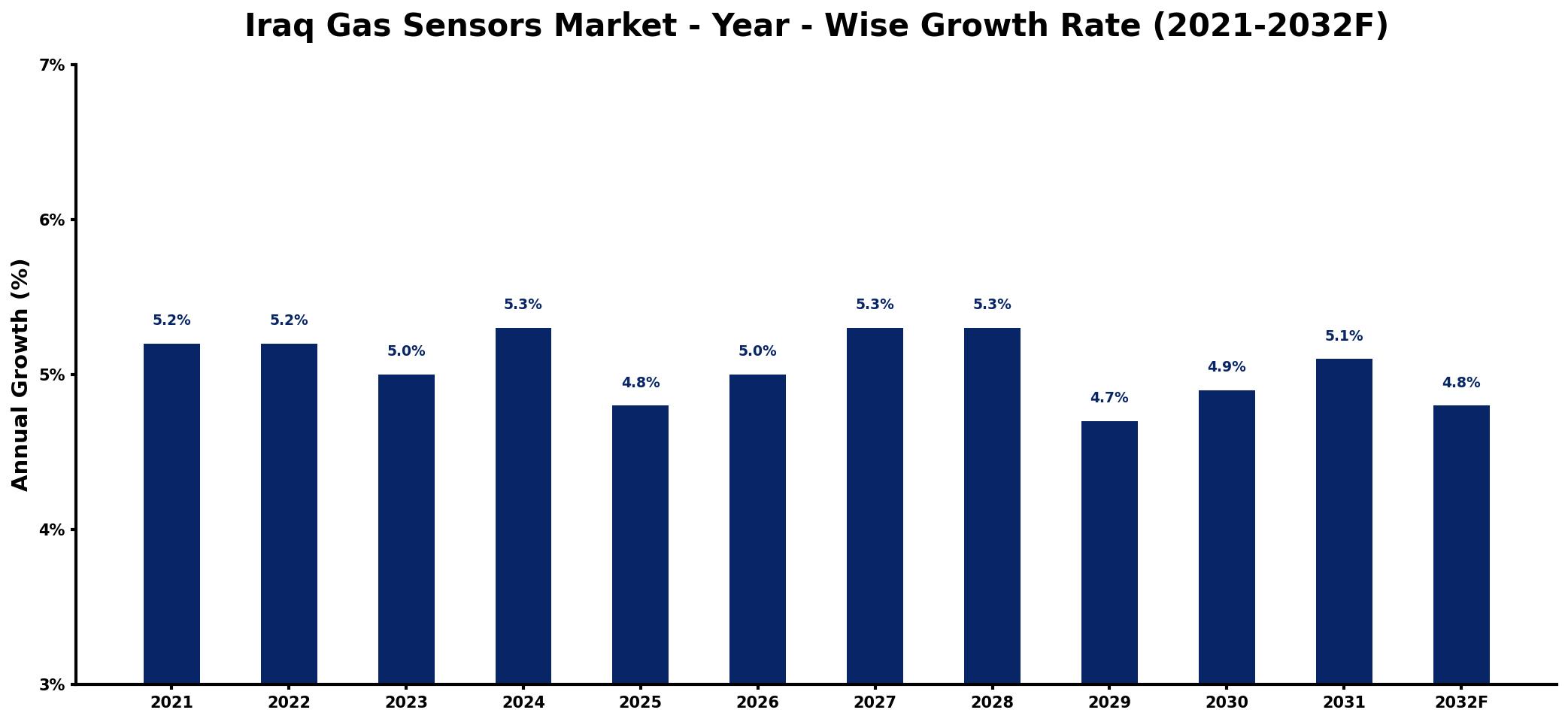
The table below presents the year‑wise growth rates along with the key drivers influencing the market
| Year | Growth Rate | Major Drivers |
| 2021 | 5.2% | Rising energy sector investments |
| 2022 | 5.2% | Growing industrial safety regulations |
| 2023 | 5.0% | Increased environmental compliance requirements |
| 2024 | 5.3% | Expansion of urban infrastructure projects |
| 2025 | 4.8% | Higher demand for industrial automation |
| 2026 | 5.0% | Surge in residential safety awareness |
| 2027 | 5.3% | Strengthened government energy initiatives |
| 2028 | 5.3% | Growth in renewable energy projects |
| 2029 | 4.7% | Emerging technologies driving innovation |
| 2030 | 4.9% | growing automotive sector requirements |
| 2031 | 5.1% | Increased focus on workplace safety |
| 2032 | 4.8% | Rising consumer awareness programs |
Note: Market size estimations and growth projections presented in this report are based on 6Wresearch's proprietary forecasting methodology, utilizing the latest available industry data, government publications, and primary research inputs.
Iraq Gas Sensors Market Synopsis
The Iraq gas sensors market has shown considerable momentum in recent years, bolstered by an uptick in industrial operations. This trend aligns with an expanding focus on environmental compliance and workplace safety. However, as the market evolves, it is set to witness deeper integration of smart technologies that promise enhanced accuracy and efficiency in gas detection.
Looking forward, the sector is adapting to new demands for real-time monitoring and IoT applications, indicative of a significant shift in operational paradigms. As regulatory frameworks tighten and investment in infrastructure increases, the Iraq gas sensors market is poised to enter a robust growth phase.
Iraq Gas Sensors Market Key Takeaways
- Steady market growth driven by increased industrial activities and regulatory compliance.
- Technological advancements are enhancing the accuracy and efficiency of gas detection solutions.
- Rising demand across sectors including oil & gas, manufacturing, and healthcare.
- Government initiatives are pushing for improved safety standards and air quality monitoring.
- Challenges such as political instability and economic volatility continue to influence market dynamics.
Evaluation of Restraints in Iraq Gas Sensors Market
While the Iraq gas sensors market shows promising potential, it grapples with significant restraints. Political instability often disrupts industrial operations, creating a challenging environment for investments. Additionally, the absence of a comprehensive regulatory framework has hindered innovation and market growth. The limited access to advanced technologies and skilled labor further complicates the adoption of cutting-edge gas sensing solutions. Lastly, economic fluctuations and volatility in the oil sector create uncertainty, impacting demand forecasts and strategic planning.
Iraq Gas Sensors Market Trends
Current trends indicate a strong shift towards the integration of IoT and AI technologies within gas detection systems, enhancing their operational efficiency and responsiveness. Moreover, there is an increasing emphasis on sensors that facilitate real-time monitoring and data analytics, empowering organizations to make informed safety decisions. The ongoing advancements in sensor technology also aim to improve sensitivity and reduce maintenance costs, thereby augmenting market appeal across various industries.
Iraq Gas Sensors Market Opportunities
The Iraq Gas Sensors Market offers significant investment opportunities, particularly in the realm of innovative gas sensor technologies. With an industrial landscape that increasingly prioritizes safety and environmental regulations, stakeholders can benefit from developing sensors capable of delivering precise real-time monitoring. Strategic partnerships with local industries and alignment with government initiatives aimed at improving air quality can also provide competitive advantages, paving the way for sustained market growth.
Government Initiatives in the Iraq Gas Sensors Market
The Iraqi government has taken proactive measures to bolster the gas sensors market, implementing policies that mandate the installation of gas sensors in industrial facilities. This includes regular inspections to ensure the operational efficiency of these sensors. Strict penalties for non-compliance with safety regulations reinforce the need for reliable monitoring solutions. Furthermore, the government has allocated resources for research and development in gas sensor technology, promoting local production and innovation.
Future Insights of the Iraq Gas Sensors Market
Looking ahead to 2026-2032, the Iraq Gas Sensors Market is anticipated to experience robust growth. The increasing emphasis on environmental safety, coupled with stringent regulatory mandates, is expected to fuel demand across various industrial sectors. Furthermore, as technological advancements in wireless and IoT-enabled sensors continue to evolve, they will provide organizations with enhanced monitoring capabilities, driving further market expansion. The ongoing pursuit of accurate and reliable gas sensing solutions to prevent workplace accidents will remain a crucial factor in this growth trajectory.
Iraq Gas Sensors Market Latest Developments (2025 - 2026)
Recent developments in the Iraq gas sensors market indicate a strong focus on technological enhancements. Industry stakeholders are investing in advanced sensor technologies, particularly those featuring improved sensitivity and faster response times. Additionally, collaborative efforts between government bodies and private sectors are gaining momentum, aimed at fostering innovation and improving regulatory compliance standards within the market.
Iraq Gas Sensors Market - Key Attractiveness of the Report
- 10 Years of Market Numbers
- Historical Data Starting from 2022 to 2025
- Base Year: 2025
- Forecast Data until 2032
- Key Performance Indicators Impacting the Market
- Major Upcoming Developments and Projects
Key Highlights of the Report:
- Iraq Gas Sensors Market Outlook
- Market Size of Iraq Gas Sensors Market, 2025
- Forecast of Iraq Gas Sensors Market, 2032
- Historical Data and Forecast of Iraq Gas Sensors Revenues & Volume for the Period 2022-2032F
- Iraq Gas Sensors Market Trend Evolution
- Iraq Gas Sensors Market Drivers and Challenges
- Iraq Gas Sensors Price Trends
- Iraq Gas Sensors Porter's Five Forces
- Iraq Gas Sensors Industry Life Cycle
- Historical Data and Forecast of Iraq Gas Sensors Market Revenues & Volume By Product for the Period 2022-2032F
- Historical Data and Forecast of Iraq Gas Sensors Market Revenues & Volume By Hydrogen for the Period 2022-2032F
- Historical Data and Forecast of Iraq Gas Sensors Market Revenues & Volume By Ammonia for the Period 2022-2032F
- Historical Data and Forecast of Iraq Gas Sensors Market Revenues & Volume By Hydrogen Sulfide for the Period 2022-2032F
- Historical Data and Forecast of Iraq Gas Sensors Market Revenues & Volume By Methyl Mercaptan Sensor for the Period 2022-2032F
- Historical Data and Forecast of Iraq Gas Sensors Market Revenues & Volume By NOx Sensor for the Period 2022-2032F
- Historical Data and Forecast of Iraq Gas Sensors Market Revenues & Volume By Carbon Monoxide Sensor for the Period 2022-2032F
- Historical Data and Forecast of Iraq Gas Sensors Market Revenues & Volume By Carbon Dioxide Sensor for the Period 2022-2032F
- Historical Data and Forecast of Iraq Hydrogen Gas Sensors Market Revenues & Volume By Oxygen/Lambda Sensor for the Period 2022-2032F
- Historical Data and Forecast of Iraq Gas Sensors Market Revenues & Volume By Technology for the Period 2022-2032F
- Historical Data and Forecast of Iraq Gas Sensors Market Revenues & Volume By Infrared for the Period 2022-2032F
- Historical Data and Forecast of Iraq Gas Sensors Market Revenues & Volume By Catalytic for the Period 2022-2032F
- Historical Data and Forecast of Iraq Gas Sensors Market Revenues & Volume By Photo-Ionization Detector for the Period 2022-2032F
- Historical Data and Forecast of Iraq Gas Sensors Market Revenues & Volume By Solid State/MOS for the Period 2022-2032F
- Historical Data and Forecast of Iraq Gas Sensors Market Revenues & Volume By Semiconductor for the Period 2022-2032F
- Historical Data and Forecast of Iraq Gas Sensors Market Revenues & Volume By Electrochemical for the Period 2022-2032F
- Iraq Gas Sensors Import Export Trade Statistics
- Market Opportunity Assessment By Product
- Market Opportunity Assessment By Technology
- Iraq Gas Sensors Top Companies Market Share
- Iraq Gas Sensors Competitive Benchmarking By Technical and Operational Parameters
- Iraq Gas Sensors Company Profiles
- Iraq Gas Sensors Key Strategic Recommendations






































