Iraq Glass Market Summary
The iraq glass market was estimated at USD 179 Million in 2025 and is projected to reach USD 250 Million by 2032, growing at a CAGR of 5.5% from 2026 to 2032.
Iraq Glass Market Year-wise Growth Rate and Key Drivers
This graph highlights how the Iraq Glass Market has steadily grown over the past five years, supported by major growth factors.
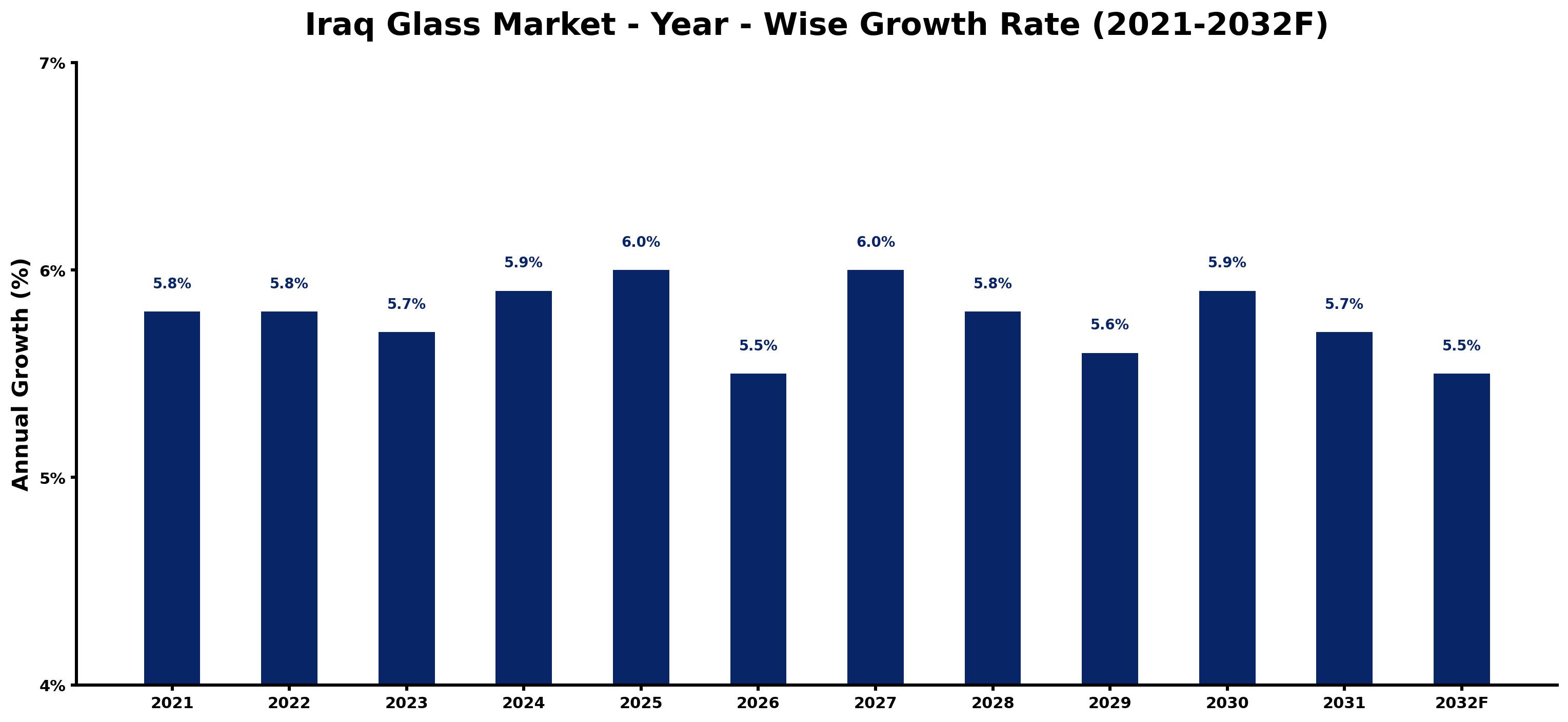
The table below presents the year wise growth rates along with the key drivers influencing the market
| Year | Growth Rate | Major Drivers |
| 2021 | 5.8% | Construction projects resumed, fueling demand for durable building materials like glass. |
| 2022 | 5.8% | Infrastructure investments increased, highlighting the need for high-quality glass solutions. |
| 2023 | 5.7% | Urbanization trends continued, pushing consumption of glass in residential and commercial spaces. |
| 2024 | 5.9% | Renewed focus on energy efficiency spurred interest in double-glazed insulation glass. |
| 2025 | 6.0% | Local manufacturers improved production technology, reducing costs and enhancing output quality. |
| 2026 | 5.5% | Collaborations with international firms introduced advanced glass technologies to the market. |
| 2027 | 6.0% | Increased tourism led to a boom in hospitality construction, boosting glass demand significantly. |
| 2028 | 5.8% | Environmental awareness prompted shifts toward sustainable and recyclable glass products. |
| 2029 | 5.6% | Smart building trends emerged, incorporating technology-enhanced glass features for modern structures. |
| 2030 | 5.9% | Economic stability attracted foreign investments, expanding local glass production capabilities. |
| 2031 | 5.7% | Emerging architects prioritized aesthetics, driving demand for custom-designed glass products. |
| 2032 | 5.5% | New regulations on construction standards emphasized the use of high-performance glass materials. |
Note - Market size estimations and growth projections presented in this report are based on 6Wresearch's advanced forecasting approach, validated with industry datasets as of June 2026.
Iraq Glass Market Synopsis
The Iraq Glass Market is projected to reach 5.5% and witness significant growth during the forecast period (2026-2032). This growth is underpinned by a robust increase in construction activities across commercial and residential segments, driven by urbanization and a growing population. Major cities, including Baghdad, Basra, and Erbil, are experiencing accelerated infrastructure development, resulting in heightened demand for various glass products such as windows, doors, and facades. Furthermore, there is a marked shift towards energy-efficient and sustainable building materials, incentivizing the adoption of advanced glass solutions.
Iraq Glass Market Growth Drivers
Several factors are catalyzing the growth of the Iraq glass market. First, the surge in urban development is leading to increased construction projects, which are essential to accommodate the rising population. Second, the trend towards modernizing infrastructure is driving demand for high-performance glass. Third, the growing attractiveness of energy-efficient buildings is compelling developers to invest in advanced glass technologies. Fourth, government initiatives aimed at promoting economic recovery post-conflict are accelerating construction activities. Finally, the increasing demand from the automotive and packaging industries is further diversifying the market's growth avenues.
Iraq Glass Market Trends and Opportunities
The Iraq glass market is evolving, characterized by several noteworthy trends. One key trend is the increasing preference for sustainable glass solutions, spurred by environmental regulations and consumer awareness. Another noteworthy development is the technological advancement facilitating the introduction of smart glass that can control light and heat transmission effectively. Furthermore, customization options are becoming essential as consumers seek tailored solutions that meet specific architectural needs. The rise in demand for value-added services, such as installation and maintenance, offers additional opportunities. Overall, the market is poised for substantial growth as stakeholders innovate to meet dynamic consumer preferences.
Iraq Glass Market Challenges and Restraints
Despite the promising outlook, the Iraq glass market is not without its challenges. A primary concern is the lack of modern production facilities, resulting in subpar quality relative to international standards. Additionally, the restricted access to quality raw materials and raw material price volatility create uncertainties in the supply chain. Political and economic instability continues to pose a significant risk, affecting consumer purchasing behavior and overall market demand. Moreover, insufficient infrastructure and inadequate transportation networks complicate the distribution of glass products across the country, further exacerbating market fragmentation.
Iraq Glass Market Investment Opportunities
Investment opportunities within the Iraq glass market are multifaceted. The increasing demand for flat glass in the construction sector is a promising target for new projects. The packaging industry is also emerging as a fertile ground for investments in container glass manufacturing. Notably, the growing need for fiberglass in various applications, including construction and automobiles, presents a significant investment opportunity. Investors can also focus on establishing partnerships with local manufacturers to enhance production capabilities and quality. Lastly, introducing advanced technologies to boost production efficiency can provide a competitive advantage in this evolving market environment.
Iraq Glass Market Government Investment and Initiatives
The Iraqi government has recognized the importance of the glass sector and is actively implementing policies to bolster market growth. These initiatives include imposing import tariffs on foreign glass products to protect domestic manufacturers, thereby encouraging local production. Furthermore, the government is offering incentives aimed at enhancing self-sufficiency and promoting quality standards within the industry. In addition, public spending on infrastructure development is expected to integrate glass components into numerous renewable energy projects, which will further bolster the market. Overall, these proactive measures are designed to stimulate the glass industry and contribute to economic development in Iraq.
Iraq Glass Market Latest Developments (May 2025 - June 2026)
Recent developments in the Iraq glass market from May 2025 to June 2026 indicate a robust trend of modernization and investment in production capabilities. Industry stakeholders have begun implementing advanced manufacturing technologies, which are expected to enhance product quality and operational efficiency. Simultaneously, there has been an uptick in collaborations between local firms and international technology providers, aimed at introducing innovative glass solutions. Furthermore, the government has ramped up infrastructure projects, driving the demand for glass products. As a result, the market is evolving, showcasing increased resilience and adaptability in response to changing economic conditions.
Iraq Glass Market - Key Attractiveness of the Report
- 10 Years of Market Numbers
- Historical Data Starting from 2022 to 2025
- Base Year: 2025
- Forecast Data until 2032
- Key Performance Indicators Impacting the Market
- Major Upcoming Developments and Projects
Key Highlights of the Report:
- Iraq Glass Market Outlook
- Market Size of Iraq Glass Market, 2025
- Forecast of Iraq Glass Market, 2032F
- Historical Data and Forecast of Iraq Glass Revenues & Volume for the Period 2022-2032F
- Iraq Glass Market Trend Evolution
- Iraq Glass Market Drivers and Challenges
- Iraq Glass Price Trends
- Iraq Glass Porter's Five Forces
- Iraq Glass Industry Life Cycle
- Historical Data and Forecast of Iraq Glass Market Revenues & Volume By Product Types for the Period 2022-2032F
- Historical Data and Forecast of Iraq Glass Market Revenues & Volume By Basic for the Period 2022-2032F
- Historical Data and Forecast of Iraq Glass Market Revenues & Volume By Tempered for the Period 2022-2032F
- Historical Data and Forecast of Iraq Glass Market Revenues & Volume By Laminated for the Period 2022-2032F
- Historical Data and Forecast of Iraq Glass Market Revenues & Volume By Insulated for the Period 2022-2032F
- Historical Data and Forecast of Iraq Glass Market Revenues & Volume By Others for the Period 2022-2032F
- Historical Data and Forecast of Iraq Glass Market Revenues & Volume By Applications for the Period 2022-2032F
- Historical Data and Forecast of Iraq Glass Market Revenues & Volume By Architectural for the Period 2022-2032F
- Historical Data and Forecast of Iraq Glass Market Revenues & Volume By Automotive & transportation for the Period 2022-2032F
- Historical Data and Forecast of Iraq Glass Market Revenues & Volume By Others for the Period 2022-2032F
- Historical Data and Forecast of Iraq Glass Market Revenues & Volume By Technology Types for the Period 2022-2032F
- Historical Data and Forecast of Iraq Glass Market Revenues & Volume By Float for the Period 2022-2032F
- Historical Data and Forecast of Iraq Glass Market Revenues & Volume By Rolled for the Period 2022-2032F
- Historical Data and Forecast of Iraq Glass Market Revenues & Volume By Sheet for the Period 2022-2032F
- Iraq Glass Import Export Trade Statistics
- Market Opportunity Assessment By Product Types
- Market Opportunity Assessment By Applications
- Market Opportunity Assessment By Technology Types
- Iraq Glass Top Companies Market Share
- Iraq Glass Competitive Benchmarking By Technical and Operational Parameters
- Iraq Glass Company Profiles
- Iraq Glass Key Strategic Recommendations






































