Iraq Gold Bullion Market Size, Share & Growth Rate
The Iraq Gold Bullion Market was estimated at USD 766 Million in 2025 and is projected to reach USD 1096 Million by 2032, growing at a CAGR of 5.3% from 2026 to 2032. This trajectory is primarily driven by a heightened demand for physical gold as a safeguard against economic volatility, combined with the growing cultural affinity for gold as both a store of value and a luxury item. Furthermore, geopolitical uncertainties and the ongoing inflationary pressures in Iraq are compelling more investors to consider gold bullion as a secure investment avenue.
Iraq Gold Bullion Market Year-wise Growth Rate and Key Drivers
This graph highlights how the Iraq Gold Bullion Market has steadily grown over the years, supported by major growth factors.
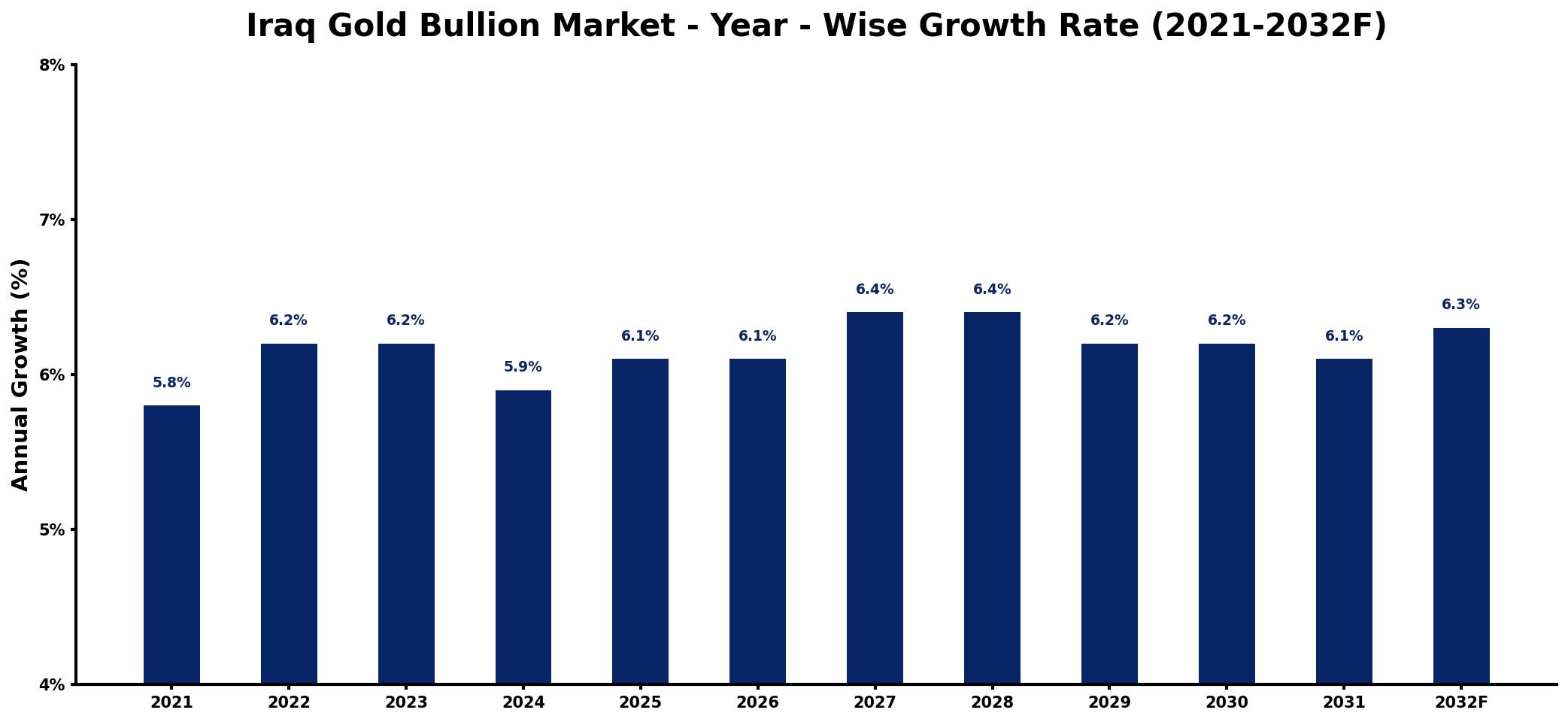
The table below presents the year‑wise growth rates along with the key drivers influencing the market
| Year | Growth Rate | Major Drivers |
| 2021 | 5.8% | Rising consumer investment interest |
| 2022 | 6.2% | Increased demand from investors |
| 2023 | 6.2% | Growing wealth among consumers |
| 2024 | 5.9% | Expansion of retail investment channels |
| 2025 | 6.1% | Strengthening economic stability expectations |
| 2026 | 6.1% | Higher institutional investment activity |
| 2027 | 6.4% | Increased global economic uncertainties |
| 2028 | 6.4% | Surge in luxury asset purchases |
| 2029 | 6.2% | Growing awareness of wealth preservation |
| 2030 | 6.2% | Increased retail market participation |
| 2031 | 6.1% | improved raw material availability |
| 2032 | 6.3% | Heightened interest in alternative assets |
Note: Market size estimations and growth projections presented in this report are based on 6Wresearch's proprietary forecasting methodology, utilizing the latest available industry data, government publications, and primary research inputs.
Iraq Gold Bullion Market Synopsis
Currently, the Iraq Gold Bullion market is witnessing a surge in interest, driven by both local investors and international buyers seeking a hedge against instability. Gold is increasingly recognized for its role as a safe-haven asset, with many Iraqis diversifying their portfolios to mitigate risks associated with economic fluctuations.
The market predominantly comprises gold bars and coins, with consumer preferences shaped by both investment potential and cultural significance. Despite challenges such as counterfeiting and an underdeveloped regulatory framework, the sector holds significant promise for expansion as more citizens seek to secure their wealth through gold investments.
Iraq Gold Bullion Market Key Takeaways
- The market is evolving rapidly, reflecting Iraq's unique socio-economic landscape.
- Gold is seen as a crucial asset for wealth preservation amid geopolitical tensions.
- Growth opportunities exist for innovative investment products related to gold.
- Cultural significance continues to drive demand for gold bullion among Iraqis.
- Investor awareness of market dynamics is key for navigating the current landscape.
Evaluation of Restraints in Iraq Gold Bullion Market
The Iraq Gold Bullion Market faces notable restraints, primarily stemming from security concerns linked to the region's political instability. Ongoing conflicts hinder the logistics and movement of gold, complicating transactions for both traders and consumers. Moreover, the lack of a comprehensive regulatory framework hampers transparency, increasing the risk of fraudulent activities. Limited access to financial services further complicates market participation, creating barriers for potential investors and traders. Therefore, addressing these constraints is critical for fostering a more robust market environment.
Iraq Gold Bullion Market Trends
Current trends in the Iraq Gold Bullion Market illustrate a marked increase in demand for physical gold, largely influenced by economic instability and inflationary pressures. As the middle class expands, consumer interest in gold as both an investment and status symbol rises. Furthermore, technological advancements in trading and verification processes are enhancing trust in gold investments, potentially mitigating concerns about counterfeit products. This convergence of economic, cultural, and technological factors is reshaping the landscape of the gold bullion market in Iraq.
Iraq Gold Bullion Market Opportunities
The market presents genuine growth opportunities as investors increasingly turn to gold for portfolio diversification. The cultural importance of gold, coupled with a strengthening middle class, enhances the attractiveness of physical bullion as both an investment vehicle and a means of wealth preservation. Additionally, the Iraqi governments efforts to bolster market infrastructure create avenues for enhanced trade and investment, allowing market participants to capitalize on the growing demand for gold.
Government Initiatives in the Iraq Gold Bullion Market
The Iraqi government is actively engaged in shaping the Gold Bullion Market through various regulatory policies aimed at ensuring fair practices and market stability. The Central Bank of Iraq plays a pivotal role in overseeing gold transactions, instituting regulations to govern imports and sales, and preventing illicit activities. Such efforts are focused on enhancing transparency, fostering investor confidence, and supporting overall economic development in Iraq, thereby creating a conducive environment for the gold market.
Future Insights of the Iraq Gold Bullion Market
Looking ahead to the period from 2026 to 2032, the Iraq Gold Bullion Market is poised for considerable growth. As the nation stabilizes and its economy continues to evolve, demand for gold as a safe haven is likely to increase further. The rising disposable incomes among consumers and an expanding middle class will contribute to a sustained interest in gold both as an investment and a cultural asset. However, market participants will need to navigate ongoing geopolitical risks and regulatory challenges as they seek to maximize opportunities in this promising sector.
Iraq Gold Bullion Market Latest Developments (2025 - 2026)
Recent developments in the Iraq Gold Bullion Market reflect a robust engagement from both local and international investors. Increasing media coverage surrounding gold investments has heightened awareness and interest among potential buyers. Initiatives aimed at strengthening regulatory frameworks are gaining traction, aimed at enhancing market trust and reducing counterfeit incidents. As the economy shows signs of recovery, market optimism continues to grow, contributing to a vibrant trading environment.
Iraq Gold Bullion Market - Key Attractiveness of the Report
- 10 Years of Market Numbers
- Historical Data Starting from 2022 to 2025
- Base Year: 2025
- Forecast Data until 2032
- Key Performance Indicators Impacting the Market
- Major Upcoming Developments and Projects
Key Highlights of the Report:
- Iraq Gold Bullion Market Outlook
- Market Size of Iraq Gold Bullion Market, 2025
- Forecast of Iraq Gold Bullion Market, 2032
- Historical Data and Forecast of Iraq Gold Bullion Revenues & Volume for the Period 2022-2032F
- Iraq Gold Bullion Market Trend Evolution
- Iraq Gold Bullion Market Drivers and Challenges
- Iraq Gold Bullion Price Trends
- Iraq Gold Bullion Porter's Five Forces
- Iraq Gold Bullion Industry Life Cycle
- Historical Data and Forecast of Iraq Gold Bullion Market Revenues & Volume By Type for the Period 2022-2032F
- Historical Data and Forecast of Iraq Gold Bullion Market Revenues & Volume By Gold Bar for the Period 2022-2032F
- Historical Data and Forecast of Iraq Gold Bullion Market Revenues & Volume By Gold Coin for the Period 2022-2032F
- Historical Data and Forecast of Iraq Gold Bullion Market Revenues & Volume By Distribution Channel for the Period 2022-2032F
- Historical Data and Forecast of Iraq Gold Bullion Market Revenues & Volume By Online for the Period 2022-2032F
- Historical Data and Forecast of Iraq Gold Bullion Market Revenues & Volume By Offline for the Period 2022-2032F
- Iraq Gold Bullion Import Export Trade Statistics
- Market Opportunity Assessment By Type
- Market Opportunity Assessment By Distribution Channel
- Iraq Gold Bullion Top Companies Market Share
- Iraq Gold Bullion Competitive Benchmarking By Technical and Operational Parameters
- Iraq Gold Bullion Company Profiles
- Iraq Gold Bullion Key Strategic Recommendations






































