Iraq Household furniture Market Summary
The iraq household furniture market was estimated at USD 207 Million in 2025 and is projected to reach USD 227 Million by 2032, growing at a CAGR of 0.7% from 2026 to 2032.
Iraq Household furniture Market Year-wise Growth Rate and Key Drivers
This graph highlights how the Iraq Household furniture Market has steadily grown over the past five years, supported by major growth factors.
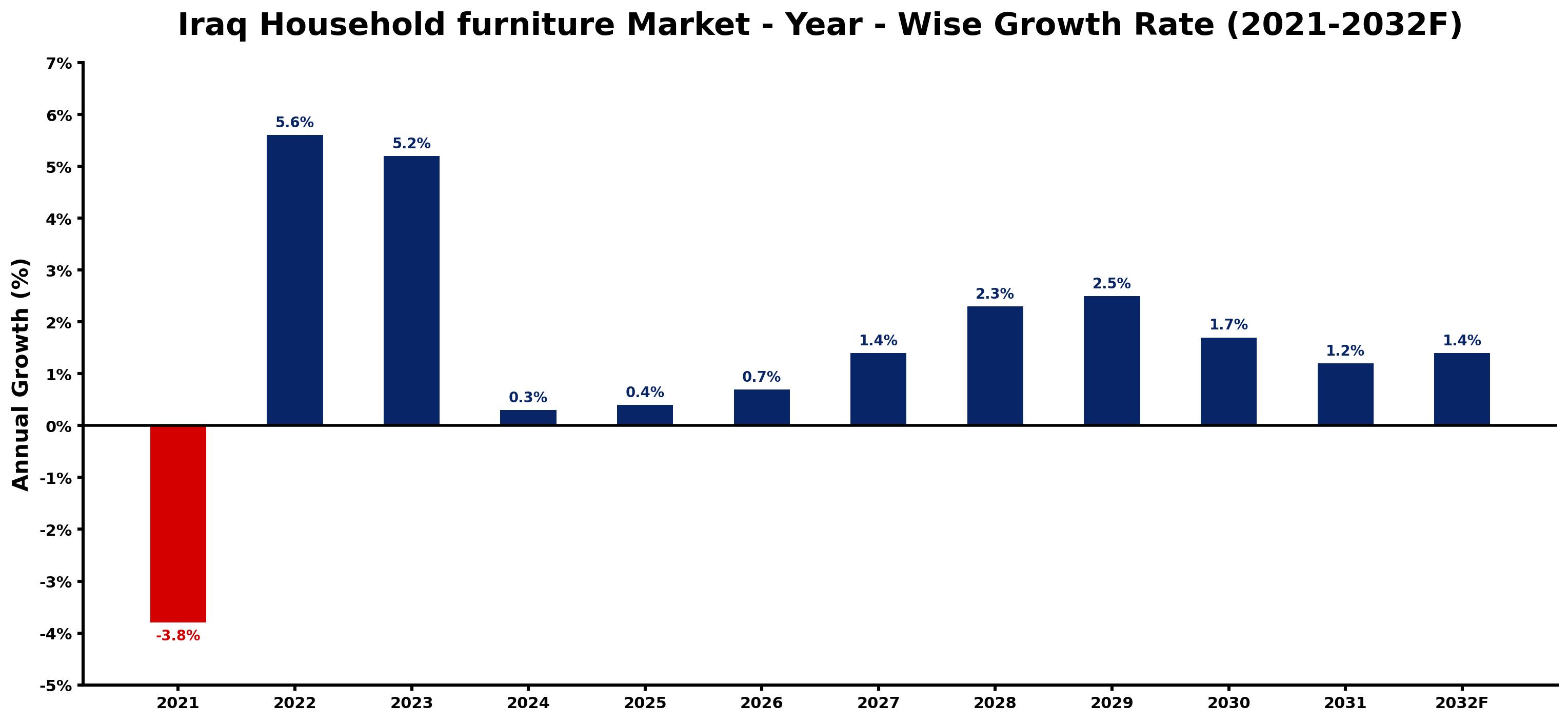
The table below presents the year wise growth rates along with the key drivers influencing the market
| Year | Growth Rate | Major Drivers |
| 2021 | -3.8% | Political instability and ongoing security concerns deterred investments and consumer spending on household furniture. |
| 2022 | 5.6% | Emerging e-commerce platforms enhance accessibility for urban and rural furniture buyers. |
| 2023 | 5.2% | Construction projects surge, increasing demand for residential and commercial furniture. |
| 2024 | 0.3% | Local artisans gain popularity, showcasing traditional craftsmanship in contemporary designs. |
| 2025 | 0.4% | Increased foreign investment bolsters manufacturers, enhancing product quality and variety. |
| 2026 | 0.7% | Urbanization trends lead to smaller living spaces, driving demand for multifunctional furniture. |
| 2027 | 1.4% | Shifts in consumer preferences favor sustainable materials, influencing production practices positively. |
| 2028 | 2.3% | Aging population creates demand for ergonomic and accessible home furnishings. |
| 2029 | 2.5% | Technological integration in design processes streamlines production efficiency and reduces costs. |
| 2030 | 1.7% | Cultural shifts emphasize home decor, prompting consumers to invest in stylish furnishings. |
| 2031 | 1.2% | Revitalized tourism boosts luxury furniture market segments, catering to higher-end clientele. |
| 2032 | 1.4% | Collaborations with global brands introduce innovative trends, reshaping local consumer choices. |
Note - Market size estimations and growth projections presented in this report are based on 6Wresearch's advanced forecasting approach, validated with industry datasets as of June 2026.
Iraq Household furniture Market Synopsis
The Iraq Household furniture Market is projected to reach 0.7% and witness significant growth during the forecast period (2026-2032). This growth is anticipated to be driven by a combination of factors including an increasingly urban population, rising disposable incomes, and a notable shift in consumer preferences towards modern and stylish furniture. The market landscape is evolving as both local manufacturers and international brands seek to capitalize on the changing dynamics of consumer behavior in Iraq.
Iraq Household furniture Market Growth Drivers
The expansion of the Iraq Household furniture Market can be attributed to several key drivers:
- Urbanization is a significant factor, as more people move to urban centers where smaller living spaces necessitate the need for multifunctional furniture that maximizes utility.
- Increases in disposable income among the young population are leading to a greater willingness to invest in home décor, reflecting a growing appreciation for interior design.
- A rise in the middle-class segment promotes a demand for higher-quality furniture products that resonate with contemporary aesthetics and functional needs.
- With improvements in infrastructure and retail channels, consumers have more access to diverse furniture options, contributing to a more competitive market environment.
- Heightened awareness of global design trends encourages consumers to seek out fashionable and innovative furniture solutions to enhance their living spaces.
Iraq Household furniture Market Trends and Opportunities
The Iraq Household furniture Market is currently characterized by distinct trends that highlight consumer preferences:
- A noticeable shift towards modern, multifunctional furniture pieces reflects the requirements of smaller households and urban living conditions.
- Consumers are increasingly favoring eco-friendly and sustainable materials, showcasing a growing awareness of environmental impacts associated with furniture production.
- The prevalence of e-commerce platforms is transforming the retail landscape, offering consumers convenient access to a wider range of furniture products.
- Innovative storage solutions are becoming essential as consumers seek to optimize space in their homes, particularly in urban areas.
- Trends toward minimalism and contemporary design elements indicate a preference for clean lines and simplicity, which aligns with modern lifestyle choices.
Iraq Household furniture Market Challenges and Restraints
Despite its growth potential, the Iraq Household furniture Market confronts several challenges that could hinder its expansion:
- Economic instability resulting from ongoing political unrest poses risks to consumer confidence and purchasing power, limiting spending on non-essential items like furniture.
- Limited access to financing options for both consumers and furniture businesses hampers the ability to make purchases and invest in inventory.
- Import restrictions along with high tariffs on furniture products create barriers for international suppliers attempting to penetrate the market.
- Infrastructure issues, including unreliable electricity and transportation logistics, complicate distribution channels and affect product availability.
- Local manufacturers face intense competition from low-cost imports and counterfeit products, challenging their market share and profitability.
Iraq Household furniture Market Investment Opportunities
Given the favorable market conditions, there are compelling investment opportunities within the Iraq Household furniture Market:
- The expanding middle-class demographic indicates a growing market for high-quality furniture solutions that meet modern lifestyle needs.
- Ongoing reconstruction efforts and infrastructure initiatives present potential demand for furniture not only in residential sectors but also in commercial spaces.
- Investors can benefit by focusing on diverse product offerings that cater to various consumer preferences, appealing to both budget-conscious and premium segments.
- The increasing trend of online shopping signals a need for digital strategies to effectively reach and engage consumers in the market.
- Fostering partnerships with local manufacturers can enhance supply chain efficiencies and build brand loyalty among Iraqi consumers.
Iraq Household furniture Market Government Investment and Initiatives
Government policies in Iraq are increasingly aimed at bolstering the household furniture market through various initiatives:
- To protect domestic production, the government has implemented import tariffs that encourage consumers to prefer locally manufactured furniture.
- There are initiatives to provide financial support to local manufacturers, including grants and subsidies, aimed at enhancing production capabilities and improving quality standards.
- The government is fostering technical assistance programs that focus on modernizing production processes within the furniture industry.
- Efforts to create a stable business environment involve addressing security concerns, thereby enabling a conducive atmosphere for investment in furniture manufacturing.
- Public spending on infrastructure development is expected to facilitate better logistics and distribution networks for furniture retailers and manufacturers.
Iraq Household furniture Market Latest Developments (May 2025 - June 2026)
Recent developments in the Iraq Household furniture Market indicate a dynamic shift towards modernization and sustainability:
- There has been an increased emphasis on sustainable production practices among local manufacturers, aligning with global trends towards environmentally conscious consumerism.
- The rise of digital commerce platforms has led to significant changes in consumer purchasing behavior, with more individuals opting to buy furniture online.
- Notable improvements in retail infrastructure have facilitated better access to a wider variety of furniture products across different consumer segments.
- Market players have been focusing on innovative designs that meet the demands of contemporary lifestyle changes, particularly in urban areas.
- Government initiatives to support domestic manufacturers have contributed to a more favorable competitive landscape, helping to mitigate the impact of foreign imports.
Iraq Household furniture Market - Key Attractiveness of the Report
- 10 Years of Market Numbers
- Historical Data Starting from 2022 to 2025
- Base Year: 2025
- Forecast Data until 2032
- Key Performance Indicators Impacting the Market
- Major Upcoming Developments and Projects
Key Highlights of the Report:
- Iraq Household furniture Market Outlook
- Market Size of Iraq Household furniture Market, 2025
- Forecast of Iraq Household furniture Market, 2032F
- Historical Data and Forecast of Iraq Household furniture Revenues & Volume for the Period 2022-2032F
- Iraq Household furniture Market Trend Evolution
- Iraq Household furniture Market Drivers and Challenges
- Iraq Household furniture Price Trends
- Iraq Household furniture Porter's Five Forces
- Iraq Household furniture Industry Life Cycle
- Historical Data and Forecast of Iraq Household furniture Market Revenues & Volume By Types for the Period 2022-2032F
- Historical Data and Forecast of Iraq Household furniture Market Revenues & Volume By Wood Furniture for the Period 2022-2032F
- Historical Data and Forecast of Iraq Household furniture Market Revenues & Volume By Metal Furniture for the Period 2022-2032F
- Historical Data and Forecast of Iraq Household furniture Market Revenues & Volume By Plastic Furniture for the Period 2022-2032F
- Historical Data and Forecast of Iraq Household furniture Market Revenues & Volume By Others for the Period 2022-2032F
- Historical Data and Forecast of Iraq Household furniture Market Revenues & Volume By Area of Use for the Period 2022-2032F
- Historical Data and Forecast of Iraq Household furniture Market Revenues & Volume By ?Bedroom Furniture for the Period 2022-2032F
- Historical Data and Forecast of Iraq Household furniture Market Revenues & Volume By Living Room Furniture for the Period 2022-2032F
- Historical Data and Forecast of Iraq Household furniture Market Revenues & Volume By Dining Room Furniture for the Period 2022-2032F
- Historical Data and Forecast of Iraq Household furniture Market Revenues & Volume By Household Furniture for the Period 2022-2032F
- Historical Data and Forecast of Iraq Household furniture Market Revenues & Volume By Others for the Period 2022-2032F
- Iraq Household furniture Import Export Trade Statistics
- Market Opportunity Assessment By Types
- Market Opportunity Assessment By Area of Use
- Iraq Household furniture Top Companies Market Share
- Iraq Household furniture Competitive Benchmarking By Technical and Operational Parameters
- Iraq Household furniture Company Profiles
- Iraq Household furniture Key Strategic Recommendations






































