Iraq Human Hair Extension Market Size, Share & Growth Rate
The Iraq Human Hair Extension Market was estimated at USD 1355 Million in 2025 and is projected to reach USD 2361 Million by 2032, growing at a CAGR of 8.3% from 2026 to 2032. This growth trajectory is significantly driven by an increase in disposable income among the population, alongside a burgeoning beauty consciousness and a preference for high-quality, natural-looking hair extensions. Additionally, evolving fashion trends and heightened consumer awareness regarding personal grooming further contribute to the expanding market landscape.
Iraq Human Hair Extension Market Year-wise Growth Rate and Key Drivers
This graph highlights how the Iraq Human Hair Extension Market has steadily grown over the years, supported by major growth factors.
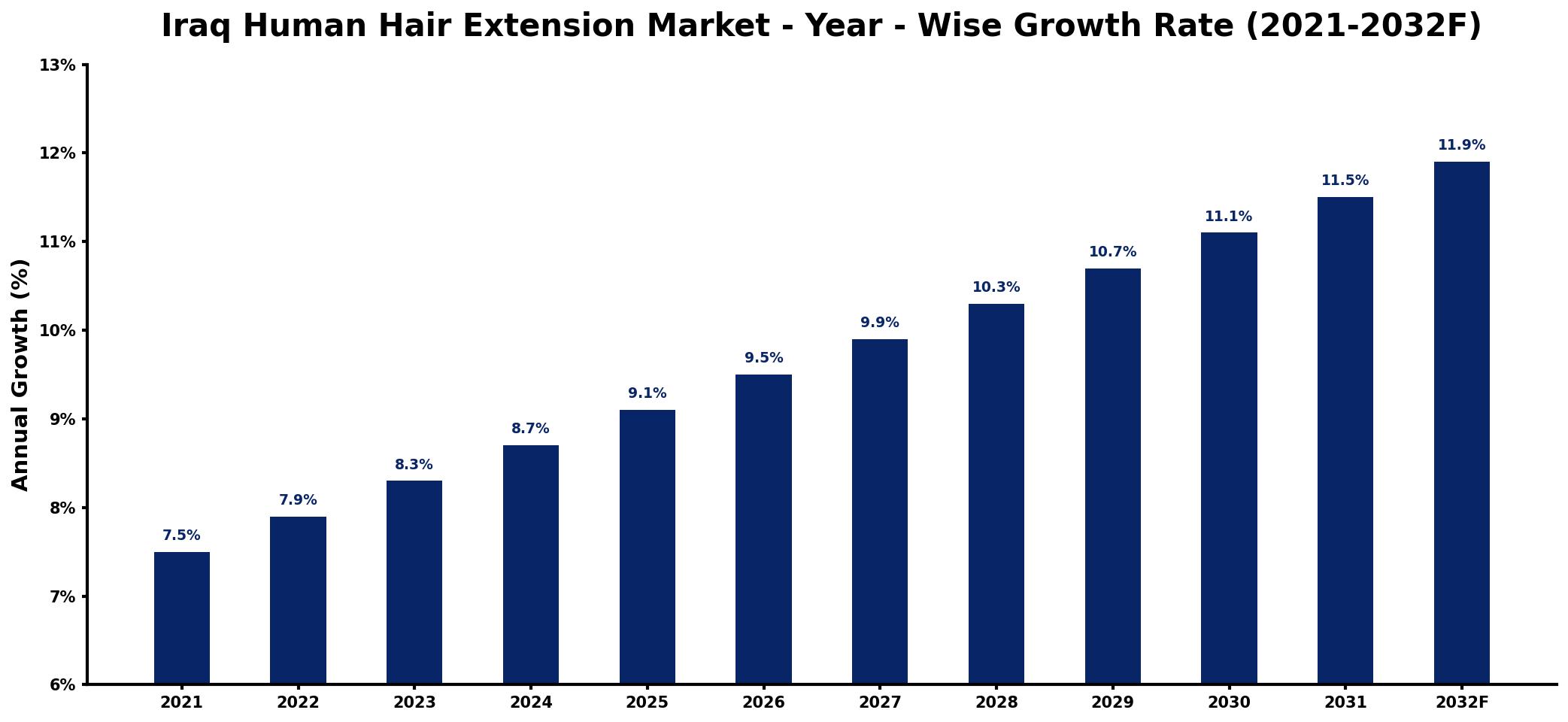
The table below presents the year‑wise growth rates along with the key drivers influencing the market
| Year | Growth Rate | Major Drivers |
| 2021 | 7.5% | Rising consumer interest in beauty |
| 2022 | 7.9% | Increased disposable income levels |
| 2023 | 8.3% | Growth in online retail channels |
| 2024 | 8.7% | Expansion of beauty salons market |
| 2025 | 9.1% | Surge in social media influence |
| 2026 | 9.5% | Emergence of new fashion trends |
| 2027 | 9.9% | Higher demand for luxury products |
| 2028 | 10.3% | Increased investment in beauty sector |
| 2029 | 10.7% | improved raw material availability |
| 2030 | 11.1% | Enhanced product availability online |
| 2031 | 11.5% | Rising popularity of beauty events |
| 2032 | 11.9% | Growing acceptance of beauty diversity |
Note: Market size estimations and growth projections presented in this report are based on 6Wresearch's proprietary forecasting methodology, utilizing the latest available industry data, government publications, and primary research inputs.
Iraq Human Hair Extension Market Synopsis
As beauty standards continue to evolve in Iraq, the human hair extension market is rapidly gaining traction. Consumers are increasingly prioritizing their appearance, leading to a surge in demand for high-quality hair extensions that not only enhance beauty but also boost self-confidence.
The market is witnessing a shift towards ethically sourced products, reflecting a growing awareness about sustainability and cruelty-free practices. Local salons, beauty shops, and online platforms are pivotal in making these desirable products accessible to diverse consumer segments across Iraq.
Iraq Human Hair Extension Market Key Takeaways
- The market is expanding due to rising disposable income and increased beauty consciousness among consumers.
- There is a notable shift towards sustainable and ethically sourced hair extensions, aligning with global trends.
- High-quality Remy human hair extensions are becoming increasingly popular for their natural appearance.
- Online retail and local salons are crucial distribution channels, driving product accessibility.
- Future growth opportunities lie in building consumer trust and improving product education in the market.
Evaluation of Restraints in Iraq Human Hair Extension Market
Despite its growth potential, the Iraq Human Hair Extension Market faces significant restraints. A notable challenge is the lack of consumer awareness regarding the benefits of high-quality human hair extensions, leading to competition with cheaper synthetic alternatives. Furthermore, limited distribution channels and the presence of counterfeit products create hurdles for genuine brands. Economic instability and the political climate also affect consumer spending on luxury beauty products, necessitating strategic efforts to foster consumer trust and navigate these challenges.
Iraq Human Hair Extension Market Trends
Current trends in the Iraq Human Hair Extension Market are heavily influenced by a growing demand for sustainable and ethically sourced products. Consumers are increasingly seeking hair extensions that are not only beautiful but also responsibly sourced. Additionally, the trend toward natural-looking hair extensions continues to dominate, as individuals desire seamless blends with their own hair. Social media is also playing a pivotal role in driving demand, with influencers showcasing customizable styles, further encouraging consumers to explore diverse options.
Iraq Human Hair Extension Market Opportunities
The market presents substantial investment opportunities, particularly for brands willing to focus on high-quality, ethically sourced hair extensions. Establishing manufacturing facilities and distribution networks in key cities such as Baghdad, Basra, and Erbil can facilitate market penetration. Partnering with local salons and beauty influencers can amplify brand visibility and attract a broader customer base. Furthermore, innovative marketing strategies emphasizing product quality and sustainability can capture the growing segment of conscious consumers.
Government Initiatives in the Iraq Human Hair Extension Market
While there are no specific government policies tailored explicitly to the human hair extension market, businesses must adhere to the broader regulations governing the beauty and cosmetics industry in Iraq. This includes compliance with quality control measures and standard business practices. Companies engaged in importing hair extensions must also navigate customs regulations and tariffs, making it essential for market players to remain vigilant about any regulatory changes that may influence their operations.
Future Insights of the Iraq Human Hair Extension Market
Looking ahead to 2026-2032, the Iraq Human Hair Extension Market is poised for steady growth, driven by a combination of increasing disposable income, evolving fashion trends, and a heightened focus on personal grooming. The market is likely to expand significantly as more consumers seek to enhance their appearance through hair extensions, especially within the younger demographic. However, addressing counterfeit products and pricing pressures will be essential for sustainable growth in this vibrant sector.
Iraq Human Hair Extension Market Latest Developments (2025 - 2026)
Recent developments in the Iraq Human Hair Extension Market indicate a shift towards more innovative product offerings and marketing strategies. Companies are increasingly focusing on sustainability, with many introducing hair extensions that are both high-quality and ethically sourced. The influence of social media continues to grow, driving consumer interest in diverse styles and applications, while efforts to educate consumers on product authenticity are gaining momentum across various distribution channels.
Iraq Human Hair Extension Market - Key Attractiveness of the Report
- 10 Years of Market Numbers
- Historical Data Starting from 2022 to 2025
- Base Year: 2025
- Forecast Data until 2032
- Key Performance Indicators Impacting the Market
- Major Upcoming Developments and Projects
Key Highlights of the Report:
- Iraq Human Hair Extension Market Outlook
- Market Size of Iraq Human Hair Extension Market, 2025
- Forecast of Iraq Human Hair Extension Market, 2032
- Historical Data and Forecast of Iraq Human Hair Extension Revenues & Volume for the Period 2022-2032F
- Iraq Human Hair Extension Market Trend Evolution
- Iraq Human Hair Extension Market Drivers and Challenges
- Iraq Human Hair Extension Price Trends
- Iraq Human Hair Extension Porter's Five Forces
- Iraq Human Hair Extension Industry Life Cycle
- Historical Data and Forecast of Iraq Human Hair Extension Market Revenues & Volume By Hair Type for the Period 2022-2032F
- Historical Data and Forecast of Iraq Human Hair Extension Market Revenues & Volume By Human Hair for the Period 2022-2032F
- Historical Data and Forecast of Iraq Human Hair Extension Market Revenues & Volume By Animal Hair for the Period 2022-2032F
- Historical Data and Forecast of Iraq Human Hair Extension Market Revenues & Volume By Synthetic Hair for the Period 2022-2032F
- Historical Data and Forecast of Iraq Human Hair Extension Market Revenues & Volume By Application for the Period 2022-2032F
- Historical Data and Forecast of Iraq Human Hair Extension Market Revenues & Volume By Fusion & Pre-bonded for the Period 2022-2032F
- Historical Data and Forecast of Iraq Human Hair Extension Market Revenues & Volume By Tap-in for the Period 2022-2032F
- Historical Data and Forecast of Iraq Human Hair Extension Market Revenues & Volume By Clip-in for the Period 2022-2032F
- Historical Data and Forecast of Iraq Human Hair Extension Market Revenues & Volume By Distribution Channel for the Period 2022-2032F
- Historical Data and Forecast of Iraq Human Hair Extension Market Revenues & Volume By Non-Store Based for the Period 2022-2032F
- Historical Data and Forecast of Iraq Human Hair Extension Market Revenues & Volume By Store Based for the Period 2022-2032F
- Iraq Human Hair Extension Import Export Trade Statistics
- Market Opportunity Assessment By Hair Type
- Market Opportunity Assessment By Application
- Market Opportunity Assessment By Distribution Channel
- Iraq Human Hair Extension Top Companies Market Share
- Iraq Human Hair Extension Competitive Benchmarking By Technical and Operational Parameters
- Iraq Human Hair Extension Company Profiles
- Iraq Human Hair Extension Key Strategic Recommendations






































