Iraq Hydraulic Motors Market Size, Share & Growth Rate
The Iraq Hydraulic Motors Market was estimated at USD 439 Million in 2025 and is projected to reach USD 578 Million by 2032, growing at a CAGR of 4.0% from 2026 to 2032. This growth trajectory is predominantly fueled by increasing investments in infrastructure development and a rising demand for efficient machinery across sectors like construction and agriculture. As industrial activities expand, the need for reliable hydraulic motors that can withstand Iraq's challenging operating conditions further drives market dynamics.
Iraq Hydraulic Motors Market Year-wise Growth Rate and Key Drivers
This graph highlights how the Iraq Hydraulic Motors Market has steadily grown over the years, supported by major growth factors.
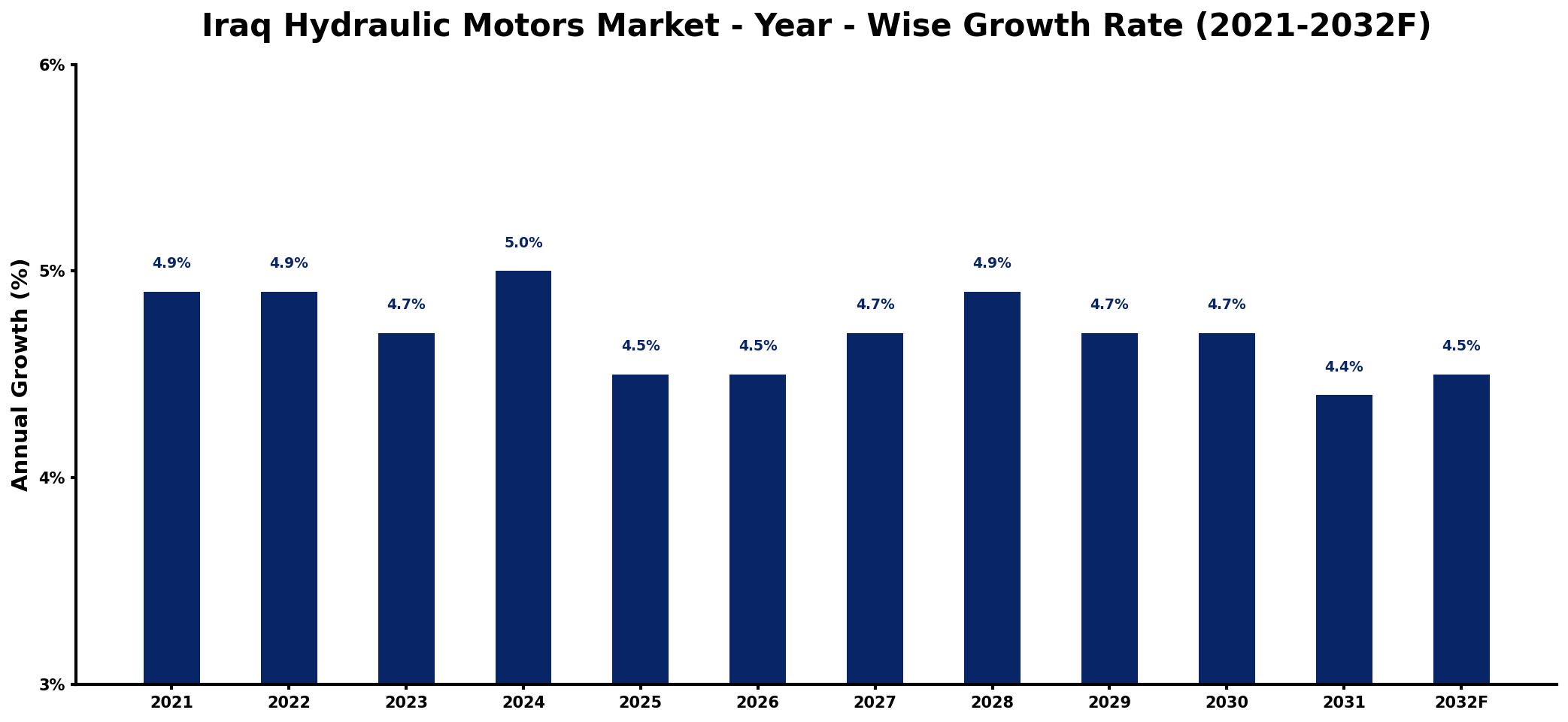
The table below presents the year‑wise growth rates along with the key drivers influencing the market
| Year | Growth Rate | Major Drivers |
| 2021 | 4.9% | Infrastructure development projects increase demand |
| 2022 | 4.9% | rising demand from electronics |
| 2023 | 4.7% | Construction market shows steady growth |
| 2024 | 5.0% | Agricultural automation drives demand expansion |
| 2025 | 4.5% | Renewable energy projects attract investments |
| 2026 | 4.5% | Manufacturing sector experiences recovery |
| 2027 | 4.7% | Transportation infrastructure upgrades needed |
| 2028 | 4.9% | Mining activities contribute to growth |
| 2029 | 4.7% | Urbanization trends create new opportunities |
| 2030 | 4.7% | Technological advancements enhance applications |
| 2031 | 4.4% | Export opportunities stimulate market interest |
| 2032 | 4.5% | Government initiatives support industry growth |
Note: Market size estimations and growth projections presented in this report are based on 6Wresearch's proprietary forecasting methodology, utilizing the latest available industry data, government publications, and primary research inputs.
Iraq Hydraulic Motors Market Synopsis
The strongest force currently shaping the Iraq Hydraulic Motors Market is the surge in infrastructure projects driven by government initiatives. This trend has led to an increased demand for hydraulic motors, as industries seek advanced and efficient solutions to enhance productivity.
Additionally, the growing emphasis on energy-efficient technologies is reshaping customer expectations. As environmental regulations tighten, manufacturers are increasingly focusing on the development of eco-friendly hydraulic motors that meet both performance and sustainability standards.
Iraq Hydraulic Motors Market Key Takeaways
- The market is set for steady growth, driven by infrastructure investments and industrial expansion.
- Technological advancements are enhancing the performance and energy efficiency of hydraulic motors.
- Demand is rising for durable and reliable hydraulic solutions in challenging environments.
- Investment opportunities exist in local manufacturing and maintenance services.
- Government policies aim to boost domestic production and reduce reliance on imports.
Evaluation of Restraints in Iraq Hydraulic Motors Market
While the Iraq Hydraulic Motors Market is experiencing growth, it is not without its challenges. Political instability and security concerns create an unpredictable environment that can hinder business operations. Coupled with economic uncertainties, such as fluctuating oil prices and limited access to financing, these factors complicate strategic planning for companies in the sector. Corruption and bureaucratic hurdles further restrict market entry and expansion, necessitating a thoughtful approach to navigate these obstacles effectively.
Iraq Hydraulic Motors Market Trends
Currently, there is a noticeable shift towards the adoption of smart technologies within hydraulic motors. Features such as remote monitoring and predictive maintenance are becoming increasingly desirable for enhancing operational efficiency and minimizing downtime. Furthermore, as industries push for more energy-efficient solutions, manufacturers are investing heavily in research and development to create hydraulic motors that not only meet but exceed customer expectations in performance and sustainability.
Iraq Hydraulic Motors Market Opportunities
The Iraq Hydraulic Motors Market presents several lucrative investment opportunities, particularly in the context of the countrys ongoing industrialization. Investors can explore partnerships with local manufacturers or offer specialized maintenance and repair services to support the growing need for hydraulic systems. Additionally, the government's focus on diversifying the economy creates potential for joint ventures aimed at expanding manufacturing capabilities in the hydraulic motors sector.
Government Initiatives in the Iraq Hydraulic Motors Market
The Iraqi government is actively promoting domestic manufacturing to boost the hydraulic motors market. Initiatives such as providing incentives to local manufacturers and implementing tariffs on imports are designed to encourage production within the country. Moreover, regulations aimed at ensuring compliance with international quality standards contribute to creating a more competitive landscape for local players, aligning with broader economic development goals.
Future Insights of the Iraq Hydraulic Motors Market
Looking forward to the period from 2026 to 2032, the Iraq Hydraulic Motors Market is expected to witness robust growth. The anticipated rise in infrastructure investments, particularly in construction and manufacturing, will significantly boost the demand for hydraulic motors. Furthermore, ongoing advancements in technology will continue to play a critical role in enhancing motor efficiency and durability. However, companies must remain vigilant to the socio-political challenges that may impact market stability and growth.
Iraq Hydraulic Motors Market Latest Developments (2025 - 2026)
Recent developments in the Iraq Hydraulic Motors Market indicate a growing focus on sustainability and innovation. Companies are increasingly prioritizing the integration of smart technologies in their product offerings, enhancing operational efficiency and reliability. Additionally, partnerships between local and foreign entities are emerging, aimed at leveraging shared expertise to bolster production capabilities and meet the evolving demands of the market.
Iraq Hydraulic Motors Market - Key Attractiveness of the Report
- 10 Years of Market Numbers
- Historical Data Starting from 2022 to 2025
- Base Year: 2025
- Forecast Data until 2032
- Key Performance Indicators Impacting the Market
- Major Upcoming Developments and Projects
Key Highlights of the Report:
- Iraq Hydraulic Motors Market Outlook
- Market Size of Iraq Hydraulic Motors Market, 2025
- Forecast of Iraq Hydraulic Motors Market, 2032
- Historical Data and Forecast of Iraq Hydraulic Motors Revenues & Volume for the Period 2022-2032F
- Iraq Hydraulic Motors Market Trend Evolution
- Iraq Hydraulic Motors Market Drivers and Challenges
- Iraq Hydraulic Motors Price Trends
- Iraq Hydraulic Motors Porter's Five Forces
- Iraq Hydraulic Motors Industry Life Cycle
- Historical Data and Forecast of Iraq Hydraulic Motors Market Revenues & Volume By Type for the Period 2022-2032F
- Historical Data and Forecast of Iraq Hydraulic Motors Market Revenues & Volume By Vane Motor for the Period 2022-2032F
- Historical Data and Forecast of Iraq Hydraulic Motors Market Revenues & Volume By Gear Motor for the Period 2022-2032F
- Historical Data and Forecast of Iraq Hydraulic Motors Market Revenues & Volume By Piston Motor for the Period 2022-2032F
- Historical Data and Forecast of Iraq Hydraulic Motors Market Revenues & Volume By Others for the Period 2022-2032F
- Historical Data and Forecast of Iraq Hydraulic Motors Market Revenues & Volume By Application for the Period 2022-2032F
- Historical Data and Forecast of Iraq Hydraulic Motors Market Revenues & Volume By Oil & Gas Industry for the Period 2022-2032F
- Historical Data and Forecast of Iraq Hydraulic Motors Market Revenues & Volume By Marine/Shipyard for the Period 2022-2032F
- Historical Data and Forecast of Iraq Hydraulic Motors Market Revenues & Volume By Processing Units for the Period 2022-2032F
- Historical Data and Forecast of Iraq Hydraulic Motors Market Revenues & Volume By Bulk Material Handling for the Period 2022-2032F
- Historical Data and Forecast of Iraq Hydraulic Motors Market Revenues & Volume By Others for the Period 2022-2032F
- Iraq Hydraulic Motors Import Export Trade Statistics
- Market Opportunity Assessment By Type
- Market Opportunity Assessment By Application
- Iraq Hydraulic Motors Top Companies Market Share
- Iraq Hydraulic Motors Competitive Benchmarking By Technical and Operational Parameters
- Iraq Hydraulic Motors Company Profiles
- Iraq Hydraulic Motors Key Strategic Recommendations






































