Iraq Injection Molding Machine Market Size, Share & Growth Rate
The Iraq Injection Molding Machine Market was estimated at USD 244 Million in 2025 and is projected to reach USD 329 Million by 2032, growing at a CAGR of 4.4% from 2026 to 2032. This growth trajectory is primarily fueled by a rising demand for injection-molded plastics across various sectors, including automotive, electronics, and consumer goods. The trend toward manufacturing automation and the need for high-quality, customized plastic components further accelerates market expansion, reflecting a significant industrial evolution within Iraq.
Iraq Injection Molding Machine Market Year-wise Growth Rate and Key Drivers
This graph highlights how the Iraq Injection Molding Machine Market has steadily grown over the years, supported by major growth factors.
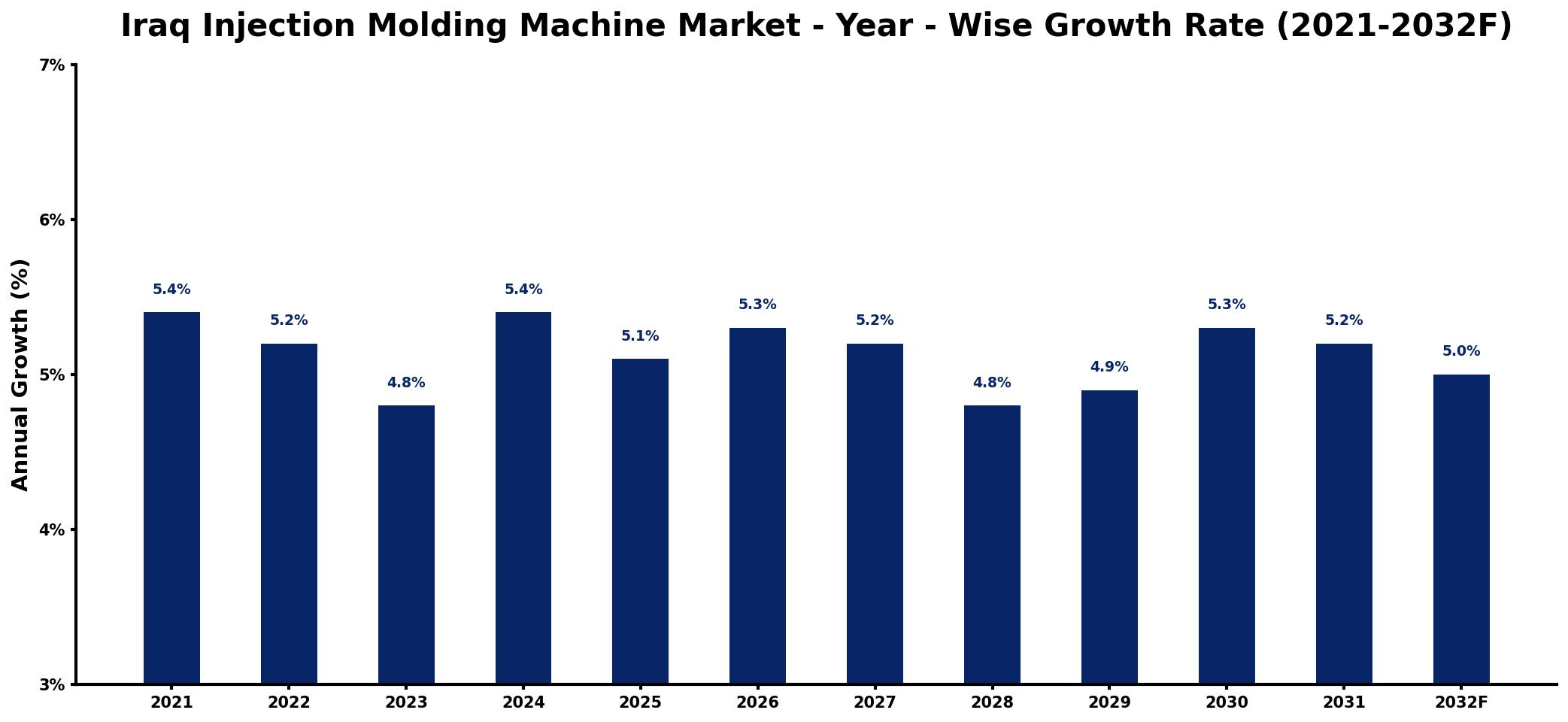
The table below presents the year‑wise growth rates along with the key drivers influencing the market
| Year | Growth Rate | Major Drivers |
| 2021 | 5.4% | Rising demand from packaging sector |
| 2022 | 5.2% | Expansion in automotive manufacturing facilities |
| 2023 | 4.8% | Increased investment in construction projects |
| 2024 | 5.4% | Growth in consumer goods production |
| 2025 | 5.1% | Surge in electronics manufacturing activities |
| 2026 | 5.3% | Development of renewable energy projects |
| 2027 | 5.2% | Boost in agricultural equipment production |
| 2028 | 4.8% | Advancements in healthcare product manufacturing |
| 2029 | 4.9% | rising end-use demand growth |
| 2030 | 5.3% | Increase in export-oriented production |
| 2031 | 5.2% | growing regional consumption patterns |
| 2032 | 5.0% | Expansion of local manufacturing capabilities |
Note: Market size estimations and growth projections presented in this report are based on 6Wresearch's proprietary forecasting methodology, utilizing the latest available industry data, government publications, and primary research inputs.
Iraq Injection Molding Machine Market Synopsis
The strongest force shaping the Iraq injection molding machine market today is the increasing emphasis on manufacturing automation. As industries strive for operational efficiency and higher production rates, there is a marked shift towards adopting advanced injection molding technologies. This transformation is not just about volume; it emphasizes quality, precision, and flexibility in producing plastic parts.
Additionally, the push for customized products has gained traction in Iraq, prompting manufacturers to seek versatile injection molding solutions. The ability of these machines to adapt to various specifications and materials allows businesses to meet the evolving demands of consumers and industries, thus sustaining momentum in the market.
Iraq Injection Molding Machine Market Key Takeaways
- The market is poised for significant growth, driven by automation and customization demands.
- Investment in advanced technologies is crucial for improving manufacturing processes.
- The automotive and electronics industries are the leading sectors for plastic component demand.
- Challenges include the need for skilled technicians and access to advanced machinery.
- Government policies are supportive, aiming to enhance productivity and safety standards.
Evaluation of Restraints in Iraq Injection Molding Machine Market
Despite its growth potential, the Iraq injection molding machine market faces several restraints. A significant barrier is the limited availability of technical expertise, which hampers the effective deployment and maintenance of sophisticated molding technologies. Furthermore, affordability issues can restrict smaller manufacturers from investing in high-performance machines. These factors contribute to a competitive landscape where companies must balance cost with the adoption of innovative solutions to remain viable.
Iraq Injection Molding Machine Market Trends
Current trends in the Iraq injection molding machine market indicate a strong movement towards sustainable manufacturing practices. Companies are increasingly adopting environmentally friendly materials and processes, reflecting a global shift toward sustainability. Moreover, technological advancements such as Industry 4.0 integration, including IoT-enabled machines, are transforming production efficiency and real-time monitoring capabilities.
In addition to sustainability, there is a noticeable rise in demand for smart manufacturing solutions. Automation and artificial intelligence are becoming integral to the molding process, enhancing precision and reducing cycle times while lowering operational costs. These trends highlight the market's evolution as it adapts to contemporary manufacturing challenges.
Iraq Injection Molding Machine Market Opportunities
There are significant growth opportunities in the Iraq injection molding machine market, particularly in sectors like automotive and consumer goods, where demand for customized and high-quality plastic components is on the rise. Investment in advanced technology and training programs can position companies to capitalize on this demand. Furthermore, collaborations with international partners can enhance technological transfer and skill development, driving innovation and market penetration.
Government Initiatives in the Iraq Injection Molding Machine Market
Government policies in Iraq have increasingly focused on promoting innovation and efficiency within the manufacturing sector. Initiatives are in place to set performance and safety standards for injection molding machines, which aim to support various industrial applications and enhance productivity. Furthermore, public spending on infrastructure improvements is expected to benefit the manufacturing sector, indirectly bolstering the injection molding machine market.
Future Insights of the Iraq Injection Molding Machine Market
Looking ahead to 2026-2032, the Iraq injection molding machine market is poised for continued growth driven by technological innovation and increasing industrial activity. The shift towards digital manufacturing and automation will likely intensify, with more players recognizing the importance of high efficiency and customization. As businesses adapt to market demands and governmental support continues, the landscape for injection molding machines will evolve, creating new avenues for investment and development.
Iraq Injection Molding Machine Market Latest Developments (2025 - 2026)
Recent developments in the Iraq injection molding machine market reflect a growing inclination towards smart manufacturing practices. Companies have started to invest in IoT capabilities for better process monitoring and optimization. Additionally, there is an increasing focus on sustainability, with manufacturers exploring eco-friendly materials and practices. This trend not only meets regulatory requirements but also responds to consumer preferences for environmentally responsible products.
Iraq Injection Molding Machine Market - Key Attractiveness of the Report
- 10 Years of Market Numbers
- Historical Data Starting from 2022 to 2025
- Base Year: 2025
- Forecast Data until 2032
- Key Performance Indicators Impacting the Market
- Major Upcoming Developments and Projects
Key Highlights of the Report:
- Iraq Injection Molding Machine Market Outlook
- Market Size of Iraq Injection Molding Machine Market, 2025
- Forecast of Iraq Injection Molding Machine Market, 2032
- Historical Data and Forecast of Iraq Injection Molding Machine Revenues & Volume for the Period 2022-2032F
- Iraq Injection Molding Machine Market Trend Evolution
- Iraq Injection Molding Machine Market Drivers and Challenges
- Iraq Injection Molding Machine Price Trends
- Iraq Injection Molding Machine Porter's Five Forces
- Iraq Injection Molding Machine Industry Life Cycle
- Historical Data and Forecast of Iraq Injection Molding Machine Market Revenues & Volume By Material for the Period 2022-2032F
- Historical Data and Forecast of Iraq Injection Molding Machine Market Revenues & Volume By Plastic for the Period 2022-2032F
- Historical Data and Forecast of Iraq Injection Molding Machine Market Revenues & Volume By Metal for the Period 2022-2032F
- Historical Data and Forecast of Iraq Injection Molding Machine Market Revenues & Volume By Others for the Period 2022-2032F
- Historical Data and Forecast of Iraq Injection Molding Machine Market Revenues & Volume By Technology for the Period 2022-2032F
- Historical Data and Forecast of Iraq Injection Molding Machine Market Revenues & Volume By Hydraulic for the Period 2022-2032F
- Historical Data and Forecast of Iraq Injection Molding Machine Market Revenues & Volume By Electric for the Period 2022-2032F
- Historical Data and Forecast of Iraq Injection Molding Machine Market Revenues & Volume By Hybrid for the Period 2022-2032F
- Historical Data and Forecast of Iraq Injection Molding Machine Market Revenues & Volume By End-use for the Period 2022-2032F
- Historical Data and Forecast of Iraq Injection Molding Machine Market Revenues & Volume By Automotive for the Period 2022-2032F
- Historical Data and Forecast of Iraq Injection Molding Machine Market Revenues & Volume By Consumer Goods for the Period 2022-2032F
- Historical Data and Forecast of Iraq Injection Molding Machine Market Revenues & Volume By Packaging for the Period 2022-2032F
- Historical Data and Forecast of Iraq Injection Molding Machine Market Revenues & Volume By Electronics for the Period 2022-2032F
- Historical Data and Forecast of Iraq Injection Molding Machine Market Revenues & Volume By Others for the Period 2022-2032F
- Iraq Injection Molding Machine Import Export Trade Statistics
- Market Opportunity Assessment By Material
- Market Opportunity Assessment By Technology
- Market Opportunity Assessment By End-use
- Iraq Injection Molding Machine Top Companies Market Share
- Iraq Injection Molding Machine Competitive Benchmarking By Technical and Operational Parameters
- Iraq Injection Molding Machine Company Profiles
- Iraq Injection Molding Machine Key Strategic Recommendations






































