Iraq Insecticides Market Summary
The iraq insecticides market was estimated at USD 407 Million in 2025 and is projected to reach USD 559 Million by 2032, growing at a CAGR of 5.7% from 2026 to 2032.
Iraq Insecticides Market Year-wise Growth Rate and Key Drivers
This graph highlights how the Iraq Insecticides Market has steadily grown over the past five years, supported by major growth factors.
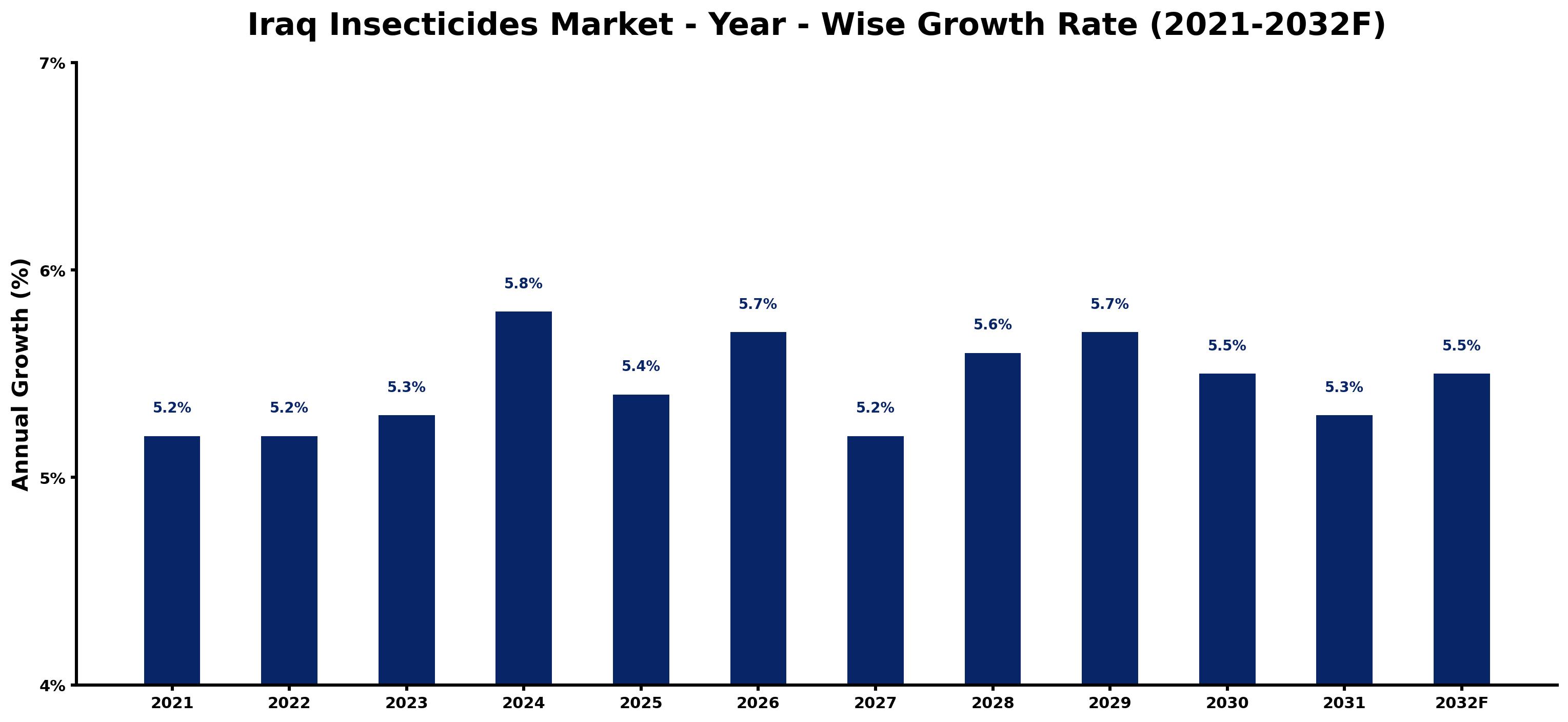
The table below presents the year wise growth rates along with the key drivers influencing the market
| Year | Growth Rate | Major Drivers |
| 2021 | 5.2% | Post-conflict recovery efforts are boosting agricultural productivity across Iraq's diverse regions. |
| 2022 | 5.2% | Increased investment in agriculture aims to enhance crop yields for local farmers. |
| 2023 | 5.3% | Climate change impacts are raising awareness of pest control's critical importance for sustainability. |
| 2024 | 5.8% | Emerging local manufacturers are entering the insecticides market to meet regional needs. |
| 2025 | 5.4% | Evolving consumer preferences are driving demand for environmentally friendly pest management solutions. |
| 2026 | 5.7% | Urbanization trends are escalating pest issues in densely populated Iraqi cities. |
| 2027 | 5.2% | Technological innovations in formulation are improving efficacy and safety of insecticides. |
| 2028 | 5.6% | Partnerships with international suppliers are expanding product variety and access for local distributors. |
| 2029 | 5.7% | Increased agricultural exports are motivating farmers to adopt advanced pest control methods. |
| 2030 | 5.5% | Education and training programs are enhancing awareness of integrated pest management strategies. |
| 2031 | 5.3% | Strong economic recovery is boosting disposable income, facilitating greater spending on farming inputs. |
| 2032 | 5.5% | Cross-border trade agreements are providing opportunities for enhanced market access and competitiveness. |
Note - Market size estimations and growth projections presented in this report are based on 6Wresearch's advanced forecasting approach, validated with industry datasets as of June 2026.
Iraq Insecticides Market Synopsis
The Iraq Insecticides Market is projected to reach 5.7% and witness significant growth during the forecast period (2026-2032). This market encompasses a broad spectrum of products and technologies designed to control insect pests in both agricultural and public health contexts. The rising awareness of the economic, environmental, and health impacts associated with insect pests is driving the demand for innovative insecticide solutions tailored to Iraq's specific needs and circumstances.
Iraq Insecticides Market Growth Drivers
Several key factors are propelling growth in the Iraq Insecticides Market. Firstly, the intensification of agricultural practices to meet food demands is leading to an increased reliance on effective pest control solutions. Secondly, urbanization has resulted in rising pest populations in residential areas, necessitating the use of insecticides to maintain public health standards. Thirdly, regulatory frameworks aimed at pest management are becoming more stringent, driving the need for compliant and effective insecticide products.
- The agricultural sector's growth, particularly in crop production, is a primary driver for the insecticides market as farmers seek effective solutions to protect their yields against pests.
- Urbanization creates hotspots for pest proliferation, which in turn increases the demand for urban pest control services and associated insecticide products.
- Regulatory pressures are pushing farmers and pest control operators to seek safer and more effective pest management solutions, spurring innovation in the insecticides sector.
- The evolving nature of pest populations, including resistance to existing chemistries, is driving the demand for novel insecticide formulations and delivery systems.
- Government awareness campaigns on the importance of effective pest management further fuel the market as they endorse the use of insecticides that are safe and effective.
Iraq Insecticides Market Challenges and Restraints
Despite its growth potential, the Iraq Insecticides Market faces several challenges that could impede progress. One significant challenge is the need for stringent regulatory compliance, which can slow the introduction of new products into the market. Public perception regarding the safety of chemical insecticides poses another barrier, with many consumers advocating for reduced chemical use in favor of organic solutions. Additionally, as pest populations continue to evolve, ensuring the efficacy of existing insecticides becomes increasingly complex.
- Regulatory compliance can be a lengthy and costly process for companies, potentially delaying product launches.
- Public skepticism regarding chemical pesticides can result in decreased market acceptance, impacting sales negatively.
- The emergence of pest resistance to traditional insecticides can lead to increased product development costs as companies seek out new formulations.
- Promoting sustainable pest management practices requires investment in education and outreach, which can strain resources for smaller companies.
- Economic instability in the region can hinder investment in pest control technologies and innovation.
Iraq Insecticides Market Government Investment and Initiatives
The Iraqi government is actively involved in shaping the insecticides market through various investments and initiatives aimed at improving public health and agricultural productivity. This includes enforcing regulations that prioritize the safety and effectiveness of pest control methods while promoting environmentally friendly alternatives. Initiatives are also being undertaken to educate farmers on integrated pest management practices, emphasizing the prudent use of insecticides to minimize environmental impacts. Additionally, public spending on agricultural modernization and pest control infrastructure has the potential to significantly boost the market.
Iraq Insecticides Market Latest Developments (May 2025 - June 2026)
In the period from May 2025 to June 2026, the Iraq Insecticides Market witnessed notable developments reflecting ongoing trends in pest management and regulatory compliance. The government has continued to tighten regulations around pesticide use, prompting companies to invest in research and development for safer and more effective pest control solutions. There has been a marked increase in public-private partnerships aimed at enhancing pest management strategies, with a focus on integrated pest management practices. The market has also seen advancements in technology with the introduction of new formulations that address evolving pest resistance issues, aligning with global sustainability trends in pest control.
Iraq Insecticides Market - Key Attractiveness of the Report
- 10 Years of Market Numbers
- Historical Data Starting from 2022 to 2025
- Base Year: 2025
- Forecast Data until 2032
- Key Performance Indicators Impacting the Market
- Major Upcoming Developments and Projects
Key Highlights of the Report:
- Iraq Insecticides Market Outlook
- Market Size of Iraq Insecticides Market, 2025
- Forecast of Iraq Insecticides Market, 2032
- Historical Data and Forecast of Iraq Insecticides Revenues & Volume for the Period 2022-2032F
- Iraq Insecticides Market Trend Evolution
- Iraq Insecticides Market Drivers and Challenges
- Iraq Insecticides Price Trends
- Iraq Insecticides Porter's Five Forces
- Iraq Insecticides Industry Life Cycle
- Historical Data and Forecast of Iraq Insecticides Market Revenues & Volume By Crop Type for the Period 2022-2032F
- Historical Data and Forecast of Iraq Insecticides Market Revenues & Volume By Cereals & grains for the Period 2022-2032F
- Historical Data and Forecast of Iraq Insecticides Market Revenues & Volume By Oilseeds & pulses for the Period 2022-2032F
- Historical Data and Forecast of Iraq Insecticides Market Revenues & Volume By Fruits & vegetables for the Period 2022-2032F
- Historical Data and Forecast of Iraq Insecticides Market Revenues & Volume By Other crop types for the Period 2022-2032F
- Historical Data and Forecast of Iraq Insecticides Market Revenues & Volume By Formulation for the Period 2022-2032F
- Historical Data and Forecast of Iraq Insecticides Market Revenues & Volume By Wettable powder for the Period 2022-2032F
- Historical Data and Forecast of Iraq Insecticides Market Revenues & Volume By Emulsifiable concentrate for the Period 2022-2032F
- Historical Data and Forecast of Iraq Insecticides Market Revenues & Volume By Suspension concentrate for the Period 2022-2032F
- Historical Data and Forecast of Iraq Insecticides Market Revenues & Volume By Oil emulsion in water for the Period 2022-2032F
- Historical Data and Forecast of Iraq Insecticides Market Revenues & Volume By Microencapsulated suspension for the Period 2022-2032F
- Historical Data and Forecast of Iraq Insecticides Market Revenues & Volume By Granules for the Period 2022-2032F
- Historical Data and Forecast of Iraq Insecticides Market Revenues & Volume By Other formulations for the Period 2022-2032F
- Historical Data and Forecast of Iraq Insecticides Market Revenues & Volume By Forms for the Period 2022-2032F
- Historical Data and Forecast of Iraq Insecticides Market Revenues & Volume By Sprays for the Period 2022-2032F
- Historical Data and Forecast of Iraq Insecticides Market Revenues & Volume By Baits for the Period 2022-2032F
- Historical Data and Forecast of Iraq Insecticides Market Revenues & Volume By Strips for the Period 2022-2032F
- Iraq Insecticides Import Export Trade Statistics
- Market Opportunity Assessment By Crop Type
- Market Opportunity Assessment By Formulation
- Market Opportunity Assessment By Forms
- Iraq Insecticides Top Companies Market Share
- Iraq Insecticides Competitive Benchmarking By Technical and Operational Parameters
- Iraq Insecticides Company Profiles
- Iraq Insecticides Key Strategic Recommendations






































