Iraq Kitchenware Market Size, Share & Growth Rate
The Iraq Kitchenware Market was estimated at USD 269 Million in 2025 and is projected to reach USD 360 Million by 2032, growing at a CAGR of 4.3% from 2026 to 2032. This growth trajectory is underpinned by increasing urbanization, which is encouraging households to invest in both functional and aesthetically pleasing kitchenware. Additionally, rising disposable incomes are empowering consumers to seek modern kitchen gadgets and high-quality utensils, enhancing their cooking experiences.
Iraq Kitchenware Market Year-wise Growth Rate and Key Drivers
This graph highlights how the Iraq Kitchenware Market has steadily grown over the years, supported by major growth factors.
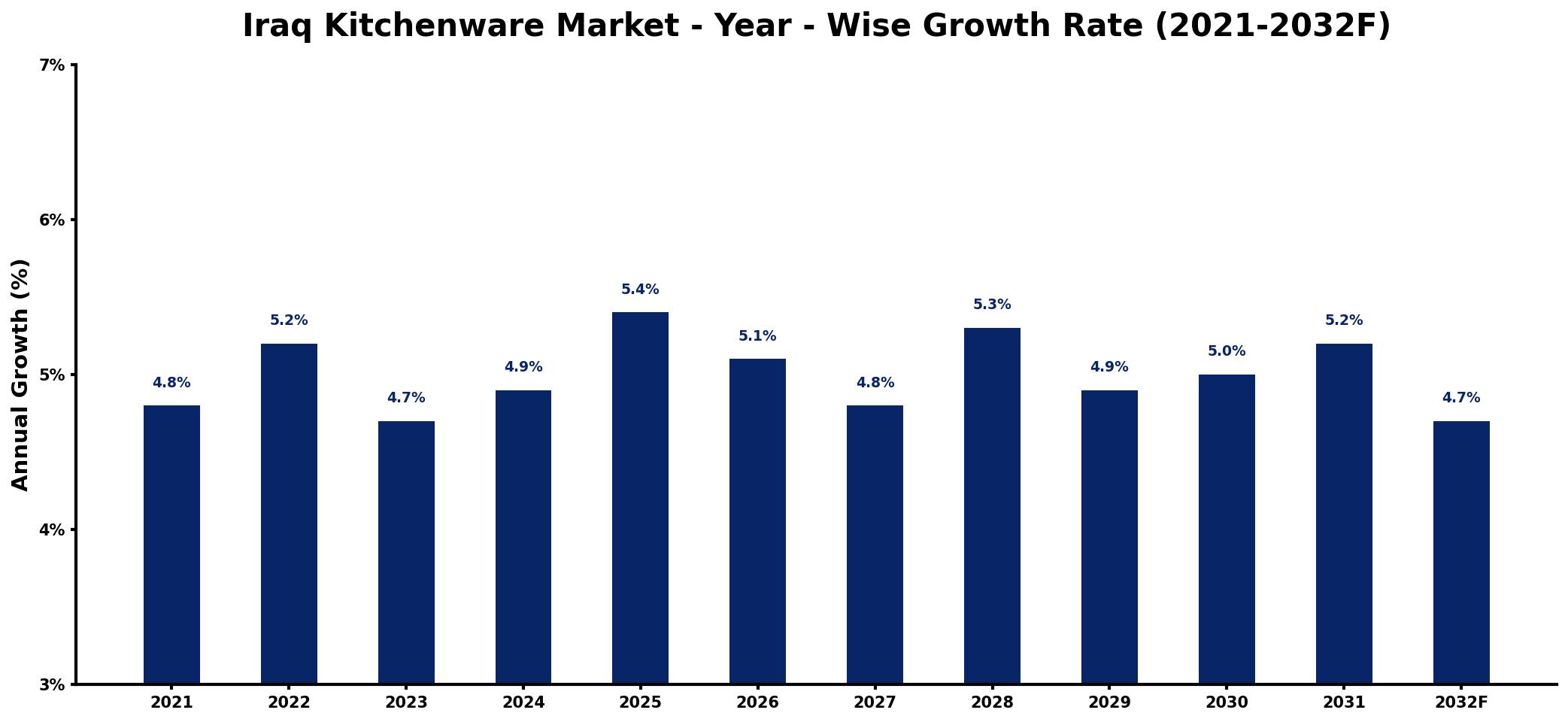
The table below presents the year‑wise growth rates along with the key drivers influencing the market
| Year | Growth Rate | Major Drivers |
| 2021 | 4.8% | Rising consumer disposable income |
| 2022 | 5.2% | Increased urbanization and housing |
| 2023 | 4.7% | Expansion of e-commerce platforms |
| 2024 | 4.9% | Growing interest in home cooking |
| 2025 | 5.4% | Investment in local manufacturing facilities |
| 2026 | 5.1% | Surge in tourism and hospitality |
| 2027 | 4.8% | Emerging trends in culinary arts |
| 2028 | 5.3% | Enhanced marketing and branding strategies |
| 2029 | 4.9% | Development of eco-friendly materials |
| 2030 | 5.0% | Technological advancements in production |
| 2031 | 5.2% | Strengthened distribution network efficiency |
| 2032 | 4.7% | Rise in social media influence |
Note: Market size estimations and growth projections presented in this report are based on 6Wresearch's proprietary forecasting methodology, utilizing the latest available industry data, government publications, and primary research inputs.
Iraq Kitchenware Market Synopsis
The Iraq kitchenware market has witnessed a notable surge recently, fueled by changing consumer preferences and a shift towards modernization. Traditional kitchenware items like pots and pans remain staples in many households, yet there is a palpable shift towards innovative kitchen solutions that offer convenience and style.
As the market evolves, there is an increasing demand for eco-friendly products and multifunctional tools, reflecting a broader global trend. This transition offers exciting prospects for businesses as they align their offerings with the evolving tastes and needs of Iraqi consumers.
Iraq Kitchenware Market Key Takeaways
- The market is experiencing steady growth driven by urbanization and increasing disposable incomes.
- Consumers are increasingly interested in modern, multifunctional, and eco-friendly kitchenware products.
- Online retail platforms are becoming vital in shaping purchasing behaviors in the kitchenware segment.
- Domestic and international brands are competing for a diverse consumer base, offering a wide range of products.
- Government policies are supportive of local manufacturing, enhancing market dynamics and competition.
Evaluation of Restraints in Iraq Kitchenware Market
While the Iraq kitchenware market is poised for growth, several factors may restrain its potential. Political instability and economic uncertainties can undermine consumer confidence, which is crucial for retail performance. Additionally, infrastructure limitations affect distribution networks, creating logistical challenges for suppliers. Cultural preferences, which can vary widely across regions, also impact product demand. Moreover, competition from both established brands and emerging local players intensifies the pressure on pricing strategies, requiring companies to innovate continually and maintain high-quality standards to succeed in this dynamic environment.
Iraq Kitchenware Market Trends
Emerging trends within the Iraq kitchenware market illustrate a shift towards sustainability and multifunctionality. Consumers are increasingly gravitating towards eco-friendly options, such as bamboo utensils and silicone storage solutions, driven by a growing awareness of environmental issues. Furthermore, the open-concept kitchen trend is gaining traction, prompting buyers to seek stylish and visually appealing kitchenware that doubles as décor. Social media influencers play a significant role in popularizing new brands and products, shaping consumer preferences and driving purchases through effective online channels.
Iraq Kitchenware Market Opportunities
Significant opportunities for investment abound in the Iraq kitchenware market. As urban populations expand and disposable incomes rise, there is a clear demand for high-quality kitchen products. Investors can capitalize on this trend by introducing innovative kitchenware that meets contemporary needs. There is also potential for growth in retail and e-commerce platforms that specialize in kitchenware, allowing for broader market reach. Collaborating with local distributors can enhance market penetration, making it easier for foreign manufacturers to navigate local preferences and establish a foothold.
Government Initiatives in the Iraq Kitchenware Market
The Iraqi government has put forth several initiatives aimed at strengthening the domestic kitchenware industry. Policies are in place to promote local manufacturing and reduce dependence on imports. These include protective tariffs on foreign products and incentives for domestic producers, thereby stimulating local businesses. Efforts are also underway to simplify regulatory processes to foster entrepreneurship within the kitchenware sector. Overall, these initiatives are expected to enhance job creation and improve self-sufficiency in kitchenware production.
Future Insights of the Iraq Kitchenware Market
The outlook for the Iraq kitchenware market is notably positive for the period from 2026 to 2032. Increased urbanization, coupled with rising disposable incomes, is anticipated to sustain consumer interest in modern kitchen solutions. The influence of Western lifestyles and the proliferation of cooking shows are further driving demand for innovative and stylish kitchenware. As more young, tech-savvy consumers enter the market, there are ample opportunities for businesses to introduce new products that resonate with evolving tastes. The emphasis on sustainability will continue to shape product development, aligning with global standards and consumer expectations.
Iraq Kitchenware Market Latest Developments (2025 - 2026)
Recent developments in the Iraq kitchenware market highlight a concerted effort among brands to embrace sustainability while enhancing product innovation. Companies are launching new lines that focus on eco-friendly materials and multifunctional designs, appealing to the changing preferences of consumers. Moreover, the rise of online shopping is prompting more brands to invest in digital marketing strategies to engage with consumers effectively. Industry stakeholders are also collaborating to enhance supply chain efficiencies, addressing existing logistical challenges and improving product availability across various regions.
Iraq Kitchenware Market - Key Attractiveness of the Report
- 10 Years of Market Numbers
- Historical Data Starting from 2022 to 2025
- Base Year: 2025
- Forecast Data until 2032
- Key Performance Indicators Impacting the Market
- Major Upcoming Developments and Projects
Key Highlights of the Report:
- Iraq Kitchenware Market Outlook
- Market Size of Iraq Kitchenware Market, 2025
- Forecast of Iraq Kitchenware Market, 2032
- Historical Data and Forecast of Iraq Kitchenware Revenues & Volume for the Period 2022-2032F
- Iraq Kitchenware Market Trend Evolution
- Iraq Kitchenware Market Drivers and Challenges
- Iraq Kitchenware Price Trends
- Iraq Kitchenware Porter's Five Forces
- Iraq Kitchenware Industry Life Cycle
- Historical Data and Forecast of Iraq Kitchenware Market Revenues & Volume By Product Type for the Period 2022-2032F
- Historical Data and Forecast of Iraq Kitchenware Market Revenues & Volume By Cookware for the Period 2022-2032F
- Historical Data and Forecast of Iraq Kitchenware Market Revenues & Volume By Bakeware for the Period 2022-2032F
- Historical Data and Forecast of Iraq Kitchenware Market Revenues & Volume By Others for the Period 2022-2032F
- Historical Data and Forecast of Iraq Kitchenware Market Revenues & Volume By End User for the Period 2022-2032F
- Historical Data and Forecast of Iraq Kitchenware Market Revenues & Volume By Residential Kitchen for the Period 2022-2032F
- Historical Data and Forecast of Iraq Kitchenware Market Revenues & Volume By Commercial Kitchens for the Period 2022-2032F
- Historical Data and Forecast of Iraq Kitchenware Market Revenues & Volume By Sales Channel for the Period 2022-2032F
- Historical Data and Forecast of Iraq Kitchenware Market Revenues & Volume By Online for the Period 2022-2032F
- Historical Data and Forecast of Iraq Kitchenware Market Revenues & Volume By Offline for the Period 2022-2032F
- Iraq Kitchenware Import Export Trade Statistics
- Market Opportunity Assessment By Product Type
- Market Opportunity Assessment By End User
- Market Opportunity Assessment By Sales Channel
- Iraq Kitchenware Top Companies Market Share
- Iraq Kitchenware Competitive Benchmarking By Technical and Operational Parameters
- Iraq Kitchenware Company Profiles
- Iraq Kitchenware Key Strategic Recommendations






































