Iraq Linseed Oil Market Size, Share & Growth Rate
The Iraq Linseed Oil Market was estimated at USD 243 Million in 2025 and is projected to reach USD 326 Million by 2032, growing at a CAGR of 4.3% from 2026 to 2032. This upward trajectory is primarily driven by an increasing consumer awareness of health benefits associated with linseed oil, particularly its omega-3 fatty acid content. Additionally, the rising trend towards natural and organic products has spurred demand across various sectors, particularly food and personal care, solidifying linseed oil's position in the Iraqi market.
Iraq Linseed Oil Market Year-wise Growth Rate and Key Drivers
This graph highlights how the Iraq Linseed Oil Market has steadily grown over the years, supported by major growth factors.
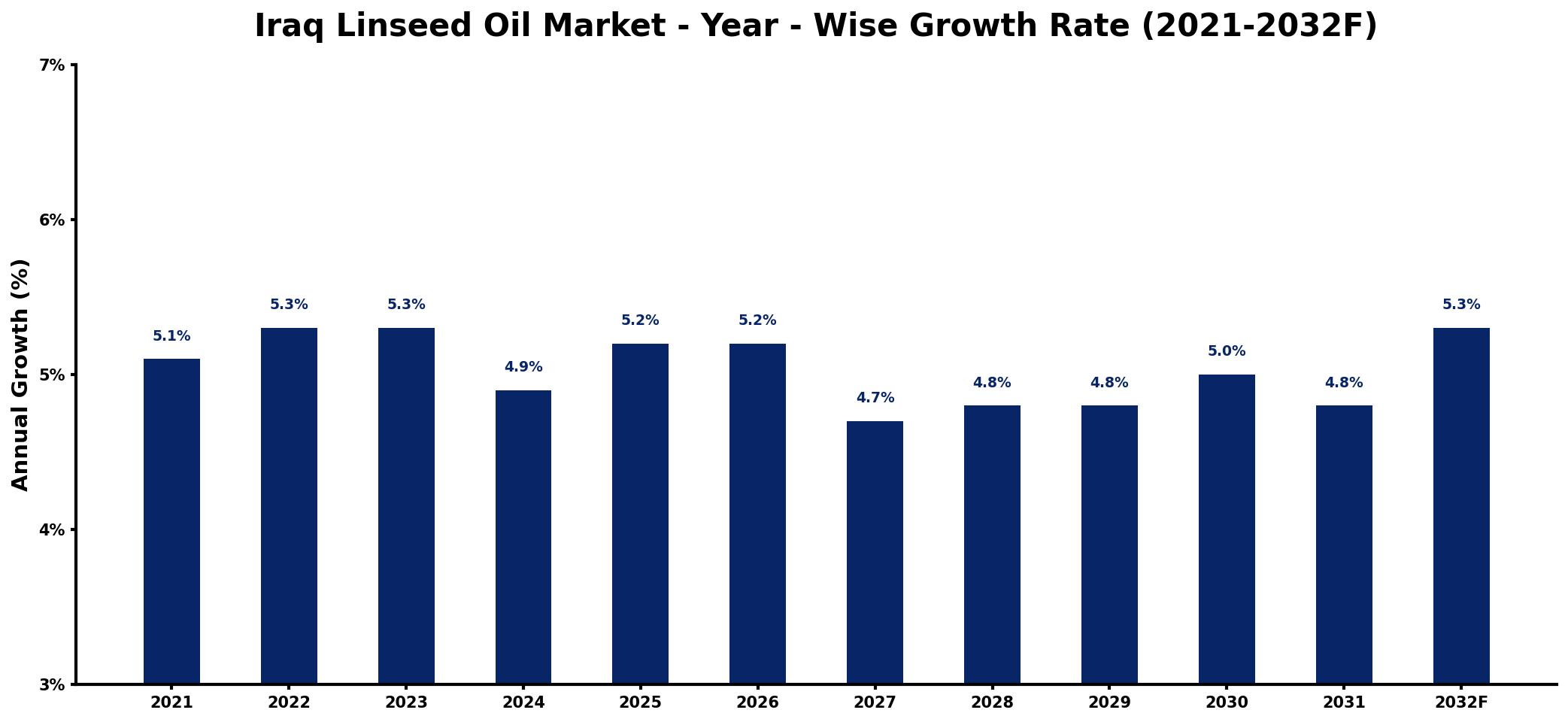
The table below presents the year‑wise growth rates along with the key drivers influencing the market
| Year | Growth Rate | Major Drivers |
| 2021 | 5.1% | increased health awareness among consumers |
| 2022 | 5.3% | rising demand for organic products |
| 2023 | 5.3% | expansion of food processing sector |
| 2024 | 4.9% | growing popularity of plant-based diets |
| 2025 | 5.2% | increased investment in agriculture technology |
| 2026 | 5.2% | higher exports to neighboring markets |
| 2027 | 4.7% | emerging trends in natural supplements |
| 2028 | 4.8% | growth in wellness industry sectors |
| 2029 | 4.8% | development of new distribution channels |
| 2030 | 5.0% | advancements in sustainable farming techniques |
| 2031 | 4.8% | increased consumer interest in nutrition |
| 2032 | 5.3% | enhanced product quality standards |
Note: Market size estimations and growth projections presented in this report are based on 6Wresearch's proprietary forecasting methodology, utilizing the latest available industry data, government publications, and primary research inputs.
Iraq Linseed Oil Market Synopsis
The demand for linseed oil in Iraq is on the rise, especially among health-conscious consumers looking for natural dietary supplements. The integration of linseed oil into everyday diets—thanks to its perceived health benefits—reflects a broader shift towards plant-based nutrition within the country.
Local farmers are increasingly cultivating flaxseeds, the primary raw material for linseed oil, taking advantage of Iraq's agricultural landscape. This focus on domestic production not only supports local economies but also enhances the quality and availability of linseed oil in the market.
Iraq Linseed Oil Market Key Takeaways
- Growing consumer awareness about the health benefits of linseed oil drives market expansion.
- Increasing application of linseed oil in food, cosmetics, and pharmaceuticals enhances demand.
- Local production initiatives support self-sufficiency and reduce import dependency.
- Investment opportunities exist through vertical integration and export facilitation.
- Government policies are aimed at improving agricultural practices and production standards.
Evaluation of Restraints in Iraq Linseed Oil Market
Despite the promising growth of the Iraq linseed oil market, several constraints impede progress. Limited production capacity due to outdated agricultural practices and insufficient technological infrastructure is a primary concern. Additionally, there is a noticeable lack of quality control measures, leading to inconsistencies that can undermine consumer trust. Market access remains another challenge, as distribution channels are not fully developed, making it difficult for local producers to reach wider audiences. Political and economic instability further complicates the landscape, contributing to fluctuating prices and uncertain demand for linseed oil products.
Iraq Linseed Oil Market Trends
The market is witnessing notable trends, such as an increased focus on sustainability and eco-friendly products. This shift is pushing both consumers and producers to prioritize natural ingredients over synthetic alternatives. Moreover, innovations in processing technologies are enabling the extraction of higher-quality linseed oil, which is crucial for maintaining competitiveness. The trend toward plant-based diets is also becoming more pronounced, aligning perfectly with the health attributes associated with linseed oil, thus bolstering demand.
Iraq Linseed Oil Market Opportunities
The investment landscape within the Iraq linseed oil market is ripe with opportunities. With Iraq being a key producer of flaxseeds, there is significant potential for investors to engage in vertical integration, from cultivation to processing. Partnerships with local farmers and the establishment of modern processing facilities can enhance product quality and value addition. Furthermore, the rising interest in health foods presents opportunities for product innovation, allowing new linseed oil applications to emerge across various industries, particularly in exports.
Government Initiatives in the Iraq Linseed Oil Market
The Iraqi government has implemented several initiatives aimed at enhancing domestic linseed oil production. These include providing subsidies for agricultural inputs and investing in infrastructure development to support local farmers. Additionally, efforts are being made to improve the quality standards of linseed oil, ensuring that products can compete effectively in both domestic and international markets. By fostering an environment conducive to self-sufficiency, these initiatives are crucial in reducing import reliance and empowering local producers.
Future Insights of the Iraq Linseed Oil Market
The future outlook for the Iraq linseed oil market appears promising. With anticipated growth stemming from heightened awareness of its health benefits, demand is expected to rise consistently. As agricultural practices evolve and investments in the linseed oil sector increase, Iraq is well-positioned to strengthen its role in the global linseed oil market. However, stakeholders must remain vigilant regarding potential challenges, including fluctuations in raw material prices and intensified competition, to maintain sustainable growth.
Iraq Linseed Oil Market Latest Developments (2025 - 2026)
Recent developments in the Iraq linseed oil market indicate a gradual shift towards modern production techniques and enhanced quality control measures. Local producers are increasingly adopting innovative extraction processes that yield higher quality oil, thereby attracting health-conscious consumers. Furthermore, initiatives promoting linseed oil in the food industry are gaining traction, fostering a greater understanding of its nutritional value and expanding its applications beyond traditional uses.
Iraq Linseed Oil Market - Key Attractiveness of the Report
- 10 Years of Market Numbers
- Historical Data Starting from 2022 to 2025
- Base Year: 2025
- Forecast Data until 2032
- Key Performance Indicators Impacting the Market
- Major Upcoming Developments and Projects
Key Highlights of the Report:
- Iraq Linseed Oil Market Outlook
- Market Size of Iraq Linseed Oil Market, 2025
- Forecast of Iraq Linseed Oil Market, 2032
- Historical Data and Forecast of Iraq Linseed Oil Revenues & Volume for the Period 2022-2032F
- Iraq Linseed Oil Market Trend Evolution
- Iraq Linseed Oil Market Drivers and Challenges
- Iraq Linseed Oil Price Trends
- Iraq Linseed Oil Porter's Five Forces
- Iraq Linseed Oil Industry Life Cycle
- Historical Data and Forecast of Iraq Linseed Oil Market Revenues & Volume By Type for the Period 2022-2032F
- Historical Data and Forecast of Iraq Linseed Oil Market Revenues & Volume By Raw Linseed Oil for the Period 2022-2032F
- Historical Data and Forecast of Iraq Linseed Oil Market Revenues & Volume By Boiled Linseed Oil for the Period 2022-2032F
- Historical Data and Forecast of Iraq Linseed Oil Market Revenues & Volume By Double boiled Linseed Oil for the Period 2022-2032F
- Historical Data and Forecast of Iraq Linseed Oil Market Revenues & Volume By Pale Boiled Linseed Oil for the Period 2022-2032F
- Historical Data and Forecast of Iraq Linseed Oil Market Revenues & Volume By Application for the Period 2022-2032F
- Historical Data and Forecast of Iraq Linseed Oil Market Revenues & Volume By Paints & varnishes for the Period 2022-2032F
- Historical Data and Forecast of Iraq Linseed Oil Market Revenues & Volume By Flooring for the Period 2022-2032F
- Historical Data and Forecast of Iraq Linseed Oil Market Revenues & Volume By Processed food for the Period 2022-2032F
- Historical Data and Forecast of Iraq Linseed Oil Market Revenues & Volume By Wood finish for the Period 2022-2032F
- Historical Data and Forecast of Iraq Linseed Oil Market Revenues & Volume By Putty for the Period 2022-2032F
- Historical Data and Forecast of Iraq Linseed Oil Market Revenues & Volume By Cosmetics for the Period 2022-2032F
- Historical Data and Forecast of Iraq Linseed Oil Market Revenues & Volume By Pharmaceuticals for the Period 2022-2032F
- Historical Data and Forecast of Iraq Linseed Oil Market Revenues & Volume By Others for the Period 2022-2032F
- Historical Data and Forecast of Iraq Linseed Oil Market Revenues & Volume By Industry Vertical for the Period 2022-2032F
- Historical Data and Forecast of Iraq Linseed Oil Market Revenues & Volume By Chemical for the Period 2022-2032F
- Historical Data and Forecast of Iraq Linseed Oil Market Revenues & Volume By Oil for the Period 2022-2032F
- Historical Data and Forecast of Iraq Linseed Oil Market Revenues & Volume By Food & Beverages for the Period 2022-2032F
- Historical Data and Forecast of Iraq Linseed Oil Market Revenues & Volume By Healthcare for the Period 2022-2032F
- Historical Data and Forecast of Iraq Linseed Oil Market Revenues & Volume By Others for the Period 2022-2032F
- Iraq Linseed Oil Import Export Trade Statistics
- Market Opportunity Assessment By Type
- Market Opportunity Assessment By Application
- Market Opportunity Assessment By Industry Vertical
- Iraq Linseed Oil Top Companies Market Share
- Iraq Linseed Oil Competitive Benchmarking By Technical and Operational Parameters
- Iraq Linseed Oil Company Profiles
- Iraq Linseed Oil Key Strategic Recommendations






































