Iraq Lithium Hydroxide Market Size, Share & Growth Rate
The Iraq Lithium Hydroxide Market was estimated at USD 366 Million in 2025 and is projected to reach USD 501 Million by 2032, growing at a CAGR of 4.6% from 2026 to 2032. This growth trajectory is largely propelled by the booming electric vehicle market in Iraq, spurred by the government's commitment to renewable energy initiatives. As electrification trends take root and energy storage solutions become paramount, demand for high-performance lithium-ion batteries will naturally escalate, creating a favorable environment for lithium hydroxide.
Iraq Lithium Hydroxide Market Year-wise Growth Rate and Key Drivers
This graph highlights how the Iraq Lithium Hydroxide Market has steadily grown over the years, supported by major growth factors.
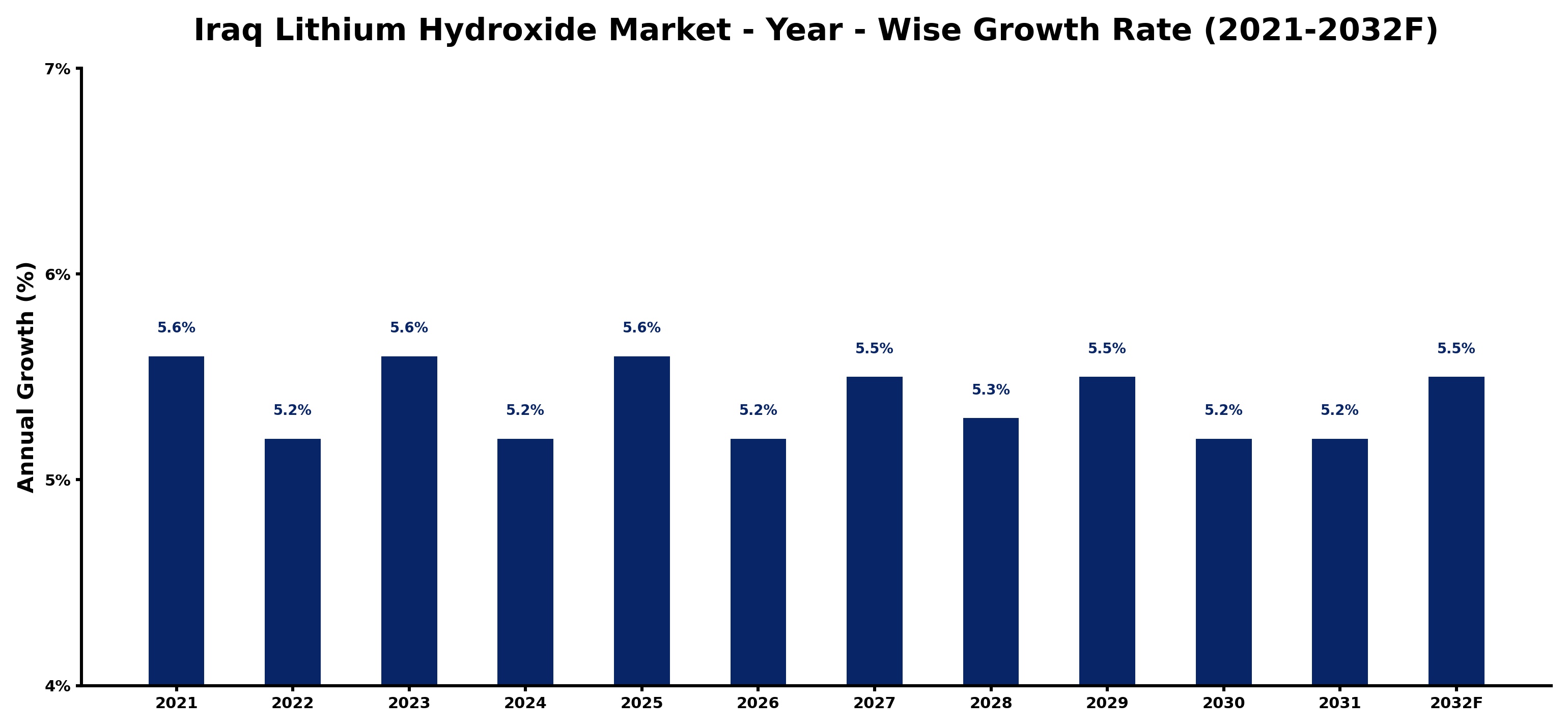
The table below presents the year‑wise growth rates along with the key drivers influencing the market
| Year | Growth Rate | Major Drivers |
| 2021 | 5.6% | Battery production demand increased significantly |
| 2022 | 5.2% | Electric vehicle market expanded rapidly |
| 2023 | 5.6% | Renewable energy storage needs surged |
| 2024 | 5.2% | Technological advancements improved efficiency |
| 2025 | 5.6% | Global lithium demand rose sharply |
| 2026 | 5.2% | Industrial applications expanded usage |
| 2027 | 5.5% | Sustainability initiatives drove adoption |
| 2028 | 5.3% | Investment in mining infrastructure increased |
| 2029 | 5.5% | Partnerships with manufacturers strengthened supply |
| 2030 | 5.2% | Research and development accelerated innovations |
| 2031 | 5.2% | Consumer electronics demand remained strong |
| 2032 | 5.5% | Export opportunities enhanced market reach |
Note - Market size estimations and growth projections presented in this report are based on 6Wresearch’s advanced forecasting approach, validated with industry datasets as of June 2026.
Iraq Lithium Hydroxide Market Synopsis
Iraq's lithium hydroxide market is uniquely positioned due to its rich mineral resources, which hold significant potential for sustainable development in the battery sector. As domestic electric vehicle production ramps up, the requirement for high-quality lithium hydroxide is expected to surge, directly impacting local supply chains and production capabilities.
The focus on renewable energy projects further amplifies the market's growth potential. With global trends leaning towards green technologies, Iraq's investment in lithium hydroxide production aligns with international sustainability goals, thereby attracting both domestic and foreign interest in the sector.
Iraq Lithium Hydroxide Market Key Takeaways
- The market is driven by increasing demand for electric vehicles and renewable energy storage solutions.
- Technological advancements and supply chain optimizations are key factors influencing growth.
- Domestic policies aimed at enhancing value addition and industrial diversification support market development.
- Quality consistency and production scalability are critical challenges that need addressing.
- Opportunities for foreign investment and technology transfer exist, boosting local production capabilities.
Evaluation of Restraints in Iraq Lithium Hydroxide Market
Despite its promising outlook, the Iraq lithium hydroxide market faces notable restraints. Limited availability of high-quality lithium resources poses a significant challenge, hampering the scalability of production. Furthermore, maintaining product quality and consistency is essential for meeting international standards, which could prove difficult amidst fluctuating demand. Addressing these constraints is vital for realizing the full potential of the lithium hydroxide sector in Iraq.
Iraq Lithium Hydroxide Market Trends
The market is witnessing a shift towards advanced battery chemistries that favor lithium hydroxide, particularly in the electric vehicle sector. Furthermore, rising consumer awareness around sustainable practices is influencing manufacturers to seek greener alternatives. Investment in research and development is also on the rise, focusing on enhancing lithium extraction technologies, which could lead to more efficient production processes in the future.
Iraq Lithium Hydroxide Market Opportunities
Opportunities abound in the Iraq lithium hydroxide market, particularly in the realm of infrastructure development for electric vehicles and renewable energy systems. By tapping into the growing global demand for sustainable technologies, Iraq can establish itself as a pivotal player in the lithium supply chain. Collaborative ventures with foreign companies could foster innovation and skill transfer, propelling local industries forward.
Government Initiatives in the Iraq Lithium Hydroxide Market
The Iraqi government is actively pursuing policies that encourage domestic value addition and industrial diversification within the lithium hydroxide market. Initiatives aimed at promoting research and development in lithium extraction and processing, along with attractive frameworks for foreign investment, are pivotal for enhancing the market's growth trajectory. Such strategies may also involve forming partnerships with global players to leverage expertise and technology transfer.
Future Insights of the Iraq Lithium Hydroxide Market
Looking towards 2026-2032, the Iraq lithium hydroxide market is set to undergo significant transformation. With a robust framework supporting electric vehicle adoption and renewable energy projects, the market will likely see heightened investment and technological advancements. As Iraq aligns with global sustainability initiatives, its lithium hydroxide sector may emerge as a critical contributor to both the national economy and the global energy transition.
Iraq Lithium Hydroxide Market Latest Developments (May 2025 - June 2026)
Recent developments indicate a growing focus on enhancing local lithium hydroxide production capabilities. The government has initiated several public-private partnerships aimed at modernizing extraction techniques and boosting overall production efficiency. Additionally, there is a visible shift towards securing agreements with foreign entities for technology sharing, which is expected to play a crucial role in scaling up production to meet rising demand.
Iraq Lithium Hydroxide Market - Key Attractiveness of the Report
- 10 Years of Market Numbers
- Historical Data Starting from 2022 to 2025
- Base Year: 2025
- Forecast Data until 2032
- Key Performance Indicators Impacting the Market
- Major Upcoming Developments and Projects
Key Highlights of the Report:
- Iraq Lithium Hydroxide Market Outlook
- Market Size of Iraq Lithium Hydroxide Market, 2025
- Forecast of Iraq Lithium Hydroxide Market, 2032
- Historical Data and Forecast of Iraq Lithium Hydroxide Revenues & Volume for the Period 2022-2032F
- Iraq Lithium Hydroxide Market Trend Evolution
- Iraq Lithium Hydroxide Market Drivers and Challenges
- Iraq Lithium Hydroxide Price Trends
- Iraq Lithium Hydroxide Porter's Five Forces
- Iraq Lithium Hydroxide Industry Life Cycle
- Historical Data and Forecast of Iraq Lithium Hydroxide Market Revenues & Volume By Application for the Period 2022-2032F
- Historical Data and Forecast of Iraq Lithium Hydroxide Market Revenues & Volume By Batteries for the Period 2022-2032F
- Historical Data and Forecast of Iraq Lithium Hydroxide Market Revenues & Volume By Lubricating Greases for the Period 2022-2032F
- Historical Data and Forecast of Iraq Lithium Hydroxide Market Revenues & Volume By Purification for the Period 2022-2032F
- Historical Data and Forecast of Iraq Lithium Hydroxide Market Revenues & Volume By Others for the Period 2022-2032F
- Iraq Lithium Hydroxide Import Export Trade Statistics
- Market Opportunity Assessment By Application
- Iraq Lithium Hydroxide Top Companies Market Share
- Iraq Lithium Hydroxide Competitive Benchmarking By Technical and Operational Parameters
- Iraq Lithium Hydroxide Company Profiles
- Iraq Lithium Hydroxide Key Strategic Recommendations






































