Iraq Metal containers Market Summary
The iraq metal containers market was estimated at USD 610 Million in 2025 and is projected to reach USD 1023 Million by 2032, growing at a CAGR of 8.8% from 2026 to 2032.
Iraq Metal containers Market Year-wise Growth Rate and Key Drivers
This graph highlights how the Iraq Metal containers Market has steadily grown over the past five years, supported by major growth factors.
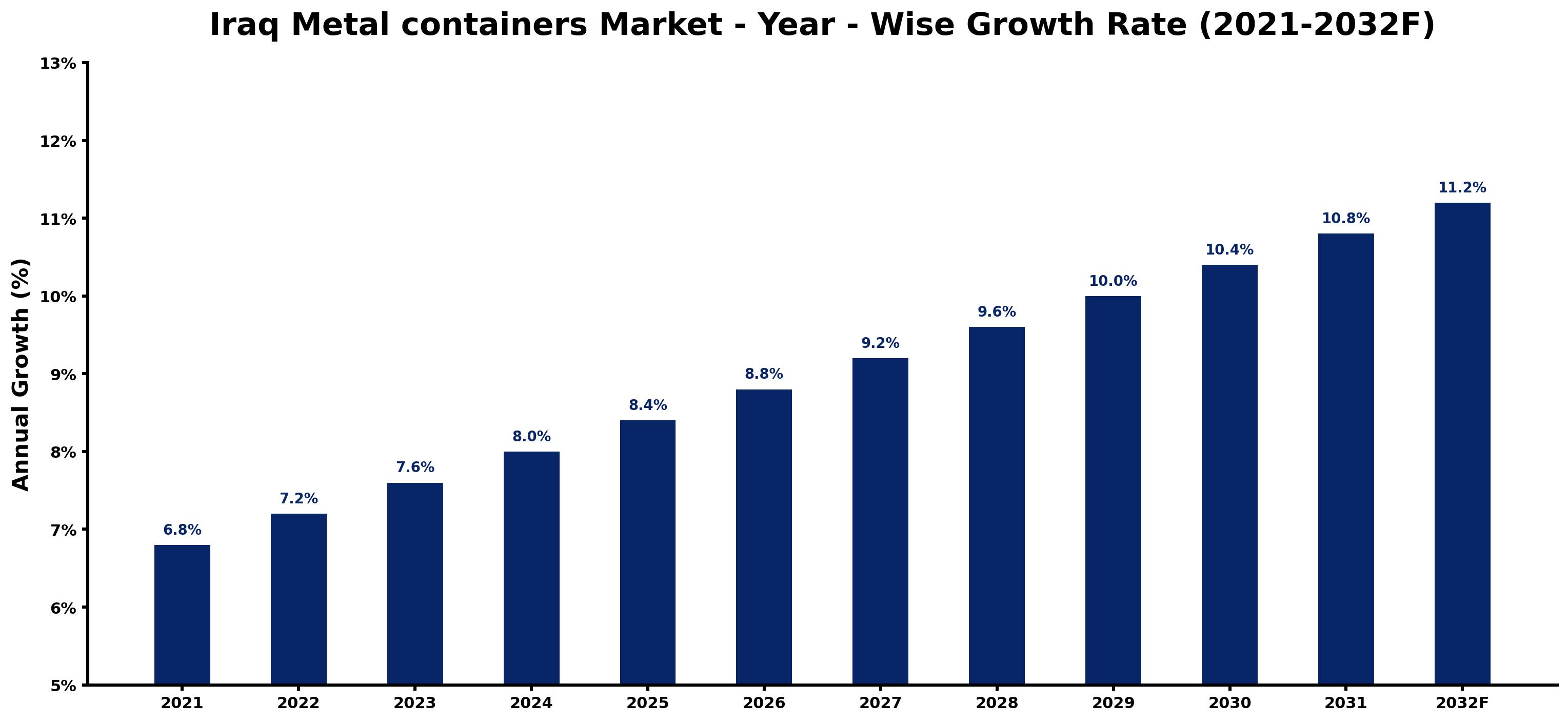
The table below presents the year wise growth rates along with the key drivers influencing the market
| Year | Growth Rate | Major Drivers |
| 2021 | 6.8% | Local manufacturers struggle to meet demand amid supply chain disruptions from COVID-19. |
| 2022 | 7.2% | Investment in infrastructure projects boosts requirements for durable metal containers. |
| 2023 | 7.6% | Construction sector expansion highlights the need for reliable storage solutions. |
| 2024 | 8.0% | Environmental concerns push companies towards sustainable packaging options like metal containers. |
| 2025 | 8.4% | Increased urbanization drives demand for packaging in food and beverage industries. |
| 2026 | 8.8% | Local production capabilities improve through enhanced technology and skilled workforce training. |
| 2027 | 9.2% | Collaboration between public and private sectors incentivizes metal container innovations. |
| 2028 | 9.6% | Export opportunities emerge as regional markets seek quality packaging solutions. |
| 2029 | 10.0% | Shift towards e-commerce necessitates robust packaging solutions for delivery services. |
| 2030 | 10.4% | Advancements in metal recycling techniques boost sustainability in container manufacturing. |
| 2031 | 10.8% | Rising consumer awareness about environmental impacts influences market preferences. |
| 2032 | 11.2% | Large-scale industrial projects create sustained demand for various metal container sizes. |
Note - Market size estimations and growth projections presented in this report are based on 6Wresearch's advanced forecasting approach, validated with industry datasets as of June 2026.
Iraq Metal containers Market Synopsis
The Iraq Metal containers Market is projected to reach 8.8% and witness significant growth during the forecast period (2026-2032). This growth is driven by increasing industrial activities and heightened demand for versatile packaging solutions across key sectors such as food and beverage, chemicals, and pharmaceuticals. The market is characterized by a diverse array of metal containers, including steel drums, aluminum cans, and tin containers, which cater to various packaging requirements.
Iraq Metal containers Market Growth Drivers
Several factors are contributing to the growth of the Iraq metal containers market. The inherent durability and recyclability of metal containers are significant advantages, making them an attractive option for manufacturers and consumers alike. Additionally, metal containers provide excellent protection against external factors such as moisture and contamination, which is vital for preserving product integrity. As industrial activities ramp up, the demand for reliable packaging solutions continues to increase.
- The rise of food and beverage processing requires robust packaging that preserves freshness and extends shelf life, thus driving the demand for metal containers.
- Chemical industries are increasingly relying on metal packaging to ensure safe and efficient transportation of hazardous materials, contributing to overall market expansion.
- The pharmaceutical sector's need for tamper-proof and sterile packaging has led to heightened interest in metal containers, which offer superior protection.
- Growing environmental concerns are pushing manufacturers towards sustainable solutions, making metal containers, with their high recyclability, a preferred choice over plastic alternatives.
- Innovation in design and technology is enhancing the aesthetic appeal of metal packaging, further attracting consumer interest and driving market growth.
Iraq Metal containers Market Trends and Opportunities
The Iraq metal containers market is witnessing several notable trends that indicate its evolution. One significant trend is the shift towards sustainable and eco-friendly packaging solutions. Consumers are increasingly favoring metal containers as they are perceived as more environmentally responsible compared to traditional plastics. This trend is particularly pronounced in the food and beverage industry, where portability and convenience are becoming essential.
- As e-commerce continues to expand in Iraq, there is an increased demand for packaging that can withstand the rigors of online distribution, providing opportunities for metal container vendors.
- The adoption of innovative manufacturing techniques is on the rise, enabling the creation of lightweight and custom-designed metal containers that enhance product visibility.
- There is a growing integration of smart technology in packaging, with metal containers increasingly incorporating QR codes and other tracking mechanisms to engage consumers.
- Investments in automation and advanced manufacturing processes are streamlining production, allowing for greater customization and efficiency in the metal container market.
- The collaboration between manufacturers and end-users is resulting in tailored metal packaging solutions that meet specific industry requirements, further propelling market growth.
Iraq Metal containers Market Challenges and Restraints
Despite its growth, the Iraq metal containers market faces several challenges. Political instability in the region can lead to demand fluctuations, which may impact long-term investment decisions. Furthermore, the lack of adequate infrastructure for distribution hampers market efficiency, while high import costs for raw materials due to trade restrictions pose additional hurdles. Competing packaging materials, particularly cheaper plastics and papers, also represent significant challenges.
- Fluctuating raw material prices can lead to unpredictable production costs, thereby affecting pricing strategies and profit margins for manufacturers.
- Local manufacturers often struggle with limited access to financing, which can stifle innovation and hinder growth within the market.
- Trade regulations and tariffs can complicate the importation of necessary raw materials, further increasing production costs.
- The ongoing economic dependence on oil exports increases market vulnerability to shifts in global oil prices, which may affect consumer purchasing power.
- Lack of skilled labor in manufacturing processes can limit production capabilities and innovation in the metal container sector.
Iraq Metal containers Market Investment Opportunities
The Iraq metal containers market presents a plethora of investment opportunities, particularly as the industrial sector continues to expand. The increasing demand for durable and secure metal containers across various industries, including food and beverage, pharmaceuticals, and chemicals, signals a ripe environment for investment. Potential investors can explore opportunities in the manufacturing and supply of various metal container types, such as drums, cans, and barrels.
- Investments in modern technologies can lead to innovative metal container solutions that appeal to environmentally conscious consumers.
- Opportunities abound for developing partnerships with e-commerce platforms to create packaging solutions tailored to online retail logistics.
- Research and development in advanced materials can yield more cost-effective and efficient manufacturing processes, further capturing market share.
- The market for customized metal containers offers unique opportunities for niche players to meet specific consumer needs effectively.
- Investing in automation and digitalization could enhance production capabilities and reduce overhead costs, ensuring a competitive edge in the market.
Iraq Metal containers Market Government Investment and Initiatives
Government policies play a critical role in shaping the Iraq metal containers market. The Iraqi government has made significant efforts to promote local production and reduce reliance on imports. Initiatives include providing financial incentives and subsidies to domestic manufacturers, as well as imposing tariffs on imported metal containers to encourage local industry growth. Moreover, policies aimed at enhancing self-sufficiency are crucial for establishing a competitive and thriving metal container industry.
- Regulatory frameworks are being developed to ensure compliance with quality standards and environmental sustainability, fostering a more robust market environment.
- Support for research and development is a key focus, with the government encouraging innovation in metal container design and production processes.
- Public spending on infrastructure improvements is also evident, aiming to support better distribution channels for metal container manufacturers.
- Collaboration between government and industry stakeholders is enhancing the overall business landscape for the metal containers market.
- Strategic initiatives aimed at diversifying the economy and reducing dependency on oil exports are expected to positively impact the metal containers sector in the long term.
Iraq Metal containers Market Latest Developments (May 2025 - June 2026)
Recent developments in the Iraq metal containers market indicate a positive trajectory, highlighting industry dynamism. During this period, the focus has been on increasing investment in technology and manufacturing processes to improve efficiency and reduce costs. Additionally, there has been a push towards sustainable practices, with many manufacturers exploring eco-friendly materials and production techniques.
- Collaborations between government bodies and manufacturers have intensified, aimed at improving local production capacities and reducing import reliance.
- Innovation in packaging design has become a key focus, with companies actively seeking to enhance the aesthetic and functional qualities of metal containers.
- Market players are increasingly adopting digital tools to streamline operations and enhance customer engagement through innovative packaging solutions.
- The shift towards e-commerce has led manufacturers to develop packaging specifically designed for the logistics of online sales, responding to consumer demand for convenient solutions.
- Overall, these developments point to a growing recognition of the importance of the metal containers market in Iraq's broader industrial landscape.
Iraq Metal containers Market - Key Attractiveness of the Report
- 10 Years of Market Numbers
- Historical Data Starting from 2022 to 2025
- Base Year: 2025
- Forecast Data until 2032
- Key Performance Indicators Impacting the Market
- Major Upcoming Developments and Projects
Key Highlights of the Report:
- Iraq Metal containers Market Outlook
- Market Size of Iraq Metal containers Market, 2025
- Forecast of Iraq Metal containers Market, 2032F
- Historical Data and Forecast of Iraq Metal containers Revenues & Volume for the Period 2022-2032F
- Iraq Metal containers Market Trend Evolution
- Iraq Metal containers Market Drivers and Challenges
- Iraq Metal containers Price Trends
- Iraq Metal containers Porter's Five Forces
- Iraq Metal containers Industry Life Cycle
- Historical Data and Forecast of Iraq Metal containers Market Revenues & Volume By Product Type for the Period 2022-2032F
- Historical Data and Forecast of Iraq Metal containers Market Revenues & Volume By Cans for the Period 2022-2032F
- Historical Data and Forecast of Iraq Metal containers Market Revenues & Volume By Drums for the Period 2022-2032F
- Historical Data and Forecast of Iraq Metal containers Market Revenues & Volume By Aerosol Cans for the Period 2022-2032F
- Historical Data and Forecast of Iraq Metal containers Market Revenues & Volume By Pails for the Period 2022-2032F
- Historical Data and Forecast of Iraq Metal containers Market Revenues & Volume By Intermediate Bulk Containers for the Period 2022-2032F
- Historical Data and Forecast of Iraq Metal containers Market Revenues & Volume By Bottles for the Period 2022-2032F
- Historical Data and Forecast of Iraq Metal containers Market Revenues & Volume By Others for the Period 2022-2032F
- Historical Data and Forecast of Iraq Metal containers Market Revenues & Volume By Metal Type for the Period 2022-2032F
- Historical Data and Forecast of Iraq Metal containers Market Revenues & Volume By Stainless Steel for the Period 2022-2032F
- Historical Data and Forecast of Iraq Metal containers Market Revenues & Volume By Aluminum for the Period 2022-2032F
- Historical Data and Forecast of Iraq Metal containers Market Revenues & Volume By Tin for the Period 2022-2032F
- Historical Data and Forecast of Iraq Metal containers Market Revenues & Volume By End-users for the Period 2022-2032F
- Historical Data and Forecast of Iraq Metal containers Market Revenues & Volume By Food and Beverage Industry for the Period 2022-2032F
- Historical Data and Forecast of Iraq Metal containers Market Revenues & Volume By Paints & Lubricants for the Period 2022-2032F
- Historical Data and Forecast of Iraq Metal containers Market Revenues & Volume By Chemical Industry for the Period 2022-2032F
- Historical Data and Forecast of Iraq Metal containers Market Revenues & Volume By Automotive Industry for the Period 2022-2032F
- Historical Data and Forecast of Iraq Metal containers Market Revenues & Volume By Pharmaceutical & Healthcare for the Period 2022-2032F
- Historical Data and Forecast of Iraq Metal containers Market Revenues & Volume By Cosmetics & Personal care for the Period 2022-2032F
- Historical Data and Forecast of Iraq Metal containers Market Revenues & Volume By Building & Construction for the Period 2022-2032F
- Historical Data and Forecast of Iraq Metal containers Market Revenues & Volume By Other consumer goods for the Period 2022-2032F
- Iraq Metal containers Import Export Trade Statistics
- Market Opportunity Assessment By Product Type
- Market Opportunity Assessment By Metal Type
- Market Opportunity Assessment By End-users
- Iraq Metal containers Top Companies Market Share
- Iraq Metal containers Competitive Benchmarking By Technical and Operational Parameters
- Iraq Metal containers Company Profiles
- Iraq Metal containers Key Strategic Recommendations






































