Iraq Microphone Market Size, Share & Growth Rate
The Iraq Microphone Market was estimated at USD 482 Million in 2025 and is projected to reach USD 650 Million by 2032, growing at a CAGR of 4.4% from 2026 to 2032. This positive trajectory is largely fueled by a burgeoning entertainment industry and a noticeable uptick in public events where quality audio is paramount. As Iraq undergoes significant infrastructural developments, the demand for sophisticated audio equipment, including advanced microphones, is expected to further escalate.
Iraq Microphone Market Year-wise Growth Rate and Key Drivers
This graph highlights how the Iraq Microphone Market has steadily grown over the years, supported by major growth factors.
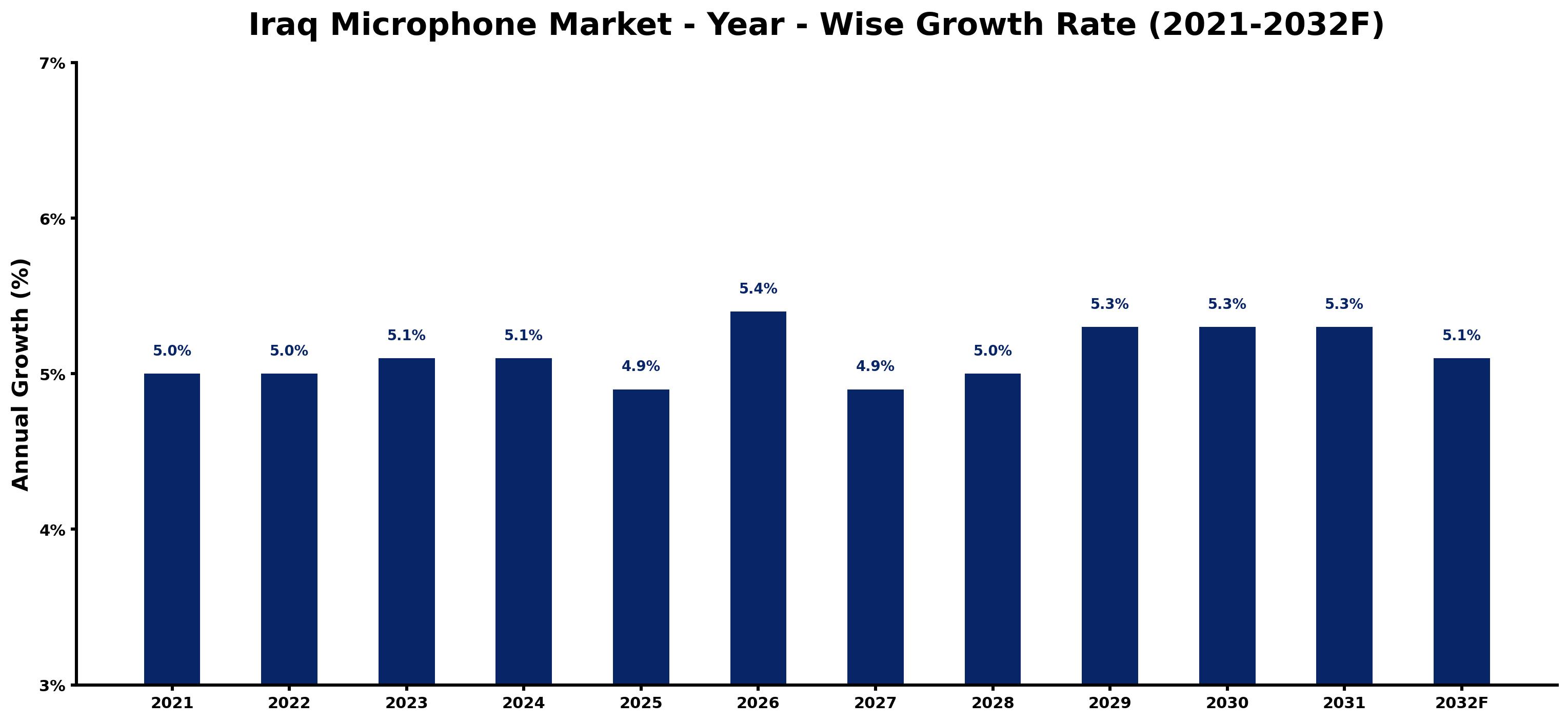
The table below presents the year‑wise growth rates along with the key drivers influencing the market
| Year | Growth Rate | Major Drivers |
| 2021 | 5.0% | Expansion of commercial construction activities |
| 2022 | 5.0% | Growing urbanization and commercial development |
| 2023 | 5.1% | Growing renewable energy integration projects |
| 2024 | 5.1% | Increasing adoption of advanced technologies |
| 2025 | 4.9% | Rising electricity demand across industries |
| 2026 | 5.4% | Expansion of manufacturing activities |
| 2027 | 4.9% | Expansion of transportation and logistics networks |
| 2028 | 5.0% | Government infrastructure modernization initiatives |
| 2029 | 5.3% | Government infrastructure modernization initiatives |
| 2030 | 5.3% | Increasing adoption of advanced technologies |
| 2031 | 5.3% | Government infrastructure modernization initiatives |
| 2032 | 5.1% | Increasing adoption of advanced technologies |
Note - Market size estimations and growth projections presented in this report are based on 6Wresearch's advanced forecasting approach, validated with industry datasets as of June 2026.
Iraq Microphone Market Synopsis
Currently, the Iraqi microphone market is witnessing a transformative phase, driven by increasing applications across various sectors such as broadcasting, live events, and digital communication. The integration of cutting-edge technologies, particularly wireless and noise-canceling features, is reshaping user expectations and enhancing overall audio experiences.
The market is not only buoyed by technological advancements but also by a growing youth demographic eager to engage in music and media production. As smartphone penetration rises, so does the demand for high-quality audio accessories, positioning microphones as essential tools for both professionals and amateurs alike.
Iraq Microphone Market Key Takeaways
- Steady growth is supported by technological advancements in microphone design and functionality.
- Public and private sector events are increasingly prioritizing high-quality audio solutions.
- Government policies are fostering local manufacturing, enhancing market competitiveness.
- Emerging trends in mobile communication are driving demand for portable microphone solutions.
- Supply chain optimizations remain crucial for addressing quality control issues.
Evaluation of Restraints in Iraq Microphone Market
Despite the optimistic outlook for the Iraq microphone market, several constraints could impede growth. Quality control remains a significant challenge, as fluctuating market conditions can lead to inconsistencies in product standards. Additionally, the complexity of supply chain management exacerbates these issues, making it difficult for market players to ensure reliable delivery and service. Companies must address these logistical hurdles and invest in robust quality assurance processes to navigate this challenging landscape successfully.
Iraq Microphone Market Trends
In the ever-evolving landscape of the Iraq microphone market, several noteworthy trends are emerging. Firstly, the shift towards wireless microphone technology is gaining momentum, as users prioritize convenience and mobility. Noise-canceling microphones are also on the rise, appealing to content creators and professionals seeking clear audio in noisy environments. Furthermore, there is a growing interest in eco-friendly and sustainable production practices, as consumers become more conscious of their environmental impact.
Iraq Microphone Market Opportunities
With Iraq's ongoing modernization efforts, there are numerous opportunities for growth and investment within the microphone market. Local manufacturing initiatives, bolstered by government incentives, could pave the way for companies to enhance their production capabilities. Moreover, expanding digital content creation, such as podcasts and video streaming, presents new avenues for microphone usage. As businesses and individuals alike seek to improve audio quality, the demand for innovative solutions will likely soar.
Government Initiatives in the Iraq Microphone Market
The Iraqi government is increasingly aware of the microphone market's role in driving growth across telecommunications, entertainment, and broadcasting sectors. To support this, policies are in place that promote local manufacturing through tax incentives and subsidies. Additionally, the government has implemented regulatory frameworks to ensure product quality and safety, fostering a more competitive environment. Initiatives aimed at enhancing research and development capabilities in microphone technology further underline the commitment to innovation in this sector.
Future Insights of the Iraq Microphone Market
Looking ahead to 2026-2032, the Iraq microphone market is poised for substantial growth driven by technological advancements and a steady increase in audio production across various industries. The rising influence of social media and digital content creation will continue to fuel demand for high-quality microphones. Additionally, as local manufacturing capabilities expand, consumers can expect a wider range of products with improved quality and affordability. This dynamic landscape indicates a promising future for market stakeholders willing to adapt and innovate.
Iraq Microphone Market Latest Developments (May 2025 - June 2026)
Recent developments in the Iraq microphone market have seen a surge in new product launches, particularly focusing on wireless and compact solutions tailored for mobile users. Moreover, industry stakeholders are increasingly collaborating with local entities to improve production efficiencies and ensure compliance with quality standards. Events and trade shows have also gained traction, showcasing the latest innovations and fostering networking opportunities among businesses.
Iraq Microphone Market - Key Attractiveness of the Report
- 10 Years of Market Numbers
- Historical Data Starting from 2022 to 2025
- Base Year: 2025
- Forecast Data until 2032
- Key Performance Indicators Impacting the Market
- Major Upcoming Developments and Projects
Key Highlights of the Report:
- Iraq Microphone Market Outlook
- Market Size of Iraq Microphone Market, 2025
- Forecast of Iraq Microphone Market, 2032
- Historical Data and Forecast of Iraq Microphone Revenues & Volume for the Period 2022-2032F
- Iraq Microphone Market Trend Evolution
- Iraq Microphone Market Drivers and Challenges
- Iraq Microphone Price Trends
- Iraq Microphone Porter's Five Forces
- Iraq Microphone Industry Life Cycle
- Historical Data and Forecast of Iraq Microphone Market Revenues & Volume By MEMS Type for the Period 2022-2032F
- Historical Data and Forecast of Iraq Microphone Market Revenues & Volume By Analog for the Period 2022-2032F
- Historical Data and Forecast of Iraq Microphone Market Revenues & Volume By Digital for the Period 2022-2032F
- Historical Data and Forecast of Iraq Microphone Market Revenues & Volume By Technology for the Period 2022-2032F
- Historical Data and Forecast of Iraq Microphone Market Revenues & Volume By Electret for the Period 2022-2032F
- Historical Data and Forecast of Iraq Microphone Market Revenues & Volume By MEMS for the Period 2022-2032F
- Historical Data and Forecast of Iraq Microphone Market Revenues & Volume By Others for the Period 2022-2032F
- Historical Data and Forecast of Iraq Microphone Market Revenues & Volume By Communication Technology for the Period 2022-2032F
- Historical Data and Forecast of Iraq Microphone Market Revenues & Volume By Wired for the Period 2022-2032F
- Historical Data and Forecast of Iraq Microphone Market Revenues & Volume By Wireless for the Period 2022-2032F
- Historical Data and Forecast of Iraq Microphone Market Revenues & Volume By Applications for the Period 2022-2032F
- Historical Data and Forecast of Iraq Microphone Market Revenues & Volume By Automotive for the Period 2022-2032F
- Historical Data and Forecast of Iraq Microphone Market Revenues & Volume By Commercial Security & Surveillance for the Period 2022-2032F
- Historical Data and Forecast of Iraq Microphone Market Revenues & Volume By Consumer Electronics for the Period 2022-2032F
- Historical Data and Forecast of Iraq Microphone Market Revenues & Volume By Industrial for the Period 2022-2032F
- Historical Data and Forecast of Iraq Microphone Market Revenues & Volume By Medical for the Period 2022-2032F
- Historical Data and Forecast of Iraq Microphone Market Revenues & Volume By Noise Monitoring & Sensing for the Period 2022-2032F
- Iraq Microphone Import Export Trade Statistics
- Market Opportunity Assessment By MEMS Type
- Market Opportunity Assessment By Technology
- Market Opportunity Assessment By Communication Technology
- Market Opportunity Assessment By Applications
- Iraq Microphone Top Companies Market Share
- Iraq Microphone Competitive Benchmarking By Technical and Operational Parameters
- Iraq Microphone Company Profiles
- Iraq Microphone Key Strategic Recommendations






































