Iraq Microwave Oven Market Size, Share & Growth Rate
The Iraq Microwave Oven Market was estimated at USD 252 Million in 2025 and is projected to reach USD 340 Million by 2032, growing at a CAGR of 4.4% from 2026 to 2032. This growth trajectory is primarily fueled by increased urbanization and a rising middle-class population, which drives demand for convenient cooking appliances. Additionally, the shift towards modern kitchen designs and the growing need for time-efficient cooking methods have further contributed to this upward trend.
Iraq Microwave Oven Market Year-wise Growth Rate and Key Drivers
This graph highlights how the Iraq Microwave Oven Market has steadily grown over the years, supported by major growth factors.
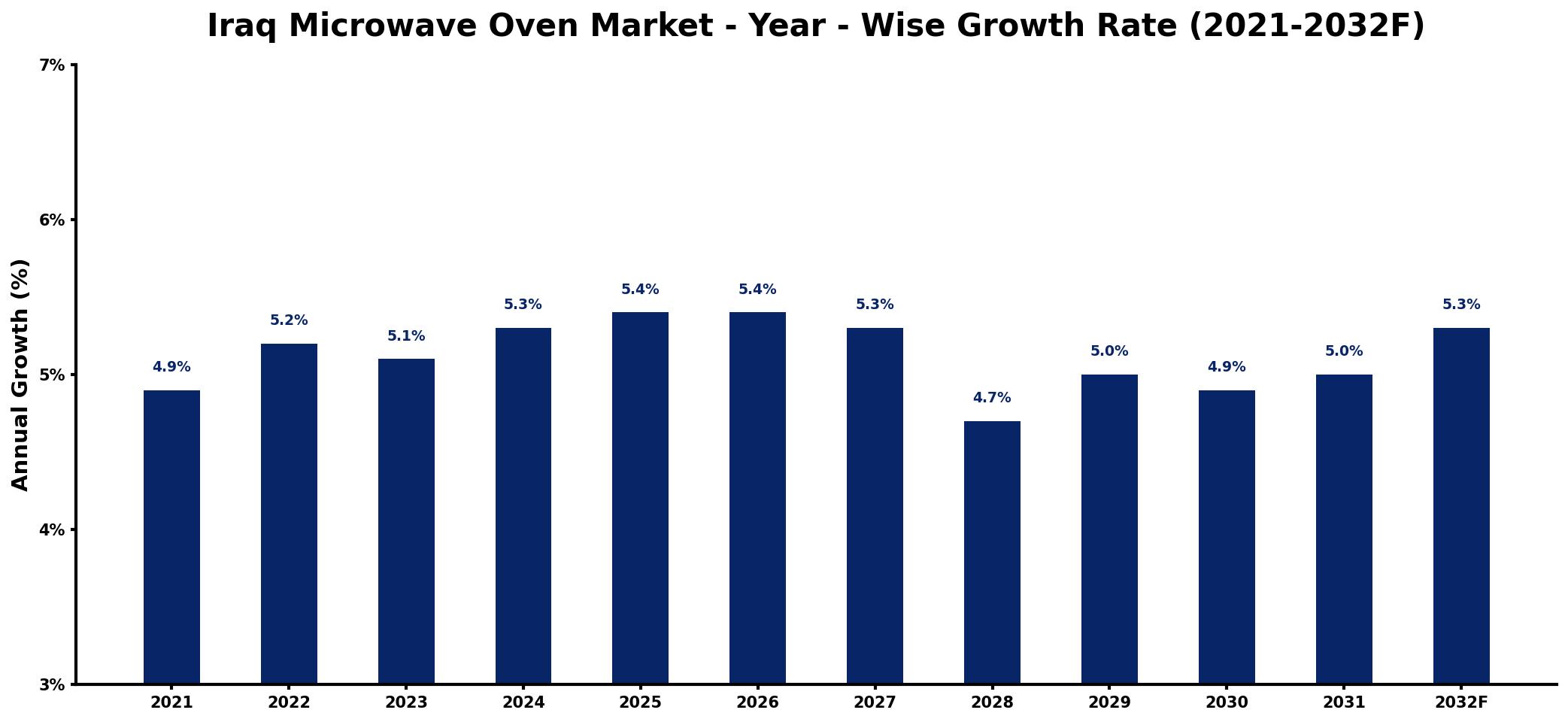
The table below presents the year‑wise growth rates along with the key drivers influencing the market
| Year | Growth Rate | Major Drivers |
| 2021 | 4.9% | Rising disposable income levels |
| 2022 | 5.2% | Increased urbanization trends observed |
| 2023 | 5.1% | Growth in consumer electronics sector |
| 2024 | 5.3% | Expansion of retail distribution networks |
| 2025 | 5.4% | Higher demand for convenience cooking |
| 2026 | 5.4% | Technological advancements in appliances |
| 2027 | 5.3% | Shift towards energy efficient solutions |
| 2028 | 4.7% | Emerging interest in smart home |
| 2029 | 5.0% | Growing awareness of health benefits |
| 2030 | 4.9% | Increased online shopping preferences |
| 2031 | 5.0% | increased pharmaceutical industry usage |
| 2032 | 5.3% | Rising popularity of quick meals |
Note: Market size estimations and growth projections presented in this report are based on 6Wresearch's proprietary forecasting methodology, utilizing the latest available industry data, government publications, and primary research inputs.
Iraq Microwave Oven Market Synopsis
The Iraqi microwave oven market has seen a notable rise in recent years, characterized by an increasing acceptance of modern cooking technologies among consumers. However, as the market evolves, it faces challenges that could impact future growth, particularly in the form of infrastructure constraints and economic fluctuations.
Looking ahead, the demand for microwave ovens is expected to further escalate, driven by changing lifestyles and a growing appreciation for convenience in cooking. As more households seek space-saving and feature-rich appliances, the market is poised for expansion, indicating a positive outlook for stakeholders.
Iraq Microwave Oven Market Key Takeaways
- The market is shifting towards innovative microwave oven models with smart features and energy efficiency.
- Urbanization and a growing middle-class population are primary drivers of demand for these appliances.
- Challenges such as economic instability and limited consumer awareness hinder broader adoption.
- Compact designs are gaining popularity among urban consumers with limited kitchen space.
- Investment opportunities exist in marketing and product development tailored to local preferences.
Evaluation of Restraints in Iraq Microwave Oven Market
While the Iraq microwave oven market shows promise, several critical restraints are limiting its growth. Cultural preferences for traditional cooking methods still prevail among many consumers, leading to limited awareness and acceptance of microwave ovens. Economic instability and low disposable incomes in certain regions restrict the purchasing power, making it difficult for some consumers to invest in modern appliances. Moreover, infrastructure challenges, such as unreliable electricity supply and voltage fluctuations, complicate the operational feasibility of microwave ovens. Addressing these issues will require strategic marketing initiatives and infrastructure improvements to facilitate wider adoption.
Iraq Microwave Oven Market Trends
The Iraq microwave oven market is currently experiencing significant trends, particularly the demand for technologically advanced models. Innovations such as convection cooking, inverter technology, and smart features that enable remote operation are becoming increasingly sought after. Energy efficiency is also a primary consideration, prompting consumers to prefer models that are not only effective but also sustainable. Additionally, the trend toward compact designs is evident, reflecting the needs of urban households facing space limitations in their kitchens.
Iraq Microwave Oven Market Opportunities
The Iraq microwave oven market presents several promising investment opportunities, driven by an increasing demand for efficient cooking solutions. With more working professionals seeking time-saving cooking appliances, manufacturers have a chance to innovate and offer a variety of products that cater to local consumer preferences. Furthermore, by focusing on marketing strategies that emphasize the benefits of microwave ovens—such as speed and convenience—investors can effectively attract a broader customer base. The rising interest in home cooking and baking among younger demographics also opens additional avenues for growth in this market.
Government Initiatives in the Iraq Microwave Oven Market
The Iraqi government has enacted several policies aimed at regulating the import and distribution of microwave ovens within the market. These policies include quality control measures designed to ensure that all appliances meet safety standards and are free from health risks. Import regulations are in place to oversee the influx of microwave ovens and deter the entry of substandard products. Moreover, tariffs and taxes on imports are imposed to protect domestic manufacturers and encourage local production, ultimately fostering a competitive environment for the microwave oven industry.
Future Insights of the Iraq Microwave Oven Market
The future outlook for the Iraq microwave oven market is optimistic, with projections indicating continued growth driven by urbanization, rising disposable incomes, and evolving consumer lifestyles. The demand for convenient cooking solutions is anticipated to bolster market expansion as households increasingly seek effective appliances. Technological advancements in smart features and energy efficiency are likely to appeal to a broader audience, while the growing trend of home cooking among younger generations could further amplify demand. Stakeholders are well-positioned to harness these trends for continued success in the coming years.
Iraq Microwave Oven Market Latest Developments (2025 - 2026)
Recent developments in the Iraq microwave oven market reflect a shift towards more innovative and energy-efficient products. Manufacturers are increasingly introducing models with enhanced functionalities, responding to the rising consumer demand for smart kitchen appliances. Additionally, marketing campaigns highlighting the advantages of microwave ovens are gaining traction, aimed at overcoming cultural barriers to acceptance. As competition intensifies, advancements in distribution channels and after-sales services are also being prioritized to improve customer support and satisfaction.
Iraq Microwave Oven Market - Key Attractiveness of the Report
- 10 Years of Market Numbers
- Historical Data Starting from 2022 to 2025
- Base Year: 2025
- Forecast Data until 2032
- Key Performance Indicators Impacting the Market
- Major Upcoming Developments and Projects
Key Highlights of the Report:
- Iraq Microwave Oven Market Outlook
- Market Size of Iraq Microwave Oven Market, 2025
- Forecast of Iraq Microwave Oven Market, 2032
- Historical Data and Forecast of Iraq Microwave Oven Revenues & Volume for the Period 2022-2032F
- Iraq Microwave Oven Market Trend Evolution
- Iraq Microwave Oven Market Drivers and Challenges
- Iraq Microwave Oven Price Trends
- Iraq Microwave Oven Porter's Five Forces
- Iraq Microwave Oven Industry Life Cycle
- Historical Data and Forecast of Iraq Microwave Oven Market Revenues & Volume By Structure for the Period 2022-2032F
- Historical Data and Forecast of Iraq Microwave Oven Market Revenues & Volume By Built In for the Period 2022-2032F
- Historical Data and Forecast of Iraq Microwave Oven Market Revenues & Volume By Counter Top for the Period 2022-2032F
- Historical Data and Forecast of Iraq Microwave Oven Market Revenues & Volume By Type for the Period 2022-2032F
- Historical Data and Forecast of Iraq Microwave Oven Market Revenues & Volume By Convection for the Period 2022-2032F
- Historical Data and Forecast of Iraq Microwave Oven Market Revenues & Volume By Grill for the Period 2022-2032F
- Historical Data and Forecast of Iraq Microwave Oven Market Revenues & Volume By Solo for the Period 2022-2032F
- Historical Data and Forecast of Iraq Microwave Oven Market Revenues & Volume By Production for the Period 2022-2032F
- Historical Data and Forecast of Iraq Microwave Oven Market Revenues & Volume By Commerical for the Period 2022-2032F
- Historical Data and Forecast of Iraq Microwave Oven Market Revenues & Volume By Household for the Period 2022-2032F
- Iraq Microwave Oven Import Export Trade Statistics
- Market Opportunity Assessment By Structure
- Market Opportunity Assessment By Type
- Market Opportunity Assessment By Production
- Iraq Microwave Oven Top Companies Market Share
- Iraq Microwave Oven Competitive Benchmarking By Technical and Operational Parameters
- Iraq Microwave Oven Company Profiles
- Iraq Microwave Oven Key Strategic Recommendations






































