Iraq Mineral Wool Market Summary
The iraq mineral wool market was estimated at USD 283 Million in 2025 and is projected to reach USD 387 Million by 2032, growing at a CAGR of 5.3% from 2026 to 2032.
Iraq Mineral Wool Market Year-wise Growth Rate and Key Drivers
This graph highlights how the Iraq Mineral Wool Market has steadily grown over the past five years, supported by major growth factors.
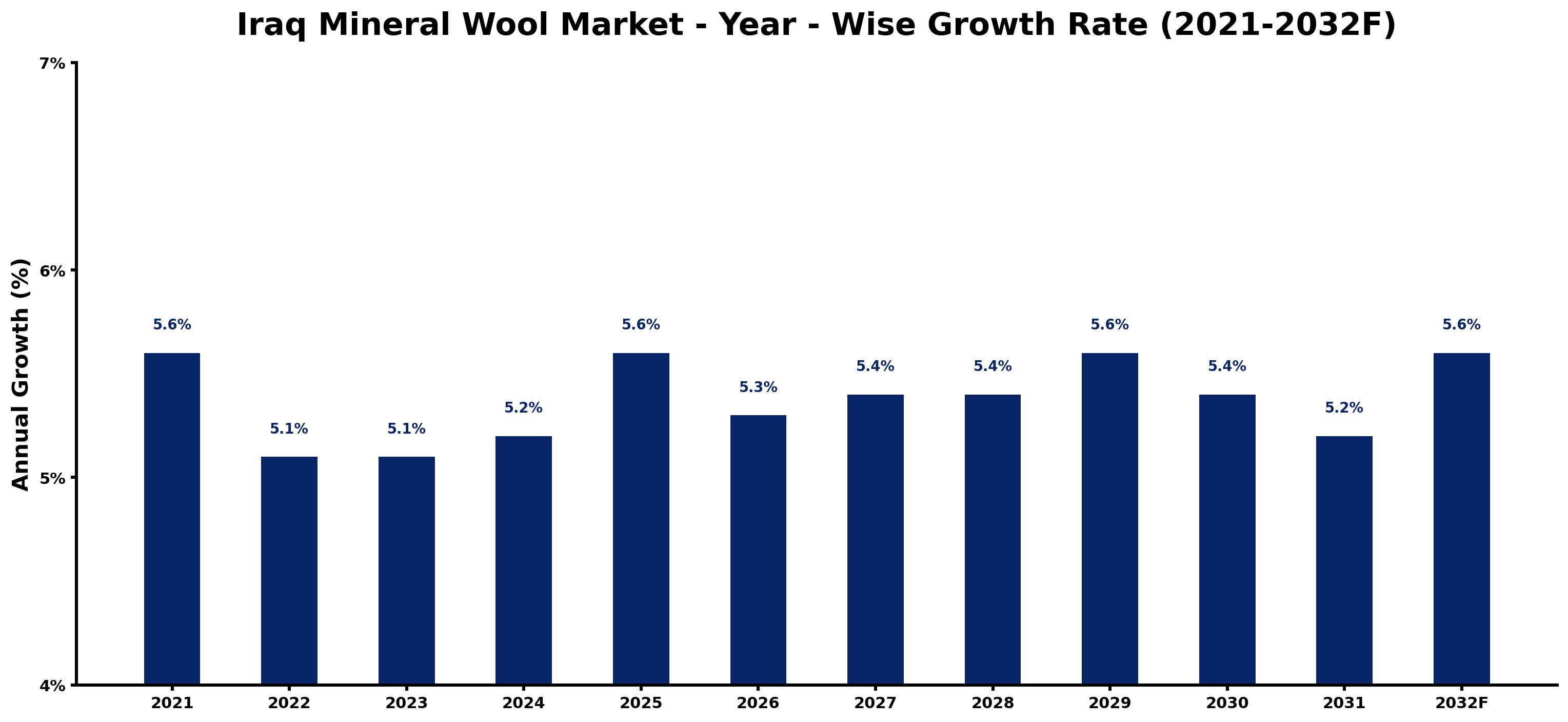
The table below presents the year wise growth rates along with the key drivers influencing the market
| Year | Growth Rate | Major Drivers |
| 2021 | 5.6% | Market demand spurred by reconstruction projects in urban areas and infrastructure. |
| 2022 | 5.1% | Increased awareness of energy efficiency benefits for insulation materials among builders. |
| 2023 | 5.1% | The emergence of local manufacturers enhancing production capabilities and supply chains. |
| 2024 | 5.2% | Growing interest in sustainable building solutions, particularly in commercial construction. |
| 2025 | 5.6% | Collaborations between international firms and local players boosting technology transfer. |
| 2026 | 5.3% | Investments in residential housing projects focusing on climate-responsive building materials. |
| 2027 | 5.4% | A heightened focus on thermal insulation reflecting a shift in construction practices. |
| 2028 | 5.4% | Government-led initiatives promoting energy-efficient standards across new building developments. |
| 2029 | 5.6% | The construction sector's recovery and expansion, driving demand for quality insulation. |
| 2030 | 5.4% | Increased awareness of fire safety and soundproofing benefits influencing purchasing decisions. |
| 2031 | 5.2% | Tech innovations in manufacturing processes making mineral wool products more competitive. |
| 2032 | 5.6% | Rising consumer preferences for environmentally friendly materials reshaping market dynamics. |
Note - Market size estimations and growth projections presented in this report are based on 6Wresearch's advanced forecasting approach, validated with industry datasets as of June 2026.
Iraq Mineral Wool Market Synopsis
The Iraq Mineral Wool Market is projected to reach 5.3% and witness significant growth during the forecast period (2026-2032). This anticipated expansion is driven by increasing demand from critical end-user sectors, particularly the construction and automotive industries. An ongoing trend of infrastructural development across Iraq is further enhancing market prospects, as mineral wool products are favored for their cost-effectiveness in installation and superior sound insulation properties. In addition to these market drivers, stringent government regulations promoting energy efficiency are leading to greater adoption of mineral wool in both residential and commercial buildings for thermal insulation purposes. Furthermore, substantial investments in renewable energy initiatives are expected to contribute positively to the market's growth trajectory in the coming years.
Iraq Mineral Wool Market Growth Drivers
Several factors are propelling the growth of the Iraq Mineral Wool Market. The first significant driver is the increasing demand for energy-efficient building materials. With rising energy costs and environmental concerns, both private and public sectors are focusing on materials that enhance energy efficiency in structures. Mineral wool's excellent thermal insulation properties make it a popular choice in this regard.
Another key driver is the rapid urbanization occurring in Iraq, which is leading to a surge in construction activities. As cities expand, the need for effective insulation solutions in both residential and commercial buildings becomes paramount. Mineral wool not only provides insulation but also helps in soundproofing, making it ideal for urban settings.
Moreover, the automotive industry in Iraq is witnessing a revival, with increased production activities that require high-quality insulation materials. Mineral wool's lightweight and durable nature makes it suitable for automotive applications, further boosting the market.
Additionally, government initiatives focused on promoting sustainable construction practices are motivating builders to opt for eco-friendly materials like mineral wool. The material's fire-resistance properties also align with safety regulations in construction, enhancing its appeal.
Lastly, the growing emphasis on health and wellness in building design is leading more developers to consider the acoustic properties of building materials, with mineral wool being known for its effectiveness in sound absorption.
Iraq Mineral Wool Market Trends and Opportunities
The Iraq Mineral Wool Market is currently witnessing several trends that present significant opportunities for stakeholders. One prominent trend is the shift towards green building practices, where materials that contribute to sustainability and energy efficiency are prioritized. Mineral wool, being both recyclable and energy-efficient, fits well within this movement.
Furthermore, the increasing focus on smart city projects in Iraq is opening up opportunities for innovative insulation solutions. As these projects often integrate advanced building technologies, the demand for high-performance materials like mineral wool is likely to grow.
The recent governmental push for infrastructure development and modernization is leading to a more robust construction sector, which further fuels the demand for mineral wool. Enhanced funding for rebuilding efforts and urban development is likely to spur investments in mineral wool production and application.
Additionally, the market is expected to benefit from advancements in production technologies, which may lower manufacturing costs and enhance product performance. Innovation in mineral wool formulations to improve insulation quality will attract more users in both the commercial and residential sectors.
Investments in local production facilities are also a trend that could lead to reduced import dependency, thereby stimulating market growth and creating job opportunities within the region.
Iraq Mineral Wool Market Government Investment and Initiatives
The Iraqi government has recognized the importance of sustainable materials in construction, leading to various initiatives aimed at fostering the adoption of mineral wool. Significant public spending on infrastructure projects illustrates a commitment to enhancing the building sector's efficiency and sustainability.
Policies promoting energy efficiency have encouraged developers to utilize insulation materials that comply with new building codes, further supporting the mineral wool market. These regulations often require improved thermal performance, which mineral wool can provide.
Moreover, there are incentives for investments in renewable energy projects that positively influence the mineral wool market. As the government encourages the use of eco-friendly materials, the construction sector is increasingly turning to mineral wool for its environmentally friendly attributes.
The government is also facilitating partnerships with international organizations to improve manufacturing capabilities and standards in the thermal insulation sector, which includes mineral wool products, thus driving industry growth.
Overall, the Iraqi government's strategic focus on sustainability and infrastructure development is likely to create a robust environment for the mineral wool market.
Iraq Mineral Wool Market Latest Developments (May 2025 - June 2026)
During the period from May 2025 to June 2026, the Iraq Mineral Wool Market has seen notable developments indicating a positive direction for the industry. The government has increasingly promoted the use of thermal insulation materials, recognizing their role in enhancing energy efficiency in buildings.
In this timeframe, numerous construction projects are being launched across various cities, resulting in heightened demand for mineral wool products. These projects emphasize sustainability and aim to meet international energy standards, thereby directly benefiting the mineral wool market.
Moreover, advancements in mineral wool production techniques have been reported, addressing challenges related to cost and performance. These innovations are expected to enhance the material's appeal and expand its applications across different sectors.
The period has also seen efforts to promote awareness regarding the benefits of mineral wool among construction professionals and builders, facilitating informed choices for energy-efficient building practices. These awareness initiatives are crucial in expanding the market's reach.
Overall, the developments within this timeframe suggest a diversifying market landscape, with increasing activities indicative of strong growth potential for the Iraq Mineral Wool Market.
Iraq Mineral Wool Market - Key Attractiveness of the Report
- 10 Years of Market Numbers
- Historical Data Starting from 2022 to 2025
- Base Year: 2025
- Forecast Data until 2032
- Key Performance Indicators Impacting the Market
- Major Upcoming Developments and Projects
Key Highlights of the Report:
- Iraq Mineral Wool Market Outlook
- Market Size of Iraq Mineral Wool Market, 2025
- Forecast of Iraq Mineral Wool Market, 2032F
- Historical Data and Forecast of Iraq Mineral Wool Revenues & Volume for the Period 2022-2032F
- Iraq Mineral Wool Market Trend Evolution
- Iraq Mineral Wool Market Drivers and Challenges
- Iraq Mineral Wool Price Trends
- Iraq Mineral Wool Porter's Five Forces
- Iraq Mineral Wool Industry Life Cycle
- Historical Data and Forecast of Iraq Mineral Wool Market Revenues & Volume By Product Type for the Period 2022-2032F
- Historical Data and Forecast of Iraq Mineral Wool Market Revenues & Volume By Rock Wool for the Period 2022-2032F
- Historical Data and Forecast of Iraq Mineral Wool Market Revenues & Volume By Glass Wool for the Period 2022-2032F
- Historical Data and Forecast of Iraq Mineral Wool Market Revenues & Volume By Form Types for the Period 2022-2032F
- Historical Data and Forecast of Iraq Mineral Wool Market Revenues & Volume By Board for the Period 2022-2032F
- Historical Data and Forecast of Iraq Mineral Wool Market Revenues & Volume By Blankets for the Period 2022-2032F
- Historical Data and Forecast of Iraq Mineral Wool Market Revenues & Volume By Panel for the Period 2022-2032F
- Historical Data and Forecast of Iraq Mineral Wool Market Revenues & Volume By Others for the Period 2022-2032F
- Historical Data and Forecast of Iraq Mineral Wool Market Revenues & Volume By Applications for the Period 2022-2032F
- Historical Data and Forecast of Iraq Mineral Wool Market Revenues & Volume By Building & Construction for the Period 2022-2032F
- Historical Data and Forecast of Iraq Mineral Wool Market Revenues & Volume By Industrial for the Period 2022-2032F
- Historical Data and Forecast of Iraq Mineral Wool Market Revenues & Volume By Transportation for the Period 2022-2032F
- Historical Data and Forecast of Iraq Mineral Wool Market Revenues & Volume By Others for the Period 2022-2032F
- Iraq Mineral Wool Import Export Trade Statistics
- Market Opportunity Assessment By Product Type
- Market Opportunity Assessment By Form Types
- Market Opportunity Assessment By Applications
- Iraq Mineral Wool Top Companies Market Share
- Iraq Mineral Wool Competitive Benchmarking By Technical and Operational Parameters
- Iraq Mineral Wool Company Profiles
- Iraq Mineral Wool Key Strategic Recommendations






































