Iraq Nuts and Seeds Market Summary
The iraq nuts and seeds market was estimated at USD 328 Million in 2025 and is projected to reach USD 439 Million by 2032, growing at a CAGR of 4.8% from 2026 to 2032.
Iraq Nuts and Seeds Market Year-wise Growth Rate and Key Drivers
This graph highlights how the Iraq Nuts and Seeds Market has steadily grown over the past five years, supported by major growth factors.
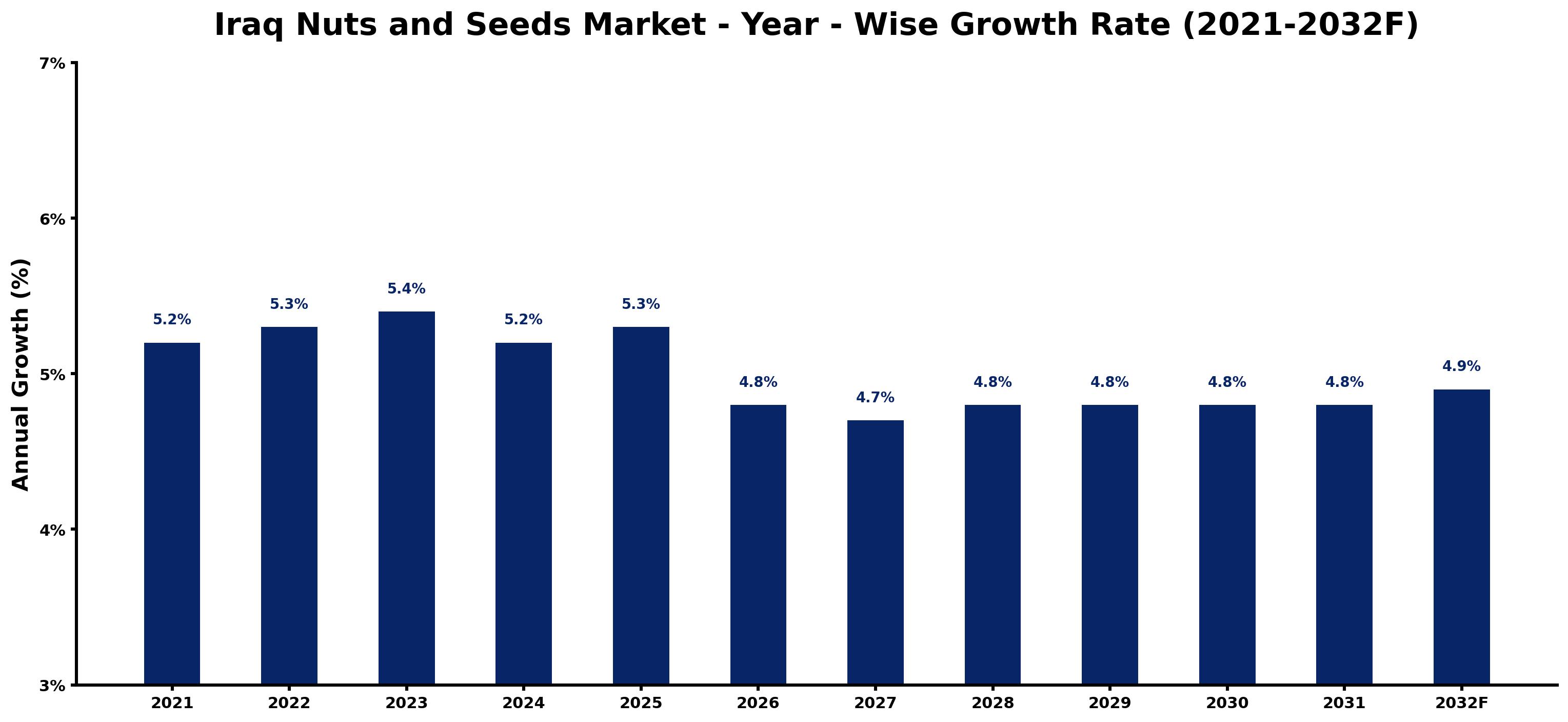
The table below presents the year wise growth rates along with the key drivers influencing the market
| Year | Growth Rate | Major Drivers |
| 2021 | 5.2% | Market recovery post-pandemic emphasizes health benefits of nuts and seeds. |
| 2022 | 5.3% | Increased urbanization in Iraq expands distribution channels for healthy snack options. |
| 2023 | 5.4% | Cultural shifts towards healthier eating enhance the appeal of natural snacks. |
| 2024 | 5.2% | Emerging local brands innovate product offerings, capturing consumer interest effectively. |
| 2025 | 5.3% | Growing awareness of nutritional value boosts consumer education and marketing efforts. |
| 2026 | 4.8% | Enhanced agricultural practices lead to improved yield and quality of seeds. |
| 2027 | 4.7% | Investment in modern retail outlets encourages higher consumer foot traffic and product access. |
| 2028 | 4.8% | Collaborations with global brands increase product visibility in international markets. |
| 2029 | 4.8% | Changes in consumer lifestyles favor convenient and nutritious snack choices. |
| 2030 | 4.8% | E-commerce growth facilitates online sales of nuts and seeds throughout Iraq. |
| 2031 | 4.8% | Sustainability trends drive demand for organic and ethically sourced nut products. |
| 2032 | 4.9% | Shifts in dietary preferences position nuts and seeds as essential pantry staples. |
Note - Market size estimations and growth projections presented in this report are based on 6Wresearch's advanced forecasting approach, validated with industry datasets as of June 2026.
Iraq Nuts and Seeds Market Synopsis
The Iraq Nuts and Seeds Market is projected to reach 4.8% and witness significant growth during the forecast period (2026-2032). The market is characterized by an increasing consumer inclination towards health-conscious eating habits, which has led to a burgeoning demand for various nuts and seeds such as almonds, pistachios, walnuts, and sesame seeds. This growth trajectory is further fueled by the rising popularity of organic and premium products, indicating a shift towards sustainable and nutritious food options.
Iraq Nuts and Seeds Market Growth Drivers
Several key factors are driving the growth of the Iraq Nuts and Seeds Market. Firstly, the heightened awareness regarding the health benefits associated with nuts and seeds consumption is propelling sales, as consumers increasingly seek out protein-rich, fiber-packed snack alternatives. Secondly, the shift towards organic and sustainably sourced options reflects a growing ethical consciousness among consumers, which drives demand for quality products.
- The popularity of nuts and seeds as convenient snack options is growing, appealing to busy consumers looking for healthy on-the-go food choices.
- Innovative packaging and product diversification are increasingly attractive to younger demographics, who value both aesthetics and functionality in food products.
- Awareness campaigns and nutritional education initiatives are contributing to a more informed consumer base regarding the various health benefits of including nuts and seeds in their diets.
- The expanding retail landscape in urban areas is facilitating greater access to a range of nut and seed products, boosting overall market sales.
- Technological advancements in agricultural practices are enhancing yield and quality, further supporting market growth.
Iraq Nuts and Seeds Market Trends and Opportunities
The Iraq Nuts and Seeds Market is observing notable trends that present unique opportunities for growth. The rising demand for healthy snacking is creating a favorable environment for suppliers, as products like sunflower seeds and walnuts gain traction among health-conscious consumers. Furthermore, the interest in innovative flavors and unique blends is catering to diverse consumer tastes, enabling product differentiation in a competitive marketplace.
- Engaging younger consumers through creative marketing strategies and collaborations with health influencers, emphasizing the nutritional benefits of nuts and seeds.
- Emphasizing organic certifications and transparent sourcing practices to capture the growing segment of environmentally conscious consumers.
- Utilizing e-commerce platforms to expand market reach, offering convenience and accessibility to a broader audience.
- Introducing health-focused snacks such as nut bars and seed protein powders to align with modern dietary trends, capitalizing on the increasing preference for plant-based diets.
- Fostering partnerships with local farmers to ensure a steady supply of high-quality raw materials while supporting community agricultural initiatives.
Iraq Nuts and Seeds Market Challenges and Restraints
Despite the positive outlook, the Iraq Nuts and Seeds Market faces several challenges that could impede growth. The unstable political situation and security concerns can disrupt supply chains and affect distribution networks, making it difficult for producers to operate effectively. Economic fluctuations and unpredictable exchange rates also pose a challenge, impacting pricing strategies and profitability.
- The absence of modern agricultural practices limits the efficiency and productivity of local farmers, hindering the market's capacity to meet rising demand.
- Stricter quality control measures and food safety regulations are necessary to ensure consumer trust, yet enforcement remains inconsistent.
- Competition from imported nuts and seeds undermines local producers, who may struggle to compete on price and quality.
- Consumers' price sensitivity in a challenging economic climate may shift focus toward cheaper alternatives, potentially impacting premium product sales.
- The need for investment in agricultural technology and infrastructure is crucial for enhancing productivity and sustaining long-term growth in the sector.
Iraq Nuts and Seeds Market Investment Opportunities
The increasing demand for nutritious snacks creates promising investment opportunities within the Iraq Nuts and Seeds Market. A young and growing population, coupled with rising disposable incomes, positions this market as an attractive venture for both local and international investors. Strategic investments emphasizing product diversity, innovative marketing, and environmentally responsible practices could yield substantial returns.
- Developing new product lines that cater to health trends, such as gluten-free or low-carb options, can attract a broader customer base.
- Enhancing packaging solutions to improve product shelf life and consumer appeal could differentiate offerings in a competitive environment.
- Investing in local agribusiness initiatives can bolster domestic supply chains and contribute to community welfare, fostering brand loyalty.
- Expanding distribution networks through partnerships with retailers and online platforms can facilitate market penetration and broaden consumer access.
- Lobbying for government incentives and subsidies aimed at boosting domestic production could enhance profitability and business viability.
Iraq Nuts and Seeds Market Government Investment and Initiatives
Government policies concerning the Iraq Nuts and Seeds Market are pivotal in shaping its development. The government has implemented various initiatives designed to promote domestic production and enhance food safety standards. Through public spending, the government aims to increase agricultural productivity, providing subsidies to local farmers for improved practices and technologies.
- Investment in education and training programs for farmers is being prioritized to modernize agricultural techniques and practices.
- The government actively supports the establishment and expansion of processing facilities to improve the quality and marketability of local nut and seed products.
- Regulatory frameworks are being fortified to ensure stringent compliance with food safety standards, thereby protecting consumer health and trust.
- Efforts are underway to assist local producers in navigating the complexities of international trade regulations, facilitating export opportunities.
- Long-term development plans are focused on building a resilient agricultural sector that can withstand economic and climatic challenges, ensuring sustainability for the nuts and seeds industry.
Iraq Nuts and Seeds Market Latest Developments (May 2025 - June 2026)
Recent industry developments in the Iraq Nuts and Seeds Market from May 2025 to June 2026 indicate a trend towards diversification and innovation. As consumer preferences evolve, companies are increasingly exploring unique flavors and healthier product formulations to align with growing health trends. Additionally, there has been a notable increase in collaborations among producers to enhance product offerings and share resources effectively.
- Research and development efforts have intensified, focusing on creating fortified products that cater to specific health concerns, such as heart health and weight management.
- Increased investment in marketing campaigns targeting younger consumers is evident, leveraging social media platforms to promote the benefits of nuts and seeds.
- Partnerships between local farmers and international suppliers are being formed to enhance quality standards and ensure a more reliable supply chain.
- Industry stakeholders are embracing sustainability by pursuing eco-friendly packaging solutions that resonate with environmentally conscious consumers.
- The government is also ramping up its support for agricultural modernization initiatives, further enhancing the local production capacity and market competitiveness.
Iraq Nuts and Seeds Market - Key Attractiveness of the Report
- 10 Years of Market Numbers
- Historical Data Starting from 2022 to 2025
- Base Year: 2025
- Forecast Data until 2032
- Key Performance Indicators Impacting the Market
- Major Upcoming Developments and Projects
Key Highlights of the Report:
- Iraq Nuts and Seeds Market Outlook
- Market Size of Iraq Nuts and Seeds Market, 2025
- Forecast of Iraq Nuts and Seeds Market, 2032F
- Historical Data and Forecast of Iraq Nuts and Seeds Revenues & Volume for the Period 2022-2032F
- Iraq Nuts and Seeds Market Trend Evolution
- Iraq Nuts and Seeds Market Drivers and Challenges
- Iraq Nuts and Seeds Price Trends
- Iraq Nuts and Seeds Porter's Five Forces
- Iraq Nuts and Seeds Industry Life Cycle
- Historical Data and Forecast of Iraq Nuts and Seeds Market Revenues & Volume By Type for the Period 2022-2032F
- Historical Data and Forecast of Iraq Nuts and Seeds Market Revenues & Volume By Nuts for the Period 2022-2032F
- Historical Data and Forecast of Iraq Nuts and Seeds Market Revenues & Volume By Seeds for the Period 2022-2032F
- Historical Data and Forecast of Iraq Nuts and Seeds Market Revenues & Volume By Distribution Channel for the Period 2022-2032F
- Historical Data and Forecast of Iraq Nuts and Seeds Market Revenues & Volume By Online for the Period 2022-2032F
- Historical Data and Forecast of Iraq Nuts and Seeds Market Revenues & Volume By Offline for the Period 2022-2032F
- Iraq Nuts and Seeds Import Export Trade Statistics
- Market Opportunity Assessment By Type
- Market Opportunity Assessment By Distribution Channel
- Iraq Nuts and Seeds Top Companies Market Share
- Iraq Nuts and Seeds Competitive Benchmarking By Technical and Operational Parameters
- Iraq Nuts and Seeds Company Profiles
- Iraq Nuts and Seeds Key Strategic Recommendations






































