Iraq Patchouli oil Market Size, Share & Growth Rate
The Iraq Patchouli oil Market was estimated at USD 482 Million in 2025 and is projected to reach USD 668 Million by 2032, growing at a CAGR of 4.8% from 2026 to 2032. This growth trajectory is fueled by a burgeoning demand from the fragrance and personal care sectors, alongside a growing inclination among consumers towards natural and sustainably sourced ingredients. The favorable climatic conditions in Iraq for cultivating patchouli further strengthen the market's foundation, enabling local producers to meet rising domestic and international demand.
Iraq Patchouli oil Market Year-wise Growth Rate and Key Drivers
This graph highlights how the Iraq Patchouli oil Market has steadily grown over the years, supported by major growth factors.
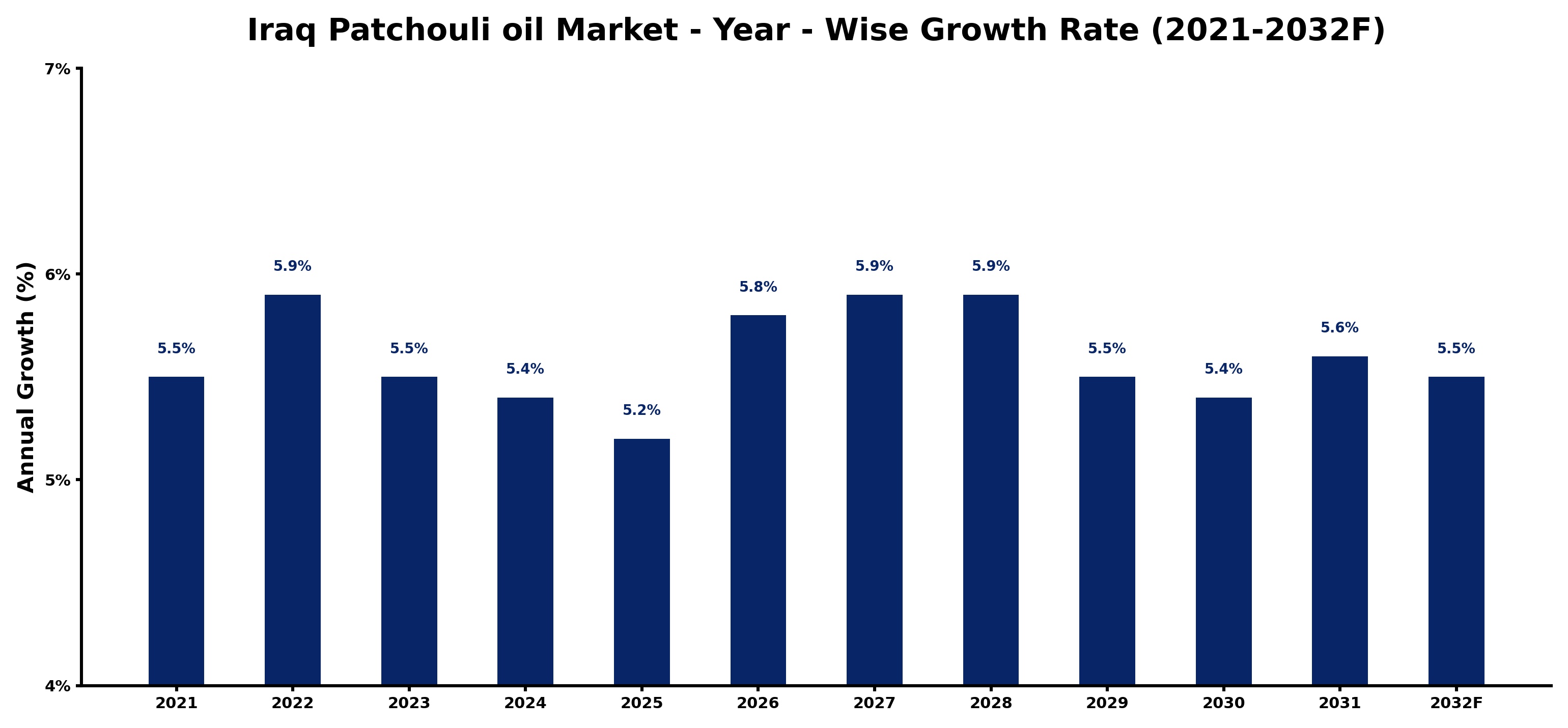
The table below presents the year‑wise growth rates along with the key drivers influencing the market
| Year | Growth Rate | Major Drivers |
| 2021 | 5.5% | Technology adoption in patchouli extraction enhanced oil yield efficiency |
| 2022 | 5.9% | Infrastructure upgrades bolstered patchouli oil extraction efficiency |
| 2023 | 5.5% | New extraction technologies boosted patchouli oil yield efficiency |
| 2024 | 5.4% | Domestic patchouli oil extraction expansion drives supply chain investments |
| 2025 | 5.2% | Foreign investment in distillation technology boosts patchouli oil production |
| 2026 | 5.8% | Increased distillation efficiency enhances Iraq's patchouli oil production capacity |
| 2027 | 5.9% | New distillation techniques boosted patchouli oil extraction efficiency |
| 2028 | 5.9% | Patchouli oil extraction technology upgrades boosted processing efficiency significantly |
| 2029 | 5.5% | New distillation technologies boosted patchouli oil extraction efficiency |
| 2030 | 5.4% | Infrastructure development fuels patchouli oil extraction and processing investments |
| 2031 | 5.6% | New extraction techniques enhanced patchouli oil production efficiency |
| 2032 | 5.5% | Domestic patchouli oil extraction technology boosts production efficiency |
Note - Market size estimations and growth projections presented in this report are based on 6Wresearch’s advanced forecasting approach, validated with industry datasets as of June 2026.
Iraq Patchouli oil Market Synopsis
Recent trends in the Iraq Patchouli oil market indicate robust growth primarily driven by the beauty and wellness industries' pivot towards natural products. However, as the market evolves, challenges such as production inconsistencies and infrastructure limitations threaten to impact the sustainability of this momentum. Navigating these challenges will be crucial for the market to fully realize its growth potential.
Looking ahead, the market is set to benefit from the increasing acceptance of patchouli oil in diverse applications, including aromatherapy and skincare. A rising consumer awareness of the therapeutic benefits associated with patchouli is expected to further enhance its appeal, ensuring that Iraqi producers remain competitive in both local and international arenas.
Iraq Patchouli oil Market Key Takeaways
- The Iraq Patchouli oil market is expected to achieve significant growth, reaching USD 668 Million by 2032.
- Consumer demand for natural and organic products is a major driver of market expansion.
- Iraq's favorable climate for patchouli cultivation offers a competitive advantage in production.
- Challenges such as inconsistent quality and limited processing infrastructure require attention.
- Government initiatives are supporting sustainable practices and market competitiveness.
Evaluation of Restraints in Iraq Patchouli oil Market
The Iraq Patchouli oil market faces several constraints that may limit its growth potential. One of the key challenges is the inconsistency in product quality stemming from varying climatic conditions that affect patchouli plant growth. Moreover, the infrastructure for processing and packaging is often underdeveloped, leading to higher production costs that can deter potential market entrants. The lack of standardized grading systems further complicates pricing and market accessibility. Additionally, ongoing political instability poses risks to reliable production and distribution, creating uncertainties for both local producers and international buyers.
Iraq Patchouli oil Market Trends
The current landscape of the Iraq Patchouli oil market is shaped by several key trends. First, there is a marked increase in consumer preference for natural ingredients, particularly in personal care and aromatherapy products, which fuels demand for patchouli oil. Additionally, the health and wellness movement encourages the use of patchouli in alternative medicine practices like Ayurveda. Innovations in formulations are also emerging, with patchouli being integrated into skincare and hair care products, credited for its anti-inflammatory and antiseptic properties. This trend signifies a growing acceptance of patchouli oil as a versatile ingredient across various personal care applications.
Iraq Patchouli oil Market Opportunities
The Iraq Patchouli oil market presents compelling investment opportunities for stakeholders looking to leverage the increasing demand for sustainable products in the fragrance and cosmetics industries. Given Iraq's status as a leading producer of patchouli oil, investors can explore various avenues, including the development of organic product lines and sustainable farming practices. The trend towards eco-friendly and ethically sourced ingredients positions Iraqi patchouli as an attractive option for both domestic and international markets. These dynamics indicate a fertile ground for investment and expansion in the patchouli oil sector.
Government Initiatives in the Iraq Patchouli oil Market
The Iraqi government has recognized the importance of the patchouli oil market and is actively implementing policies to support its growth. These initiatives include establishing licensing requirements for producers, introducing quality control standards, and setting export quotas to balance domestic needs with international trade opportunities. Furthermore, the government invests in training programs for producers, alongside financial assistance aimed at enhancing the overall competitiveness of the patchouli oil industry. Such proactive measures are designed to foster sustainable practices while promoting fair trade.
Future Insights of the Iraq Patchouli oil Market
Looking towards 2026-2032, the Iraq Patchouli oil market appears well-positioned for sustained expansion, primarily driven by an escalating global demand for natural and organic personal care products. As the unique musky scent of patchouli gains traction in various sectors, Iraq's favorable conditions for cultivation will likely solidify its role as a significant player in the market. Nevertheless, ongoing challenges such as political stability and competition from other producers may create market fluctuations. Strategic investments in infrastructure, quality control, and international partnerships will be essential for navigating these dynamics effectively.
Iraq Patchouli oil Market Latest Developments (May 2025 - June 2026)
Recent developments in the Iraq Patchouli oil market have highlighted a growing trend towards quality improvement and sustainable practices among local producers. Initiatives aimed at enhancing processing capabilities and adopting eco-friendly farming techniques are gaining traction. Additionally, there is an increasing focus on establishing international partnerships to expand market access. These movements are indicative of a collective effort to elevate the profile of Iraqi patchouli oil in global markets, ensuring that the industry remains competitive amidst evolving consumer preferences.
Iraq Patchouli oil Market - Key Attractiveness of the Report
- 10 Years of Market Numbers
- Historical Data Starting from 2022 to 2025
- Base Year: 2025
- Forecast Data until 2032
- Key Performance Indicators Impacting the Market
- Major Upcoming Developments and Projects
Key Highlights of the Report:
- Iraq Patchouli oil Market Outlook
- Market Size of Iraq Patchouli oil Market, 2025
- Forecast of Iraq Patchouli oil Market, 2032
- Historical Data and Forecast of Iraq Patchouli oil Revenues & Volume for the Period 2022-2032F
- Iraq Patchouli oil Market Trend Evolution
- Iraq Patchouli oil Market Drivers and Challenges
- Iraq Patchouli oil Price Trends
- Iraq Patchouli oil Porter's Five Forces
- Iraq Patchouli oil Industry Life Cycle
- Historical Data and Forecast of Iraq Patchouli oil Market Revenues & Volume By Type for the Period 2022-2032F
- Historical Data and Forecast of Iraq Patchouli oil Market Revenues & Volume By Dark Patchouli Oil for the Period 2022-2032F
- Historical Data and Forecast of Iraq Patchouli oil Market Revenues & Volume By Light Patchouli Oil for the Period 2022-2032F
- Historical Data and Forecast of Iraq Patchouli oil Market Revenues & Volume By Application for the Period 2022-2032F
- Historical Data and Forecast of Iraq Patchouli oil Market Revenues & Volume By Perfumery for the Period 2022-2032F
- Historical Data and Forecast of Iraq Patchouli oil Market Revenues & Volume By Medicine for the Period 2022-2032F
- Historical Data and Forecast of Iraq Patchouli oil Market Revenues & Volume By Flavorings for the Period 2022-2032F
- Historical Data and Forecast of Iraq Patchouli oil Market Revenues & Volume By Others for the Period 2022-2032F
- Iraq Patchouli oil Import Export Trade Statistics
- Market Opportunity Assessment By Type
- Market Opportunity Assessment By Application
- Iraq Patchouli oil Top Companies Market Share
- Iraq Patchouli oil Competitive Benchmarking By Technical and Operational Parameters
- Iraq Patchouli oil Company Profiles
- Iraq Patchouli oil Key Strategic Recommendations






































