Iraq Polyethylene Terephthalate Market Size, Share & Growth Rate
The Iraq Polyethylene Terephthalate Market was estimated at USD 477 Million in 2025 and is projected to reach USD 662 Million by 2032, growing at a CAGR of 4.8% from 2026 to 2032. This growth trajectory is fueled primarily by the burgeoning demand for bottled beverages and packaged foods, spurred by rapid urbanization and shifting consumer habits. As the population becomes increasingly urban, the need for efficient and sustainable packaging solutions like PET is more critical than ever.
Iraq Polyethylene Terephthalate Market Year-wise Growth Rate and Key Drivers
This graph highlights how the Iraq Polyethylene Terephthalate Market has steadily grown over the years, supported by major growth factors.
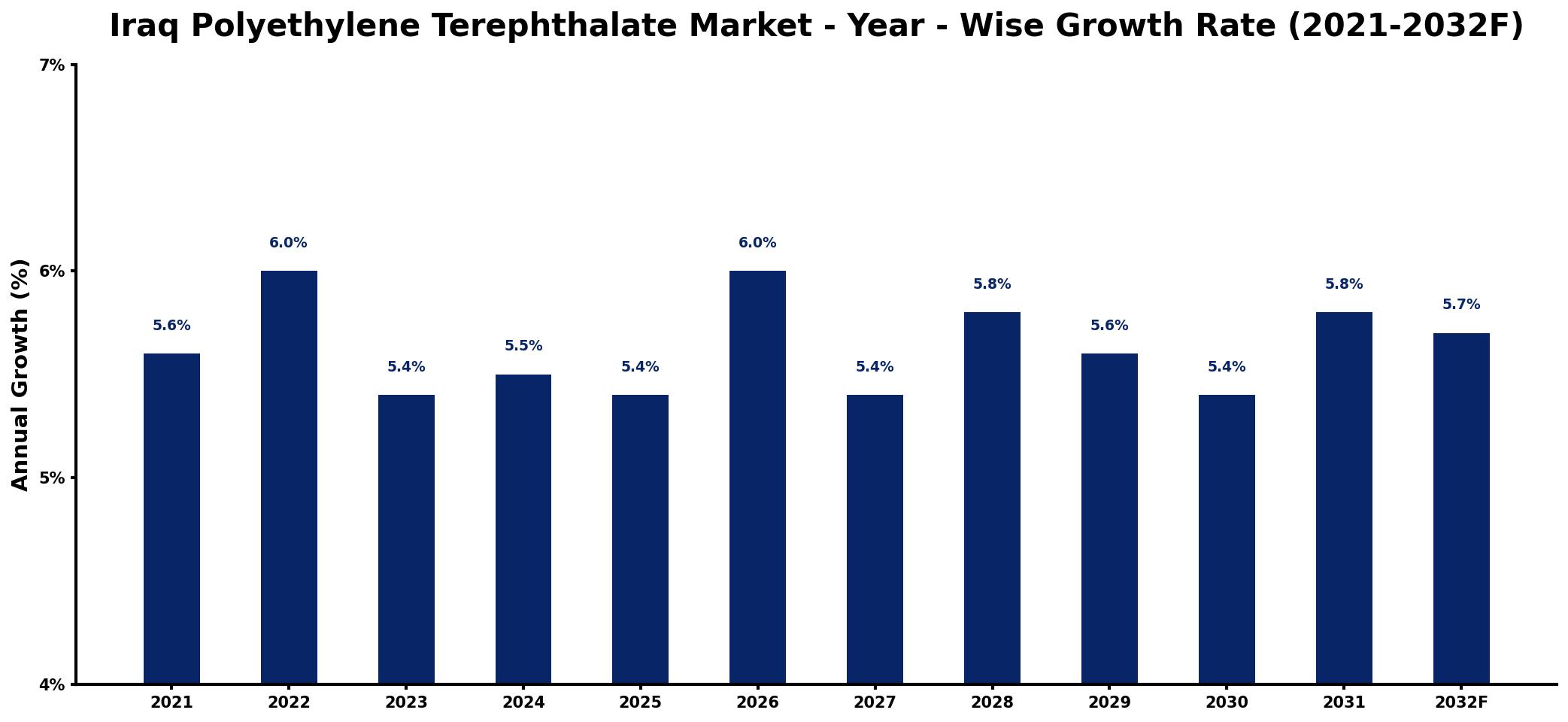
The table below presents the year‑wise growth rates along with the key drivers influencing the market
| Year | Growth Rate | Major Drivers |
| 2021 | 5.6% | Rising demand from packaging sector |
| 2022 | 6.0% | Increased investment in manufacturing facilities |
| 2023 | 5.4% | Growing applications in textiles industry |
| 2024 | 5.5% | Expansion of beverage industry production |
| 2025 | 5.4% | Boost in construction material usage |
| 2026 | 6.0% | Surge in consumer goods packaging |
| 2027 | 5.4% | Growth in automotive component manufacturing |
| 2028 | 5.8% | Increased adoption in electronics sector |
| 2029 | 5.6% | Development of sustainable packaging solutions |
| 2030 | 5.4% | growing emerging market penetration |
| 2031 | 5.8% | increased production capacity utilization |
| 2032 | 5.7% | Growing focus on recycling initiatives |
Note: Market size estimations and growth projections presented in this report are based on 6Wresearch's proprietary forecasting methodology, utilizing the latest available industry data, government publications, and primary research inputs.
Iraq Polyethylene Terephthalate Market Synopsis
The strongest force currently shaping the Iraq Polyethylene Terephthalate Market is the rising consumption of bottled beverages, reflecting broader lifestyle changes among consumers. With PET's unique properties—its lightweight nature, durability, and recyclability—manufacturers are gravitating towards its use for beverage containers, ensuring that they meet evolving consumer preferences.
Additionally, growing environmental awareness among consumers and businesses is leading to an increased emphasis on recyclable materials. This societal shift is encouraging innovations in production and recycling technologies, allowing for an even more dynamic market environment. Consequently, businesses are compelled to adapt to this landscape, further driving demand for PET.
Iraq Polyethylene Terephthalate Market Key Takeaways
- The market is witnessing a significant growth fueled by the demand for PET in the packaging sector.
- Urbanization and changing consumer lifestyles are primary drivers of PET consumption.
- Environmental sustainability pressures are increasing, leading to greater demand for recycling initiatives.
- Government incentives are focusing on enhancing production capacity and quality of PET.
- Challenges related to political instability and technology gaps are hindering market efficiency.
Evaluation of Restraints in Iraq Polyethylene Terephthalate Market
The Iraq Polyethylene Terephthalate Market faces significant restraints that are impacting its overall efficiency and growth potential. Political instability, combined with economic sanctions, creates an unpredictable business environment, resulting in disrupted supply chains. Furthermore, there exists a notable gap in technology and expertise, which limits local manufacturers' ability to enhance production capacities and adopt advanced recycling methods. The existing infrastructure for recycling is not adequately equipped to meet the rising demands of environmental sustainability, further exacerbating the challenges within the market.
Iraq Polyethylene Terephthalate Market Trends
Emerging trends within the Iraq Polyethylene Terephthalate Market are largely driven by advancements in production techniques and recycling technologies. Companies are exploring innovative methodologies to enhance the efficiency of PET production while reducing environmental impact. Additionally, the trend towards sustainability is compelling manufacturers to invest in recycling initiatives, which promise to create a circular economy for PET. These shifts not only respond to consumer demands but also align with global standards for environmental responsibility.
Iraq Polyethylene Terephthalate Market Opportunities
There are substantial growth and investment opportunities in the Iraq Polyethylene Terephthalate Market, particularly in the area of recycling technologies. As the government promotes initiatives to enhance production capacity, companies that invest in local manufacturing facilities stand to benefit from both financial incentives and reduced operational costs. Furthermore, addressing the technology gap in PET production and recycling can position businesses favorably in an evolving market, catering to the increasing demand for sustainable packaging solutions.
Government Initiatives in the Iraq Polyethylene Terephthalate Market
The Iraqi government is actively promoting initiatives aimed at enhancing the production capacity and quality of polyethylene terephthalate. This includes providing investment incentives for businesses that expand their PET production capabilities and encouraging practices that focus on recycling and minimizing environmental impact. Such policies are intended to foster a stable business environment while addressing the sustainability concerns that are increasingly influencing consumer choices.
Future Insights of the Iraq Polyethylene Terephthalate Market
Looking ahead to 2026-2032, the Iraq Polyethylene Terephthalate Market is expected to evolve significantly as it adapts to changing consumer preferences and regulatory environments. The combination of an increasing focus on sustainability and technological innovation will likely shape new opportunities for growth. Businesses that align their strategies with these trends, particularly in recycling and sustainable production practices, are positioned to thrive in a market that is becoming increasingly competitive and environmentally conscious.
Iraq Polyethylene Terephthalate Market Latest Developments (2025 - 2026)
Recent developments in the Iraq Polyethylene Terephthalate Market indicate a shift toward enhancing local production capabilities and sustainability practices. Industry stakeholders are increasingly collaborating to improve recycling processes and technologies. Efforts are also underway to align with international standards, emphasizing the importance of PET in sustainable packaging. The sector is evolving as companies respond to growing environmental concerns and consumer demand for recyclable materials.
Iraq Polyethylene Terephthalate Market - Key Attractiveness of the Report
- 10 Years of Market Numbers
- Historical Data Starting from 2022 to 2025
- Base Year: 2025
- Forecast Data until 2032
- Key Performance Indicators Impacting the Market
- Major Upcoming Developments and Projects
Key Highlights of the Report:
- Iraq Polyethylene Terephthalate Market Outlook
- Market Size of Iraq Polyethylene Terephthalate Market, 2025
- Forecast of Iraq Polyethylene Terephthalate Market, 2032
- Historical Data and Forecast of Iraq Polyethylene Terephthalate Revenues & Volume for the Period 2022-2032F
- Iraq Polyethylene Terephthalate Market Trend Evolution
- Iraq Polyethylene Terephthalate Market Drivers and Challenges
- Iraq Polyethylene Terephthalate Price Trends
- Iraq Polyethylene Terephthalate Porter's Five Forces
- Iraq Polyethylene Terephthalate Industry Life Cycle
- Historical Data and Forecast of Iraq Polyethylene Terephthalate Market Revenues & Volume By Type for the Period 2022-2032F
- Historical Data and Forecast of Iraq Polyethylene Terephthalate Market Revenues & Volume By Virgin for the Period 2022-2032F
- Historical Data and Forecast of Iraq Polyethylene Terephthalate Market Revenues & Volume By Recycled for the Period 2022-2032F
- Historical Data and Forecast of Iraq Polyethylene Terephthalate Market Revenues & Volume By Application for the Period 2022-2032F
- Historical Data and Forecast of Iraq Polyethylene Terephthalate Market Revenues & Volume By Rigid Packaging for the Period 2022-2032F
- Historical Data and Forecast of Iraq Polyethylene Terephthalate Market Revenues & Volume By Film for the Period 2022-2032F
- Historical Data and Forecast of Iraq Polyethylene Terephthalate Market Revenues & Volume By Sheets and Straps for the Period 2022-2032F
- Historical Data and Forecast of Iraq Polyethylene Terephthalate Market Revenues & Volume By Others for the Period 2022-2032F
- Iraq Polyethylene Terephthalate Import Export Trade Statistics
- Market Opportunity Assessment By Type
- Market Opportunity Assessment By Application
- Iraq Polyethylene Terephthalate Top Companies Market Share
- Iraq Polyethylene Terephthalate Competitive Benchmarking By Technical and Operational Parameters
- Iraq Polyethylene Terephthalate Company Profiles
- Iraq Polyethylene Terephthalate Key Strategic Recommendations






































